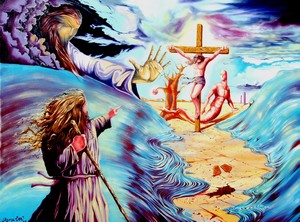
The Lord's Supper must be taken literally: the sacrificed Lord must be eaten, at least according to the 1551 Council of Trent which set forth the doctrine of transubstantiation, or substantial change, that anathematized the doctrine of consubstantiation, or substantial mixing.
Following the prehistoric tradition, the priest serves as cook at the religious mess - the pope is the high priest or head chef. He wears the sophisticated modern version of the heroic caveman's attire and carries his magic club or staff - the Egyptian priests, Greek Cynics, Sufis, and others were also fond of the official fashion set by the prototypical Hercules around 40,000 years ago. When by means of incantations, hand waving, and such, he consecrates the bread and wine in the kitchen, it is magically converted into the actual flesh and blood of the sacrificed son of god, whose parts are then distributed and devoured - the distribution was not always democratic. Thus was the first-born son of god shared that all partakers would have divine powers. The ritual cannibalism re-enacted the creation of the world from the substance of the first man.
On the other hand, the doctrine of consubstantiation championed by Luther requires that the substance of Jesus be mixed in with the blood and wine. That allowed the diners to avoid the appearance of cannibalism, perhaps by referring to the substance as the "essence" or metaphysical being of the now transcendental lord. However, a procedure common to cannibalism throughout the world entailed the mixing of human flesh in with other food - we recall the Jesus the lamb of god was scarified around Passover, when people were bringing their offerings to Jerusalem. Although Luther argued for consubstantiation, he advised people not to get caught up in the metaphysical quibbling over the issue. Nevertheless, it does appear that Lutherans were more finicky about what they ate, while some of the most devout Catholics reveled in graphic descriptions of feasting on their lord.
I have queried several lay Catholics about their current opinion on the subject. I am informed that sensible people believe that, when Jesus offered his flesh and blood, he did so figuratively, to illustrate that he would always be with those who believed in him, as if he were present in the flesh and blood. Not one of them was aware of the following:
"If any one shall say that, in the most holy sacrament of the Eucharist, there remains the substance of bread and wine together with the body and blood of our Lord Jesus Christ; and shall deny that wonderful and singular conversion of the whole substance of the bread into the body, and of the whole substance of the wine into the blood, the species of bread and wine alone remaining, which conversion the Catholic Church most fittingly calls Transubstantiation, let him be anathema" (1551 Council of Trent, Session 13, Canon 2)
Civilized people believe that the bread and wine merely remind us of the essence of the ideal man, an essence that is apprehended by the mind or felt emotionally, and is not a material substance actually grasped by the hand that serves up the reminder. We notice that Paul and Luke believed that the Eucharist is a reminder. That is, the Eucharist is symbolic. However that may be, there is little doubt that human beings were once religiously sacrificed and actually eaten in some parts of the world - the more powerful or godlike or pure the victim, the better. Of course religion is the organized worship of the highest power - politics involves the distribution of that power to the community. The sharing of meals is the most fundamental mode of community activity. Eating replenishes energy, restores power; we are not surprised to hear that the communal incorporation of powerful humans or of humans substituted for gods was practiced by prehistoric cultures, or that the food was distributed via a hierarchical pattern adumbrated by other members of the animal kingdom, particularly the apes.
To appease the highest power, the food should be offered to him first. What he does not take is shared with the others - first with his main troop, then with priests who prepared the food, and then with the rest of the population including the poor. To share with the poor was eventually crucial to the maintenance of the overall ideal, hence in some cultures the harvest is sacrificed through the chief and he and his priests redistribute it.
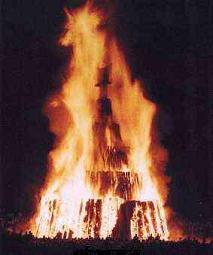
The high power or headman might be incorporated for his power when he was killed or otherwise died. The highest power of all was of course invisible or spiritual, to whom was offered the smoke and heat from the sacrificial fire. Aromatic materials or herbs were cooked with the food for the enjoyment of the one-god or Sun god. Of course the fire was associated with the Sun, fire being a gift of god - or perchance it was stolen from god by the son of god.
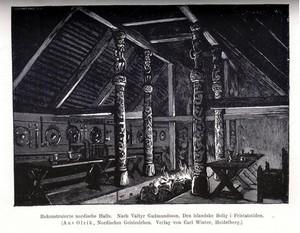
Sacred cooking rituals and implements evolved around the campfire when sacred fire was brought under technological control. Fire became the possession of humankind - since then, more fires have been set by man than ignited by natural causes. The cooks tending the campfires in India while the warriors were away, fighting demons and outlaws who did not observe the fire rituals, developed several priestly orders among themselves according to the division of their duties - preparing the site, setting up the altar, preparing the victim, and so on. We owe the discovery of alcoholic spirits to them. Food left in a pot had fermented; they tried the juice and were soon possessed by holy spirits, to which they tried to lay sole claim; but the word got around to all and eventually many priesthoods swore off of the sacred power beverage to gain better control of the drunks around the campfire.
One very important utensil used by the cooks was the sacred pot, which came to have the three legs that make the tripod the epitome of stability and symbol of the primordial trinity. The tripod had diverse uses: pot for cooking and brewing; bowl for drinking and eating; bowl for gambling in order to divine god's will; seat for the prophetess to deliver oracles on; prize trophy for champion athletes and heroic warriors. The Chinese had their sacred tripod or t'ing. It may be used for the preparation of food and wine for the ancestors, as a medium for the inscription of laws, maps and magic formulas. The emperor-dragon flies to Heaven on a tripod. I do not know who cooked up that myth. I have not heard of human flesh being cooked or served in a tripod.
I was disappointed to hear that cannibalism was actually practiced in China. I had believed that the Chinese, instead of eating their dead, virtually fed them. For that reason a few Christian missionaries accustomed to eating the son of god thought the Chinese did not have a real religion, just ancestor worship. Of course China did not have a monopoly on setting out food for ancestors. It seems that human beings took up similar practices throughout the world. The Christians however made a fine art out of sublimated cannibalism. Only a few people really eat human flesh and drink human blood today; the idea disgusts most of us even when we are starving to death. As a matter of fact, I am getting very hungry for breakfast, so I must leave off here and have some ham and eggs. I know millions of people refuse to eat swine, and various reasons are given for the tabu. I understand pigs are smart and are biologically close to human beings. Maybe I will swear off of eating them for that reason.