Religion would tame the beast within - Last article of series 'On Faith'

'no way, way out' by Darwin Leon
www.darwinleon.com
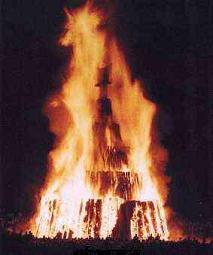
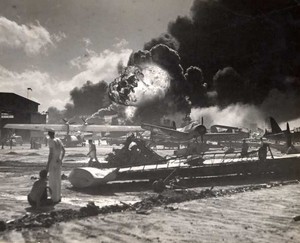
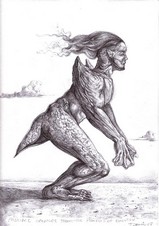
Religion would tame the beast within and harness the awesome or sublime power of the natural disasters that interfere with the mechanical order of naturally machined things. We fear the power that would destroy us and we would therefore have it for ourselves. The owner of a property has a right to dispose of it as he will. We would be gods over machines; we would lord it over the means of production and destruction while remaining capable of destroying our devices and even ourselves at the slightest whim simply to prove that we are in fact free. We mimic imaginary elemental gods who prove their power over the elements with unexpected fire and lightning, storms and floods, earthquakes and eruptions. The volcanic god-man with booming voice and lightning fingers is most sublime in some quarters. His molten wrath can be diverted to the destruction of our enemies provided that we stop murdering and thieving among our own kind – murder, theft, and rape were naturally lawful means of survival. Yet the father-god must murder his own children to keep them suppliant, and kill even innocent babies from time to time to prove his freedom from his own orders and keep theologians busy with theodicy.
Religion is a joint venture, a partnership between humankind and its gods. The one-god whom enlightened man feels he must have faith in and be loved by in order to survive his god's wrath by being godly or all-powerful is to some unknown extent a projection of his own will in its highest terms. To that extent god is made in man’s image. That is humankind’s contribution to the project: for the realization of man’s higher self, his most powerful, ideal self in the objective world, while at the same time opposing that earthly project to prove his inherent freedom or godliness. But the highest terms are the most abstract ones. In mutual contraction and expansion, the final abstract term, the One, is both infinite and infinitesimal. By virtue of abstract transcendence definition is denied and firmament abandons the fundament below. For those people whose heads are in heaven, faith is similar to the habitual trust they place in the ground they walk upon, that it shall always be there, at least until they learn otherwise when it drops out from under them and they are crushed by rubble; and then, even closer to the god who has flattened them, they shall have even more faith in their higher ground, dying smilingly in the faith that they shall personally survive and live forever in what the funeral preacher calls “a better place.” Since nothing is perfect, is there not always a better place than this one? Surely their god shall not forsake them in their agony, in their abandonment of worldly things, until their perfection is realized in Nothing, for Nothing is perfect, in the positive sense that whatever is corrupts nothing, just as things negate absolute space.. We envy them their faith, for who would not like to go to a better place, or even the perfect un-place where one is absolutely free of a world’s limitations on temporal life?
Pray tell, who would not live forever in paradise if she could do just that? If nothing is not the absolute good that nihilists presume after smashing everything, if evil is the negation of positive existence, eternal nothingness is unmitigated evil, quite impossible to contemplate; we so love the world that is our life, we urgently commit our offspring to it. Then the organized religion of survival is the communal expression of individual self-love, of each person's highest most arrogant opinion of himself. The arrogation is in the claiming of what one does not actually own; the individual discovers due cause to doubt his standalone power, therefore his worship of power is organized by hate for and fear of the obstacles to self-aggrandizement, and loving prostration follows lest hate cause the awesome power of the terrorist almighty to crush him. The community organizes selfish love for its own sake, to defend its members against each other and against their external enemies, who are, presumably, outlaws, for they are outside of the lawful organization. The tribe therefore loves itself despite the mutual fear, contempt and hatred inherent in its fear- and hate-others-based group-self-love. .
Each person, dignified by faith to despise his weaknesses, deserves his god's favors – humility may be feigned to obtain special dispensations. Self-love is native to the subjective individual by virtue of his or her will to exist independently. But on the outside of the coin, where internal subject is confronted by object, self-hate and fear/love others is the lesson learned by obstacles to one's will to independent existence. The natural objective power thwarting each individual’s will naturally includes other willful individuals who present a similar struggle for existence. In comparing himself to others who would have, if only they could, absolute power to undo all resistance to their wills and therefore persevere forever, the individual recognizes his own kind in its limits, the human race in distinction from the rest of the objective world. Moreover, no matter how unworthy men may be in each other's eyes, each man must be, at least in his own eyes, deserving of his projected objective god's love; therefore, in the interest of his self-love, he learns to love and obey the universally projected god-object he hates and fears. The moral of the story is this: If a lesser power does not “love” a higher power by fearing it, the inferior power shall be destroyed; the weakness of the higher powers is this: they need to be loved and feared, because the greater numbers of the weaker powers may add up one day to their destruction – hence they must be organized and suitably controlled. In sum, thou shall love god or else be destroyed or forever tortured at an undisclosed location some call Hell.
Since the virtual object called “god” is a complex, inchoate notion involving the continuously conflicting, particular wills of a multitude of others, a man of bad faith, although he might enjoy his instinctive feeling of freedom while running with the herd behind a sacred banner flown by a maniacal butcher, is inherently in conflict with himself. He may be aware of his own existence in all its frailty, but his faith in an objective god outside of himself is impossible to maintain: that is why he is constantly defending it; why he is anxiously recruiting others; why he cannot just keep his mouth shut and find solitary solace in peace. Faith in an unknown theos is barely distinguishable from atheism. Faith in an objective god requires its concrete presence in the world with all its relative particulars, and those particulars must obey the higher order, or else faith is good for nothing but war; the cowardly urge to impose any one order on all in order to save oneself is the greatest cause of war. The unfaithful man who pledges allegiance to an objective faith and a flag is nevertheless subject to his subjective self-love in conflict with that of others. His attempted resolution of that conflict, in organized terrorism, waged in the name of an unknown, supreme anarchist, the An-archon, is bad faith; it is really atheism; its very profession is a hostile declaration against all those who disagree with his formal profession, a form that excludes all other religions by definition.
The natural history of religion is a history of the organization of life and death, whereas some forms of sex and violence become defined as prohibited rape and murder. The murderous project called war was originally a racist project, but as the seeds of the rapacious conquerors were planted among the vanquished the races were eventually mixed; thus rape and war was actually the religion of the race despite its euphemistic professions of love and peace – love for one’s own was based on hatred of others, hence the hate-based, primitive tribal love of the modern hypocritical evangelist who preaches love, yet who envisions all those who do not share his faith in a particular organization as suffering a miserable death or burning forever in hell. Victory in battle proved the virtue of a man, and war was said to improve his mettle and the morality of humankind, as if there were no more effective way to overcome the fear of death and improve one’s lot than to routinely kill other warriors, plunder their territories and rape the women who could not manage to kill themselves and their children. But our task here is not to return once again to the radical root of hatred in self-love in order to revitalize ourselves for a new wave of mass murder to vent our rage against our enslaving machinery, but to somehow conduct open heart surgery and replace the hardened heart of old-time religion with the stranger’s cloverleaf heart of four circulating chambers wherein people can enjoy each other’s cultural differences. This shall not be an easy task; it might require a miracle now that the time is nigh. People thirst for the loving cup, but it is occluded. Only a tiny minority believe that a life one must kill others for is not worth living, while the majority, when aroused by fear, claim that a life not worth killing for is not worth living. May not every one of us be reconciled in peace some sunny day?
Yes, is our answer, for the true faith may be found where it has always been, figuratively speaking, in that sacred place within us all. Despite the doubts we suffer in respect to the ultimate, life-and-death question, we are born with native faith in life, our true love. We may be tempted on the high limbs and ledges as we climb, but the sane shall not take the fatal leap, for the decision has already been made for them. The innate faith may simply be the will to endure, to survive forever, referred to sometimes as the "survival instinct" or the "will to live", urges rationalized into religions by those who want explanations and lifestyles to fight over and impose. But each cattle already enjoys the instinct. Naturally this native faith is suspected of being at the root of the evils cultivated by man-made faiths in formulas and lifestyles; but wherever evil is found some good is present as well, and there is good reason to reason, just as the Zoroastrians reasoned before the Zurvanian heresy, that of the two spiritual principles, good shall prevail in the end. And is not life sweeter when lived well; that is, in the faith that good shall overcome evil?
Perhaps those who quibble over the forms of faith have bad faith; that is, they have no faith at all; they lack even the faith of the pessimist whose pessimism is grounded in awareness of the reality of goodness, or not even the faith of the cynic that an honest dog and its sincere fight over a bone is a better creature than a man clothed by clashing cultures, civilized to cut his neighbors’ throats over trifles, or even worse, to deny their very existence by ignoring them. A fleeting life does not provide much time for the individual to act, but a great deal of good can be done with a life; sometimes a few hours of personal goodness suffices to overthrow years of badness.
We have said that native faith is the love of life. And what is love? Love is your life, my life, our lives, the life of our kind or species, in which we have some faith. Faith conveys a sense of self at risk, a self-conscious awareness of the certainty of the death of the self and a contrary will to live, an awareness found even in a relative state of ignorance with a bare minimum of self-consciousness. Although the word ‘faith’ symbolizes the self-consciousness of the will to survive, self-consciousness is not biologically necessary: life generally proceeds without self-conscious reflection let alone the projection of that self onto an objective collective deity or object-god. But humankind is a special development of life. “Man” is he who is drawn into existence by “Ma,” he who is destined to draw out thought, to think. Man has native faith in order to develop as a human; for instance, s/he has enough native faith to crawl, to stand up, to take his first steps, to acquire the habit of walking erect according to his developing nature. Nevertheless, man finds the mental aspect of his developing self a rather flimsy ground to stand on, especially now that postmodern experts tell him that god is dead and that there is no such unitary self either subjective or objective. In his fear of disappearing into conflicting mental abstractions, he seeks some solid theological ground to stand on along with some ruling god to support the dignity of his stance.
Man might find an idol or idols to worship in the political realm of ideas, an ideology might be his sacred path instead of a theology. But s/he still treads in hate and fear and trepidation, constantly having to reaffirm his artificial faith, which can never be the truth that brings humankind together in love. Everyone on Earth must have their relative position in the time-space continuum, some portion of the ground to stand on. After being jostled about for awhile, one learns to take a stance, and one takes it on faith that one deserves to live in this body at this place and time; after all, two bodies cannot occupy the same place at the same time. When his or her life is at stake, the individual would lay claim to an absolute right to live. And in matters of unearthly faith, what does it matter what abstract plot one might claim for one’s own? We shall not throw the first stone nor shall we light the sacrificial fire at any stake. We have no objection to the recitation of various creeds, nor do we condemn any lifestyle that would not deprive us of our own. Virginal space has room for every soul: How many angels may fit on an infinitesimal point? An infinite number is most fitting.
May the next world called paradise be instantiated on Earth so we may be as generous to our kind in this life as the kind and merciful god of our best wishes would be with us in the next. No one in this world would go hungry if the food and shelter we already can produce were efficiently and effectively distributed – we hate not the power of the machinery when employed rightly by our welfare capitalists. Therefore when an hopeless idealist makes an absolute statement of good faith, we respond, "Absolutely," if not “Hallelujah!” Let the good will be done on Earth as it is in heaven. Then the more absolute or all-encompassing such a benevolent confession of faith is, the better we might like it.
We are romantics at heart: the more intuitive or mystical the declaration of faith is, the more we are enchanted by it. The next world is vastly appealing, but in this world we are appalled by hateful deeds, no matter what symbolic expressions of faith are afforded as justification, for we are concerned more with what someone does than what s/he has faith in. When symbols of faith are used to justify evil deeds, we call that faith bad faith. Bad faith invariably involves the worship of objective gods, possessive powers whom power-mongering people would possess, sorry excuses for irresponsible self-hate and mutual contempt. Object-gods are symbols of bad faith. There is no truth or love in an object-god. Fighting over object-gods is patently absurd, dishonest, and suicidal. To have blind faith in things is self-contradictory. Bad faith is used to justify every sort of vicious behavior. Witness the massive abominations faithfully committed by deluded peoples under the influence of unwholesome or insane fanatics who restrain their follower's rationality with confusing complexities and contradictory texts, then led them into Hell with oversimplified notions of Heaven. Such false preachers are in effect running a protection racket: they provide the threat and then offer protection against it.
Alas, the blinded faith of the frightened, credulous herd has far too often been exploited by holding out false hopes for utopias while providing the faithful with self-flattery and, all too often, the thrill of mass murder, serial killing, and mayhem. Blind faith serves endless desire. Such is life that it may never be satisfied. But we are given the faculty of reason to accomplish our objectives in a cooperative and limited manner according to the laws of love, instead of at random in an insane, vicious and unwholesome manner. Faith may be our native cause for living, but reason should be our guide, just as reason gives us cause to believe: faith is the motive to believe, while knowledge is the gradual perfection of belief. That is why we articulated differences between faith and belief and knowledge in our first article on faith. Believing is be-loving, is living the reasonable law of love; while believing is the perfecting of faith through the love of truth-seeking. Belief is ever subject to further verification until knowledge becomes perfected as wisdom. When subject and object are perfectly reunited as one in absolute knowledge, nothing further need be said about faith. It is with that in mind that we conclude our series on faith.
|