AuthorsDen.com   Join | Login    
Where Authors and Readers come together!

SIGNED BOOKS    AUTHORS    BOOKS    SAMPLE CHAPTERS    AUDIOBOOKS    eBOOKS    STORIES    ARTICLES    POETRY    BLOGS    NEWS    VIDEOS    SUCCESS    TESTIMONIALS

Featured Authors:  Emily Karlewicz, iAnita Shaw, iMORGAN ST. JAMES, iT. Cline, iMargaret Evans, iMichael Charles Messineo, iFrank Whyte, iCharlene Proctor, iDavid Arthur Walters, iPamela Ackerson, i

  Home > Science > Articles Popular: Books, Stories, Articles, Poetry      Authors: A B C D E F G H I J K L M N O P Q R S T U V W X Y Z     

Niki Collins-Queen

 Follow Me  

· Contact Me
· Success story
· Books
· Articles
· Poetry
· News
· Stories
· Blog
· Messages
· 212 Titles
· 145 Reviews
· Save to My Library
· Share with Friends!
·
Member Since: Before 2003

Niki Collins-Queen, click here to update your pages on AuthorsDen!


Books by
Niki Collins-Queen


See all Books
by Niki Collins-Queen


No Place Like Home: The Milky Way
by Niki Collins-Queen   
Rated "G" by the Author.
     
Recent articles by
Niki Collins-Queen

• An Alter to the World
• Trees Are More Than Lovely They're Essential
• Why do men still hold the vast majority of leadership positions?
• Full Circle with a Legendary Sailor
• Do animals have thoughts and feelings?
           >> View all

The gossip about our galaxy.


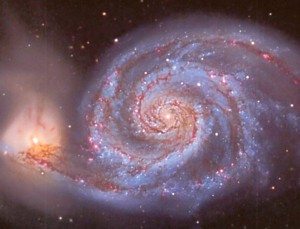
Our 4.5 billion-year-old Sun is only one of 200 billion other suns in The Milky Way, our galaxy. The Milky Way is known as a spiral galaxy and is about 100,000 light-years in diameter and 10,000 years in thickness.

Galaxies are made up of gas and millions of stars held together by gravity. Suns are gigantic balls of gas held together by gravity and kept hot by atomic reactions.

Our sun rotates slowly around the Milky Way’s center along with the other stars.

Eight planets and three dwarf planets and their moons and several thousand asteroids and comets orbit the sun in our solar system.

All galaxies, including ours, have a massive black hole at its core that is so dense that light cannot escape its gravitational field.

An object is considered a planet if it orbits the sun, is massive enough that its self-gravity gives it a nearly spherical shape and it has cleared the neighborhood around its orbit.


Andromeda is a nearby similar size spiral galaxy with two nuclei. Billions of years in the future Andromeda and the Milky Way galaxies will collide. They will pass through each other and merge into one. It will take millions of years to complete.

Astronomers say the 13.7 billion-year-old Universe could contain 40 to 50 billion other galaxies.

Web Site: The Universe - History.com


Want to review or comment on this article?


Need a FREE Reader Membership?
Popular Science Articles
  1.  Danger, danger, Will Robinson! (the fu
  2.  Regions Hospital St Paul, Minnesota Dr
  3.  Cures not Wars
  4.  Elvis Seen in Flying Saucer with Alien
  5.  GPS: How Science Gets Things Done
  6.  Organs Anonymous
  7.  Einstein and Tesla
  8.  The Pi Day of the Century
  9.  Hoax: Climate Change Caused by Mankind
  10.  The Secret of the Full Moon
  11.  Nikola Tesla Timeline - Legend, magici
  12.  Mooned in 2021
  13.  New Science Perspectives on Ghosts and
  14.  Evolution and Race
  15.  But Who's Going To Clean The Toilets?
  16.  Sun Henge
  17.  100 years of Einstein
  18.  A Scintillating Article
  19.  The Future of Humanity, book review
  20.  A Glimpse Into The Reality of The Futu
  21.  What Does Skin Do?
  22.  Socrates and Us
  23.  Einstein and Pi
  24.  Universe in a Glass of Wine
  25.  Cosmos Continued ...

Free Book Review Program
Select a book to read and review today!

Virus X by Frank Ryan

Where do viruses, such as Ebola and HIV, come from and why they are so aggressive? This book changed tenets of evolutionary virology, developing the concepts of aggressive symbiosis and plague culling, which explain much of the horror of plague virus  
Member BookAds

Virus X by Frank Ryan

Where do viruses, such as Ebola and HIV, come from and why they are so aggressive? This book changed tenets of evolutionary virology, developing the concepts of aggressive symbiosis and plague culling, which explain much of the horror of plague virus  
Member BookAds

Virus X by Frank Ryan

Where do viruses, such as Ebola and HIV, come from and why they are so aggressive? This book changed tenets of evolutionary virology, developing the concepts of aggressive symbiosis and plague culling, which explain much of the horror of plague virus  
Member BookAds