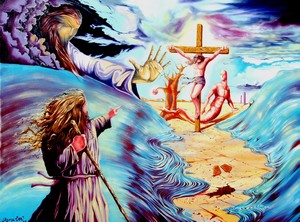
In Loving Memory of Richard & Ella Wheeler Wilcox
THE OTHER SIDE OF SHE
BY
DAVID ARTHUR WALTERS
To Helga in Loving Memory of Our Friend Richard
The recent articles I wrote about Ella Wheeler Wilcox and her literary remains, and my review of the critical dialogue between myself and Richard, may he rest in peace, appertaining to Ella's relative virtues and graces gave me sufficient cause to wish for the existence of an Other Side, peradventure or providentially a sphere, or at least a nondimensional point in timespace where all departed beings of our kind, no matter how good or evil they might have been on Earth, live on in eternal goodness after this life's complaint. Of them we may be unaware while we remain on this planet after variously disposing of their bodily remains, yet I nonetheless would have them be aware, from their presumably transcendental perspective, of our present continuances and pleas.
Richard took me to task for my fondness for the literary talent of the fair and sentimental sex, in the person of Ella Wheeler Wilcox, a poet whose virtues I had extoled to the high heavens, but who was, in his opinion, a rather lame poet despite her positive mental attitude and commercial success. My celebration of her virtues and my disparagement of the purportedly strong and reasonable sex who ignored them was indeed a provocation that moved dear Richard to pick up his own prejudicial sword to fight on behalf of one of his pet peeves, the vicious academic assault on fine literature, traditionally the domain of men, by brazen hussies and their vulgar cohorts.
I would like to take up our dialogue again, where we left off, in peace, but it is too late to do so by ordinary means. In that dialogue I would tell Richard that his critique had given me further insight into myself since his graceful death, an insight I belatedly thank him for. If only he could read my words here, or read my mind from elsewhere.
Ella thought there might be an Other Side; she was much interested in strange rappings and table-tiltings, and the occult shenanigans of Madame Blavatsky, for she hoped against hope to receive word from her dearly departed husband. Richard snorted when I presented him with my article on Ella's consideration of Madame Blavatsky's precipitation phenomenon.
Setting aside supernatural phenomena for now, I must say that I was most impressed by a point Ella made about life on this Earth, a point I pressed with Richard, that the human heart tends to grow fonder after someone dies, whether they were loved or not - legends begin at graveside - so why not hold them dearer while they are alive? Would not that make for a much better world in the here and now? But Richard, a psychologist by trade, was not given to affectionate elaborations or the democratic exaggeration of all to the level of all, which is what he supposed I had done in respect to Ella.
Ella's name, incidentally, is derived from Alia, al, meaning All, and also means bright and beautiful, as in Helen the torch of the world. Ella, then, is everyman's beloved Other, his Corposant or Holy Body, his Moon, his very She.
Richard's criticism of my high regard for Ella continues to speak to me, perhaps not from the Other Side but in the rambling critical traces he left behind during those long nights haunting the Web. And now, upon reconsideration of his critique of me and my representative other, a criticism I most vehemently rejected on the principle that there are no objective critical standards, that all criticism is essentially prejudicial, I must say that he was as right in his way as I believed I was valid in mine. Yes, my assessment of Ella and her corpus was more subjective than objective. In any case, no earthly ella is equal to heavenly Ella, and some shes are nearer to She than others.
"1) Did Wilcox get ten extra points from Author for being female?" was Richard's first question. I did not answer then, but now I am moved to respond resoundingly, with an honest "Yes."
I am too enthusiastic or 'god-possessed' by the female or 'wife of man', and as I prefer the goddess to the god, I favor women over men. Wherefore I relished defending Ella, the fallen poetess whose corpus was ravaged by the New Critics. She was the heavenly damsel whom I assumed must be distressed by the proceedings below, so I rushed with my lance to the rescue. A Hindu goddess is dynamic; she is variously named as she takes various forms, but She is One. Ella took the form of my She, namely my mother Charlotte, who died during the polio epidemic in Phoenix shortly after my birth. The world soon made an atheist out of me, in orthodox terms; but I did have one goddess: Her, Charlotte, to whom I prayed and who presumably watched over my troubled youth. As Jesus is the only one who loves some people, she was often the only one who loved me. Of course she loved my father as well; he suffers into his old age from the Orpheus Complex; and with trembling hand he constantly revises the poems he wrote nearly sixty years ago from his broken heart.
Little David Smiled
by R.B.C. Walters
The priestly words the priest intoned,
Computing nothing to my ears,
For they were tendered null by stimuli
My eyes were forced to see,
Beginning with my mother's face
So tranquil so long,
Transformed into a face of grief,
Flooded with her tears,
As we somehow stood before
A wide expanse of tended grass
Upholding on its breast
Crosses white in perfect rows,
Each one above a grave.
And, as gratuity from Hell
An open grave, too near, too near,
Eager for to hold the dear
And unflawed form of Charlotte
Sans breath of life and flow of blood,
Yet lovely in her youth.
In every dismal hour that night
The skies exuded rain,
And in the very dark of them
Her lonely spirit rose
And, through the path of love we shared,
Each to the other known,
Found her way back home.
Spirits have no way to speak
And lack substantial form,
But, as the leaves of Autumn dance
When Autumn breezes flow,
Papers trembled in my hand
When her presence passed my chair
Revealing that she was there.
And little David smiled.
He woke not from the peace of sleep.
But little David smiled.
My love for my mother, alas, did not cause me to treat women well, for I had no examples before my youth but acrimonious dissensions. I never learned how to honor and cherish real women, especially when they fell short of my ideal mother. I loved them at random, in whatever order they said "Yes," hence I loved some of them too well for their own good; on the other hand, I can never forgive myself for the evils that I - possessed by the devil outraged by the loss of She - unwittingly wrought on the shes I encountered. Of course it takes two to tango, and I love the tango. Still, no dance can excuse my conduct, not even my praise for Ella, but perhaps my mother will forgive me, and Richard, too, if there be another world for us mere mortals.
Ella Wheeler Wilcox http://postpoems.com/cgi-bin/displaypoem.cgi?pid=47612
Ella Wheeler Wilcox, Madame Blavatsky, and the Precipitation Phenomenon http://www.authorsden.com/visit/viewarticle.asp?AuthorID=23453&id=20307
Kritika http://www.ukauthors.com/modules.php?name=News&file=article&sid=14419
|