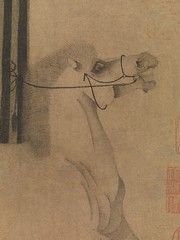
I've seen how horses can with their hoofs
Tread on the hoarfrost and deep snow,
And with their hair they can withstand
The biting wind and severe cold; they feed
On the lush grass and drink icy water;
They prance with their legs and leap -- this is
The true nature of them, dwelling in freeside.
Though there're made for them grand stables
And spacious dormitories, they would prefer
Not to use them at all. But when some men arose
And said, "We know well how to breed horses,"
They proceeded to singe and mark them,
To clip their mane, to pare their hoofs, to halter
Their heads, to bridle and confine them in corrals.
They proceeded further to subject them to hunger
And thirst, to gallop them and race them and
To make them go together in regular order:
In front there were the evils of the bit
And hard breast-bands, but behind there're
The terrors of whipping and switching.
The first potter (whose name is forbidden to utter,
But you probably know whom I mean) once said,
"I know well how to deal with clay," and men
Proceeded then to mould it into circles as exact
As if made by the compass, and into squares
As exact as if formed by the measuring setsquare.
The first carpenter (whose name is forbidden to utter,
But you probably know whom I mean) once said,
"I know well how to deal with wood," and all men
Proceeded then to make it bent as if by application
Of the setsquare, and straight as if by application
Of the plumb-line. But is it the nature of clay and wood
To require the application of the compass and setsquare?
And yet, age after age men have praised those first grooms,
Saying, "They knew well how to breed horses," as well
The first potter and carpenter, saying, "They knew well
How to deal with clay and wood." But wasn't it the error
Committed by the founding fathers at the dawn of humanity?


 Share
Share Print
Print Save
Save Follow