Although Papa John is now sadly gone
He left us all with some marvelous letters
Several years ago he wrote one to all artists
And his inspiring thoughts couldn’t be better
And being of Polish ancestry
I’ve always felt a kinship to this man
For he truly loved all of nature
And he reveled in the Creator’s plan
When he visited Chicago in October 1979
I like thousands of others rushed to hear
The words he spoke to us that day
In my heart and soul will remain dear
He served his church extremely well
He made all of the Polish people very proud
And his message concerning the creative process
I think is extremely profound bold and loud
LETTER OF HIS HOLINESS
POPE JOHN PAUL II
TO ARTISTS
Easter 1999
To all who are passionately dedicated
to the search for new “epiphanies” of beauty
so that through their creative work as artists
they may offer these as gifts to the world.
“God saw all that he had made, and it was very good” (Gn 1:31)
The artist, image of God the Creator
“None can sense more deeply than you artists, ingenious creators of beauty that you are, something of the pathos with which God at the dawn of creation looked upon the work of his hands. A glimmer of that feeling has shone so often in your eyes when—like the artists of every age—captivated by the hidden power of sounds and words, colours and shapes, you have admired the work of your inspiration, sensing in it some echo of the mystery of creation with which God, the sole creator of all things, has wished in some way to associate you.
That is why it seems to me that there are no better words than the text of Genesis with which to begin my Letter to you, to whom I feel closely linked by experiences reaching far back in time and which have indelibly marked my life. In writing this Letter, I intend to follow the path of the fruitful dialogue between the Church and artists which has gone on unbroken through two thousand years of history, and which still, at the threshold of the Third Millennium, offers rich promise for the future.
In fact, this dialogue is not dictated merely by historical accident or practical need, but is rooted in the very essence of both religious experience and artistic creativity. The opening page of the Bible presents God as a kind of exemplar of everyone who produces a work: the human craftsman mirrors the image of God as Creator. This relationship is particularly clear in the Polish language because of the lexical link between the words stwórca (creator) and twórca (craftsman).
What is the difference between “creator” and “craftsman”? The one who creates bestows being itself, he brings something out of nothing—ex nihilo sui et subiecti, as the Latin puts it—and this, in the strict sense, is a mode of operation which belongs to the Almighty alone. The craftsman, by contrast, uses something that already exists, to which he gives form and meaning.
Yahweh had created the universe. Finally he created the human being, the noblest fruit of his design, to whom he subjected the visible world as a vast field in which human inventiveness might assert itself.
God therefore called man into existence, committing to him the craftsman's task. Through his “artistic creativity” man appears more than ever “in the image of God,” and he accomplishes this task above all in shaping the wondrous “material” of his own humanity and then exercising creative dominion over the universe which surrounds him. With loving regard, the divine Artist passes on to the human artist a spark of his own surpassing wisdom, calling him to share in his creative power. Obviously, this is a sharing which leaves intact the infinite distance between the Creator and the creature, as Cardinal Nicholas of Cusa made clear: “Creative art, which it is the soul's good fortune to entertain, is not to be identified with that essential art which is God himself, but is only a communication of it and a share in it.”
That is why artists, the more conscious they are of their “gift,” are led all the more to see themselves and the whole of creation with eyes able to contemplate and give thanks, and to raise to God a hymn of praise. This is the only way for them to come to a full understanding of themselves, their vocation, and their mission.
The artist and the common good
Society needs artists, just as it needs scientists, technicians, workers, professional people, witnesses of the faith, teachers, and fathers, and mothers, who ensure the growth of the person and the development of the community by means of that supreme art form which is “the art of education.” Within the vast cultural panorama of each nation, artists have their unique place. Obedient to their inspiration in creating works both worthwhile and beautiful, they not only enrich the cultural heritage of each nation and of all humanity, but they also render an exceptional social service in favour of the common good.
The “Beauty” that saves
On the threshold of the Third Millennium, my hope for all of you who are artists is that you will have an especially intense experience of creative inspiration. May the beauty which you pass on to generations still to come be such that it will stir them to wonder! Faced with the sacredness of life and of the human person, and before the marvels of the universe, wonder is the only appropriate attitude.
Beauty is a key to the mystery and a call to transcendence. It is an invitation to savour life and to dream of the future. That is why the beauty of created things can never fully satisfy. It stirs that hidden nostalgia for God which a lover of beauty like Saint Augustine could express in incomparable terms: “Late have I loved you, beauty so old and so new: late have I loved you!”
Artists of the world, may your many different paths all lead to that infinite Ocean of Beauty where wonder becomes awe, exhilaration, and unspeakable joy.
“From chaos, there rises the world of the spirit.” These words of Adam Mickiewicz, written at a time of great hardship for my Polish homeland, prompt my hope for you:
May your art help to affirm that true beauty which, as a glimmer of the Spirit of God, will transfigure matter, opening the human soul to the sense of the eternal.
With my heartfelt good wishes!”
Thank You, Papa John, For These Inspiring Words
And May You Now Rest in Eternal Peace
Poland's official crest is a white eagle with golden beak and talons, its head poised to the right, and set against a red shield. The eagle first appeared on coins minted in the 12th century, and subsequently on the heraldic seals of the Piast dynasty. Toward the end of the 13th century, during the reign of Przemyslaw II, the Polish eagle was depicted with a crown.
Over the years, the Polish Eagle has become a symbol recognized throughout the world. It is seen on flags, in Polish publications, on Polish American specialty items, and on products imported from Poland.
This man truly did make the Ancient Polish Eagle Proud.


 Share
Share Print
Print Save
Save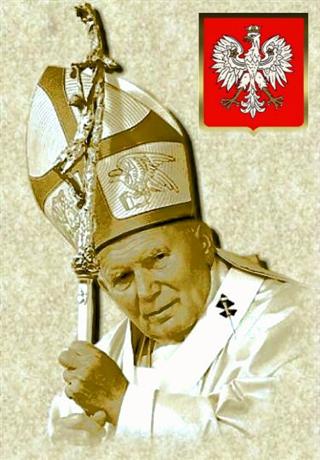







Thank you. :) This is something to treasure. Papa John will be missed, by many.
(((HUGS))) and love, Karla. :(
For sharing this wonderful
facts with us all
Love & Peace
William
My gratitude is infinite for these Words. All of them.
Love&Light*
Alexandra*
Wonderful write!...and thank you for sharing for sharing this meaningful piece!
Sandie May Angel a.k.a. Sandie Angel :o)
Peace and blessings, Carole
Love Tinka
Thanks Ed...
Micke
Eileen
A beautiful retrospect on a one of kind human being - superb!!
Best to you,
Robert
makes one feel a special importance in their endeavors
and calls us all to higher ground.
Your poem is a great tribute and the additional
information is a gift that I am thankful for.
Love & Light,
Joseph
Your poem is straight from the heart.........!!! Your spirtuality shines thru in all your works.......always, in all ways!!!
and this letter from the Pope!!!
I am passing it on to internet friends and family........ty so much
this whole page is a keeper for me
gracias!
anita ;)