“IN THIS SEPULCHRE
REST THE BONES OF A MAN
WHO WAS A LION BY NAME
AND STILL MORE SO BY NATURE”
The Epitaph of Juan Ponce
This tale begins on Easter Sunday in the year 1513
On a grand sailing ship of the gigantic Spanish Armada
As Juan Ponce gazed out at the new land he had just discovered
He joyously named it ‘The Place of Flowers’ – or ‘Pescua Florida’
As Ponce’s ship the Santiago sailed down the lush Florida coastline
He soon came upon an ancient city built high upon an ocean mound
It was inhabited by a mysterious society of native people called the Calusa
Known as ‘The Fierce Ones’ they didn’t like these foreigners lurking around
The Calusa soon launched an attack on Ponce’s ship
So he reluctantly sailed away back to his native Spain
And for eight long years Juan Ponce grew very restless
He was getting bored and his life was now far too plain
He had sailed with Columbus on his second voyage
He had conquered Puerto Rico for the Spanish King
Now the man called ‘The Lion’ grew extremely bored
When he heard an ancient tale that made his soul sing
He heard the legend of a crystal clear fresh water spring
To drink from it would gloriously give one instant youth
This aging man known as The Lion wanted to live forever
So he embarked on another voyage of discovery very soon
He heard this Fountain of Youth was in the Bahamas
Or perhaps in a mystical ancient land called Bimini
So this intrepid anxious conqueror set sail one last time
Now his aging heart and soul were truly filled with glee
He instructed his loyal crew to stop at each and every island
He eagerly searched for and drank from each and every spring
Then one day on an isolated atoll he met a mysterious native woman
And a great vision of Ponce de Leon’s destiny to him she would bring
She told Ponce that she knew exactly where this ancient ‘youth fountain’ was
She described it in exquisite detail which filled Juan Ponce with complete awe
She told him that it was here his destiny and his future would surely be fulfilled
So the rapidly aging Lion again eagerly set sail for his discovery Pescua Florida
On Florida’s southwest coast Ponce de Leon did meet his epic foretold destiny
But the fountain that flowed for him was shaded a deep dark gushing crimson red
The Fierce Ones had been patiently waiting in silent ambush for his expected return
And the jagged shell arrow that pierced his thigh soon rendered this bold old lion dead
©2005, Ed Kostro
Juan Ponce of Leon, Spain, credited with the discovery of Florida in 1513, died in Havana, Cuba in July 1521 from the mortal wound he had received on his second voyage to The Place of Flowers. His body is entombed in the Cathedral of San Juan, and the above epitaph marks his grave.
It’s said that the enjoyment of life had been an exquisite pleasure for Ponce de Leon, and that his desire to prolong his earthly existence was extremely intense. This desire also probably made him readily believe the intriguing tales told by Caribbean natives of crystal clear waters flowing from living springs in which he who drank would be instantly endowed with immortal youth and great beauty.
Many also believe that Ponce’s death at the hands of The Calusa tribe in Florida was fitting justice for his extremely cruel treatment of the native peoples on the island of Puerto Rico when he became its first Spanish Governor.
The Calusa were a mysterious civilization of ancients who had lived on the sandy shores of Florida’s southwest coast for centuries. Their population may have reached as many as 50,000 at one time, and they were described by the Spanish as a very fierce war-like race.
They built their homes on reed stilts and wove Palmetto leaves to fashion roofs; they fished for food on Florida’s coasts, bays, rivers, and waterways; and they were very knowledgeable sailors.
They were also known as ‘The Shell People’ since they utilized seashells for everything - weapons, utensils, jewelry, and ornaments for their sacred shrines. They also constructed enormous shell mounds off the Florida coast on which they built their cities and sacred temples.
One such shell mound site is Mound Key shown in the picture above. Its construction is made entirely of shells and clay, and this site is believed to have been their main city.
Archaeologists have excavated many of these ancient Calusa mounds to learn more about these intriguing people. Artifacts such as the mask and the Panther God statue shown above have also been found and are on display in Florida museums.
But what happened to them?
These ancient Florida natives died out in the late 1700s. Enemy tribes from Georgia and South Carolina began raiding their territory, and many of them were eventually captured and sold as slaves.
In addition, diseases such as smallpox and measles were brought into their area by the early Spanish and French explorers, and these diseases eventually wiped out entire Calusa villages.
It is now believed that the last remaining Calusa Indians sadly sailed away into the deep blue waters of the Caribbean forever when the Spanish turned Florida over to the British in 1763.


 Share
Share Print
Print Save
Save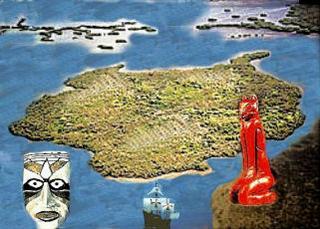











Perfect image, superb write . . . you are a masterful poet!!
Best to you,
Lance
I really love them. Thanks Ed. (c :)
Spacey 42xoox hope all are doing Better than well.
Weird I heard a programme about belivers in a fountain of youth in florida, today.
We could sell -Piddles fountain of youth golden water- $15500 per ounce..
Ed Man you are a Maestro de historia'.
And what a wonderous adventurous way you express
these lessons Maestro. I'd have no other way.
Excellent write about an especially intriguing topic,
being that my family all come from Cuba. I knew a little
bit of what you wrote and this made it all the more enhanced
to a delightful creative form of education.
Excellent .....oh, and there was more after all.
thanks, peace and long life of inspired life with true joy',
Rich Criso Suarez
A marvelous tale, told with beauty and grace; excellent!
(((HUGS))) and love, Karla. :)
(((HUGS))) and much love, your friend in tx., karen lynn. :D
uyup..another keeper! :)
Ps; Spiderbites aint fun!!
Love Tinky
This is a poetic compliance. "A Florida Tale" stimulates
the mind of imagination, and gives a clear picture of history.
Thank You, Poet!
Andre Emmanuel Bendavi ben-YEHU
Sandie May Angel a.k.a. Sandie Angel :o)
He instructed his loyal crew to stop at each and every island
He eagerly searched for and drank from each and every spring
Then one day on an isolated atoll he met a mysterious native woman
And again one more beautiful write from a man whose pen never rests. Keep posting these marvelous poems. thanks