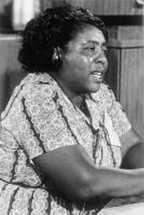
Fannie Lou Hamer was a brave civil rights activist and philanthropist who fought against racial segregation and injustice in the South and organized rallies and campaigns to encourage African-Americans to vote, even in the face of danger.
Fannie Lou Hamer 1917 - 1977
Civil Rights Activist/Philanthropist
Known as the lady who was “sick and tired of being sick and tired,” Hamer was a maverick for social and racial equality and she fervently fought to end racial segregation and injustice in the South. Hamer co-founded the Mississippi Freedom Democratic Party to expand African-American voter registration and to challenge the state’s all-white Democratic Party. Hammer became a strong leader in the fight for civil rights, social justice and equality, and economic advancement for the African-American community. Andrew Young, the then-U.S. Ambassador to the United Nations, gave her eulogy, saying, “None of us would be where we are now had she not been there then.”
Thank you for telling us about Fannie Lou Hamer. I have not heard of her before but I have heard of the role that the Mississippi Freedom Democratic Party played in changing attitudes in the South during the civil rights movement.
I attended the quadrennial conference of the Methodist Church in Lincoln Nebraska over the after Christmas period 1964-65 as a college student. Martin Luther King was the keynote speaker on New Year's Eve. Mississippi sent an all white delegation of students and ministers. I believe, but I'm not sure, that the black Methodist churches also sent a delegation.
Anyway, during the conference the conferees declared that they were solidly behind and would endorse the Mississippi Freedom Democratic Party over the traditional, all-white Democratic Party of Mississippi. It was a major blow to the Mississippi delegation. I heard that some of the students cried when they learned that their privileged superior position had been undermined and they no longer could continue to oppress fellow citizens of Mississippi.
The Borderline Anti-Memory PastBook asks questions a diary does not ask and raises the questions to dialectics and answers them in a way a memory work does not answer questions.
A work in American history and existentialism Which is an Invitation to connect and create the dots in your life to other revolutions like the Cuban Revolution.