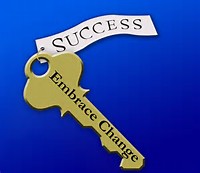
February is the perfect time to determine if we are open to life altering change? I ask the question because it is human nature for us to be resistant to change. Yet, what we don’t often realize is that change is constant and it’s both a survival and success skill. And while unplanned and unexpected change can be difficult, even if we choose to avoid it, change will manifest itself into our lives in some way, shape, or form. However, if we make a conscience choice to initiate the change, disruption can be minimized and change becomes easier to manage.
Let’s face it, change is uncomfortable and can fall under many categories, from professional advancement and personal growth to relocation and matrimony. Most of us don’t like uncertainty or the thought of failing; thus, we prefer to remain in our comfort zones. But if you don’t learn to embrace change you could become immobile, irrelevant, or worse, get left behind. Bottom line, by embracing change you will be one step closer to learning how to deal with change. Below are a few thoughts for your consideration to help ease the discomfort of change:
1. Take small steps:
Change doesn’t always happen overnight or in leaps and bound…change can be incremental. Once you embrace the basic concept of change, take small steps forward and find one the small thing that you can do…then repeat it! In doing so, change becomes more palatable and easier to accomplish.
2. Be willing to take a step back.
Success is not always linear. Relative to status, pay, or advancement, there may be periods in your life when you have to take a step backwards to move forward. If you embrace your decision to take a step back as part of the change process, you automatically remove uncertainty and doubt, which increases your ability to be flexible.
3. Lose the ego.
If you define yourself by other’s people’s perception of you or if you are dependent on external factors to make you feel good, you will likely fear failure and YOU will likely be your biggest obstacle to embracing change. Carefully consider the downside to whatever change you are facing, deal with it, and move on.
4. It’s okay to fail.
Bottom line, the word “failure” in and of itself sounds like a bad word and some of us simply don’t know how to fail. By nature, people allow failure to hold them back, when in some cases, failure can be a good thing. It was Thomas Edison who said “I have not failed. I've just found 10,000 ways that won't work.” It’s all about your mentality and how you chose to face and deal with failure.
Remember, change is necessary. It allows us the opportunity to reexamine our lives and look at things from a different perspective. Change can also open doors to new beginnings and can add excitement to life. So the next time you think about resisting change, first think about what you may be missing out on!






I consider myself a change agent until I tried to reenter industry after being in higher education and found that I wasn't even able to get an interview. With my disability limiting my options, I kept initiating change (computer systems and productivity tools) where I worked that wasn't very often appreciated, but kept me working well until retirement age. For example, late in my career, I took small steps and taught myself how to construct computer databases. It took two years but was well worth it. And then, I taught myself how to construct and maintain a website.
Ron