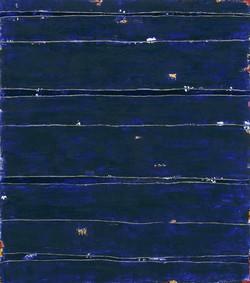
Indigo Stripes #2 by Babette Herschberger
www.BabetteHerschberger.com
On Indigo Stripes
by David Arthur Walters
Ãrtéwörldé Artékrítìk
I have torn through the blue lampshade of color limitations, and came out into the white; after me, comrade aviators sail into the chasm - I have set up the semaphores of Suprematism. Kasimir Malevich (1919)
Babette Herschberger's Indigo Stripes #2 took the $5,000 Second Prize in the 2005 ‘art and the city’ competition at ArtCenter/South Florida on Miami Beach's chic Lincoln Road Mall. The competition was sponsored by Artécity, a $100 million condominium development located a few blocks from the ArtCenter colony, in the South Beach Art District at the newly designated "Collins Park Cultural Center" in and around historic Collins Park. The Artécity project is representative of the burgeoning "art-industrial" complex. A triumvirate of Artécity developers have allied themselves with financial resources, politicians, and several cultural institutions, in hopes that ãrté will serve to sizzle real estate sales and renovate the blighted district.
Herschberger's horizontal Indigo Stripes are painted on a 54 x 48 x 2.75 inch wood panel. The indigo color is black-and-blue, the coal-tar black showing through as 'background'. Five of the indigo stripes are relatively broad and cover most of the panel. Most of the indigo stripes are separated by slightly irregular, narrow white lines, giving the appearance of clothes lines or barbed wire. Two or three broader but still relatively narrow, almost pitch black stripes - "black cracks" in the indigo - also divide the indigo swaths. Small white blotches, perhaps starlight, appear in or near the dividing lines, while other slightly larger white blotches appear elsewhere, giving the illusion of tiny figures such as a crawling baby and Elsie the Cow.
The cover of Artécity's excellent brochure - a small poster folded in twelves, arranged to display the contest entries - imitates Indigo Stripes. It is a blue-black photograph of a condominium compound, over which is printed in brilliant white, “art and the city.”
I happen to be allergic to synthetic indigo dye, which is derived from coal tar. My experience with two pairs of jeans, which I tried to tolerate by washing them in bleach a dozen times, usually causes me to associate indigo with furious itching. If I do not check myself, I automatically start scratching my crotch when I see indigo. Yet Indigo Stripes' weighty wall of black-and-blue boards suppressed that reaction because, I suppose, the color as well as the horizontal plane suggests the very extremity of repose, grave depression, bordering on the dead weight of death, beyond which the deceased is weightless.
Of course weightlessness was the subjective objective of the Russian avant-garde painters after the grave catastrophe of the Great War. Artists were especially fascinated by the fly machines and the possibility of flight beyond the blue sky, where they supposed the navigator would be greeted by the white light of the Sun. Cosmic consciousness would have to do until then. In fact, they believed that their supreme art, or art in its highest manifestations, was the sole path to cosmic consciousness and to the eventual realization of utopia. Later on, Milan Kundera wrote a novel about 'The Unbearable Lightness of Being' in one utopia:
"The heaviest of burdens is therefore simultaneously an image of life's most intense fulfillment. The heavier the burden, the closer our lives come to earth, the more real and truthful they become. Conversely, the absolute absence of a burden causes man to be lighter than air, to soar into the heights, take leave of the earth and his earthly being, and become half real, his movements as free as they are insignificant.... Which one is positive, weight or lightness? Parmenides responded: lightness is positive, weight is negative. Was he correct or not? That is the question. The only certainty is: the lightness/weight opposition is the most mysterious, most ambiguous of all."
That question is perhaps another form of what Camus thought was the most important question of modern times: "To be or not to be?" As far as Freud was privately concerned, anyone who seriously asked that question was insane - psychiatry soon became a booming business. Although we usually elect gravity instead of weightlessness, our self-contradictory dialectic or "progress", as developing children and as civilization, is from the concrete to the abstract. Those who do not believe the ideal is real might say that death is the final destination of both philosophies; at which time the psyche is released from its concentration camp into the weightlessness of nonexistence. In between distracting bites and images, we have occasion to doubt whether or not our increasingly symbolic life, un-tethered as it is from planet earth, is a real as we want it to be. But at least we are free, or so we panoptic beings believe as we lock ourselves in our modern caves. The next day, as the turkey vultures circle over head, we behold the grand federal prison in downtown Miami If it were not for its narrow windows, tourists might believe the prison to be a postmodern condominium compound. I need more space.
"Indigo Stripes brings to mind a concentration camp scene," I casually remarked to an ArtCenter associate artist. "I am standing inside a barbed wire fence in the dark blue of deep winter dusk. Two blurry stars beckon to me, but I cannot crawl through the black cracks."
"I don't talk about those things," said the associate haughtily. "Everybody has their own opinions, and it is useless to discuss such things. I like everybody’s art. Goodbye." Case dismissed, and me along with it.
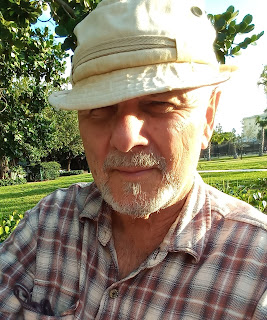
Of course an honest description of my psychological reaction to Indigo Stripes is not intended to insult the artist or her colony. I know nothing of her except her paintings - I suppose they are, to a certain extent, self-portraits, just as this is a snapshot of me. Nor are my remarks meant to be art criticism. Nor did I intend the can of paint I threw up against the wall of a garage when I was a juvenile delinquent to be a work of fine art. Nor should any one imply that I by any means mean to say that Indigo Stripes is not art at all. In my lay opinion it is art. The work brings other artists to mind; off hand: Clyfford Still and Barnett Newman, and the Color Fielders, Larry Poons and Jules Olitsky.
I do not have the faintest idea of the artist's intentions for Indigo Stripes, or what she had in mind when she painted it. For all I know, she thought her lines were alive and superior, say, to fish swimming in the deep blue sea. After all, Wassily Kandinsky, writing from Paris in 1935, said:
"I see no essential difference between a line one calls 'abstract' and a fish, but rather an essential likeness, The isolated line and the isolated fish alike are living beings with forces peculiar to them.... It is the environment of the line and the fish that brings about a miracle.... The environment is the composition.... But approaching it in another way, there is an essential difference between a line and a fish. And that is that the fish can swim, eat, and be eaten. It has, then, capacities of which the line is deprived. These capacities of the fish are necessary extras for the fish itself and for the kitchen, but not for painting. And so, not being necessary, they are superfluous. That is why I like the line better than the fish - at least in my painting."
However that might be, I suppose Babette paints because that is what she really likes to do. Wherefore she does it conscientiously; that is, she paints instead of doing something else. I opine that she requires no verbal crutches during the production process. I presume she feels the things she painted, that she has feelings which she has no need to give mouth to, except perhaps as advertisements to stimulate demand.
Yes, again, Indigo Stripes might be her self-portrait at the time, as if she were imprisoned by the work if she was not the work itself. Indeed, Wassily Kandinsky (1866-1944) once said that an abstract composition has a "soul", a soul dependent upon the integrity of the artist. In any event, I feel Hershberger felt the painting was finished at one point, at which time she submitted it for judgment. Finally, to divine her feelings in this matter, if feeling is to be the universal principle of aesthetics, I think I would have to close my eyes, rub my face and hands over Indigo Stripes, smell it, lick it, chip off some paint and taste it, sleep on top of it one night and under it the next.
By the way, and this is of no small moment in the historical context, I am informed by an ArtCenter staff member that Hershberger complimented my verbal art: in an email to the director of ArtCenter, she called one of my linguistic portraits "crazy". Conversely, there was a time when abstract works such as Indigo Stripes were called "crazy" because they did not clearly represent anything in particular, nor anything of universal import, for that matter, except modern dissolution, decadence, subjective individualism, unwholesomeness or insanity.
The modern distemper and malaise or malease (bad ease) was lamented on at length by the French conservative René Guénon in Crisis of the Modern World (1927). As far as he was concerned, the modern degeneration originated in the West with the repudiation of traditional society. Hence the West is gradually corrupting the rest of the globe, fanatically imposing its version of freedom on the world whether the world likes it or not. Of course the dissolution is according to Hoyle; or rather according to the Hindu texts which outline the regression from the Golden Age to the last stage of the Iron or Dark Age, now enjoyed by de-spiritualized consumers.
To paraphrase our frustrated French guru: Although wisdom and practice, knowledge and activity, are complementary when in harmonious equilibrium, the West has abandoned contemplation for incessant action. That is why a Hindu Brahmana observed that there were only a handful of Brahmanas in the United States among a multitude of Kshtrayas (warriors). Action, ceaseless change without contrasting permanence, competition, and war are dominant in the West. Analytical, divisive, head-in-sand thinking; infinite division of labor into meaningless functions; disintegrative multiplicity and atomizing individualism; - dominate the final imperial civilization ruled by the dark forces of corporate-board tribalism. The Western culture has reduced itself to worshiping the absurd in its mindless pursuit of temporal happiness. The sciences are divorced from morality: the higher the technology, the lower the moral standards. Religion is degraded to commodity fetish and its abstract one-god, Money. Wherefore ceaseless change, perpetual innovation and the like are idolized by the West, pursuant to its scientific-industrial revolution. In art, the plastic art called Action Painting helped blaze the path to general instability.
Many neo-Kantian pioneers of abstract modern art, dissatisfied as they were with the bourgeois materialism of their disciplined therefore self-hating caste, and ignoring Kant's precautions about the illusions inherent in transcendental dialectic, thought their path led to the absolute transcendence of mind over matter. Ironically, they become anti-intellectuals, replacing mind with irrational feelings. In other words, they thought sensational intuition was divine intuition. Alas, after God was assassinated with Nature's laws, Nature herself was denuded and de-spiritualized; existentialist Man proclaimed the absurdity of his world, and soon realized that the assassination of the projected social god has led to his own nothingness. God is dead. Nature is dead. Existence is dead.
Everything is permitted. Everything is absurd. Everybody is deaf. Never mind. Nothing matters.
That sort of craziness, sometimes unwittingly represented in contemporary abstract art, is no longer called crazy. Modern art is traditional now, and even conservative in the context of fleeting contemporary art. Any sort of coherent verbal expression purporting to be truthful or even artful in its finest sense is deemed to be insulting and crazy and is promptly denounced as incipient fanaticism which might lead to concentration camps and ovens if not hard labor in prisons.
Artists, at least, are supposed to be absolutely free, and those who really believe that are often the hungriest of their lot. The great Kandinsky had his conservative reservations on the account of freedom. He said abstract art should not be completely divorced from nature (of which we are a part) lest the result be merely decorative, "like a rug or necktie". Yet, in the final analysis, Kandinsky declared the artist to be, essentially, absolutely free, period; so there, take that.
After all (we interject for good measure) the various ideological "isms", even the "Artistic Urbanism" of post-modern Miami Beach's Artécity, are methodological antitheses of truly creative art.
We should feel free to think about art no matter how we feel, for gross sensate feeling is not all there is to being human. Perception is not mere sensation: perception is sensation judged. Emotion is not just feeling: although the feeling side is on top, there are two sides to the coin of emotion: feeling and thought. And if we would have the truth about the number of senses, the brain is a sense organ too, and thinking itself, no matter how abstract, is fine feeling, is "sublime" feeling. So the divorce of feeling from thought is a false dichotomy although convenient to some ends. Without associated thought, an abstract painting, no matter how much "feeling" is incorporated - especially nonsensical "pure feeling" - cannot exceed decoration.
Piet Mondrian said as much in reverse when he observed that the new, "flat" paintings are not decorative when they allude to things "much more inward" - Indigo Stripes, from my perspective, has depth. The critical dissociation of art from thinking is a shallow and superficial way of thinking. In fact, to get and to hold an appreciative public, modern artists have felt obliged to explain works that might otherwise appear to be absurd or meaningless. Manifestos and other formal statements have been composed to that end, many of them, in accord with the times, incoherent or absurd.
An artist at ArtCenter filled me in on the contemporary elements of art, "new" elements which are allegedly replacing the "old" elements of color, line, and form - incidentally, Indigo Stripes has color, line, and form.
"The successful ArtCenter artist must have three things," he said, "a concept, a medium, and blah-blah-blah."
"Well," I responded, "the blah-blah-blah is not so good, it gives me the blahs. I think artists should hire artistic thinkers and writers. That would enable them to devote themselves to what they do best."
But no, the art of rhetoric is denied artistic status nowadays. People like their writing in the flat nowadays, like newsprint and newspeak; impersonal, as if it were true . Emotion must be avoided: meaning moral values should e out of the picture.
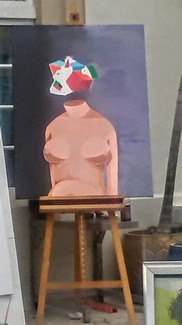
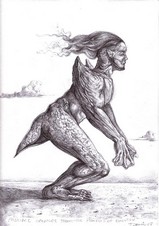
The remnants of the manifestos are largely subjective today. Only the artist, by virtue of some sort of divine right, may define his art. While at ArtCenter, I made the grave mistake of calling the grotesque subject of associate artist Sara Stite’s watercolors – creatures with hirsute arms on headless fleshy objects, torsos with gaping mouths, hairy pelvises with feet and so on – “monstrosities" and "monsters".
"Don't call them that, you can't call them monsters, you have to ask the artist what they are," imperiously stated another ArtCenter associate.
"But of course," I said, amiably but sarcastically, "There are no standards for anything at all, therefore everything is equal. Everything is absolutely justified by its creator."
She thought I was serious; my remark drew an approving smile. I silently recalled that a friend of the Russian Cubo-Futurists envisioned the fourth dimension as a sort of utopia where an infinite number of words would be needed to name each object according to the subjective prejudices of everyone involved.
All in all, I think another bonfire of the vanities is called for today, but not a revolution. The time is nigh to burn the clutter framing the fine pieces. We have no cause to fear for the destruction of the masterpieces themselves. Savonarola, contrary to historical gossip, did not demand the destruction of the dearest objects: as the flames rose on Florence corners; the brisk trade in precious metals and fine handicrafts and fine art continued apace. As for the modern revolution, the accelerating dissolution and disintegration of traditional society was represented by modern art, but it was not painted right away. In 1857, New England Transcendentalist Orestes Brownson anticipated twentieth-century complaints about the atomizing individualization of modern society:
"The work of destruction commenced by the Reformation, introducing an era of criticism, had, I thought, been carried far enough. All that was dissoluble had been destroyed, and it was time to begin the work of reconstruction - a work of reconciliation and love.... The first thing to be done is to cease our hostility to the past."
Modern artists of iconoclastic disposition generally disliked history, tradition, convention, anything that smacked of authority. Down with History! Down with thinking and language! Death to art! Down with prostituted beauty! Down with frivolous and elegant and pretty art! Given modern art's original contempt for history, it is hardly surprising that contemporary artists - of course every artist of every time is contemporary - know little of their roots or the lessons and alternatives that history offers. Every school kid should know that the modern artistic revolution was born between two world wars, that it was a revolution against war and the perfectly logical justification for murdering millions of people. So much for the cogent, enlightened reason of the vultures under the scorching Sun, they said, as their anti-intellectual manifestos grew increasingly absurd. They threw traditional art into the bonfire of its own infernal Sun, and proclaimed a complete break with history.
At each moment of the past," declared Piet Mondrian (1872-1944), "all the variations of the old might have been called new. But this was never the new as such. For we must not forget that we are at a turning point in the history of culture, at the end of everything old in the global sense. The divorce between the old and new is now absolute, definitive. Plastic art must move not only parallel with human progress, but must advance ahead of it."
In Victory over the Sun (victory over conventional art), the Russian Suprematists declared themselves immortal as well: "Everything is good that has a good beginning. The world will die, but for us there is no end." (1913)
Realists, sickened by the customary fictions, made the first break, and it was not long before invisibility became reality and every example in the world was rejected off hand. Everything must be smashed to bits, preferably into atoms. The Cubists tried to abolish conventional rules of perspective, to representing an allegedly omniscient view of an object, a view from all sides at once. Perhaps a divine artist might imagine such a thing, but a realistic representation of omniscience is impossible. We are left with allusions to the omniscient view, by means of finite multiple perspectives. But sight is only one sense, and to see is not to know everything. An "omniscient" grasp of an object is better sensed by wrapping the hand around it. Touch is at the foundation of intelligence. The manipulative hand helped teach man (manu – he who draws out thoughts) reasonable procedures, yet reason never left behind its origin with things in womb and hand.
As far as Kasimir Malevich (1878-1933) was concerned, cubist fragmentation did not go far enough. Smash everything; what is left is good, cried an anarchist. After all, when nothing seems to work, it is best to start with Nothing, if one can get there by smashing things, for Nothing works.
"The Cubo-Futurists piled objects in the main square and destroyed them, but they did not burn them. Pity!" exclaimed Malevich, once the foremost supporter of Russian Cubism. Pulverizing things frees the artist. Malevich had flown farther than Cubism, where no artist had gone before, into the Nothing beyond dimensions, a discontented space where, if Nothing exists, one has all the benefits of weightlessness.
"This space takes the place of cosmic space without any determination by relation of a person or a thing. It is without dimension, without orientation; it ignores right and left, high and low, near and far." I have capitalized 'nothing' because nothingness is not intended, but rather the pregnant feeling of its infinite possibilities.
Malevich painted his void white, a white square on white canvass, to indicate infinite space, into which he wanted to launch a Suprematist satellite. The black of his black square ("rectangle"), he said, represented anarchy, and the black cross, his death. A square felt rather good to Malevich: "It is difficult for you to get warm in the face of a square," he wrote to a critic, "accustomed as you are to get your warmth from a sweet little face.... The secret of the incantation is the art of creation itself, and it lies in time, time which is greater and wiser than swine!"
Well, a man may be a square, but he hopes for something beyond geometry. In 1915, Malevich wrote: "I have transformed myself into a zero of form, and have gone beyond 'O' to '1'." But after waxing eloquent on the square, he effuses: "A blissful sense of liberating non-objectivity drew me forth into the 'desert,' where nothing is real except feeling.... and so feeling became the substance of my life."
"The general philosophical path of these trends," he declared while questioning imitative art, "leads to the disintegration of things, to the non-objective and to Suprematism, as a new utilitarian body and to the spiritual world of phenomena.... We are going to work on new creative constructions of life...." Moreover, " I think that freedom can be attained only after our ideas about the organization of solids have been complete smashed. This liberates each unit from the single, complex mass made up of units of energy."
Wherefore Malevich would atomize everything into energetic particles, witnessed by mere mortals as material forms, and he wound up with the pure feeling corresponding to pure colors:
"Everything is linked and at the same time separate in its own motion.... This notion was the impetus for breaking up the visual complexity of a solid and dividing its mass into the separate colors of Suprematism.... My research has shown that color in its basic state is autonomous; that is, each ray has its own energy and characteristics. When colors are mixed the produce different hues and release new color energies.... In Suprematism the mass of energy breaks down into individual color constructs on the two-dimensional plane - with the result that each plane or volume becomes an independent unit powered by its own motion. Thus, in expressing pure colored form, the colored period of Suprematism discovered the very essence of color.... As a result, Suprematist atomization of the picture and the reduction to single color has released the action of atomization.... This process of isolation has created the form of the black or colorless square, a form that in its atomization offered all kinds of other forms, and these in turn were painted many different colors.... Such forms, of course, do not express anything related to the objective world, and in the viewer's mind they are non-objective. Consciousness now begins to operate with supremes, with individual units - the signs of dynamic mathematical connections. Expressing this dynamic functioning is the primary purpose of consciousness. The forms are built exclusively on white, which is intended to signify infinite space. The tactility of this dynamism, however, beings to assume importance in this kind of composition."
Suprematism, then, as Malevich defined it, was pure feeling of pure color. Of course white is the pregnant color, the "color" of sunlight unbent into its spectrum. The pure feeling is the transcendental feeling of the new man, the superman, the godly artist whom several philosophers thought would lead the way to utopia: "Art in its highest manifestation is a path to cosmic consciousness," declared a mystically inclined philosopher. But the philosophers soon changed their mind, and, like Plato, they concluded that artists cannot get there except by lucky flashes of the transcendental intuition once associated with enthusiasm ("god-possession").
Critics declared the Suprematist scheme absurd. Of course it was logically absurd, and intentionally so. Every A is, at the same time, not-A. In 1911 Ouspensky praised art for freeing itself from three-dimensionality: "All art is just one entire illogicality."
The artistic magus is a clairvoyant, a Superartist who discerns the nature of the ideal world behind the veil of the illusory "real" world. Malevich's circle strove to transcend logic with their "alogical" art. To get at the truth, which is a moving target, one has to contradict oneself from time to time - even the orthodox critic Ruskin said that he liked to contradict himself several times in every article for good measure.
When Malevich eventually repudiated "all aesthetic beauties, experiences, or moods," he repudiated feeling; hence some critics think that, despite his profession of pure feeling, Malevich was not a feeler at all, but rather a frustrated thinker who needed to work on his writing skills. As for his black quandrangle, some time after hanging it high on the wall like a Russian religious icon, he denied having mystical inclinations and said the Black Squre represented nothing but itself and his relationship to it. We should recall here that Ouspensky double-crossed the Suprematists. As we have seen, he said that all art is irrational, and said the irrational artists would lead the way into the fourth dimension; but he was not pleased with their art, and denounced it in the next addition of his masterpiece.
One version of the spiritual utopia intuited by the Russian Suprematists was realized in the concrete Soviet Union. Piet Mondrian, artist-Theosophist, took up the question of the inherent instability of the subjective nature of the Russian revolutionary movement. He envisioned a new city on the hill to resolve the dissolution into a sort of tribal commune where everyone would enjoy the same feelings and thoughts about art. The private, home-sweet-home life as well as street life would be extinguished in Mondrian's city, and replaced by a "unity formed by planes composed in neutralizing opposition that destroys all exclusiveness."
I prefer the glass city of Zamiatian's WE. Mondrian moved to New York, where he gave up his static city after becoming fond of skyscrapers and things African, boogie-woogie for instance.
What remains in store for the world today, for the United States and Miami Beach, remains to be seen. Let Indigo Stripes, which, depending on your prejudice, progresses or regresses from the blank black or white square of Suprematism, represent for our purpose tea leaves steeped in a cracked pot of indigo held together by tar and cement. Here, in the gallery at ArtCenter/South Florida in Miami Beach’s chic South Beach, we witness a representation of the marked reluctance to arrest the general decadence and dissolution because it provides a great deal of money to the sponsors. We witness a tendency to call those who protest the insanity they call freedom, “crazy”, and to recommend their commitment to therapeutic institutions, where art is dope.
On one end of our grand scheme we find the affluent, whose government buildings are virtual fortresses, penned up in gated compounds manned by guards and voluntarily locked down in their condominium caves, or residing in freestanding homes with bars over windows and doors. All that to protect themselves from outlaws, i.e. “free” people. On the other end we find prisoners confined in prison cells and in concentration camps, at an average cost of $70,000 per annum, an average that gives us cause to believe that involuntary prisoners should have luxurious, three-bedroom condominiums on the ocean instead of sharing the bottom bunk by the steel toilet.
The Artécity complex, wherein Indigo Stripes will rest in state, looks like a pink prison complex in the January 2005 Miami Visual Arts Guide, complete with an exercise yard. And the indigo city on the “art in the city” brochure also has the appearance of a prison.
None of the above is intended as an insult to anyone at all, but it will undoubtedly be perceived as such. It is merely another sign of a great rectification pending. We must not blame the revolution on the enthusiastic artists, many of whom do not understand the nature of their visions; they do not know the mechanics of their motivation. Many artists have become automatic feeling machines. They are, as Mondrian predicted, "living machines, capable of realizing in a pure manner the essence of art."
No, do not blame the revolution on our artists or poets. Poets, long before they became surrogate gods, were makers not of truth but of poems revealing same. And artists, before they rid themselves of one-gods and became subjective gods, were not revolutionaries, bound to creative-destruction as things moved along for the hell of it. Modern artists certainly do not deserve much of the blame, censorship and repression laid upon them for twentieth-century revolutions. Nor will they deserve the blame for the escalating neoteric terror of our twenty-first century.
As for me, my meditation on Indigo Stripes has moved me to become a painterly painter. Indeed, I shall be the most radical of the painterly painters. And in this my endeavor I shall do everything by doing absolutely nothing, thereby transcending all the dimensions, and thus establish the dictatorship of the painterly masses without a painting. To that end I shall apply to ArtCenter/South Florida for my own studio, in the form of a white sphere, that I, a painterly painter without a painting, dressed in black, may be the world's greatest masterpiece, setting the stage for the assassination of mediocrity and incompetence in art.