 The modern version of Thanatos is an insult to the ancient Greek conception of the god

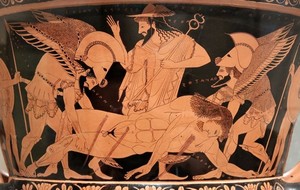
Greek calyx krater in the Metropolitan Museum, painted by Euphronios (c 515 BC)
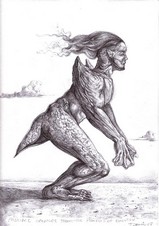
Thanatos, bewinged and bearded personification of death, has been juxtaposed in the modern mind with Eros, the personification of love. The two gods are said to be contraries engaged in mortal combat on Earth. In abstract terms, Eros represents the instinctive forces of organic life perpetuated in order, while Thanatos represents the so-called death instinct, a tendency to return to inorganic disorder and, ultimatedly, to formless chaos or Nothing. To comprehend this process, humans made a person of death and projected upon him humanity's own destructive characteristics, and made of human love another person with creative aspects.
To make a scapegoat of Thanatos might be convenient, but when we look more closely into the matter we must conclude that our version of Thanatos is an insult to the ancient Greek conception of the god. Thanatos was quite shadowy in the early days; he dressed in a black robe and carried a sword to cut a forelock from the head of the dying in preparation for the journey to the tomb or to Tartarus. In later times he was viewed as a beautiful young man who carried a lowered torch in one hand to guide the dead to their proper abode. He was usually seen travelling with his twin brother, Hypnos, or Sleep - both are gods of bodily or physical states in formal constradistinction to mental or spiritual states. Thanatos was not shown engaged in a titanic battle with Eros. Thanatos was not on the ultimate level of conflict between absolute being and non-being.
Absolute non-being or death might be described as an absolute state of rest, or, as far as the dead are concerned, nothingness. We do not experience absolute death. To paraphrase Epicurus, we do not directly know death when we are alive, and when we are dead we know nothing about it; it does not behoove us to worry about nothing. Epicurus did point out that it is the idea of death and not death itself which is feared by humans; his solution is to live in the moment, for a moment of pleasure in an infinite life is no more than a moment of pleasure in a finite life, hence the desire for immortality is vain. Yet this again avoids the problem of human existence. Without complex memory and imagination there would be no humanity.
Living in the now is more akin to the life of a beast than a human, and life in the moment without cognitive dampening of reticular activity can be filled with intense, immediate fear of novel objects whatever they might be. We must not ignore the meaning of death. While alive we experience partial death in grief; the body of the person we knew returns to the elements constituting it. The apparently self-moving person no longer appears, no longer has a face except for the features of his or her descendents. Thanatos then represents the return of the bodily state to absolute rest, in contrast to the will which would have every body persist forever in perpetual motion. Now some thinkers hold that every body, whether animate or inanimate, has an innate and essential tendency to endure to eternity.
When we exercise our spiritiual will in such a manner as to apply a force against a material object in order to have our way, we work to overcome its "inertia"; we consider the working force the cause of action, and the object it works upon as the passive recipient of the force exercised.
However, if we reverse our perspective, we see that inertia is an opposite force, which, when equal to the force applied, brings motion to a dead stop. Dead matter in the form of material objects, although they are not self-moved, seem to have an inner "life" of their own. Such objects may outlast animate beings for eons, yet they too are death bound in the universal scheme of things.
Again, it might be convenient to hold ancient Thanatos to blame for what in effect is a natural process ending in Nothing or inchoate chaos, and to suppose he is locked in perpetual struggle against Eros. But in respect to his ancient Greek function, we give him far too much credit. Important as he appears to be, Thanatos plays a rather minor role in the ancient tales, as we shall soon see. First of all, we shall review the top of the cosmic organizational chart, giving priority to Hesiod's arrangement.
In the Beginning there was Chaos - infinite space. Then appeared Gaea, our "broad-bosomed Mother Earth" surrounded by the great river Oceanus. Underneath Gaea by nine-day's fall of an anvil, we have Tarturus surrounded by bronze wall reinforced with three circles of darkest night. Tarturus comprises the entire lower world, not only the hell where bad souls are punished, but the realm where good souls abide after they leave Gaea. And next on this highest level we have Eros; he is not the flightly Cupid we are most familiar with, but is the irresistable uniting force who brings order to Chaos, harmony to conflict, ruling both gods and men for their ultimate common good. In fine, these four great gods are at the head of our organizational chart: Chaos, Gaea, Tarturus, and, last but not least, Eros.
Chaos, procreating alone, begat Night and Erebus - Erebus is the personification of the three rings of darkness encircling Tarturus. Night and Erebus begat Light (Aether) and Day (Hemera), and also the repulsive ferryman, Charon, to whom the dead had to pay fare to cross over the river Styx into Tarturus.
Night, procreating alone, begat Strife (Eris). Then Strife, also alone, begat Toil (Ponos), Lethe (Forgettfulness), Famine (Limos), Sorrow (Algea), Fighting (Usmine), Battle (Mache), Murder (Phonos), Manslaughter (Androctasia), Quarrel (Neicea), Lying (Pseudea), Dispute (Amphiloggea). Lawlessness (Dysnomia), Ruin (Ate), and Oath (Horcos).
Besides Strife, Night alone begat Doom (Moros), Fate (Cer), Death (Thanatos), Sleep (Hypnos), Dream (Oneiros), Blame (Momus), Woe (Oizys), Revenge (Nemesis), Deceit (Apate), Friendship (Philotes), Age (Geras), and, finally, the three Fates: Clotho who spins the thread of life, Lachesis who extends it, and Atropus who cuts it with her scissors.
All and all, with the exception of Eros at the top and friendship below, we find a gloomy cast of characters on the primordial levels of existence, Thanatos does have an important positioning under Night, but we do not discover him playing a major role. The god of the dead, Hades, who ruled over Hades, a region within Tartarus, employed Thanatos as his envoy to pick up the dead; Hades usually stayed close to home, but sometimes he did the heavy work himself, in which case his name was used instead of "Thanatos." Thus it is said Thanatos is an aspect or servant of Hades; but given Thanatos' rank in creation, I shall not cavil over functions, and simply assume Thanatos is the original god of death whose visible role was to pick up the dead. In any case, although today we might refer to the great struggle of Eros and Thanatos as the battle between life and death, it appears Eros versus Chaos would be a more appropriate bill for our ultimate tragedy except Chaos is unimaginable, an impossible role for even the best actor. That being said, we continue on our way.
No, Hades was not really inclined to act on the world stage instead of his "alter" Thanatos. As a matter of fact, the more serene homebodies among the Greeks found the sight of a lovely maiden or handsome young man in the light of Day, or their loving embrace at Night, much more attractive than than the portrayal of death and its inhumane causes.
The ancient Greeks were not all superstitious fools given to violent entertainments. For many the realm of the dead was simply the indefinte and mild abode of their revered ancestors presided over by the appropriate god, and not a circus of hellish side-shows imitating the destructive aspect of human nature; and death itself was not necessarily sinister. Yet even in the plays Thanatos (or Hades) was usually kept out of sight; human actors representing humans and gods took care of the killings. Indeed, poets were inclined raise hell to Earth, often employing their imagination to aggravate instead of ameliorate the passions. Nevertheless, we must not think that all Greeks were so barbarous in politics and religion as we might presume from the tales of horror.
We want to hide death. But if we consider death as the "death instinct" as personified by Thanatos, we discover that Thanatos keeps himself hidden without much effort on our part. He is a trickster. And how does he trick us? He causes each of us believe we are exceptions to the iron-clad rule that all people die. In the heat of battle with death in full view all around, the warrior, short of panic, believes he will nevertheless survive. The longer he survives the more he believes it. He becomes fatalistic, and the sight of corpses all around begin to appear as just so much dead matter. It is unnecessary to hide the casualty statistics from the soldiers, for enough of them believe they are exceptions to the odds against their survival, even though their entire number might be wiped out several times during the course of a war, to press on.
As Freud put it: "No instinct we possess is ready for a belief in our own death." On the way to the Front in the Great War, British soldiers sang, "The bells of hell go ring-a-ling/For you but not for me." An ironic joke, yet one believed in.
Since Death is a trickster, he might be tricked. Sisyphus, the king of Corinth, tricked Thanatos: when Thanatos came for him, he tied him up, thus depriving Hades of new occupants. Unfortunately, Zeus came to the rescue. Some say Ares, the god of war, conducted the rescue operation, presumably to make war worthwhile. Some warriors who love war say that what they love is not the killing of others but rather the thrilling possibility of their own destruction; although the chances of it are, as we have mentioned before, very slim, but still... In another story, Sisyphus descended into Hades to cheat death. I might trace the career of this crafty sophist elsewhere. He is presently pushing a boulder up a hill so it will roll back down again for him to push up again, and he is under the vigilant eye of the warden; therefore, like the Sun, I presume he will be available on my return for an interview in this life or the next.
As for Thanatos, Homer scarcely mentions him in the context of the Trojan War. We do find the rudiments of Greek religion in the Homeric tales; rather, in the Homeric sacred scripture. We are hardly surprised to find a close association between religion and death anywhere. In a sense, religion is an organized reaction to the fear of death; fear is overcome through the worship of Power, and that worship encourages the struggle for survival. During World War I, soldiers reportedly sighted angels hovering over the battlefields. They saw and heard ghosts in the trenches. Once the soldiers were on the battlefield awhile, they were no longer impressed with the jingoistic religious nationalism and its political theology. But the Christian love-religion motivated many Christians soldiers to march onward in war. One widely circulated story reported the Germans had actually crucified a soldier in full view of his fellows. Such a view would certainly torment the victim's comrades, but not to flee in panic; rather, in their brotherly or platonic love, they would be moved to keep up the killing with a vengeance, perpetuating, as in a Greek play, Thanatos' chain of death. Of course Christians were well aware of the conflict of their position, that of love-inspired hatred. A trench paper called the Murdock put this verse in the mouth of a chaplain:
"I do not wish to hurt you
But (Bang!) I feel I must.
It is a Christian virtue
To lay you in the dust.
You - (Zip! that bullet got you)
You're really better dead.
I'm sorry that I shot you -
Here, let me hold your head."
Homer relates how the Lycean hero, Sarpedon, a son of Zeus and an ally of the Trojans, was incensed when the Greeks slaughtered his allies wholesale one day. Enraged, he attacked the Greek hero Patroclus, and after a furious contest, Sarpedon was slain. Mind you, Zeus had wanted to prevent the death of his son, but Hera pointed out that, if he saved Sarpedon's life, then other gods would act likewise, which would in part defeat the purpose of the war. Now before Sarpedon expired he urged his kinsmen Glacus to rally the Lyceans and Trojans against the Greeks. A terrible fight ensued, during which Patroclus gave orders that Sarpedon's bronze armor be stripped from his body as a prize of war. That the Greeks managed to do without interference and they triumphantly carried it back to their ships. However, Zeus would not permit the Greeks to mutilate Sarpedon's body. At Zeus' bidding, Apollo carried the corpse from the battlefield, clothed it in immortal garb, annointed it with ambrosia, and then handed it over to Thanatos and Hypnos; they in turn transported it not to Hades, but to Lydia, the homeland of the deceased.
Apollo comes into contact with Thanatos again in Euripedes' play, Alcestis, a play about an old Greek myth. When the Greeks went to such a play they already knew the full story; furthermore, they enjoyed seeing the play repeated. They knew Alcestis was the daughter of King Pelias. Her sisters were persuaded by Media to cut up their father and boil him in herbs to rejuvenate him; of course the insane remedy did not work. Alcestis was the only daughter who did not pariticipate in the absurd effort to save the father they all loved so much they killed him. Alcestis was thereafter wooed and won by Admetus, and she bears him fine children. But alas, he discovers he will die young. He asks Apollo, who is tending Admetus' cattle, for help. Apollo visits the Fates and manages to trick out a deal whereby they will take Alcestis in exchange for Admetus. Alcestis insists on saving her husband with her death; he agrees to the substitution.
As a consequence, he not only suffers grief but intense guilt and remorse, and he envies his wife her death. Hercules appears at the palace; Admetus plays the perfect host, taking in the traveler without mentioning his terrible plight. When Hercules discovers from the servants what has transpired, he is so impressed with his host's good hospitality that he resolves to wrestle Alcestis from the grasp of Thanatos; or, if need be, to descend to Hades and retrieve her. Euripedes' play proceeds with a scene outside the Thessalian palace of King Admetus. Apollo enters - I quote from Alistair Elliot's translation:
"APOLLO Halls of Admetus!
Here I made myself, a god
Accept the food of slaves,
Because of Zeus, who killed my son Asclepius
With a bolt of fire throught the heart;
Angry that I killed the blacksmiths of his terrible flame,
The Cyclopes; my father, in penalty,
Forced me to slave under a mortal man.
I came to this land, grazed the cattle for my host,
Kept his house safe till now;
For, loyally serving I found a loyal master,
Pheres' son, Admetus.
I eventually rescued him from death,
Tricking the Fates; those goddesses promised me
He should escape an immediate end
If he paid in exchange another life to the ones below.
He went trying in turn all who were dear to him
And found nobody but his wife who was willing
To die in his place and no longer look at light.
Now she is held up in his arms there,
Her soul breaking from her, because today
Is fated for her death, her changing out of life.
And I, for fear of catching the taint of mortality in the house
Am leaving this roof, the dear halls.
[Enter Death] - (Thanatos)
"Aready I see Death near.
There he is, the priest of the dead,
To lead her down to the house of Hades;
He has come hard on time, watching the day
When she must die."
Apollo makes a half-hearted attempt to persuade Thanatos to go find someone who is riper for death than Alcestis, someone older whose time is due, pr someone who lived long enough to afford a rich burial. Thanatos says,"My prize is greater when the dead are young." He accuses Apollo of favoring the rich who would be glad to buy longer lives. Thanatos claims his right to the dead when due. "You understand my ways," he says. Apollo replies, "Hateful to men, detested by gods." Thanatos: "You can't have everything that is not yours." Apollo exits; Thanatos has the last word:
"DEATH You could say a lot; you'd gain no more by it:
The woman will go down to the halls of Hades.
I am walking to her now
To begin the ceremonies with the sword,
For, all whose heads this sword shaves clean of hair
Are holy to the gods below ground."
Thanatos is known for taking only a forelock of hair, and this referrence of a cleanly shaven head reminds us of nuns who commit themselves to the hereafter. Although in this play Alcestis will be saved from Thanatos by Hercules, her salvation is only a reprieve. Myth provides Alcestis with a seat of honor next to Perephone, Queen of the Dead, and her grave on Earth is not the abode of a dead woman but a shrine to her incomparable virtue in sacrificing herself for her husband.
Thus we have here an instance of the relation between Eros and Thanatos, wherein the self is destroyed for the beloved. We must also recall that her father was destroyed by his loving daughters in order to save him. And we know of parents who have murdered their families in order to save them; and so on. Yet in this case Admetus has saved only himself by sacrificing what he loves the most. He is inconsolable:
"ADMETUS What can be worse for a man
Than losing his wife?
I wish I had never married
And shared a home with her.
I envy the unmarried, the childless -
They have one life, and its grief
Is not too great a pain.
But the illnesses of children, the wedding
Beds plundered by deaths,
It's unbearable to see that. If you can,
Go unmarried and childless through all your life."
His words of woe run on and on, and they are not appreciated by the Chorus: "You put no limit to your pain... Endure it: you are not the first to lose a wife." Then they speak of Necessity, a goddess known as "the Strong Fate", an abstraction of the Three Fates to whom even Zeus is arguably subject since he is not their father. Now the Chorus sings to the concept of necessity:
"CHORUS ...She alone of the gods had no Altar and no image for us
To approach, she listens for no sacrifice.
O Goddess, do not come down
Greater on my life than ever.
For even Zeus fulfills his
Wishes only with your help.
Among the Chalybi you tame
Iron with your strength; there is no
Soft respect in your abrupt will.
"Admetus, the goddess has taken you in her bonds,
Her inescapable hands,
But endure it, for you will never bring the dead
Back from below by weeping.
Even the sons of gods in darkness
Waste away in death.
She was dear when she was with us,
Dear still now she is gone.
The finest of all women
Was the wife of your bed.
"Let us not think of your wife's tomb as
A mound for the mortal dead;
Let honor be paid there as to the gods,
A shrine of travelers.
One going down in slanting path will say,
'This one died for her husband once,
Is now a blessed presence here -
O Lady, give us good fortune!'"
Many critics have little respect for Admetus, for he brought his grief upon himself by allowing his devoted young wife die for him. But the gods work in mysterious ways. And we might ask, "Is it not supremely heroic, even godly, to accept the highest gift any human being can offer, her life?" The ancient practice of widow-sacrifice among the ancient warriors has also been heavily criticized, but we must not forget the heroism of the widows and maids who voluntarily mounted the pyres to honor husbands and nations.
Good hospitality and good wives, the pride of the Greeks; and bearing grief well with the proper rites was also insisted on. As I have mentioned above, bearing grief is about the only way we experience death, and that experience prepares the way for our own death. But still we hope to cheat Thanatos, the scapegoat for our own ills - or our ill-will called "death instinct", of his simple right to the dead. We hope to descend like Orpheus to resurrect the dead. Many poets have sung songs about this seemingly impossible quest to cheat death. I suppose sane people have "closure",and surely "time heals" many them in the long run. But some of us are never healed, and we continue to grieve unto our own demise. I know this from personal experience, and even more so my father: since the death of Charlotte, we would not give her up. The trails through the underworlds have been the torments of hell in contrast to our hope. But I shall not continue here in this personal vein. Suffice it to say that, if the Orpheus Complex has not been heretofore recognized, then I recognized it here and now by that name.
Hercules is now on the scene in Euripedes' play. Heresolves to retrieve Alcestis - it is difficult to ascertain whether she is actually dead or just about dead during the foregoing scenes. In either case, she is saved by Hercules, who gives her hand to Admetus. She speaks not a single word in the entire play.
"HERACLES ...For I must save the lately dead
Wife, Alcestis, and settle her in this house again,
Paying Admetus' favor back.
I will go and look out for Death,
The black clothed king of the dead;
I think I'll find him near the tomb
Drinking the blood of sacrifices there.
And if I rush from a hiding place and catch him,
And throw the circle of my arms around him,
Nobody shall free him, his ribs aching,
'Til he give up the woman to me.
Or, if I miss my prey there
And he doesn't come to the clotting blood,
I will go down to the sunless house of those below,
Persephone and her king, and ask for her.
I trust I'll bring Alcestis back up here
And put her in my host's hands.
He took me in instead of driving me away,
Though struck with heavy misfortune.
But he hid it nobly, out of respect for me.
Who is more welcoming in Thessaly?
Or in Greece?
No, this noble man shall not say
He did a kindness to someone contemptible."
To Be Continued
Copyright 2002 David Arthur Walters
Related Article
Empedocles on Etna
|