Bringing on violent insurgencies
"The spirit of resistance to government is so valuable that I wish it always to be kept alive. It will often be exercised when wrong, but better so than not to be exercised at all. I like a little rebellion now and then. It is like a storm in the atmosphere." Thomas Jefferson during the Shay's Rebellion
"Bring 'em on!" responded President Bush some time ago to worries about the possible appearance of foreign freedom fighters or terrorists in Iraq.
I for one am not very impressed by the thinking skills ably represented by the president, yet his challenge made good sense to me. Why fight the World War on Freedom Fighting or Terrorism all over the world, when Iraq, a relatively lawless foreign country dominated by the United States, can be the designated battlefield? Therefore, Commander Bush, go ahead, throw down the gauntlet! Challenge freedom fighters and terrorists to combat in Iraq. And then, when the enemies of the sole superpower swarm into the devastated country, where anything goes because all is fair in war regardless of the civilized conventions of the mythical international community, exterminate them one by one, or in droves.
Of course there might be collateral damage for years to come. Still, sacred sacrifices must be made to impose our brand of democracy - Anglo-America Corporate Capitalism - around the world, whether the world wants to be branded by Corporate or not.
I was astonished when a superpatriotic friend of mine, a veteran of scores of dangerous missions and a Democratic supporter of the president to boot, disagreed with me. He said "Bring 'em on" was a stupid thing for the president to say, and that the strategy, at least as I had posited it, would be a bad mistake. Chivalry and dueling is apparently dead: no leader, no matter how macho he might be, should invite an attack on U.S. troops. Other friends of pacific and liberal bent said the swaggering President had no such strategy in mind when he uttered the words - he was just doing his Texas cowboy routine.
Yet now, many months later, on June 28, 2005, President Bush has vowed in televised address to the nation that he intends to stay the course in Iraq. There shall be no changes in policy. His speech differed little from the prime-time speech he delivered 13 months ago at the U.S. Army War College. Although he has acknowledged the absence of any link between Iraq and the Sept. 11 attacks, he continues to imply the existence of a connection, referring to September 11 eleven times during the course of his speech - his spokespersons will continuously deny that any such implication was intended.
"After September the 11th," declared the President, "I made a commitment to the American people. This nation will not wait to be attacked again. We will defend our freedom. We will take the fight to the enemy. Iraq is the latest battlefield in this war." He stressed the point that Iraq has become such a magnet for foreign terrorists that the battle against them has become as important as was the fight against Saddam Hussein. The "sacrifice" of lives and property is worth it, he claimed.
The press noted, when reporting the speech, that public support for the war effort, albeit diminished, is surprising given the dearth of progress over the past year. We should not be too surprised. The silent majority is an authoritarian lot are likely to go along with authority regardless of its demerits. The F-type (fascist-type) authoritarian personality abhors ambiguity and tends to depend on expert authorities to divine and propagate the virtues of its leading executives. Of course when things go terribly wrong for too long, popular faith in being on the right side begins to waver towards the other side and to look elsewhere for an idol to absolve itself of responsibility. President Truman's numbers fell to the low 20s, and discontents started shrieking for his impeachment. Enter President Eisenhower to wind up the police action and aim the United States in an advisory capacity towards another one, from which President Kennedy was not about to back down and damage his party's reputation like Truman had done; wherefore JFK proceeded with the gradual escalation of the war, and sided with the landlords against the peasants, who, in turn, confronted with the selfish aims of the hamlet program, fell for the socialist rhetoric in droves. After all, there was the Domino Theory and the image of the almighty United States to believe in, and faith requires victory over all doubts.
But most of all, there is Good versus Evil. Of course This Great Nation of Ours, against Whom an attack is an attack on Civilization itself, represents Good under God. Tom Lasseter wrote a front-page feature series for Knight Ridder, glorifying the mass terrorism organized by the United States. We excerpt the following from the article that appeared toward the end of November 2004.
"Before his men left the forward operating base near Fallujah that morning, the battalion commander, Lt. Col. Pete Newell, gathered them in a circle. 'This is as pure a fight of good versus evil as we will probably face in our lifetime,' he said.... 'You know we're going to destroy this town,' said Corporal Travis Barreto. 'I hope so,' replied a soldier sitting next to him..... 'Kill those bastards! Kill those (expletive deleted)!' someone screamed in the darkness."
It is a well know secret that men love to go to war even though they might not like it so much when they get there. Many men have taken great pleasure in the battlefield. Poetic warriors have waxed eloquently about the camaraderie of warfare and the virtues of hate-others-based mutual love. That love was occasionally experienced during the Great War, by young poets happy to be away from their mothers, in homosexual trench-love, which was said to be preferable by far to the sloppy heterosexual conditions in town. And now reporters "embedded with the troops" in Iraq noted that war "brings the best out in Americans." Fortunately the reporters are on the right side of Good versus Evil to bear witness of the good on the Good side. I have met several warriors who said they relished killing - there were no reporters were around at the time. One veteran told me his one hundred and some personal kills made him feel as "divine as god, beyond good and evil" - god's evil, we should note, is really for man's own good.
Several philosophers have placed the cause of war in the brutish aspect of man's nature. Others praise that aspect as essential to moral progress: a life not worth fighting for is not worth living, or so they say. Yet others say there is no known cause or reason for war; that war just is and will always be. The suggestion that leaders who urge war should be deposed forthwith would not prevent war if the suggestion were taken seriously and acted upon - the depositions would cause wars. In any event, someone would step forward to lead men to the satisfaction of their urge for mutual bloodshed hence self-sacrifice for exalted causes.
Men are consumed by war on the battlefield. It is the ultimate collective sacrifice. The crucifix and stake stands by for the most courageous of all men and women, those who would rather die alone than take another life. For them, a life one must kill for is not worth living. We give thanks to Them - the Head Chef distributes their blood and flesh. War is the most conspicuous, wasteful consumption imaginable. Men and women are eaten by the god of war, providing the god with the means to more war, just as food is destroyed when eaten and digested that the consumer may have the energy for more consumption. But in war, the food has gone to waste ever since cannibalism was abjured to propitiate the god of death with massive human sacrifice on bloody battlefields. Oh, how generous have men been with their grand potlatch contests!
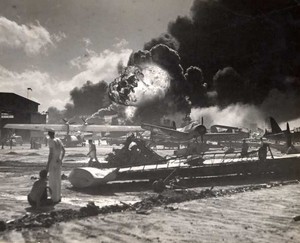
And what should be the pretext for a war when people have enough to survive without killing for a living? Anything might do, no matter how significant. Are not the worst fights within the beloved nuclear family fought over things so trivial that they are soon forgotten; it was as if the fight were for nothing. And so it goes. When people are itching for a fight, perhaps out of the sheer boredom of peace, or when they lust for blood out of anger or want more wealth than they need, some provocation shall be found by the leaders. No matter what the real motive is, and pretext will do. Make it simple, stupid. Any provocation that appeals to the masses for the particular expression of free-floating anger shall suffice. Of course a connection to a perceived enemy should be made. A grand duke was once shot and the world plunged into a war; but that would hardly do today. Mr. Wolfowitz said a meeting was held to determine what would best motivate the American people to war on Iraq and remove the man who tried to kill the President's daddy and change Iraq's sovereign regime; they came up with the fear of weapons of mass destruction. The Japanese attack on Pearl Harbor was associated with the September 11 attacks; links between Osama bin Laden, al Queda, and Saddam Hussein were continuously implied. The whole thing has been exposed as a pack of lies, but so what? The implications and images are still there, and that is what counts in our age, not the facts.
Osama bin Laden is still at large, and Saddam Hussein is in prison; both fiends are still highly regarded if not revered in some parts of the world. However, Secretary of Defense Donald Rumsfeld said on June 26 that the insurgents in Iraq would fail because they lack vision and have no leaders with the charisma of the likes of Mao Zedong and Ho Chi Minh. He deliberately discriminates against the East. One might think that an Anglo-American-Saxon would mention the "charisma" invoked by Max Weber, the right-wing German professor whose inaugural speech inspired the youth to set up two Reichs, and note how that charisma was realized in Hitler if not in Kaiser Wilhelm II, whom Weber disliked because his behavior was moronic. To offset Hitler, Rumsfeld might have then mentioned the "personality cult" established by Stalin, an Asian. But Rumsfeld if anything is clever: invoking Hitler and Kaiser might unduly irritate people who have complained about the "personal" regime of President Bush, whose followers have often called a "charismatic" leader despite the derisive hoots of historians.
In any case, Islam's theosophy and Muslim philosophy are as subtle if not more sophisticated than any - there would have been no Renaissance or Enlightenment without Islam. And Western scholars once praised Islam for being the most monotheistic religion of all. Yet we find in the vast "Arab" literature not only a singular deity offset against the creation, but also a deity so diffuse and dispersed within all that the whole shebang smacks of pantheism. To each his own, equal share of god. Note well that, at the outset of the bombing of Afghanistan, a Taliban student dismissed the Great Man Theory with a reference to his fellow students: "Every one of us is Osama bin Laden," he said.
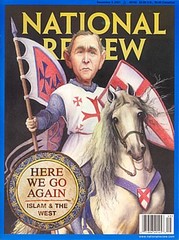
"They are foreigners trying to impose their will against an elected government in Iraq, and they are going to lose it," Mr. Rumsfeld went on to say, oblivious to the ambiguity and hypocrisy of his position and to the failure of other democracies imposed by U.S.-led factions. Of course we would like very much to help Iraqis obtain the ideal state if not Paradise. We love the people of Iraq and want them to live in peace and prosperity according to their own chosen political system - perchance a Muslim democratic republic. What President Kennedy said of the Vietnamese, President Bush now says of the Iraqis - success is really up to the natives. Yet the United States must not cut and run, for that would be bad for its image; it must stay the course and help the people win their cause.
But people have different causes and ideals; that presents certain conflicts that must be resolved, hopefully in a democratic fashion. The people might have to let President Bush's "They" participate - the insurgents. He mentioned Them in his speech: "They take innocent lives to create chaos for cameras - they are trying to shake our will in Iraq - just as they tried to shake our will on September 11, 2001. They will fail."
Maybe the insurgents will fail in the wrong run, but so far they are accomplishing their main objectives: break the will of the American people to continue the war indefinitely; provoke a civil war to regain Sunni domination of the polity. Violence organized by a rebellious minority and persevered in can pay rather well, as we have seen from the results of the American Revolution against Britain fomented by traitors and supported by less than 10% of the colonial population including those that bore arms. Less successful but still successful are challengers who are assimilated into or take a place in the normal polity - the set of contenders who routinely compete for power over the official means of coercion. After all is said and done in Iraq, success might mean that Iraq is still Iraq but without Saddam Hussein (warning: he is still alive).
For instance, Mexico's Zapatista rebels are moving for inclusion in mainstream politics. Presuming they throw down their weapons and become members of the polity, the Mexican government assures us that their history of armed rebellion would not legally bar them from political activity or from forming a political party.
And we have this just in (7/2/05) from Ramallha, West Bank - 'The Palestinian leader has invited the rival Hamas group... into his Cabinet to ensure a smooth transition in the Gaza strip after the planned Israeli withdrawal.... Hamas is sworn to the destruction of Israel....' But a spokesman for the Israeli Foreign Ministry objected to Associated Press: 'Hamas is a murderous terrorist organization.... Hamas is no partner for us in any sort of political process. They are part of the problem, not part of the solution." '
Likewise, we are informed by Ayham al Samarie, a Sunni Arab politician with dual Iraq-U.S. citizenship, that secret talks are being held between American officials and insurgents, and that he has formed a group to provide a political voice to Iraqi fighters. This political effort is intended to draw disenfranchised Sunnis, the minority that has most of the nation's technological and military expertise, into the new Iraqi polity. The head of the Mosul Bar Association, Kamal Alaw, a Sunni lawyer, said the freedom fighters "are drawing their strength from their [religious] beliefs; anyone who believes cannot be defeated by technology. Islam obliges Muslims to fight occupiers." But Saad Jawad Quandil, a Shiite legislator, is not as accepting of rebels as the Mexican government: "These are terrorist acts, and cannot be represented as acts of resistance."
War, by the way, is organized mass terrorism. Rebels must make sure their rebellious militant group or militia has a certain sign, such as a uniform or a flag; and then the group might be covered by the Geneva convention. It would certainly seem that the so-called Iraqi and Afghan "insurgents" should be recognized as a bona fide militant group under protection of the Geneva Convention, since they are actually "resurgents" fighting for the restoration of the sovereign nation pre-emptively destroyed by the United States and its allies, not in self-defense, but on the basis of a pack of lies.
The resurgents are contesting what they consider to be an illegal polity, or one they do not have adequate representation in. That polity controls the means of coercion the now irregular contenders challenge on the basis of tradition and moral authority - their moral and religious orientation encourages risk-taking, the utilization of violent means. Since the tiny violent minority does not possess the means of massive coercion, it relies on small violent acts to provoke collective violence, at least until it can obtain and deploy weapons of mass destruction in major population centers of the United States. Several great revolutions and wars have in fact resulted from the over-reactions of governments to relatively minor provocations. Hence it may seem appropriate to enlist dissidents into the normal polity and co-opt their dissent, just as a competent godfather might persuade troublemakers to join his crime family instead of hacking them to pieces - a high body count is a sure sign of mismanagement.
The proposition that violence against civilians disqualifies the perpetrators from being bona fide resistance fighters or warriors is a nice one. Violent resistance to governments and wars between government forces result in the terrible sacrifice of human life on all sides. Despite the precision bombs and the "collateral damage" euphemism, in the final analysis, civilians are not off limits and never have been - excepting a few exceptional wars in ancient India, where the warrior caste could be seen warring on battlefields next to fields being peacefully cultivated by the agricultural caste. Sending men into war and therefore submitting one's own citizens to retaliation is an act of sacrifice, an act of "killing one's own people."
All is fair in war when your life and the life of your people and nation are at risk - wherefore weapons of mass destruction. The calumny heaped on Saddam Hussein for allegedly intending to use weapons of mass destruction on invading troops, was hypocritical to say the least. If the sovereign nation of the United States of America were about to be violently overthrown, we have no doubt that tactical nuclear weapons would be deployed against the invading forces, and perhaps the capitals of those forces would be flattened by nuclear bombs.
It is a mistake to assume that violence is the product of certain kinds or types of groups, and to say that Islamists, for instance, prefer to use violence to accomplish their ends, or that "terrorists" are "irrational" because they have no end in mind except destruction. It is often the massive violence of a government to a violent kick in the shins that is irrational or foolish. The Islamist approach is not irrational or random, but is based on careful analysis of human nature, which does have its irrational aspect.
Since the existing government of Iraq existing by the grace of the United States will not attack civilians, the resurgents attack civilians in hopes of casting even more blame on the United States while demonstrating that the mightiest military force on earth cannot keep the peace in Iraq, as Saddam Hussein once did. At the same time, civil war and tribal warfare is instigated. It is in the interest of the resurgents and foreign freedom (from the Global Satan) fighters to prolong the violence as long as possible in order to exhaust the physical and moral resources of the occupying force; for long wars are not much appreciated by Americans, especially if the war machine kills too many people on the whole, either directly or indirectly, and many American lives are lost in the process.
Furthermore, the economic cost of long wars makes the employees of the U.S. military-industrial complex uncomfortable. The Second Bush War on Iraq has already cost more than the Great War and shall soon cost more than the Korean conflict. Now it is the business of the military-industrial complex to, first of all, secure the lives and property of the power elite as well as the middle class persons who worship power and consequently emulate the elite. The population when provoked initially unites in fearful fatherism, but support gradually erodes, not only because of the extraordinary economic expenses, but because immoral means and ends were used in the first place to provoke the pre-emptive war. Discontent worsens even more when it becomes apparent that the government employing the collective coercive means is incompetent - Stalin's millions of admirers can stand any sort of detraction of their great ruthless man, except criticism of his incompetence during the first stages of the war; likewise, President Bush's admirers will never tolerate the fact that their Chief was incompetent in the early stages of the Second Bush War against Iraq.
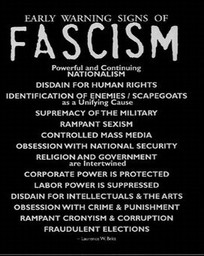
Yes, the war in Iraq is growing increasingly unpopular, thanks to the terrorists' seemingly irrational and immoral methods. Yes, that makes U.S. voters increasingly uncomfortable. The pursuit of happiness is supposed to make Americans comfortable, not anxious, poor, grief stricken, and otherwise miserable. Whatever comfort they have, they prefer not to lose it. But they are losing it: the neoconservatives, sometimes posing as free-trade neoliberals instead of neofascists, have been gutting the bulging belly bourgeoisie of "civilized" countries for some time now. President Bush would impose democracy on the world, making sure that Condaleeza Rice explains that the imposition is not really an imposition. That brand of democracy is Anglo-American Corporate Capitalism. We hear speeches about elections, about the plural and independent branches of government, and the protection of minorities, but we do not see progress towards economic justice, a fundamental pillar of democracy. Indeed, we see the opposite, as the gap between the poor and rich broadens. We see the shadows cast by the forces of darkness emanating from corporate board tribalism. We see the darkness dampening the enlightenment: who said that the devil does not cast a shadow? We see the great enemies of democracy all around: Ignorance, War, Economic Injustice. Foreign and domestic policy benefits the rich, aggravates poverty and incites violence, while the neoconservative intelligentsia conduct "scientific" studies "proving" there is no connection between poverty and terrorism.
Yes, we hear that the foreign war is waged far away to bring democracy to others, that they may prosper and enjoy the rights natural to man. But those very rights and the principles of democracy are trampled at home as America is sold off to the highest bidders. Poverty is blamed on the poor at home. Poor people show up for the free food, and neoconservatives complain that free food is demoralizing them, literally making them poor because it is free. The poor may agree there is something wrong with their morals, for they were taught the ambiguous cult of gilded individualism at an early age while saluting the flag and saying the pledge of allegiance, acknowledging the god of personal authoritarianism. Yes, every poor slob can get rich if he wants in America if he looks out for Number One, helps himself get one up on everybody, and does not get arrested. You have only yourself to blame for failure, and not the conditions that hem you in all around. The downcast are not pitied by the anti-social, self-helping, self-righteous and insolent fraction: the authorities who, because they happen to be comfortable, think they deserve their comfort, even when it is inherited (there should be no estate taxes).
If the domestic trend wasting America continues for long, the President of the United States shall not have to say "Bring 'em on" to some foreign battlefield, for Them shall be right here at home with us, and new studies will be conducted to demonstrate the connection between poverty and terrorism, and the relation between the insolence of the elite and declarations of independence.
|