Personalism was eclipsed by Existentialism

Excerpt from:
Personal Existence
by David Arthur Walters
Personal life is the fine flower of life. Emanuel Mounier
I. The Gist of Existentialism
Personalism might be a popular ideology or at least a household word today if existentialism had not better suited the aversive reaction to the cult of supreme personality that had fostered two massive world wars. Whereas personalism emphasizes the social human being, existentialism places the onus on the individual alienated from society, and affords bare existence priority over clothed being. Existentialism is an anxiety-bound mélange of rationalizations spawned by homelessness, alienation, the meaningless of life and absurdity of death made apparent in the horrors of two world wars systematically fought pursuant to the institution and breakdown of political and economic systems deemed "objective', "rational", "reasonable." Not only irrational faith in a personal god but faith in impersonal reason and universal, abstract systems-of-being was also lost when confronted with the disastrous effects of being fanatically rational and reasonable. Considering humankind as a whole, it does seem suicidal and therefore unreasonable to murder others; yet it also seems quite rational to align individuals or divide the population into fractions that murder perceived enemies for the sake of individual and group survival – there is safety in numbers.
The term "existentialism" was picked up by the press in a smoky Paris jazz cellar from a casual remark made by a jazz singer to a reporter about the "scene" observed by the American tourists flocking to Paris in the aftermath of the war. Jean Paul Sartre and other “existentialists” dismissed the term at first - they were just philosophizing – but when the label came into vogue, they adopted and employed the appellation much to their advantage. Existentialism as they described it includes especially the notion that the particular individual must be solely responsible individual for his own thinking instead of relying on habitual culture or rationalized systems of being; but existentialists seek the impossible, for language itself is a social tool dependent on and responsive to the will of others. Existentialism is not a system at all, but is more or less an anxious and absurd reflection of the human predicament, particularly the predicament of a man's individuality made obvious by the disturbing fact of death. Indeed, any sort of systematic existentialist thought put forward by a so-called existentialist would contradict the very premise of existentialism – thus did Sartre, for example, strive never to repeat himself.
The subject of Existentialism abstracted from human personality – the subject that is individual human existence as distinct from and prior to human being - is the broadest of subjects, the subject of all subjects subjected to particular existence. Kierkegaard appropriately called abstracted individuality the “category of one.” Being and existence somehow converge in the category of one. The category of one is presumably a general term for particulate being or qualitative individual existence, as if objects stripped of their predicates still had a quality in common – existence – but still remain unique in themselves. We might revert to Liebniz and speculate on independent existences as windowless monads that are identical but for number, yet, although identically constituted, somehow have slightly different perceptions.
Suffice it to say that the category of one is incomprehensible hence is compatible with irrationality – without dependent ratio or relation to others - and the concept of arbitrary individual freedom. Thus existentialism is non-systematic, indefinite, and irrational despite the volumes of rationalizations that justify it. A perceived individual or particular is a unique coincidence of universal qualities had in common by many particulars, qualities that “survive” the individuals involved, so to speak; the qualities are sorts of general beings that have no perceivable existence absent their coincidence in particular objects. The uniqueness of individuals, needless to say, does not preclude their being typecast according to their similarities, thus they are accorded with a higher, more conceptual being. But denuded existence, or the conception of existents stripped of the qualitative predicates necessary for being, is virtually nothing and unknowable to boot.
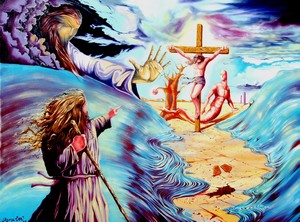
Christian existentialism, for instance, is a contradiction in terms; Christians in need of an seemingly objective standard or external authority in order to prolong isolated or “freed” subjective individuality beyond the inevitable fate of all individuals, death, project the vague qualitative impressions of the fleeting willful self within onto a screen: the eternal Subject external, the Immortal Subject of subjects, the unknown self-god painted large, the Divine Individualist crucified by existence in the world. But then the Christian existentialist has placed Being before denuded existence, and in the form of a social creature, a human being, thus slips from Existentialism to Personalism.
Long before the term 'existentialism' was coined, the abstract yet irrational subject of individual subjective existence was considered to be unlimited by or even antithetical to grandiose systems-of-being such as those cranked out by theologians and the likes of Hegel and Marx. Indeed, we have a history of centuries of alienation, freedom, irresponsibility, guilt, despair, and dire circumstances of persecution unto death, not to mention other factors of enormous interest to today's existentialists.
II. The Gist of Personalism
Personalism shares existentialism’s concern with the plight of the existent individual; the rhetoric is similar is several respects. Yet we may draw a convenient distinction to posit that personalism is the hopeful affirmation of the absolute value of the socially organized human personality, in contradistinction to existentialism’s pessimistic denial of the virtue of socially organized being. Personalism’s social optimism is not the positive mental attitude of the bourgeois towards the rational organization of economic mass man for production and consumption. Shortly before the Great War, optimistic leaders at international peace conferences declared that free trade between countries had rendered war obsolete; for, they argued, unprofitable war would certainly be self-destructive hence insane. But self-destruction is the unconscious motive for war. Of what avail is it to tell angry competitive men, for whom economic trade is an unsatisfactory surrogate for war, that the murder of particular enemies is on the whole a form of mass suicide no matter who wins or loses? The enemy, sayeth the prophets, are the rods of god, thus does the death instinct serve the god of death and relieve the swarm of its crowded stress that the remainder can begin anew with more elbow room. Once the ground is leveled, the survivors clutch their bibles, glorify their god, and the say ‘never again’ during the reconstruction period; but once prosperity sets in, bibles are laid aside and the golden calves are reestablished on altars for a repeat performance.
Emmanuel Mounier, a pioneering personalist of Catholic disposition who took refuge in Vichy France where he was was involved in the moral training of youth, had this to say of the vicious cycle wherein the cheap, hypocritical optimism of having a positive mental attitude no matter what transpires plays an important role when business is done as usual before the next apocalypse:
"But our countries, devastated by weariness, now need the builders of hopes and duties. I have developed the theme of triumphant history, because it is the Christian view of history, not in order to make the plethoric Christians feel more at ease than the cavaliers of anathema and scorn. Perhaps tomorrow we shall be invaded by worse than barbarians, by Babbitts, with crucifixes of gold, teeth of gold, and hearts of gold, coming to preach their new theologals in a big way: optimism, good temper and philanthropy, which can be achieved much more easily, we know, through using the right toothpaste, well-adjusted foundations and a Parker pen, than through the Word of God. Then once more we shall need those great sombre voices."
Personalism is essentially conservative and at odds with modernism and the unrestrained advancement of objectivist science. “Material” science, with its emphasis on analytical thought, its obsession with breaking everything down into bytes and bits, disintegrates the various social masks upon which dynamic human intercourse depends, reducing the human being to the status of a bare unit, a programmed, windowless monad whose program gives him cause to perceive that his existence is independent, while, at the same time, responsible. Ironically, he has been thoroughly socialized in the totalitarian sense. Nothing stands between him and the political-economic dictatorship. So devoted is he to rational production and consumption that he has little or no time left for clan or club or community; as for the nuclear family, it is an empty vestige of the productive institution it once was.
Not only has science dispelled belief in spirits, gods and other mythical entities, but its mechanical way of thinking if taken to its logical conclusion would transform nature and man into machines. Thus God, Nature, and Man are dead. Yet if a man were acting like a machine, we would deem him insane; providing, however, that we were not machines ourselves - in which case his behavior would seem normal. Wherefore we must revitalized and restore the human person - the social human being. This person is at least metaphysical or spiritual if not "divine." Biological evolution and scientific progress are irrelevant in the personal context: in that context, only the person is real; the rest is mere phenomena. Our thoughts about the phenomenal world may or may not be valid, but reasoning will never disclose the ultimate foundation of reality or nature; for thought itself is phenomenal, and Being is prior to thought. A being, say, a human being, then, is always more than and prior to a thought.
Personality has an individuality or existent aspect, but it is one shaped by society: the individual human being is naturally a social, thinking, rational and reasoning creature. Theological personalism - in contrast to anarcho-Christian protestations of anarchic individuality represented by an arbitrary, divine Anarchist, avers that the ultimate reality of the world is a Divine Person who sustains the universe by a continuous act of creative will. For Emmanuel Mounier, that incarnate god or Christ calls human beings to be Christian gods:
"Christianity gives man his full stature and more than his full stature. It summons him to be a god, and it summons him in freedom. This, for the Christian, is the final and supreme significance of progress in history."
Mounier pointed out that the bourgeois conception of individualism emerged from the revolt of the individual against traditional society during the Renaissance; it was a revolt against an inflexible church and domineering economic system; the revolt lead to the Reformation and Industrial Revolution. But the conception of freedom that inspired the revolt doomed society to another sort of decadence, a corruption presided over by commercial speculators who profit from doing little or nothing.
"This speculation, in which profit is gained without the rendering of service, was the ideal towards which all capitalist endeavor tended. Thus the motive passion of adventure gradually gave way to the soft enjoyment of comfort, the passion of conquest to the ideal of the impersonal mechanism, of the automatic distributor of pleasures devoid of risk or of excess, regular and constant, derived from the machine and from fixed income.... The substitution of speculative profit for industrial profit, and the values of comfort for the values of creation, has gradually dethroned the individualistic ideal and opened the way to the spirit which we call bourgeois because of its origin and which seems to us to be the exact antithesis of spirituality."
The new Christian “is a man without love, a Christian without conscience, an unbeliever without passion. He has deflected the universe of virtues from its supposedly senseless course towards the infinite and made it centre about a petty system of social and psychological tranquility..." Therefore contemporary man “needs the tragic, the Cross, as a goad to prick him along the right course.” God did not create man perfect because he wants him to work for a living, to perfect his self.
No doubt the socio-psychological disposition dubbed ‘personalism’ has ruled the sentiments of sages since prehistoric times. Even people who fervently believe in abstract existents denuded of personal qualities tend to imitate personal models and behave according to their socially derived personal biases and prejudices – Camus depicted the typical atheist of his day, who fell down on his knees and prayed to God in secret when he felt his life was at stake. Despite the many professions to the contrary, personality is the ultimate reality for personalists.
Mundane personalism strives for the full awareness and understanding of the human condition so that an happy accord may be realized between the universal WE and the particular I, or the person as the synthesis of individual existence with the socialized individuals or persons it introjects from its environment during the course of its development towards being an ideal human being in existence; that is to say, in a philosophical phrase, the human concrete universal, or, in theological terms, god incarnate. Personalism therefore is not contemporary individualism:
"Individualism is a system of ... mutual isolation and defense,” Mounier explained. “Man in the abstract ... the sovereign lord of a liberty unlimited and undirected, turning towards others with a primary mistrust, calculation and self-vindication; institutions restricted to the assurance that these egoisms should not encroach upon one another, or to their betterment as a purely profit making association.... (Personalism) is opposed to contemporary individualism. Personal man is not desolate, he is man surrounded, on the move, under summons.... It is the primal sin of the West to have departed dangerously from the original truth."
Nor is personalism other-worldly: "It is not affirmed outside the world or separately from the other, but against the impersonal world of the 'one', the world of irresponsibility and flight, of lethal slumber, amusements, ideologies and chatter, it asserts the world of responsibility, presence, of effort, of 'abundance.'"
Personalism, according to Mounier, is a form of communion: "There is one affirmation that is common to all Personalist philosophies... that the basic impulse in a world of persons is not the isolated perception of self (cogito) nor the egocentric concern for self... but the communication of consciousness.... We should prefer to call it the communication of existence, existence with the other, perhaps we should say co-existence."
Next: The Religious Implications of Personal Existence
|