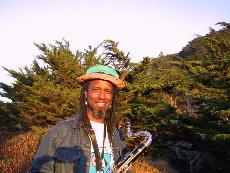
Known in the past for his jazz-influenced style of performance poetry and for wearing colorfully styled hats that he designed and made, Toussaint St. Negritude in recent years has expanded his sphere of creativity to include playing the bass clarinet. With the release in 2001 of his first hybrid CD, Live at the Koret Auditorium, recorded in San Francisco’s Main Library, the poet and hat maker turned musician announced his intent to both honor and step into the world-renowned tradition of jazz. Of his debut CD, JazzWest.com observed that Toussaint’s poetry “is indeed almost ‘sung’ as in a jazz solo and his roots are firmly found in the scat tradition.”
The poet-musician’s amazing creative metamorphosis proves less startling when one notes that he is a descendant of renowned 19th and 20th century metallurgists James T. Titus and George P. Titus respectively. The latter was equal parts writer and scientist enough to pen the book, A Practical Treatise on Base and Precious Metals. Therefore, exceptional creativity may very accurately be described as part of Toussaint’s genetic make-up. So is travel: his ancestors made their home in the New Jersey and Philadelphia area before making their way in the 1900s to Ohio. Toussaint himself was born in Arizona, the son of former radio personality James Boddy Titus and the highly esteemed public relations expert, Florence Wilson-Davis. He grew up in the politically and culturally charged San Francisco of the 1960s and 1970s, his mind, heart, and soul branded by the revolutionary music, art, and spirituality of the times.
During the following interview, Toussaint, who has called many cities and several countries home, was preparing to relocate from the West Coast to Philadelphia, the region of his paternal ancestors. Just before posting this interview, he landed in the City of Brotherly Love with all the enthusiasm of Miles Davis or James Baldwin stepping into Paris in the 1940s. Fortunately for those in the Tri-state area, he took with him his beloved bass clarinet and a recently completed combination CD and book called Afrodelphia. Part 2 of this interview is featured on Toussaint’s home base web site, the technological literary innovation spearheaded by Isaias Rodriguez and known as PoetryTelevsion.com (http://www.poetrytelevision.com/feature/toussaint.html).
Aberjhani: Your forms of creative expressiveness have run the gamut from the visual to the literary to the musical. What would you say was your first primary mode of creative expression?
Toussaint: Well, I’ve always been a renaissance sort of artist in the sense that my earliest expressions of creativity were always plural: watercolors were the first paintings that I did, but then at the same time there was poetry and dancing, I’ve always had a kind of open door or open eye to exploring all of it. There were a few areas that I decided to give more of my attention to such as the writing, the hat making, and now music in my more recent years.
Aberjhani: The natural approach that you describe to creativity is very similar to that described by the Nigerian writer Ben Okri, who won England’s Booker Prize for his novel, The Famished Road. Okri saw (and maybe still does see) such things as painting, making pottery, and producing literature all as part of a single flowing river, or maybe ocean might make a better metaphor, of creativity. Just as you are describing right now, he concentrated on specific forms and disciplines to produce specific works but didn’t recognize any real boundaries regarding creative expressiveness per se.
Toussaint: For me, there was always this sense that, you know, art in general is open to all of us. To get work done I’ve always felt compelled to focus on one or two things rather than all of them but if it were physically possible I would enjoy doing all of them simultaneously.
Aberjhani: Then I take it you don’t think in terms of limitations to your abilities?
Toussaint: I’ve always had this sense that I could do anything I wanted to do. Anything I’ve been interested in I’ve felt I had the wherewithal to do it, and as I developed I started to realize how much creativity for me came out of necessity. If I needed a certain hat to correspond with a certain mood I had at a certain time, and if I couldn’t find the hat elsewhere, I’d grab an old one and cut it up to create the hat I needed.
Aberjhani: That’s sounds kind of like acting as your own costume designer for the drama, or comedy, of your own life.
Toussaint: From making hats that I needed, I went into hat making as an artform. I really think this has been my approach to any artistic discipline. It’s always started as a functional need rather than as a creative function. If I needed a hat, I made that hat. If I needed an image, I made that image. If I need a certain sound, I experiment and make the sound. If I had the materials to make my own house I would do that.
Aberjhani: That strikes me as unique motivation for a young man to start making hats. I’ve seen you perform in a variety of hats that you designed and made, from the old styled top hats, to bowler types, to floppy apple jack caps, and domes I don’t have a name for. How did you cross the line from occasionally making a hat out of available materials to producing a virtual line of them?
Toussaint: The first time I made hats seriously was when I worked a temp job with the Bank of California… This was years ago and I was doing data entry in one of their warehouses. In the basement of the warehouse was discarded furniture and rolls of 5 feet high 6 inches wide red felt. I asked for some. I was getting around on my bike back in those days just as I am now, around 1988 or 1989. I managed over the course of a few weeks to take all of that felt home, cutting it up and putting it in bags and carrying it home on my bike. I was two years into a relationship, love was in my life, and I started making these red felt hats.
Aberjhani: So love motivated your creativity and your creativity expressed your love in the form of red felt hats. That’s a wild kind of emotional aesthetic. How would you describe your overall creative process?
Toussaint: Trial by error has always been a repeating theme in my creative endeavors.
I see every creative project, whether writing a poem, making a hat, or composing music, as this classic metaphor of a sculptor starting out with a slab or block of stone then shaping it into a desired image.
Aberjhani: I can be that way with my writing because I often tend to overwrite, then I have to edit, or sculpt, to use your metaphor, my work in such a way that it takes on the shape and meaning that I want it to.
Toussaint: I Approached making hats from a poet’s perspective because poetry had until then been my primary art form, and I didn’t do it thinking in terms of any sort of financial gain but just to create a work of art. I thought of how the hat might reveal something in someone else, the person who would wear it. I got really challenged with trying to create hats that defied gravity, or just really experimenting with the shapes. I made one hat by cutting out this huge shape of Africa. It was at least a yard wide, maybe 4 feet tall, all felt around the edges with some wire. I cut a circle in the middle for a hole, then experimented with the shapes. It really became an extended use of poetry for me.
Aberjhani: Do you recall any particular poem that may have been written to correspond with a hat, or vice versa?
Toussaint: When I first moved to Savannah in the mid ‘90s, I had a show at the Gallery Espresso Café [November 1995 to be exact]. They first invited me to do a show of my hats [as an alternative to the student paintings that usually hung in the café] which was nice, but I see all of my creative expressions as equal elements, so when one is given a spotlight I want to bring them all into it. Consequently, when I was asked to do the show, I decided to bring in corresponding poems to go with the hats and performed the poems while the hats hung from the ceiling, on the walls, and sat on my head.
Aberjhani: I remember that show and recall the Savannah News Press describing your work as “colorful hats, decorated with African and Hatian motifs, feathers and good-luck symbols.” It had to be one of the most surrealistic scenes Savannah had ever experienced! Aside from the visual impact that you made, there was your voice blues-trailing and jazz-chopping lines of very tight imagistic poetry. And some of your best work from that period not only reflected Savannah’s culture and history, but amazingly incorporated your passion for jazz as well. An example of that is this excerpt from the poem COOKING MOJOS CON CLAVE:
On this
Gullah’s Eve
Billie
Speaks low upon the waters’ back
Calling
Coltrane blessings
Upon cowry spells and
Colored maps
And with an island on her hat
Yemony plays Monk
Upon keys to Obatala
Calling
Old Sapelo Sapelo
Low upon the water’s back.
––Toussaint St. Negritude
Aberjhani: In this poem, as in much of your poetry, it’s obvious that geography has had a serious influence on your work: from San Francisco, to Paris, to Harlem, to Savannah, to Haiti, the power of place is quite evident. With that in mind, to what degree would you say travel and the sense of place inform your creativity?
Toussaint: A great deal. As I grow more mature, I’m beginning to have more of an understanding of that. When I was younger, it was just as apparent in my work but back then I took it so much for granted. I didn’t realize how much place was a part of my work. I remember commenting that I wished it was more in my work because I’ve rarely attempted to write the traditional place poem. I tend to mix things up.
Aberjhani: Along these same lines, you are currently planning to relocate from the Bay Area to Philadelphia, a city that some have described as the U.S. version of Paris and which many have traditionally referred to as the City of Brotherly Love. What are some of the cultural elements of Philadelphia that you hope to explore upon your arrival there.
Toussaint: I definitely look forward to the experiences I’ll have there but I plan on working nationally and globally, touring and performing as an artist beyond any boundaries. As far as Philly in particular goes, I look forward to being in the musical birthplace of hard bop be bop, the home of John Coltrane, a major idol of mine, and all of the tremendous luminaries that have come out and continue to come out of that city. The one thing that has impressed me about Philadelphia as a music scene is that while it may thrive in the shadow of New York and while their greats have often had to move on to New York and other places, those who have come out of Philly seem to have such a high bar of excellence. They tend to be really well studied and well rounded, whether in classical music or jazz. They just seem to have such extremely high standards for creative production. I do look forward to working in that environment but just as my experience has gone within and beyond Savannah, and within and beyond San Francisco, I know that this pattern will continue and Philadelphia will become another special place in my world.
Aberjhani: In fact, the title of your recently completed book and CD is Next Stop Afrodelphia. That title is obviously influenced by the name Philadelphia.
Toussaint: Definitely. I thought it was a nice play on the name there and I wanted to try to create a sense of an extension of the Harlem Renaissance. In Duke Ellington’s memoir, Music Is My Mistress, there’s one section where he talks about the City of Jazz. And he describes how it’s any and every place but also very specific places. That’s what I was trying to capture with the title Next Stop Afrodelphia.
Aberjhani: So as you move to Philadelphia, no matter what you do or don’t encounter there, you plan to make that one of your Cities of Jazz? Would that be a good interpretation of your title?
Toussaint: Yes.
Aberjhani: That’s interesting because it now makes me think of the places you lived previously as Cities of Poetry. During those particular sojourns, you carried your hats and your poetry with you. This is the first time that you’ve made a major move and carried your newly established jazz chops with you, is it not?
Toussaint: It is. Opening my self up to being a jazz musician has been a beautiful experience. On a constant gradual evolution in my life, in as much as every minute of the evolution is as significant as the last, picking up this horn and becoming intimately involved in this music has been like getting on a high speed elevator going up. It makes me struggle sometimes because I still have my love of poetry and my, um, love of painting and sewing and everything else. But the music has really––in terms of my own awakening spiritual development––it has really been just an amazing endeavor, like an express train, in its infinite possibilities. And it is so far from over.
Aberjhani: And yet you’ve come pretty far for someone who didn’t decide to play until he was almost 40 years old. Since that initial decision some 5 or 6 years ago, you have not only become proficient enough to perform with seasoned musicians but actually started composing, which isn’t something every musician does. What would you say was the first song you composed?
Toussaint: The first song that I composed, gosh, I don’t even know if I can remember the name of it. I actually started composing while in the process of learning to play and practicing. And the way I would practice, I would literally just randomly improvisationally play. After doing this for a couple of hours, suddenly these notes would come. It wasn’t easy. There was definitely a learning process. My earliest composition might have been just, you know, running together 10 notes, and after that I’d be wiping my brow and going, Whew!
Aberjhani: But putting together 10 notes can be serious progress for someone teaching himself to play.
Toussaint: I really had to listen and try to figure it out, just like when writing a poem. In your earliest attempts at writing a poem, you might not get beyond the third line. A great poem can be just one line but you need more when you’re trying to write a more complete piece.
Aberjhani: I hear what you’re saying as far as the poetry part goes because sometimes we get that first flash of inspiration when a certain phrase or line comes to us but without a full stanza or completed text. But how do you connect that experience with the construction of something based on pure melodic sound without the element of words?
Toussaint: For me, music was just another new language. Just like trying to learn to speak French. I decided that, well, I like the way Ellington speaks this language and he composed a full composition, so let me listen to how he took it beyond the first steps. So I really just listened, and worked by trial and error until I started writing fuller pieces. At this point, I’ve written hundreds of compositions.
Aberjhani: So hundreds of songs over a period of how long now?
Toussaint: About 5 years now. I started writing after that first year. It just opened up to me, which shocked the hell out of me. I was as grateful as I don’t know what. I wouldn’t have expected that I had the talent for composing. I’ll never forget the first real confirmation to me that I could play a song on the clarinet. I had been listening to Lester Young, and he played with this beautiful soft breathy tone that I really love so much. He played “They Can’t Take that Away From Me.” [sings] “The way you wear your hat, the way you brush your shoes,” or whatever––
Aberjhani: You’re talking about the song Billie Holiday made famous?
Toussaint: Yes. The way Lester Young played just soooo touched me, the lyrics and the message of that is so special. It could have been used in civil rights marches. It’s a perfect song about experiences… While listening to Young, I got to a point where I was hitting the notes, then all of a sudden I was actually playing “They Can’t Take That Away From Me.” And I was just…I felt like I was—
Aberjhani: You had a serious breakthrough moment.
Toussaint: I felt like I was channeling Lester Young. Not at all like I was being or playing like him, but like he was literally coming down inside me and saying, “Here son, this is how it goes,” and my fingers were playing it. That was the greatest affirmation.
Aberjhani: How long did that experience last?
Toussaint: That definitely opened the door and it lasted for several months. And then I uh…I go back and forth through the various periods in jazz and tend to listen to some of the more aggressive Coltrane albums. At one point, he is just playing at a rapid-fire speed and he’s going and switching octaves way up and way low. At this point I was well within one octave and Coltrane was going up several octaves and then going back down: just sheer virtuosity in addition to the tone. [Listening to his mastery of his instrument] I put that horn down and asked myself what the f*** was I thinking?! I remember just becoming so despondent.
Aberjhani: Why? Because you were a beginner who couldn’t keep up with a jazz master like John Coltrane? Or because you felt it had been arrogant for you to think that you should even try?
Toussaint: With all this beautiful courtship and experience and development, it was an important recognition and not a put-down. I can see that now. But it was kind of like a recognition where the god or master is saying, “Ok, just so you know, this is not a plaything …just so you know basically how bad we are.” I’ve heard mystic stories where people go to a mountain top or somewhere and they have an encounter with God and God gives them one glimpse, one tiny glimpse of heaven, and they die. Just that one glimpse takes their mind. It was kind’a like that for me. It put me into a serious depression. And up until this point, for that first year, I had dropped all my friends, all my carousing at the bars, stopped focusing on all these idle social things, and dropped them all.
Aberjhani: But that kind of self-imposed solitude is necessary when you’re trying to achieve a certain level of artistic proficiency. Many people who like the idea of calling themselves a poet or a musician or a painter often don’t like the individual sacrifices we sometimes have to make to become those things in substance as well as in name
Toussaint: And I made those sacrifices at the peak of my prettiness, for this instrument. My friends thought that I had literally lost my mind spending all my time with my clarinet. They asked what future was there in this? It was just so difficult to play that it became obvious that the only way I was going to be able to tap into this instrument was through sheer devotion and it was just something I really loved. So I remember waking up––here I had been a total night owl, working late night shifts and not getting up until noon––then suddenly I’m getting up at nine in the morning and I’m just working with this instrument. Then as soon as I got off my job, I no longer wanted to go have a drink, I wanted to go home and practice. After going from that kind of devotion to my experience with Coltrane, I didn’t touch the instrument for a long time.
Aberjhani: It seems to me that you both take a lot of serious risks as well as make significant sacrifices––by foregoing the establishment of a traditional career, family structure, or even permanent living environment––for the sake of fulfilling your sense of creativity. Do you feel like…it’s really worth it? I ask this question with some hesitation but obviously you must because you actually live this life and it seems to me that there are not a whole lot of people who would make as many sacrifices for the fulfillment of their sense of creativity as you do without receiving some immediate serious big-money cash rewards for it.
Toussaint: I’m glad you asked that. Exploring and developing my creative potential is hands down important, tantamount in my life. Coming up as a poet, and having that awareness as my earliest recognition of what my talents are, what I was to be, a poet, I knew from the get-go that I was choosing a field that didn’t pay the rent. And that whatever I did choose to pay the rent would not be my calling but would be something that just paid the rent.
Aberjhani: Then you made a conscious decision to follow your bliss as opposed to choosing to live your life in an economically safe manner?
Toussaint: In kind of beginning with a notion that art does not necessarily have to be, uh, immediately compensated with cash, that was ok with me. I also knew that in my commitment to music, and with my creativity in general, that it does require absolute sacrifice and absolute commitment. Some people, unfortunately, interpret that to mean it requires a certain amount of suffering. They might endure a certain amount of suffering but it’s not an S&M relationship. But given the society we live in and what actions are rewarded and what actions are not rewarded, to choose a path of creativity unfortunately requires sacrificing a certain amount of what we call rewards. That dynamic did keep me for many years from really committing myself to it as I have later in my life because I wanted to pay the rent. As much as I loved the muse and trusted it, I also knew I did not want to starve. But at some point it was like, you know, it just gets to the point where, like, you know you love a certain person. I love this muse, I love this creativity, I’m just going to have to do it and make whatever sacrifices that enable me to do it. And what I do today is just a stepping stone at the bottom of the scale of where I’m trying to go. Any sacrifice I make today is nothing.
Please look for Part 2 of CREATIVE CONVERSATIN’ WITH TOUSSAINT ST. NEGRITUDE at PoetryTelevision.com (http://www.poetrytelevision.com/feature/toussaint.html).
Aberjhani
© 4/9/2005








Shear perfection ... an exemplary and power-packed interview - Bravo!!
Blessings,
Robert
You asked truly captivating questions that dug deep into Mr Negritude's thinking, drawing his creative genius into the Light. I find him fascinating, to say the least. <grinnin'>
You have a keenly honed skill in locating and then bringing forth the creative vision in the people you interview. I look forward to reading Part II.
~ Mari
You may want to fix your links to PoetryTelevision.com so that we'll have an easier time finding our way to the next installment, sir. ~~Nordette