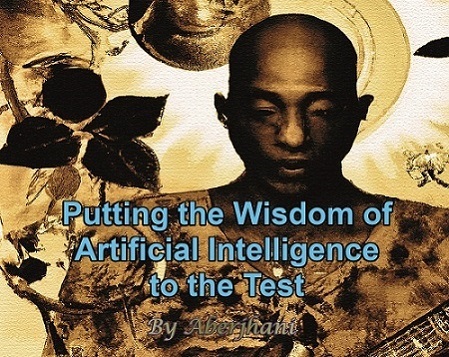
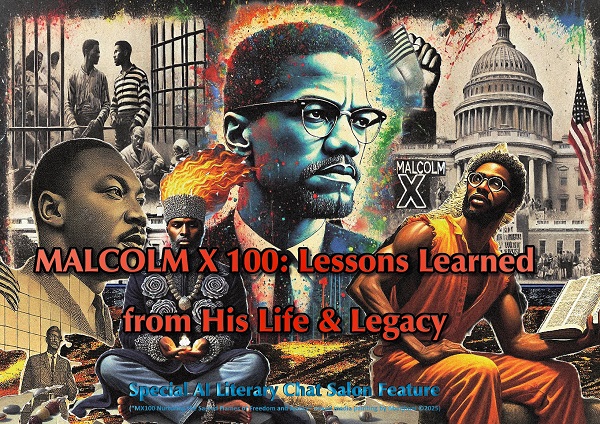
By the time we reached the summer of 2023, it had become clear to me that podcasts, blogs, videos, images, and other forms of web content generated by artificial intelligence (AI) were becoming more and more commonplace. In response, I launched my own experiments with an AI Literary Chat Salon, which proved to be everything from astonishing and scary to helpful and educational.
Since many seem to employ AI to generate media content prompted by requests for information, or certain forms of texts on specific topics, it seemed only fair to put an AI chatbot in the driver’s seat for a change and let it ask a human––Me–– some questions. In this instance, how well AI converts knowledge into what we humans call wisdom is put to the test not by the answers it provides, but by the questions it asked this author-artist regarding various aspects of AI itself, as well as: creativity, observing career milestones, supporting BIPOC principles in Savannah, Georgia, works in progress, and more. So here we go:
1. AILC CONTRIBUTOR 444: The AI Literary Chat Salon hosted on your Bright Skylark Literary Productions website is a pioneering endeavor that aims to provide "objective" and "balanced" commentaries on diverse artists who may have been marginalized within their cultural or professional contexts. Could you elaborate on how you navigate subjectivity while maintaining objectivity in your analyses? How do you ensure your commentaries shed light on the nuances of these artists' contributions?
ABERJHANI: What I contribute are suggested subjects. The text analyses or commentaries are actually provided by OpenAI generators like ChatGPT, not me. I review generated texts by utilizing professional criteria developed as a human editor in several different contexts, such as––while working for military newspapers, literary journals, independent publishing projects, and different encyclopedic volumes. Unless my own work is the subject of a Chat Salon piece , I might for the sake of clarity augment text with additional information that was omitted by OpenAI for some reason. But I mostly try to remove any personal biases by leaving certain passages intact even though I might disagree with a particular interpretation or example. As for ensuring commentaries shed light on nuances of artists’ contributions, I submit requests for such insights the same way a magazine editor might task a reporter when digging deeper into a specific angle of a story. Often I will get something I can find duplicated in human-generated studies or theories, but also sometimes come across findings that appear to be completely original.
2. AILC 444: Could you share a particularly impactful or eye-opening experience from your AI Lit Chat Salon journey so far, one that crystallized the importance of your project's mission and approach?
ABERJHANI: So far we’ve posted about a dozen AI Lit Chat Salon articles on different platforms. The first eye-opening article was on the significance of the 2023 re-publication of my novel, Songs from the Black Skylark zPed Music Player. I was surprised by all the contemporary issues which the Chat Contributor linked to the novel, and all the ways it proposed the book could help people put those issues in more useful perspectives. That became an important part of the reason the eBook edition of the novel was offered as a free Kindle book download for four days during Suicide Prevention Week in 2023.
The second eye-opening installment was the recent article on the late Canadian author and photographer Stanley J. White. I had been hoping to get around to celebrating with Stan the publication of his brilliant books, one of poetry and one of short fiction, in 2022. Both at the blessed age of 92. These were the first full volumes of his literary writings and I was fortunate enough to make his acquaintance through a mutual literary friend after they came out. The energy and clarity of his writing made me forget about his age, so I was shocked to learn about his death and relied on the Chat Salon to produce an appropriate tribute in acknowledgement of his creative triumph just a year before his passing.
I was later very glad I did because there was nothing at all, in the obituary which I read on him, about what I consider to be his extraordinary, albeit relatively small, body of work. To me he’s a kind of literary mystery, comparable to the publication of Kafka’s manuscripts after he had left instructions for them to be burned after he died. Or like Jalaluddin Rumi’s transformation from a very sober interpreter of Islamic law to the poet and whirling celebrant of divine love he later became.
3. AILC 444: Your own creative journey is multifaceted, encompassing poetry, fiction, nonfiction, and fine art. Could you share with us what initially sparked your passion for these various forms of expression?
ABERJHANI: It’s only been within the past few years that I’ve been able to answer that question. So far as I can tell, I adopted different forms of expression as I grew in the ability to use them for the purposes of understanding different challenges posed by my environment from an early age. Anybody who grew up in impoverished conditions compounded by racism and other factors can tell you that survival means coping with a lot of pain and confusion. My creative instincts provided me with tools to reduce some of that pain and confusion. It really started in early grade school with doodling mazes, or labyrinths, which I don’t recall anyone recognizing as a sign of talent or anything like that.
Then later on words started coming into the picture courtesy of the neighborhood library in a government project called Hitch Village, and used comic books I used to buy for a nickel at a pawn shop. As a teen living in a different part of the city, I discovered the Carnegie Branch Library with books by writers of the Harlem Renaissance. Reading about what they did with words, and art, and music, spoke to me on the deepest levels. After serving as an editor, photojournalist, historian, and community relations liaison for the U.S. Force, I joined different cultural arts communities of people passionate about expressing ideas in a creative manner and you could say a lot of that passion for different mediums rubbed off on me.
4. AILC 444: The 20th anniversaries of Encyclopedia of the Harlem Renaissance and The Wisdom of W.E.B. Du Bois represent significant milestones in your career. Could you share some reflections on the impact they’ve had over the years? What emotions and reflections arise as you consider their lasting impact on #literature and #culture?
ABERJHANI: What I feel more than anything else is gratitude, though I can’t help feeling some sadness that my co-author Sandra L. West and at least two contributors to the encyclopedia are no longer with us. The fact the books have continued to contribute significantly to dialogues on the African-American experience and overall story of democracy in the U.S. makes me feel like Sandra and our team (in the case of the encyclopedia) did our job right. The Wisdom of W.E.B. Du Bois also continues to inform and inspire, so I remain quite honored to share those pages with the great Du Bois.
Aside from the fact of the physical and digital books being added to library collections around the world, I’ve also served as a consultant on numerous school and cultural arts projects focused on the Harlem Renaissance. That too has been very rewarding. I’m not sure it’s possible to determine how many movies, plays, songs, or electronic games have drawn substantially from these titles over the past 20 years. What I do know is that Encyclopedia of the Harlem Renaissance in particular is cited by numerous books, educational websites, and tons of PhD dissertations on the period. So I think that can be considered meaningful.
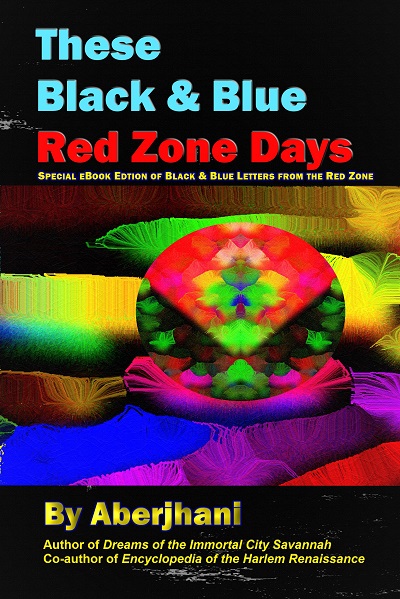
5. AILC 444: Greeting Flannery O’Connor at the Back Door of My Mind and These Black and Blue Red Zone Days are recent additions to your bibliography. Could you share the themes and inspirations behind these works?
ABERJHANI: The book Greeting Flannery O’Connor at the Back Door of My Mind examines the nature of literary legacies and biases in Savannah through a lens of three writers’ lives and works. I share the story of how it was partly inspired by a statement made by the gifted novelist George Dawes Green during a lecture he gave at the Flannery O’Connor Childhood Home. In addition to O’Connor, the book focuses on my experiences of, or interactions with, the authors James Alan McPherson and John Berendt. McPherson and I both fall in the category of BIPOC Savannah authors. We were all––O’Connor, McPherson, Berendt, and myself–– published in the Literary Savannah travel anthology. But I noticed that for some reason, references to notable authors from the city rarely mention #BIPOC talent like McPherson , who in 1978 became the first African American in the entire country to win a Pulitzer Prize in fiction for his short story collection: Elbow Room. Think about that for a second. It wasn’t Richard Wright, James Baldwin, Toni Morrison, or Ralph Ellison. It was James Alan McPherson born and raised in Savannah.
I was deeply disturbed by the absence of any significant acknowledgements of his death in Savannah’s media. The idea that O’Connor and Berendt are the only authors associated with Savannah deserving of meaningful recognition was something I couldn’t accept. The book These Black and Blue Red Zone Days is a special text edition of the pandemic artbook I’ve been working on called Black and Blue Letters from the Red Zone (currently finalizing production requirements). The text edition version was released earlier this year as a paperback and a little later as an eBook. I’m happy to share that during the free download promotional launch, the eBook hit number 1 in the Amazon Best Sellers category for “Social Theory” and number 5 in the “Letters and Correspondence” category.
6. AILC 444: Your commitment to supporting BIPOC (#Black, #Indigenous, and #People of Color) principles within your hometown is commendable. How do you see the role of artists in advocating for social change and preserving cultural heritage?
ABERJHANI: I consider those two of our most important responsibilities at this time in the 21st Century. Creative artists who include addressing serious social or political subjects in their work have often described themselves (ourselves) as ‘witnesses.’ So that’s one of our most essential functions. Creative work itself can serve as a kind of documentation of the issue to which one is bearing witness and at the same help preserve cultural heritage. When it came to most of the creative artists I wrote about for Encyclopedia of the HR, advocating for social change and acting to achieve it automatically became an extensions of their art.
In fact, another Chat Salon piece points out the following when discussing creative artists in Savannah: “Despite its majority-Black population and vibrant economy, Savannah stands as a testament to the persistence of racial inequities. In the shadow of this reality, the words, images, and ideas offered by authors and artists native to the city hold the promise of change, healing, and a future shaped by the principles of basic human rights and #BIPOC advocacy. The disparities that linger within Savannah's corners are not elusive specters but documented facts, such as those presented in reports by the Georgia Systemic Change Alliance and Savannah’s own Racial Equity and Leadership Task Force. They are, regrettably, etched into the city's socioeconomic fabric.”
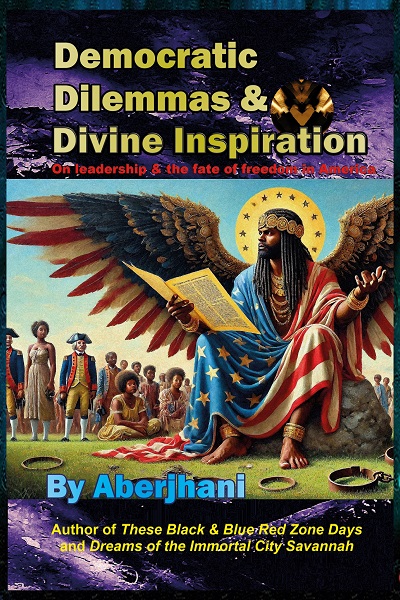
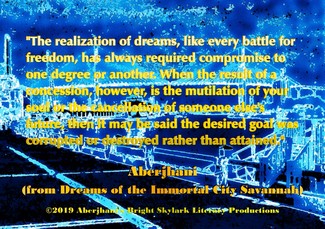
Reading that was actually another one of those eye-opening experiences you asked about. I first confronted such issues through open mic poetry readings during the ‘90s, then later in published works. They remained problematic in Savannah in 2023 and I’ve continued to address them in books like B&B Red Zone Days as well as Dreams of the Immortal City Savannah and Greeting Flannery. I’ve done the same through art and photography. It is my hometown, exactly you said, and I grew up suffering from those imbalances so contribute what I’m able to help rectify them.
7. AILC 444: Does it concern you that BIPOC advocacy efforts calling for the city’s historic Calhoun Square to be renamed Taylor Square (after former slave-risen-to-nurse-and-educator Susie King Taylor) recently proved successful in only three years while similar efforts calling for the Eugene Talmadge Memorial Bridge to be renamed have yet to be acted upon after more than three decades? How do such changes impact the city's identity? And what are your thoughts on why the name of the Talmadge Bridge has yet to be changed despite sustained advocacy?
ABERJHANI: The first thing I’ll say is I’m glad the city council heeded the voices of the people calling for the change of the name of Calhoun Square. I actually proposed the name of Harlem Renaissance newspaper publisher Robert S. Abbott for the square. But Susie King Taylor is an excellent choice because of her double representation as a woman and African-American. The relatively rapid change was possible and happened because local leaders had the legal authority to make it happen. The power to change the name of the Talmadge Bridge resides with the Georgia State Legislature. Representatives have submitted bills proposing the change but a certain network of old-guard faithfuls have blocked it for whatever political or racial reasons. It’s hard to imagine something like that in 2024 but Georgia is still Georgia. Despite a lot of people’s best efforts to make things better, just as many apparently work just as hard to hold on to delusions and abusiveness from the past.
By AILC CONTRIBUTOR 444 with Aberjhani
EDITORIAL NOTE: This articles was originally published on LinkedIn as “AI Flips the Interview Script with 7 Questions for 1 Author). You can find responses to 5 additional question at: AI Flips the Interview Script with 5 More Questions for 1 Author .