“In the last decade the number of armed conflicts has doubled. So has the number of people killed, and the number of displaced. And this was even before the invasion of Ukraine.”
–– The Stockholm International Peace Research Institute (from Environment of Peace: Security in a New Era of Risk)
People speak truth to power with hopes of accomplishing goals ranging from personal advantages and extravagances to collective acknowledgements and political freedom. The occasion for such a conversation might be something as simple as a teenager negotiating use of the family car for a date. Or it could be as serious as the parents of children slain in a mass shooting demanding officials entrusted with their safety be held accountable in some way.
When members of the American Friends Service Committee published their 1955 “report” titled SPEAK TRUTH TO POWER A Quaker Search for an Alternative to Violence, they were mostly concerned with addressing international conflicts. Contributing authors noted the title of the report was inspired by “a spiritual duty” assigned Quakers in the 18th Century. They considered themselves speaking truth to several embodiments of power:
- Influential political leaders...
- “…the American people who are the final reservoir of power in this country and whose values and expectations set the limits for those who exercise authority..”
- “…the idea of power itself.”
Although his name does not appear among signers of the report, famed civil rights icon Bayard Rustin (1912-1987) has often been cited as one of its principal authors and originator of the phrase: Speak truth to power. Various researchers have pointed to archived correspondence and alternate versions of the report to verify Bayard’s now historic contribution to it.
Yesterday and Today
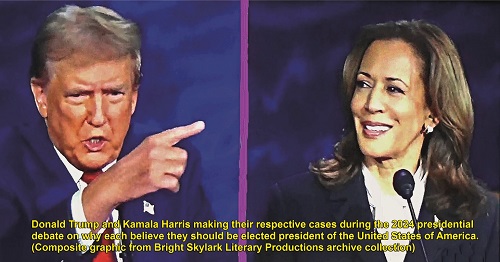
The concept and practice of speaking truth to power is no less relevant, or compelling, in the 2020s than in the 1900s. If anything, it has likely become more so both within America’s borders and beyond them. People stunned to witness the skill with which President of Ukraine Volodymyr Zelenskyy requested, via live video links, military assistance from international heads of state during the early days of his country’s current war with Russia know this for themselves. The same lesson was driven home in dramatic fashion by American voters who chose to elect Donald Trump for a comeback term as president, as opposed to electing Kamala Harris for a historic term as the United States’ first woman president.
Dialogues between truth and power may be engaged in a variety of forms. Young people like USA’s Mari Copeny and Kenya’s Lesein Mutunkei articulate concerns over environmental sustainability with a sense of urgency largely absent from discussions held by members of previous generations. Pro-democracy demonstrations in Sudan, Hong Kong, Myanmar and other locations draw international attention as protestors present their case for greater personal freedom and human rights. The ongoing push to end racism in America has spawned a generation of activists who identify as anti-racists and routinely address concerns over the issue as the country’s demographic profile continues to steadily evolve.
In most of these instances, people rarely present themselves as “heroes” but as human beings struggling to correct imbalances––be they environmental, political, or social––which pose direct threats to their continued existence.
Women Speaking Truth to History
Women around the world in the 2020s have been speaking their truths to power in ways which cannot be ignored. Upon Russia’s invasion of Ukraine in February 2022, many fled the country with children and elders in tow. At the same time, many others stayed behind to support resistance efforts by making explosive Molotov cocktails or learning to shoot guns themselves. Women in Afghanistan defiantly challenged Taliban soldiers in the streets of Kabul when told they would have to give up liberties, such as pursuing education, they had become accustomed to while under U.S. protection.
Among the most vocal of women speaking their truths to power are Americans who cast their votes for Kamala Harris in protest against the Supreme Court’s reversal of the Roe versus Wade decision which previously protected women’s rights to get abortions. Former U.S. Speaker of the House of Representatives Nancy Pelosi pointed out what appeared to be conflicting standards when she noted the Supreme Court’s decision to support the right of citizens to bear concealed weapons (one form of power) while denying women the right to choose (another form of power) what happens to their bodies when dealing with unwanted pregnancy.
As Pelosi put it, “the hypocrisy is raging but the harm is endless. What this means to women is such an insult. It's a slap in the face to women about using their own judgment to make their own decisions about their reproductive freedom…”
Author Margaret Atwood’s 1985 novel The Handmaid’s Tale tells the story of a totalitarian society in which women’s bodies are, essentially, controlled by the state. A popular 2017 Hulu adaptation of the novel became an instant social media reference point for responses to the overturning of Roe v. Wade , and now for responses to the non-consecutive re-election of Donald Trump. Atwood herself posted on Instagram (in 2022) a photo in which she simply holds a cup bearing the words: “I told you so.” Yes, she had, but what 21st century American feminist (female or male) was about to believe such a dystopic nightmare could be forced upon them in “real” life?
FOR PART 2 OF THIS ARTICLE, PLEASE CHECK OUT: Conversations with the World: Speaking Truth to Power and Ourselves 111 Part 2 of 2
By Aberjhani
To enjoy more of my Conversations with the World article series, feel free to visit the following: