The historic Federal and Gothic architecture of downtown Savannah, Georgia, clashed aesthetic horns with the progressive cultural movement known as Fashion Moda when artists Stefan Eins and Pleasant presented a public installation of their works August 26 in the city’s Reynolds Square.
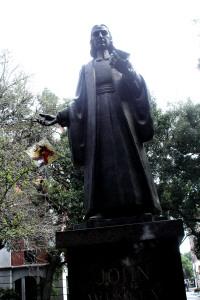
Eins literally and figuratively supported his creative vision by allowing Pleasant to stand on his shoulders long enough to hang two art pieces from the right hand of a statue of John Wesley, one of the principle founders of the Methodist Church. The works installed on the statue were in the mode of the Suspended Thoughts style created by Pleasant, with one an “Untitled” (6”x11”) abstract fusion of blues and the other named “Shaping of Form” (14”x10”). Unfortunately, local policemen decided the art defaced, rather than enhanced, a public religious monument and promptly took it into custody.
“I’ve done public installations in Berlin, Paris, London, all over the world, and this is the only place where the police have taken my art,” said Pleasant. A native of the city, Pleasant had come home for several months to complete work for an upcoming 2006 show at the GO Gallery in Amsterdam.
Undaunted by the arrest, as it were, of Pleasant’s art, Eins went on the install on the lawn work from his “Growth” series, which explores the properties and images derived from the artist’s experiments with what he describes as “the physics of liquid formation.” The bright green fluid piece sat just half a block from the world famous Lucas Theater and perhaps two blocks from the equally world-famous River Street. It was surrounded by buildings occupied, and thus spared, by Union soldiers during the Civil War.
With law enforcement officials no longer present, passersby viewed the work with curious smiles. Had they been aware that its creator was the tall silver-haired Austrian taking photos of the art and onlookers, they may have asked him about the starkness of the presentation. He in turn could have waxed eloquently on his desire to liberate art, and individuals’ experience of it, from traditional shapes and places.
“Square frames are the symbols of restriction placed upon visual art and I want to make it more open and less confined,” said Eins. He added, “I’m glad we did a Fashion Moda project here in Savannah. This is a beautiful city and my hope is to do more projects here.”
Among those present for this second stage of the public installation were art reviewer Bertha Husband and artist Luther E. Vann, whose own works will soon be available in the retrospective book titled ELEMENTAL .
Eins first introduced the world to his cultural philosophy and practice of Fashion Moda in the late 1970s. The movement blossomed into a major creative force in New York City’s art world during the 1980s and through it Eins helped launch the careers of numerous major artists of the period. He was also among the first to actually exhibit the street graffiti that evolved into popular Hip Hop art. More recently, Eins has focused on work synthesizing his scientific interests with creative aesthetics. These have led, in addition to the aforementioned physics of liquid formation, to inquiries into the nature of light, meditations on the possibilities of individual eternal life, and the sun as the source, rather than just the supporter, of life in general.
He became particularly interested in the photographic interpretation and documentation of a Hudson River pier that had been destroyed by fire. The remaining masses of steel, viewed through Eins uniquely transformational perspective, comprise an amazing work of abstract phenomena that can be viewed on the artist’s web site at www.geocities.comoneunoeins.
The artist’s outdoor installation in Savannah remained installed on the lawn just long enough to accomplish his aesthetic mission while the statue of John Wesley gazed serenely toward it. Ironically, or perhaps appropriately, Wesley had also been something of an iconoclast who attempted from 1735-1737 to convert Native Americans to his method of practicing Christianity. However, he experienced a spiritual crisis of his own and, though he would later prove spectacularly triumphant in England, had little success in Savannah. It is possible he could have appreciated the visionary aspects of what Pleasant and Eins––who, by the way, holds an MA in theology from the University of Vienna––brought to a city more revered for its preservation of the past than for any tendencies to embrace the future.
For more on this story, please visit Pleasant's web site at http://pleasantpaintings.com/id158.htm .
Aberjhani
© 9/20/2005