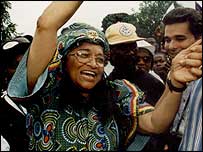
Upon hearing about the election of Ellen Johnson-Sirleaf as the president of Liberia, the first woman elected to head an African country, I could not help thinking that the great historian and humanitarian W.E.B. Du Bois would have been very pleased. A great believer in the liberation of all the people of the world, Du Bois recognized in the first half of the twentieth century that women were not merely an oppressed group but a major untapped resource possibly capable of rescuing humanity from its addiction to chaos and self-destruction. It is therefore in honor of Ellen Johnson-Sirleaf’s historic victory that I present the following from THE WISDOM OF W.E.B. DU BOIS.
To Mary Silvina Bughardt Du Bois, W.E.B. Du Bois was a devoted son. To Nina Gormand, and after her death, to Shirley Graham, he was a loving husband. To Nina Yolande (as well as to Burghardt Gomer, his son who died infancy) he was a proud and doting father. As a son, husband, and father, Du Bois engaged a perspective on women not endorsed by the majority of men of his era. He was a feminist who lobbied for the social, political, and sexual equality of women. Like that of his contemporary, Ida B. Wells Barnett, his political agenda placed the urgency of securing civil rights for African Americans [as a group] a notch above that of obtaining the same for women in general, but he never let it drift far from the sphere of his concerns.
The issue for Du Bois was as much a matter of political and social practicality as it was one of sacred duty. As the son of a nomadic father, Alfred Du Bois, who left his family when Du Bois was still a toddler, he was very much aware of the limitations placed upon the lives of women by their forced dependence on men. The painful irony was that in cases like that of his mother, women were often forced to accept the responsibilities refused by men but were left without the social or economic means to meet those responsibilities.
American women, like so many others around the world, were trained largely to live as second-class citizens, and living as a second-class citizen meant living as a victim. It was only by empowering them with full social and economic equality that average mothers, wives, and daughters of the world stood a chance of providing for themselves and the offspring they bore.
Most extreme among the abuses of women were those suffered by black women during American slavery. Against their will, they served in turn as instruments of sexual pleasure for their white masters and as breeding mares for the institution of slavery. Added to the shock of the routine violation of their bodies was the trauma of having to relinquish their children to unknown slave-holders. Du Bois considered this physical, mental, and spiritual abuse of black women—with its inevitable result being the destruction of the traditional African family—the highest crime committed by the slave-holders and the one thing for which he said he could not forgive them.
In his universe, the image of the black mother was that of a sacred being whose innate enchantment had been polluted and diluted by the ignorance, greed, and lust of white men. She now ‘sobbed her life away in song, longing for her lost palm trees and scented waters.’ Many of his writings were offered as atonement for the ignored tears of mothers, wives, and daughters.
Aberjhani
(from The Wisdom of W.E.B. Du Bois)