The writer Victor Sejour, who counted the great French author Alexandre Dumas among his associates, was still a teenager when he left his family in New Orleans, Louisiana, and headed for Paris, France, around 1836. Although a free young man, he was also a black one who believed it would be impossible for him to live an authentic literary life in a country where those who were not black often considered those who were as something less than human. With that in mind, he established himself as a celebrated Parisian playwright and novelist who eventually moved his parents to the city as well. He died there September 20, 1874.
One of the world’s first internationally acclaimed divas, the audaciously provocative Josephine Baker, made her way from the United States to Paris as part of a stage show called La Revue Nègre in 1925. She then went on for another fifty years to wow theatre audiences while dressed in skirts made of bananas or long elegant gowns stitched with glittering jewels, charm movie-goers with her enchanting onscreen smile, and garner tons of fans in countries all over Europe. Along the way, somewhat like mega-movie stars Angelina Jolie and Brad Pitt today, she adopted a dozen children of different racial backgrounds. Her exceptional life ended in Paris on April 12, 1975.
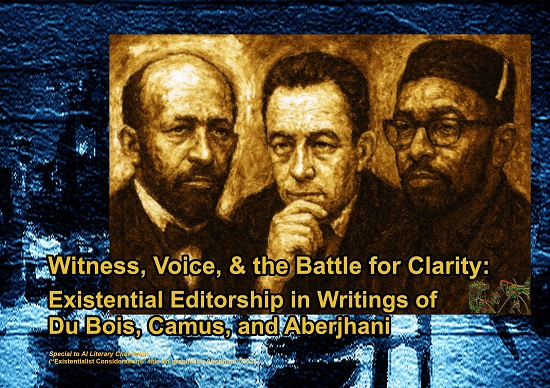
Having spent the greater part of his life campaigning for social and racial justice across the globe, the great African-American scholar and political activist W.E.B. Du Bois on his 95th birthday, February 23, 1963, became a citizen of Ghana, Africa, after the American embassy rejected the request to renew his passport. He died there August 27, 1963, on the very eve of Martin Luther King Jr.’s historic “I Have a Dream” speech. Exactly 45 years to the day after Du Bois’ death, Senator Hillary Rodham Clinton officially announced Barack Obama as the 2008 Democratic Party Presidential nominee.
Victor Sejour, Josephine Baker, and W.E.B. Du Bois are names that stand out in the annals of history because of their achievements and fame. There are many thousands more who are not so well known but who, like them, were either forced out of their homeland by the designations of slavery, or later on second-class citizenship, automatically applied to black lives at the time. Or who exiled themselves because such exile was preferable to living in constant fear of being lynched or in constant despair over the dehumanizing practices of American apartheid.
Their biggest crime was the same as that of people like the United States’ Founding Fathers and Mothers, like that of President Abraham Lincoln, the extraordinary philanthropist Andrew Carnegie, and the brilliant educator Mary McLeod Bethune. It was the crime of believing that the citizens of their country could live up to its democratic ideals by overcoming ignorance with knowledge, by defeating fear with faith, and by conquering hatred with love. But for some inexplicable reason we insisted on betraying a beautiful possibility in favor of a tragic hypocrisy. The scenario replayed itself decade after decade and century after century, from one state and ocean to another, like a never-ending collective nightmare.
Until this moment at this hour in the history of our country and world.
On August 27, I sat spellbound watching the 6:30 evening news as our great Senator Hillary Rodham Clinton stood with her New York State colleagues and officially pronounced Barack Obama as the 2008 Democratic Presidential Nominee. I don’t know what made me think of all those African Americans who in the past had left their country because they feared that to remain here would cost them their sanity or their lives. But I did think about them very hard and before I knew it there were tears rolling down my face. Teachers, painters, musicians, philosophers, war heroes, ordinary sons, ordinary daughters, scientists, authors, historians, singers, entrepreneurs—all jumped on the first thing smoking to vacate their homeland because they believed their homeland had long abandoned them and could not imagine the arrival of a day like August 27, 2008.
Then I thought about the millions who did stay, some of them losing their lives exactly as feared, some of them permanently maimed physically or mentally, or both, by the cruel disregards of bigotry empowered by indifference.
I thought too of my own deceased mother forcing my older siblings to take on the challenge of marching against segregation in the 1950s and 1960s. Courage can make human beings astonishingly beautiful and one can see such beauty in news films of freedom marchers, black and white, from the 1960s. The thought of their mesmerizing dedication broke my heart and I found myself crying even more than before, like some dopey-brained poet trapped inside the exquisite depths of an unbearable passion.
At some point, it dawned on me that the next day––August 28, 2008–– would mark the actual anniversary of King’s history-defining speech. I then recalled a quote from one of my favorite poets and teachers, Rumi, who once said, “There is nothing more noble than the manifestation of a noble vision or prophecy.” Or, put another way: To experience a moving dream is one kind of blessed inspiration; but to see that dream become reality is divine grace of a higher order. I felt like that just might be true , so naturally flicked away another tear and thought how glad I was to have the house to myself for a few minutes.
Finally, an idea that had escaped me nested in my thoughts like a dove of peace on an olive branch: blood shed and souls doomed by the brutal ignominies of the past are not always vindicated by intentions and actions in the present. And: what we do today does not always secure reasonable hope for tomorrow. Only this time––with the fact of Barack Obama’s presidential nomination––our country had overcome the odds in a profoundly miraculous way.
Like millions––literally, millions––of others, I was privileged to bear witness to a gift of history more than 200 years in the making: it was and it is a moment worthy of joy’s sweet and bitter tears.
By Aberjhani
The American Poet Who Went Home Again














I am always glad to read words from Master Aberjhani ~ because they are written with ink mixed with scent of fairness and seraphic sound; they are made of flawless diamond letters to resist the abrasion of time.
Yes, the moment is historical; it marks the commencement of a new era, and sets the time for Justice and social understanding of obligations of Government and the people. It is the right moment for people and government officers ~ from the number ONE in all executive positions, to everyone in CONGRESS, State Senate, Assembly, County executives and City Councils to respect and obey the CONSTITUTION OF THE UNITED STATES OF AMERICA.
I have enjoyed the reading of this article. Thank You for sharing
"Why I Cried When Obama Received the Democratic Presidential Nomination".
May we live to share the positive fruits of a Nation under the order of the Supreme Law, (The Constitution) and may we unite to command respect and obedience to our Constitution.
Most respectfully,
Andre Emmanuel Bendavi ben-YEHU