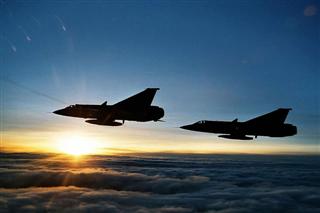
 A third and continuing segment of our great Norskehuvean adventure. Fly with us as we blast off into the blue skies of the Northern Finnish Air Defense Region, accidentally launch a missile against a friendly Swedish interceptor, and save face by mistaking our aircraft's ejection seat actuation handle for a cigarette lighter. Laughter and cheap thrills for the whole family, despite severe embarrassment for the Suomen Ilmavoimat (Finska flygvapnet in Swedish).
Saunas and Wartoys: A Modern Kalevala,
Part 3
RULE ONE FOR JOCKS...DON’T TALK SHIT:
With the final briefing over with, we doffed the personal equipment, stowed it, and were taken to the nearby Wing auditorium, where I was scheduled to deliver a prepared talk on the Convair F106A Delta Dart that is so similar to the SAAB Draken.
I had been told that my audience would consist of aircrew, ground support personnel, and life support people serving with the Wing, as well as pilots, air cadet students, and headquarters staff. The total number expected was unknown, but when I arrived I found about 150 people waiting to hear this Yank blather on about one of the lesser-known US supersonic Century Series fighters. Unfortunately, the impending Finnish National Holidays and midsummer celebrations that were about to take place had resulted in a lot of personnel taking off for early leave, but this was not necessarily a disappointment. Those present were easily identifiable--at least as far as flying personnel went, for pilots seem to uniformly affect a sort of cocky “What makes you think you know shit from shinola?” attitude (see the US movie TOP GUN for an example of this Sierra Hotel jock affect). The non-flying personnel also stood out as more attentive, less casual and somewhat more serious listeners, while the air cadets were the obviously animated onlookers and appeared ready to literally drink in anything at all having to do with the glamour of military flying--even if it meant having to listen to a boring American visitor who wasn’t even a rated member of the sacred brotherhood. The senior headquarters staff were also easy to spot, dressed in Class A blues, and more sober, older appearing--probably desk-flying members of the audience who now pushed pencils and wished they were still on active flying status.
I had prepared a fairly formal, somewhat technical presentation but found to my discomfort that my audience was substantially less formal than I had anticipated, and more interested in subjective experience than theoretical, historical background (they were focused on what it had been like to actually fly the aircraft, rather than its historical aspects). I was further surprised by how young the Finnish fighter pilots appeared (all seemingly blonde adolescents, it appeared, and most barely old enough to shave!). With this in mind, and armed with a score of overhead transparencies, I tried to alter the nature of the presentation. It was a spotty go at best, and I could see some of the pilots evidencing boredom and not trying to hide it very well. I could only hope that some of those present would appreciate the fairly comprehensive study I gave them of US developed, delta-winged Cold War air defense fighters which formed the primary American continental air defense era front line inventory.
X Introduced me in Finnish, explaining that although I was not a rated fighter pilot, I had served in SAC during the Vietnam War and had flown occasionally as unassigned aircrew in B52 bombers (BUFFs--Big Ugly Fat Fuckers, as we fondly knew them). That caught the interest of the audience, since Finland’s young pilots have never had the opportunity to experience a real shooting war--every pilot’s dream of fame and ‘Right Stuff’ glory. Then, after finishing up in his native language, X turned to me and said (in English): “...and I hope you will remember that all-important Rule Number One!” Picking up my prearranged cue, I faced the gathered listeners and remarked, “Yes, X, it would never do to forget that all-important Rule Number One!” I hoped that this would leave at least a few of the bored young fighter jocks curious as I began the speech.
About 45 minutes later and 20 overhead transparencies gone through, I brought the speech home with my concluding remarks. The mike was then opened up for questions, and I was hoping that some one would remember to ask what in hell ‘Rule Number One’ was. Since there were few questions--only one or two about the new stealth technology, which I was completely unable to deal with at any length--I took the ball back and asked, “I suppose some of you are wondering what exactly that all-important Rule Number One is, eh? Actually, whether you are speaking to a group of pilots or flying hot military jets, it always pays to remember Rule Number One.... Rule Number One is ‘Ala puhuhu pasca!’” This indeed cracked a few otherwise serious or bored faces in the audience, since “Ala puhu pasca!” translates in English to “Don’t talk shit!” Well, it was worth the cheap effort to provide a laugh it amounted to, but for the most part the youthful pilots remained largely laconic behind their shades. I had to remind myself that this disinterested affect is simply a ‘fighter pilot thing’; it’s merely part of the act.
Mercifully, the speech was over and done with. It turned out that not just the Wing’s pilots, but the whole Wing’s personnel were far more interested in the latest developments in stealth technology than in a not-very-well-known US military air defense fighter of the 60s and 70s. Several questions were asked about this subject, and I had to admit ignorance of most of the specifics since that is not a topic I was technically familiar enough with to speak extemporaneously on. A few other questions were asked about the US Air Force experience in the Vietnamese war, but it was plainly evident in Finland, as in America, that younger people generally find history a bore.
Several weeks before my visit I had taken a phone call from the Wing Commander who asked if I could come deliver an additional talk on this subject (stealth technology), but I had to explain that all of my reference materials were in the United States, and that I could not hope to come up with anything of this complex nature on such short notice, while in the Kingdom (Saudi Arabia). I was amazed to think they thought so much of me that I could simply whip together an hour long presentation on leading-edge aircraft stealth technology. What was clear to me when I had time to consider the experience of giving the speech afterwards was that the two hot topics among the Finnish Air Force personnel were: 1) stealth technology, and 2) the US air war in Vietnam.
Finally questions ended, and I was surprised when the Deputy Commander of the Satakunta Air Wing presented me with a nicely framed black & white framed photograph of two of the squadron’s J-35 Draken fighters over the city of Tampere at sunset. This was a token of appreciation in view of the fact that I was speaking on the day of my 49th birthday and it was a pleasing, unexpected memento of my visit with the Central Finland Regional Air Defense Center’s Satakunta Air Wing. I managed to bring it back to the Kingdom with me intact, despite the difficulty of trying to protect the framed glass from breakage in the airliner’s cramped luggage bin.
HUEVOS RACHEROS A LA FINN:
By this time it was late in the afternoon, and we loaded up the cramped Toyota once again for the short drive to the Finnish Defense Research Centre. The Draken flight was scheduled for the next day so we had some time to relax that evening with the research centre’s director. Dr. Z. met us after our arrival and took us to a country accommodation sited beside a lake that provided lodging and a recreation program for blind persons. The operator of the center was a former colleague of Dr. Z’s, and everything from swimming to fishing and hiking was provided for sight-disadvantaged individuals under the supervision of trained staff. The concept is very Finnish, and the atmosphere of the resort was somewhere between a Japanese Ryokan and a Canadian wilderness hostel. Our stay at the place was quite pleasant, located as it was directly on a lake and surrounded by groves of birch trees. As might be expected, at the water’s edge a quaint sauna was located, and situated so that one could step out the door and dive right into the lake.
After settling in to our rooms, Dr. Z. took X and I out for dinner. He asked us whether we wanted excellent atmosphere or excellent food. We opted for the latter and this turned out to be a Spanish restaurant named Salud!, which we were told had the reputation of having the most well prepared food in all of Tampere. Dr. Z. was quite correct, and Salud! was an wonderful surprise, featuring a wide ranging menu of Spanish specialties and a substantial wine-list of hearty Spanish red wines. The dinner and conversation were a perfect way to end a day such as we had experienced and Dr. Z. impressed me with his down-to-earth candor. I enjoyed the meal even more due to the fact that I hadn’t had anything remotely resembling Spanish-style food since leaving California a year before (and of course California colonial style food is vastly different from both authentic Mexican and Spanish fare).
We arrived back at the resort well-sated and I began to appreciate what a uniquely intelligent and congenial person our host was. Shortly after our return, we had another sauna. This time with several of Dr. Z.’s colleagues from the Defense Research Centre. Clustered around the stone hearth, the heat and steam began to increase and in no time the thermometer was hovering around 105 degrees. I had resolved not to flinch, and was determined to demonstrate that I was as able to handle the heat as any Finnish sauna devotee. There were beer and the usual snacks on hand and this time we underwent 3 cycles of about 15 minutes each, interspersed with quick trips out to the lake where the chill lake water threatened to perform another cryosurgical alteration of a certain part of me. Actually, it wasn’t as bad as I had anticipated, as I was this time a bit better prepared for the experience. I managed to dive in, like the others, and swan two laps from the dock to a buoy and back. Aside from a purplish cast to my skin, I survived each of these dips in fairly good order. The conversation with Dr. Z were very interesting since he has maintained a life-long interest in aviation and has a son who flies Drakens with the Satakunta Wing. Dr. Z. is a very down-to-earth person, despite his august credentials as chief of the Defense Research Centre, and my friend X later remarked that he is renown for always treating others as if they were his equals, no matter what the context or situation. His humility and broad knowledge of most things impressed me greatly and we sat about in the steam, drinking good Finnish beer while the mosquito squadrons droned off the lake and into the air around us. As expected, Dr. Z.’s English was excellent, and he had quite a refreshing sense of humor as well. Whoever thinks the Finns as a people are morose and reserved has obviously never encountered the Finns I had met so far on this trip!
The next morning we met Dr. Z. at the Defense Research Centre for a special tour of that facility. The Finnish Defense Research Centre is responsible for all the military and defense-related projects carried out within the aegis of the Finnish Armed Forces. Of especial interest to X and I were the laboratories in which their chemical and biological protection studies were performed, and it was fascinating to view the hermetically sealed containment areas wherein deadly toxins and virulent biological organisms were being studied for the development of defensive measures. Here were real-live counterparts of the bogus biological lab movie-sets featured in the movie OUTBREAK!, and it was quite sobering to be mere inches from such intensely deadly substances as Anthrax and Ebolla.
Dr. Z. presented us with a slide and overhead projection lecture detailing the mission and scope of the defense center’s operations, after a break for some excellent Finnish coffee and pastries; then we were taken to the center’s cafeteria and were treated to a typical Finnish dinner, such as the employees enjoyed. The cafeteria is situated in what used to be part of an old copper mine complex that originally occupied the site upon which the Defense Research Centre has been developed. Next to the cafeteria building is a very deep artificial lake--a remnant of the former pit copper mining operation. We were told the lake was still too acidic to permit it to be stocked with fish but that in another 10 years such an enhancement might be possible.
The midday meal we were treated to was substantial and sumptuous, a good example of how seriously the Finns take their dining, even in an institutional setting. There was a unique Finnish beverage served with the meal which was dark and made from hops and grain. It is actually a sweetish sort of beer without the alcohol. Unusual, but very refreshing (also LOTS of calories). Once again, after thanking Dr. Z. for his excellent hospitality, X and I waddled with full bellies out to the small Toyota (which seemed to be even smaller after all that good food!). Security clearances turned in at the main gate to the center, we drove out and headed back to the Satakunta Air Wing facility, which shares the Tampere Airport runways with civilian air traffic. This was to be the highlight of our trip--the main event: a flight in a Draken fighter!
MOVE OVER, CHUCK YEAGER & TOM CRUISE:
The Satakunta Air Wing life support people took X and I in tow shortly after arrival, and we headed for one of the hangers accompanied by the base Deputy Commander (who is rated for Drakens). One of the Commander’s adjutants gave us a last briefing on egress procedures and then went through a rundown on the flight profile which we would be engaging in, once in the air. Then we visited the life support shop where we were again fitted with our personal equipment, and a staff car drove us out to the ramp where two SK-35C two-seat Draken trainers stood, side by side, awaiting us in their dark, forest-green camouflage (the Satakunta Air Wing facilities are on the opposite side of the Tampere Airport’s main runways, and military aircraft must taxi a short distance out to the adjoining taxiways for take-off). No photographs were permitted, of course, due to security concerns; this was a pity, since it would have been nice to have some photographic souvenirs of the flights.
The Drakens are impressive machines, despite being built rather lower to the ground than comparable American fighters. Still, they give the impression of being a bit more toy-like than the Convair F106A Delta Dart we used to fly. Any fallacious assumptions of this sort quickly dissipate, however, as soon as the throttle quadrant of the SAAB engine is pushed forward into full reheat position and the characteristic, shattering banshee howl of the Draken engine bursts forth to announce that take-off is imminent.
First, a preliminary walk-around inspection of each of the two Drakens was completed. Then, mounting the cockpit ladders, X and I were literally shoe-horned into the cramped crew-spaces of the machines, each of us in a separate aircraft, along with the instructor pilot who would fly the mission. A last minute check, connections to life support all engaged and then the canopies were lowered and sealed. It was finally time to GET REAL!
The preflight checklist was run through, engines powered up and we rolled out onto the taxiways to the main runway where final preflight items were checked off. At last clearance was received from Tampere tower ground control, and engine RPMs were increased as the turbines spooled up with the brakes kept firmly on. You could feel the powerful SAAB engine straining against the brakes, trying to break free until the throttle was pushed full into the afterburner detent....suddenly, WHAM! We were slammed back into our ejection seats as the Drakens rolled down the runway, finally turned loose. Even through the sound deadening effect of our helmet headsets we could hear the scream of these powerful engines. The takeoff roll quickly increased and the full force of the Draken engine became apparent as speed built up until V1 was reached, then V2. Finally the nose lifted to an angle of attack of about 15 degrees as the planes broke free of the ground effect and slashed up into the grey Finnish sky. The noise to bystanders is quite loud and one knows, even without seeing an aircraft, that a Draken is in the immediate vicinity from all the bone-shaking sound the Draken engine generates on full reheat.
FAST COMPANY & LABORED BREATHING:
Pullout was smooth, then the snick of wheels up and locked and we were making speed out of the pattern and reaching for altitude. The mission we were flying was a mock air intercept to the north--the precise details of the flight would be too complex and doubtless boring to recount here, but suffice to say that an intercept altitude of about 40,000 feet was reached as we were vectored to the IP (Initial Point) by ground control at slightly over Mach 1. Contact, given the distances involved in Finnish terrain, was not far from being established quickly. I strained for a visual contact from my seat; encumbered by all my flight gear and coping with the pressure demand breathing of the mask, I still managed to get some excellent views of the north Finland countryside. The lakes that the Finnish map shows are all over the country are really all there, like so many thousands of small mirrors reflecting sunlight back from the ground. I could only imagine what the sight must be in the winter, when all are sheets of solid ice.
Breathing 100% oxygen at that altitude via pressure is a task that takes some getting used to, for the technique is the exact reverse of normal breathing at sea-level. Oxygen flows under pressure in through the mask until one exhales forcefully. This stops the flow until the exhalation is stopped and pressurised oxygen begins to flow in once more. Experienced over a period of time, it can be a bit fatiguing and some training in use of pressure breathing is usually required. With visual impairment and cerebral dysfunction a concern in flying at high altitudes, normal practice for military aviation is to maintain 100% oxygen at all times while flying at night, and pressurised breathing of 100% oxygen is maintained during all flights above 20,000 feet.
It wasn’t long before the relatively short, fast flight resulted in an interception with the simulated Finnish air space penetration--in this case a Hawk trainer playing “bad guy.” Quickly a weapons lock was established and AIM type missiles were dry fired. Immediately thereafter we broke off contact, the Hawk’s electronic hit receiving equipment confirming a probably kill, and we vectored back to Tampere and home base at a rather leisurely Mach 0.85.
I had some moments to examine the cockpit more in detail then, and while I was lost in thought the pilot of my Draken come on the interphone and asked me if I wanted to take the stick? My call sign at that moment could have been Sweaty Palms, for the excitement of taking control of a plane of this size and performance was unexpected--I had thought we would simply be having a guided tour with our chauffeur! Replying in the affirmative however, I placed my hand on the control stick grip, taking care not to accidentally flip any switches, and waited for the signal that I had the craft. For about 2 minutes afterwards I had the reins of this beautiful green 40-year old beast in my hand and it felt absolutely fantastic! Of course, I knew better than to do anything more than hold it on a straight and level course, but it was still a big thrill. I’ve been up in the back seats of other military jets before but have rarely had the courtesy of actually taking the stick offered. The Instructor Pilot who was flying our plane was undoubtedly closely shadowing my movements, his hand loosely grasping the stick in the front office to be ready to take control if anything untoward happened--I know it’s a sham, and he knows it’s a sham, but hey!.....I’ll settle for that fantasy any day! Me and Tom Cruise, up there on wings of flame at the age of 49! Looking off the port wing I could see X in the back seat of his SK-35C Draken, holding station with us as we neared home. I could imagine there was as big a grin behind the face-visor of his helmet as I had behind mine.
BACK TO EARTH & REALITY:
I could have gladly answered the Celestial Trumpet Call at that moment with no regrets, but the flight continued, of course. After a few minutes of extremely gentle banking and a slight nose-down maneuver--it was so slight you would have thought the pilot hiccupped--I relinquished control to my pilot once more and we shortly thereafter assumed our descent vector for final approach to Tampere, orbiting the field for a few circuits while a commercial airliner took off. Then it was roll out and base leg before dropping like a rock over the field’s outer marker The Draken’s engine screamed like the thunder of the Norse Gods, now that we were lower and slower, and it was easier to hear the cavernous wail of its internal guts howling like a banshee. Finally we were a few seconds from touchdown, noise in a characteristically high attitude for delta winged aircraft, and the rise and fall of the engine’s wail changed with each alteration of the engine’s throttle detent as the pilot sought that magic combination of power, angle of attack, speed and flaperon settings to land us precisely on our main gear. A delta doesn’t have conventional control surfaces; instead of ailerons, elevators, and flaps a delta used flaperons, which combine the several functions. Landing a big delta is no small matter, although to witness an accomplished pilot do it (as we did several times that day, after the flight) from the vantage of the nearby ground is like watching a modern day Toscanini conduct Mahler--pure brilliant art! The nose of a delta has to be kept at a fairly high angle of attack, both in take-off and in landing, with appreciable airspeed in order to generate the desired lift; once the main gear kiss the runway after floating on the ground effect for a second the nose is kept high to help use aerodynamic braking forces to kill airspeed and maintained in this angle of attack until the airspeed falls away and the nose gently falls onto the runway of its own accord. The drag chute on the Draken is especially helpful as it enables the aircraft to land on very short runways, or even on highways used as wartime emergency strips. Behind us X’s Draken executed a perfect landing not long after our own craft had touched down and they joined us for a picture-perfect promenade down the tarmac back to the hangers.
By the time we finally came to a stop, engine cut and canopy released, it was just starting to get a bit misty high overhead. We had had a great flight, perfect weather (just got back ahead of a thunderstorm that was rolling in) and a superb introduction to this classic Swedish designed and Finnish made air defense interceptor—a near counterpart to America’s own Convair F106A Delta Dart. Disconnecting my gear from the aircraft’s life support system, I eased myself out of the cramped Draken cockpit with the help of several grinning ground crewmen and clambered down the crew ladder ahead of the pilot, who was running down a final post-flight checklist.
To say I was stoked would be understating the feeling--I felt like an old Berkeley pot-head after three sticks of Manzanillo Blue. So strong was the “righteous brother” feeling that I hated to take off my gear after the flight, wanting to prolong the mood just a bit longer! This was, aside from a flight in an F106, the nearest I had ever come to joining the righteous brotherhood. But, all things must end sooner or later and we climbed into the transport vehicle for a ride back to life support where we turned in our personal equipment and joined up with the base’s Deputy Commander for a few cups of strong coffee and some post-flight exuberance. Our pilots joined us after a few minutes, and I found out that mine was only 25 years old. I instantly felt like something of a fossil when I considered how righteous his stuff was at almost exactly half my own age, but reminded myself that the job of flying today’s hot aircraft is rightfully the preserve of young guys in their 20s with the sharply honed reflexes that such complex aircraft and demanding flying requires. In fact, the younger they are the better--assuming a certain quotient of resident maturity--since new state of the art designs require youthful reflexes and alertness. Just watch any teenager playing video games to appreciate this essence requirement that confers a decided tactical advantage in negotiating the world of razor-sharp leading edge performance envelopes.
After some stimulating 'hanger flying' and male bonding rituals with the base DC and our pilots, we made ready to depart, thanking everyone once again for giving us the unique and long-to-be-remembered experience of being treated to a flight in one of the world’s most interesting contemporary delta-winged jet fighters. Soon we were ready, gear loaded. With one last fond look at the two green dragons we had flown in, we were off once again--this time headed for the Finnish School of NBC Defense, which is located in Keuruu at the headquarters of the Central Finland Regiment. A whole new set of experiences were soon to follow, and undoubtedly a few more saunas to go along with them! I thought it likely that I would end up resembling one of our famous California Raisins before this trip was over--or at least a wrinkled prune!
Next: Part 4, assuredly.
|