THE FARTISTE…Joseph Pujol, le Petomane!
One summer's day in the mid-1860's, a young French boy named Joseph Pujol had a frightening experience at the seashore. Swimming out alone, he held his breath and dove underwater. Suddenly an icy cold feeling penetrated his gut. Frightened, he ran ashore, but then received a second shock when he noticed seawater streaming from his anus. The experience so disturbed the lad that his mother took him to a doctor to allay his fears. The doctor complied.
The boy didn't know it at the time, but this unsettling rectal experience at the beach not only indicated no illness, but it also foretold of a gift that would later make him the toast of Paris and one of the most popular and successful performers of his generation.
Joseph Pujol was born in Marseilles on June 1, 1857 to Francois Pujol and Rose Demaury, a respected stonemason/sculptor and his wife, both of whom had emigrated from Catalan. Young Joseph went to school until the age of 13, whereupon he apprenticed himself to a baker. Several years later, he served in the French army.
While in the army, he mentioned his childhood sea-bathing experience to his buddies. They immediately wanted to know if he could do it again, so on a day's leave soon afterward he went out to the shore to swim and experiment. He successfully reenacted the hydraulics of his childhood experience there and even discovered that by contracting his abdomen muscles, he could intentionally take up as much water as he liked and eject it in a powerful stream. Demonstrating this ability back at the barracks later provided the soldiers with no end of amusement, and soon Pujol started to practice with air instead of water, giving him the ability to produce a variety of sounds.
This new development provided even more enjoyment for his buddies. It was then and there, in the army, that Pujol invented a nickname for himself that would later become a stage name synonymous throughout Europe with helpless, hysterical laughter: "Le Petomane" (translation: "The Fartiste"). After his stint in the army, Pujol returned to Marseille and to a bakeshop his father set him up in, on a street that, today, proudly bears the name "rue Pujol." At the age of 26 he married Elizabeth Henriette Oliver, the 20-year-old daughter of a local butcher. Pujol enjoyed performing, so in the evenings he entertained at local music halls by singing, doing comedy routines, and even playing his trombone backstage between numbers. He continued amusing his friends privately with his "other" wind instrument, but only at their suggestion and urging did he decide to turn this parlor trick into a full-fledged act for public audiences.
Pujol worked up a Le Petomane routine, and with some friends he rented a space in Marseille to perform it in. They promoted the show heavily themselves through posters and handouts, but word-of-mouth soon took over and they packed the house every night. Fin de siecle European audiences, deeply repressed but newly prosperous and trying to be modern-- the same people Freud observed (Freud was one year older than Pujol)-- must have found a man on stage building an entire act out of mock farting and other forms of anal play considerably more shockingly funny than we would today. Pujol's was a good act by any era's standards, but back then his scatology hit a raw nerve, and hit it hard, at an especially vulnerable time. Like Alfred Jarry, whose epoch-makingly scatological Ubu Roi actually post-dates Pujol's Paris debut by several years, Pujol was a French Revolutionary of the modern theater. Jarry gets the credit today because he was a "serious playwright" and not a lowbrow cabaret performer, but Pujol clearly laid some of the groundwork.
Word-of-mouth spread reports of the quality and uniqueness of Pujol's new show, and soon people from all over Marseille were coming to see it.
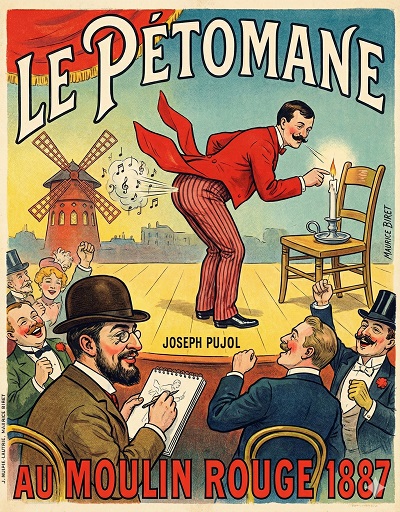
After the hometown success, Pujol's friends urged him to take the act to Paris. Pujol hoped to, but cautiously decided to play several other provincial cities first to refine the act and test the breadth of its appeal before taking it to the capital. He performed in Toulon, Bordeaux, and Clermont-Ferrand with great success, and in 1892 was finally ready to try his act at Paris's Moulin Rouge. It was then that Pujol reputedly uttered a line oft-repeated in cabaret lore; looking up at the windmill sails of the landmark Moulin Rouge ("Red Mill") building, he exclaimed, "The sails of the Moulin Rouge-- what a marvelous fan for my act!"
In getting booked at the Moulin Rouge, Pujol wasted no time. He walked in and demanded to see the director with such confidence that the secretary showed him in immediately. He then told the director, a man named either Zidler or Oller depending on whose account you follow (I'll use "Oller"), "I am Le Petomane, and I want an engagement in your establishment." He said that he was a phenomenon and that his gift would be the talk of Paris. When Oller asked for an explanation, he calmly replied, "You see, sir, my anus is of such elasticity that I can open and shut it at will. . . . I can absorb any quantity of liquid I may be given. . .[and] I can expel an almost infinite quantity of odorless gas." After this, he gave Oller a quick demonstration.
Oller put Pujol on stage that very night.
Pujol dressed formally for his act, wearing a coat, red breeches, white stockings, gloves, and patent leather shoes-- a stuffy, old-fashioned outfit that, coupled with his unrelentingly deadpan delivery, must have set up an abrasive comedic dissonance against the actual content of his performance. To begin his act he introduced himself and explained that he was about to demonstrate the art of "petomanie." He further explained that he could break wind at will, but assured his audience not to worry because his parents had "ruined themselves" in scenting his rectum.
Then Le Petomane performed some imitations, using the simple, honest format of announcing and then demonstrating. He displayed his wide sonic range with tenor, baritone, and bass fart sounds. He imitated the farts of a little girl, a mother-in-law, a bride on her wedding night (tiny), the same bride the day after (loud), and a mason (dry-- "no cement"). He imitated thunder, cannons ("Gunners stand by your guns! Ready-- fire!!"), and even the sound of a dressmaker tearing two yards of calico (a full 10-second rip). After the imitations, Le Petomane popped backstage to put one end of a yard-long rubber tube into his anus. He returned and smoked a cigarette from this tube, after which he used it to play a couple of tunes on a song flute. For his finale he removed the rubber tube, blew out some of the gas-jet footlights from a safe distance away, and then led the audience in a rousing sing- along.
This first night, a few tightly-corseted women in the audience literally fainted from laughing so hard. Oller immediately gave Pujol a contract to perform at the Moulin Rouge, elsewhere in France, and abroad. Turning audience-fainting into a great gimmick, Oller later conspicuously stationed white-uniformed nurses in the hall at each Le Petomane show and instructed them to carry out any audience members rendered particularly helpless by the hilarity. Meanwhile, to quash any rumors that his performance was faked, Pujol occasionally gave private men-only performances clad in a bathing suit with a large hole in the seat rather than his concealing regular costume.
It was after one of these private performances that a distinguished- looking man put a 20-franc gold coin in the collection plate. When Pujol questioned him, he turned out to be the King of Belgium, who had come incognito just to see his act.
After signing up with the Moulin Rouge in 1892, Pujol moved his growing family (starting in 1885, Pujol and his wife had a child every two years for eighteen years) into a chalet staffed by servants who soon became family friends. As he predicted, he became the talk of Paris, and admirers saluted him affectionately as he rode by in his carriage. Paris doctors examined him and published an article in La Semaine Medicale that described his health but offered no new explanation for his ability. It did however record that he could rectally project a jet of water 4 to 5 yards. Box office receipts alone attest to Le Petomane's popularity. One Sunday the Moulin Rouge took in 20,000 francs for a Le Petomane performance, an amount which dwarfs the 8000 francs typically grossed by Sarah Bernhardt at the peak of her career there.
But another thing happened in 1892 that provoked a series of battles between Pujol and Moulin Rouge management, the litigious nature of which makes it sound more like 1992. Pujol visited a friend of his who sold gingerbread, and to attract customers to his friend's stall, he did some Petomane tricks right there in the marketplace. Word of this "unauthorized performance" got back to Oller, who took it up with Pujol and threatened to sue. Over the next couple of years, Pujol, who dreamed of opening up his own travelling theater, had more rows with Oller. In 1894, Oller brought suit against Pujolover the gingerbread stall incident and won. Pujol was fined 3000 Francs.
The next year, Pujol left the Moulin Rouge to start his own venture, the Theatre Pompadour. Soon after Pujol left, the Moulin Rouge put up a new act, billed as a "Woman Petomane" (they concealed a bellows under her skirt). Pujol then brought a lawsuit against the Moulin Rouge for plagiarizing his idea. At about the same time, however, a newspaper panned the "Woman Petomane" act, and the actress, Angele Thiebeau, sued the paper for libel. The judgement against Thiebeau was so harshly worded and humilating that Pujol, satisfied at the harm done to the Moulin Rouge's reputation, withdrew his own lawsuit against them.
Pujol's new Theatre Pompadour included mime and magic and other acts performed by Pujol's family and performer friends. He changed his own act into a woodland tale told in doggerel punctuated at the end of each couplet by Le Petomane sound effects and imitations of the animal and bird characters in the story. Paris audiences liked the winning charm of this home-grown variety show and still yucked it up at Pujol's fart noises, so the Theater Pompadour prospered for many years.
Le Petomane continued to be an enormous draw in his new venue until around 1900, when the interest of the show-going public began to wane. The Pompadour continued to do pretty well, however, until World War I, when four of Pujol's sons went off to fight and the theater had to close down. One son was taken prisoner and two of the others became invalids, and Pujol was so shattered that after the war he had no interest in returning to his performing career. The family moved back to Marseille and Pujol ran bakeries with his sons and unmarried daughters. In 1922, he and his family moved to Toulon and he set up a biscuit factory which he gave to his children to manage. He lived the rest of his life there, surrounded by his many dearly loved children and grandchildren. His wife died in 1930 and he died in 1945. One medical school offered the family 25,000 francs to be allowed to examine his body, but out of respect, reverence and love for this warm, funny, and caring man, not one of his children agreed to let them.
-------------------------
In keeping with the serious nature of this casual exposition on Fartology, may I present to you an informative insight, appended to the above, into human bodily digestive gaseous release physiology by one Brenna Lorenz, reportedly a Professor of Geology (perhaps also a specialist in human kidney stones?) and an August Faculty Member Emeritus of the ICEF (Invisible College of Experimental Flatology, whose website may be accessed here .)
Where does fart gas come from?
The gas in our intestines comes from several sources: air we swallow, gas seeping into our intestines from our blood, gas produced by chemical reactions in our guts, and gas produced by bacteria living in our guts.
What is fart gas made of?
The composition of fart gas is highly variable. Most of the air we swallow, especially the oxygen component, is absorbed by the body before the gas gets into the intestines. By the time the air reaches the large intestine, most of what is left is nitrogen. Chemical reactions between stomach acid and intestinal fluids may produce carbon dioxide, which is also a component of air and a product of bacterial action. Bacteria also produce hydrogen and methane.
But the relative proportions of these gases that emerge from our anal opening depend on several factors: what we ate, how much air we swallowed, what kinds of bacteria we have in our intestines, and how long we hold in the fart.
The longer a fart is held in, the larger the proportion of boring, inert nitrogen it contains, because the other gases tend to be absorbed into the bloodstream through the walls of the intestine.
A nervous person who swallows a lot of air and who moves stuff through his digestive system rapidly may have a lot of oxygen in his farts, because his body didn't have time to absorb the oxygen.
Encyclopaedia Britannica offers the intriguing statement that some people's farts contain no methane. The reason for this is apparently unknown. Some researchers suspect a genetic influence, whereas others think the anomaly is due to environmental factors. However, all methane in any farts comes from bacterial action and not from human cells.
[NOTE: For extra points: in most German cities, the commonly seen street sign stating “Fahrtgasse” has no doppeldeutikeit meaning; it merely translates to “Driving Lane.”]
What makes farts stink?
The odor of farts comes from small amounts of hydrogen sulfide gas and mercaptans in the mixture. These compounds contain sulfur. The more sulfur-rich your diet, the more sulfides and mercaptans will be produced by the bacteria in your guts, and the more your farts will stink. Foods such as cauliflower, eggs and meat are notorious for producing smelly farts, whereas beans produce large amounts of not particularly stinky farts.
Why do farts make noise?
The sounds are produced by vibrations of the anal opening. Sounds depend on the velocity of expulsion of the gas and the tightness of the sphincter muscles of the anus.
How much gas does a normal person pass per day?
On average, a person produces about half a liter of fart gas per day, distributed over an average of about fourteen daily farts. Whereas it may be difficult for you to determine your daily flatus volume, you can certainly keep track of your daily numerical fart count. You might try this as a science fair project: Keep a journal of everything you eat and a count of your farts. You might make a note of the potency of their odor as well. See if you can discover a relationship between what you eat, how much you fart, and how much they smell.
How does a fart travel to the anus?
One may wonder why fart gas travels downward toward the anus when gas has a lower density than liquids and solids, and should therefore travel upwards.The intestine squeezes its contents toward the anus in a series of contractions, a process called peristalsis. The process is stimulated by eating, which is why we often need to poop and fart right after a meal. Peristalsis creates a zone of high pressure, forcing all intestinal contents, gas included, to move towards a region of lower pressure, which is toward the anus. Gas is more mobile than other components, and small bubbles coalesce to from larger bubbles en route to the exit. When peristalsis is not active, gas bubbles may begin to percolate upwards again, but they won't get very far due to the complicated and convoluted shape of the intestine. Furthermore, the anus is neither up nor down when a person is lying down.
How long does it take fart gas to travel to someone else's nose?
Fart travel time depends on atmospheric conditions such as humidity, temperature and wind speed and direction, the molecular weight of the fart particles, and the distance between the fart transmitter and the fart receiver. Farts also disperse (spread out) as they leave the source, and their potency diminishes with dilution. Generally, if the fart is not detected within a few seconds, it will be too dilute for perception and will be lost into the atmosphere forever.
Exceptional conditions exist when the fart is released into a small enclosed area such as an elevator, a small room, or a car. These conditions limit the amount of dilution possible, and the fart may remain in a smellable concentration for a long period of time, until it condenses on the walls.
Why is there a 13 to 20 second delay between farting and the time it starts to smell?
Actually, the fart stinks immediately upon emergence, but it takes several seconds for the odor to travel to the farter's nostrils. If farts could travel at the speed of sound, we would smell them almost instantly, at the same time we hear them.
Is it true that some people never fart?
No, not if they're alive. People even fart shortly after death.
Do even movie stars fart?
Yes, of course. So do grandmothers, priests, kings, presidents, opera singers, beauty queens, and nuns. Even Yoda farts.
Do men fart more than women?
No, women fart just as much as men. It's just that most men take more pride in it than most women. There is a large variation among individuals in the amount of fart gas produced per day, but the variation does not correlate with gender. I have read that men fart more often than women. If this is true , then women must be saving it up and expelling more gas per fart than men do.
Do men's farts smell worse than women's farts?
Based on what I have experienced of women's farts, all I can say is that I hope not.
At what time of day is a gentleman most likely to fart?
A gentleman is mostly likely to fart first thing in the morning, while in the bathroom. This is known as "morning thunder," and if the gentleman gets good resonance, it can be heard throughout the household.
Why are beans so notorious for making people fart?
Beans contain sugars that we humans cannot digest. When these sugars reach our intestines, the bacteria go wild, have a big feast, and make lots of gas! Other notorious fart-producing foods include corn, bell peppers, cabbage, milk, and raisins. A friend of mine had a dog who was exceptionally fond of apples and turnips. The dog would eat these things and then get prodigious gas. A dog's digestive system is not equipped to handle such vegetable matter, so the dog's bacteria worked overtime to produce remarkable flatulence.
What things other than diet can make a person fart more than usual?
People who swallow a lot of air fart more than people who don't. This can be cured somewhat by chewing with your mouth closed. Nervous people with fast moving bowels will fart more because less air is absorbed out of the intestines. Some disease conditions can cause excess flatulence. And going up in an airplane or other low-pressure environment can cause the gas inside you to expand and emerge as flatulence.
Is a fart really just a burp that comes out the wrong end?
No, a burp emerges from the stomach and has a different chemical composition from a fart. Farts have less atmospheric gas content and more bacterial gas content than burps.
Is it harmful to hold in farts?
There are differences in opinion on this one. Certainly, people have believed for centuries that retaining flatulence is bad for the health. Emperor Claudius even passed a law legalizing farting at banquets out of concern for people's health. There was a widespread belief that a person could be poisoned or catch a disease by retaining farts. Doctors I have spoken to recently have told me that there is no particular harm in holding in farts. Farts will not poison you; they are a natural component of your intestinal contents. The worst thing that can happen is that you may get a stomach ache from the gas pressure. But one doctor suggested that pathological distention of the bowel could result if a person holds in farts too much.
How long would it be possible to not fart?
As I understand it, a captive fart can escape as soon as the person relaxes. This means that a lot of people who assiduously refrain from farting during the day do so at great length as soon as they fall asleep. Having been on a great many overnight field trips, long bus trips, and trans-Pacific flights, I can personally vouch for the fact that lots of people do fart voluminously as they doze off. So the answer to the question would be, you can refrain from farting as long as you can stay awake!
Do all people fart in their sleep?
I have not made a scientific study of this, but I don't think all people fart in their sleep. I think mainly those who refuse to fart when they're awake do so when dozing off. For other people, toilet training takes such a strong hold that they let nothing pass their sphincters in sleep. For these people, the gas accumulates in the night and they vent it upon awakening.
Where do farts go when you hold them in?
How often have you held in a fart, intending to release it at the first appropriate opportunity, only to find that the fart has disappeared when you are ready for it? I asked several doctors where the fart goes. Does it leak out slowly without the person knowing it? Is it absorbed into the bloodstream? What happens to it? The doctors agree that the fart is neither released nor absorbed. It simply migrates back upward into the intestine and comes out later. It is reassuring to know that such farts aren't really lost, just delayed.
How can one cover up a fart?
There is a company called Fartypants that sells underwear designed to absorb the odor of farts. If you should be caught without your Fartypants, another ploy is to blame the dog or cat, if one should be present, or complain about how the wind must be blowing from the direction of the paper mill. As for the sound... if you are in a large group of people, act oblivious and innocent, or glance quickly at the person next to you, as if you think he/she did it. Other strategies include coughing or suddenly moving your chair so that people think that they misheard the fart. If you are with one other person, you can act as if nothing happened, and the other person may believe he was mistaken in thinking he heard a fart.
CJT addresses the problem of farting loudly in a public restroom as follows: "My solution: use a handful of loose toilet paper, cover your butt hole and it will muffle the farting; my friends and I call it the 'Buff Muff'!" Depending upon the company, another strategy is not to cover it up, but to proudly proclaim the fart as your own grand accomplishment and to issue a challenge to the others to outdo that one if they think they can.
Is it really possible to ignite farts?
The answer to that is yes! However, you should be aware that people get injured igniting flatulence. Not only can the flame back up into your colon, but your clothing or other surroundings may catch on fire. A survey done by Fartcloud (the site, alas! is not more) indicates that about a quarter of the people who ignited their farts got burned doing it. Ignition of flatulence is a hazardous practice. However, if you want to try it, and you don't have a friend to light your fart for you, you might find it easier to accomplish the job using the Fartlighter. There have also been cases in which intestinal gases with a higher than normal oxygen content have exploded during surgery when electric cautery was used by the surgeon.
Why is possible to burn farts?
Farts burn because they contain methane (usually) and hydrogen, both of which are flammable gases. (Hydrogen was the same gas that was used in the ill-fated Hindenburg dirigible.) Farts tend to burn with a blue or yellow flame.
Is it possible to light a match with a fart?
No, even strike-anywhere matches have their limits, unless the fart has the consistency of sandpaper! Any fart that rough I would hesitate to call a fart. Also, farts have the same temperature as the body from which they emerge, and aren't hot enough to initiate combustion.
Are there any books about farting?
There are several! My favorite is the new book, Who Cut the Cheese: A Cultural History of the Fart by Jim Dawson. This book provides an entertaining and thought-provoking history of the fart in literature, language and society. It is very informative and very funny! Ben Franklin's classic Fart Proudly is still in print. There is a collection of suggestive photographs called Who Farted Now? by St. Martin's Press. Most of the photos come from old movies and political shots.
For children, we have the famous The Gas We Pass : The Story of Farts by Shinta Cho, and Amanda Mayer Stinchecum (Translator), and the Canadian picture book, Good Families Don't, by Alan Daniel and Robert N. Munsch, about a highly visible fart infesting a proper middle class family. Aside from the other good stuff in Kids Shenanigans, this book comes with a whoopie cushion!
The Fart Guys are talented guys who bring us songs, skits and sound effects. Possibly the funniest CD you'll ever own. Here it is: Who Cut the Cheese? It's the best fart book out there. The Unspeakably Worst Fart Book is an illustrated guide to types of farts.
Is it possible for a talented person to earn a living through flatulence?
Few people earn their living directly via flatulence. But a friend of mine says that he saw a carnival act in which the performer whistled tunes with his farts, blew out candles on the opposite side of the stage, and sent flames all the way across the stage. A famous performer who earned his living this way was Le Petomane, who performed in France at the beginning of the 20th Century. However, my friend isn't old enough to have seen Le Petomane, so maybe he had a chance to see Mr. Methane.
Mr. Methane lays claim to the distinction of being the world's only performing flatulist. Click here to listen to Mr. Methane, whose CD can be purchased at the FartMart. However, people may also earn a living through the prevention of flatulence (as do the manufacturers and sellers of Beano and other products), through the practice of medicine specializing in the treatment of flatulence and other gastrointestinal problems, by writing books about flatulence (see the question before this one), and through the production and sales of various fart gags such as whoopee cushions and farts in a can.
Fartypants sells a fart filter and a number of other fart-related products. Ultratech Products, Inc., sells the Flatulence Filter, "an activated carbon air filter disguised as a seat cushion." (This link was discovered by Steve of Boulder, CO.) Maybe, if you're lucky, you'll be able to find a copy of Le Petomane's biography by searching at alibris by clicking on the link below. Last time I checked, they had two copies available! Search by Title: Le Petomane