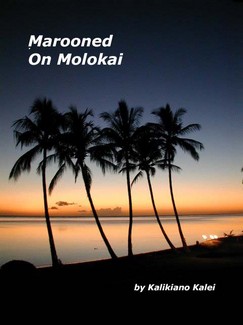
 No less a person than Robert Lewis Stevenson once observed that 'Hawaii is a state of mind.' Of course this was long before the islands were coerced into becoming a legal outpost of the United States. Samuel Clemens, during his famous trip to Hawaii, characterised the Hawaiian archipelago as 'The loveliest fleet of islands that lies anchored in any ocean'. Of all the Hawaiian Islands, my own favorite is beautiful, mysterious Molokai. Read on and I'll explain why 'Molokai mo bettah, brah!'
Molokai Mo Bettah, Brah!
This past week, I returned to Moloka'i (across the Pailolo channel from Maui), something that I now do recurrently after having bought some land on the ancient Koloko’eli Fishpond lagoon frontage of the Kamiloloa Heights section. Measuring 10 miles by 38 miles, with a population of about 7500 people, Moloka'i is often referred to as 'The Friendly Island' by visitors (in actual fact, that somewhat euphemistic name was created by the State of Hawaii public relations flacks) and has the highest percentage of people with predominantly native Hawaiian lineage (estimated at between 37% and 45%) of all the islands (excluding Ni’ihau, the ‘closed island’) that comprise Captain Cook's 'Sandwich Islands' chain; a further 30% are of Filipino extraction, and the remaining balance are whites. While O'ahu, Maui, Hawai'i (the 'Big Island'), and Kaua'i have all been developed to excess, reeling from the ravages of real estate speculation run amok, overrun by tourism, and generally loved to death by visiting mainland Haoles (that’s us honkies, brahs--also known as haole malihinis in the Hawaiian lingua franca!), the lovely island of Moloka'i has nevertheless managed to retain almost all of its original low-key, traditional flavor.
The modern name Moloka'i may be translated as 'The land of gathering waters' (according to one source), but it was traditionally known by native Hawaiians as 'Moloka'i Pule-o'o' ('Moloka'i of the powerful prayers'), due to the island's purportedly potent spirits. Lying 8.5 miles northwest of Maui and 9 miles north of Lana'i, it is 5th largest of the Hawaiian Islands group (260 square miles only). Comprised of the outflux of two large volcanoes linked together by one smaller one, the higher, eastern end of Moloka'i rises to a height of nearly 5000 feet (Kamakou summit) and consists largely of lush tropical forest growing in profusion on the flanks of its heights. To the west, the older ancient volcano known as Mauna Loa (not to be confused with the Big Island's famous and much higher volcano of the same name) rises to a more modest height of only 1380 feet and is an arid, dry region that catches only a small fraction of the leeward eastern end of the island's substantial annual rainfall. The two chief polar volcanic protrusions are joined together by a connecting plain that is today the site of experimental farming projects and the communities of Ho'olehua (the island's airport, serviced by several inter-island carriers and air-charter companies, is located there) and Kualapu'u.
The western third of the island was acquired by private interests (these were granted by the Hawaiian King, Kamehameha III) that in 1895 established what has come to be known as The Moloka'i Ranch; this was an active cattle, horse, and sheep ranch for decades, although a large part of it was leased to the Dole and Libby companies for pineapple cultivation until the 60s (it is now owned by a New Zealand company). The real centre of 'local' population is the small community of Kaunakakai, which is located on the southern shore of the island, about midway from east to west coasts. This part of Moloka'i fronts what has been described as the longest and most spectacular extended reef outside of Australia's Great Barrier Reef. At low tide, the depth of the reef is only about 8 feet and a profusion of exotic fish may be found there. Most of the island's population lives in the Kaunakaka'i area (about 4000 of the island’s total population of 7500, or so), in or around the town.
While in the Kaunakakai area, where I was, staying in a friend’s hale (home) in the Fish Camp section this time, one of the chief attractions on Ala Malana Street ('main street') in the town is the Kanemitsu Bakery. Started many years ago by a Japanese immigrant who contracted with the pineapple producers to provide baked goods to the island’s plantations, this great little bakery today makes wonderful breads, cakes, sweets, and all sorts of other delicious pastry goods. Their items go fast in the early morning, however, so one has to get in ASAP after the store opens to be assured of getting the goods. There is also a hometown, low-key cafe on the premises where locals enjoy a large island-style onolicious (delicious) breakfast of eggs, SPAM, and two heaping scoops of white rice.
As for coffee, aside from the Moloka'i Estate Coffees plantation coffee house near Kualapu'u, there used to be two coffee shops in the town of Kaunakaka'i for the die-hard caffeine freak (moi): the first was Stanley's Coffee Shop Gallery, which combines a coffeehouse on its first floor (has wifi access) with a gallery upstairs that showcases local Moloka'ian artists. The other coffeehouse (which has now gone out of business) is located near the Moloka'i Pizza Cafe (a new and modern cafe that serves a range of good things) and was run by a proselytizing Christian evangelical type who stocked 'bible-thumper tracts' in his store along with the capuccinos (so I never bothered to try it...Christ and coffee are a poor admixture for born-again, Pele-worshipping pagans). There are a number of other, smaller, 'local' cafes here and there along Ala Malana Street and they all have to be tried, of course; they tend to come and go, however (like the former 'Midnight Inn, one of the best...now defunct). Kanemitsu’s Bakery also serves regular coffee (that’s where locals prefer to catch their java ).
Kaunakaka'i has a small surf shop (surprise!), a fairly good Lanai-style (outdoor) water’s edge restaurant at the Hotel Moloka'i, several energetic grocery and general stores, a few real estate offices (the enemy!), a post office, a Chevron gas station, a drug store, an ice cream shop (surprise!), and even a rather excellent community hospital (Moloka'i General) with clinics and an emergency room (especially serious emergencies, however, are air-evac'ed to facilities on the bigger islands). Small though it may be, Molokai has three small newspapers (The Moloka'i Dispatch, the Moloka'i Advertiser News, and most recently The Molokai Island Times); the Molokai Advertiser News is published on the East End of the island, while The Molokai Dispatch and The Molokai Island Times are both published in Kaunakakai Town. There's even a new local FM radio station (Radio Molokai) that plays non-stop traditional music only.
To the north, the eastern end of the island's famed 'North Coast' rises steeply from the ocean in immense, towering, sheer sea cliffs that soar almost 3000 or more feet (the tallest such seacliffs in the entire world). With no reef to protect it, the ocean in that area is wild, restless, and endlessly pounds the volcanic shores with unceasing fury. The steep green cliffs, overgrown with lush tropical foliage, are so sheer that neither Sherpa nor mountain goat could successfully negotiate their slopes. Although millions of gallons of fresh rain water drop daily into the sea from these cliffs (via spectacular waterfalls), it is from this part of the island that most of the entire water supply of Moloka'i comes (via a 5 mile long tunnel that penetrates the eastern mountain core to deliver the water to holding reservoirs at Kualapu'u). Despite this veritable aquaduct, water remains the island's principal concern, even through the present time.
The wind-swept western part of the island, including the area in and around the small plantation community of Mauna Loa, belongs mainly to the privately owned Moloka'i Ranch organisation, which has been engaged in contentious interaction with the indigenous peoples of the island for over a century. As might well be imagined, the local economy is very modest and barely viable, with the highest rates of unemployment to be found in the entire Hawaiian Islands chain. Thus, the native Hawaiians (‘locals’, as they prefer to be called—don’t call them ‘natives’!) are ever engaged in a love/hate relationship with Moloka'i Ranch (now owned by a Far eastern global investment conglomerate); as oppressive as Moloka'i Ranch's presence may seem to be, the employment and water management rights which it controls are crucial for the local economy--a factual view many locals are extremely reluctant to acknowledge. The island's only large luxury resort complex, the Sheraton Kaluakoi Hotel, Golf & Tennis Club, shut down some years ago (pending reorganisation by new owner, Moloka'i Ranch), but a large section of condominiums remain there, occupying the extensive Kaluakoi grounds and golf course, and nearby Ke Nani Kai.
I stayed there some years ago (it had at that time a number of Japanese nationals who had come all the way from Japan to play the spectacular golf course) and was later surprised to find the hotel now closed (this occurred in 2004). In Mauna Loa, Moloka'i Ranch has opened an expensive new development, known as the Moloka'i Ranch Inn, and has rebuilt that quaint old pineapple plantation town into a new urban development that attempts (only partly successfully, in my opinion) to capture a flavor of the old time plantation era. There, the island's only motion picture show plays the latest film hits from the mainland. The restaurant at the Inn provides Molokai’s sole ‘up-scale’ dining experience, if you’re into that sort of sniffy malihini thing.
One of the recent changes in the island relates to efforts to diversify the island's economy, a process that is still being experimented with. Now that pineapples are no long a source of income (Dole and Libby used to have large plantations on Moloka'i that provided steady employment for locals, but the last plantation closed operations down in the late 80s), new sources of economic income are being developed. One of these is coffee; Moloka'i Estate Coffees has a plantation situated in Kualapu'u town that covers more than 500 acres. While the coffee plantation provides local employment, the coffee itself is excellent and some of the best I've had from Hawaii. In fact, when on the mainland I obtain my coffee beans from Moloka'i by mail order, sent to me in five pound bags. Two excellent types sold by Moloka'i Estate Coffees are their ISLAND ESPRESSO and their famous MULESKINNER (a dark, strong roast of hybrid Arabica beans), but there are several other types, as well. See the link at bottom, below, to order genuine 'grown in Moloka'i coffee'. If you are a genuine card-carrying, long-time coffee freak like myself (I began my habit back in the Berkeley coffee houses of the late 60s), you won't regret it! Indigenous Molokai beans easily rival the vaunted ‘Kona’ Arabica bean of Hawaii, in my opinion.
Farming is also big on Moloka'i, believe it or not; The University of Hawaii has several large experimental stations operating there and this effort is so successful that Moloka'i now supplies most of all the other islands' fruits and vegetables. The Moloka'i High School football team is known as the 'Moloka'i Farmers', a reflection of the role farming activity plays in the island’s economy (although I doubt the kids relish playing other Hawaiian Island teams with more dramatic names like the ‘Tiger Sharks’, ‘Morays’, etc.) In that part of the middle island area near Hoolehu'u where the experimental farms are operating, a number of small, native Hawaiian farms also operate under the aegis of the Native Hawaiian Homelands Act (this is land given at no cost to individuals with at least 50% Hawaiian blood who wish to cultivate the property).
One very ingenious local enterprise is the brainchild of a local Molokaiian woman who has created a thriving international business from the sea-salts found on Molokai. While this is product just starting to be developed, the idea is exactly the sort of thing that Molokai needs: locally owned business that has a very substantial interest in the island and its peoples (and not the sort of corporate greed-motivated, mainland-owned enterprise that usually obtains in most places in the islands today).
Most of the higher eastern end of the island is now part of the Moloka'i National Park and Forest Reserve, as is the entire Makanalua Peninsula on the North Coast part of the island, site of the Father Damien's Kalaupapa colony for victims of Hanson's Disease (Leprosy). It is now a monument to the tragic existence of those who were once condemned to live on Makanalua Peninsula in splendid, but fierce isolation from the rest of the world (prior to the discovery of Sulfonamid drugs in the early 40s, which enabled Leprosy to be arrested and essentially eradicated). On the east end of Moloka'i live a number of anti-establishment types of mixed blood, who shun the conveniences of modern society in austere, but invariably breathtakingly beautiful natural settings. The whole area of the North and Northeast Coast is so isolated that hardly anyone lives there, which is somewhat ironic, considering that 1200 years ago, the earliest Polynesian sea-farers first located at that spot, and for centuries afterwards its population was far higher than it is today on the entire rest of the island. Today’s beautiful Halawa Bay, where this first colony of Polynesian immigrants settled centuries ago, is subject to occasional dangerous tidal waves and it was one such huge Tsunami that all but wiped out this early settlement, long ago (the most recent giant tsunami devastated the area again in 1946).
More recently, a movement started among the local preservationists on Molokai for the purpose of cultivating the historic Halawa area for kalo once more (‘Taro’) and today, there are several large and beautiful kalo fields there under traditional cultivation by traditional methods.
In ancient times, Moloka'i was regarded by the peoples of Hawaii as having very powerful mana (spiritual power) and its priests/kahunas were considered to be formidable opponents. One result was that despite all the frequent fighting that marked interactions among the island’s ancient royalty, Molokai remained largely untouched by those conflicts. Today, Moloka'i is still the most 'sacred' of the islands in terms of its preservation of the old cultural ways, and has a number of very sacred sites ('Heiau', or religiously Kapu ['taboo', in Tahitian] temples/shrines). There is, for this reason, all the more resistance among locals to any modern development plans for the island by commercial interests. In fact, back in the late 70s and early 80s, this 'most friendly of the islands' saw a substantial home-grown resistance movement gain strength among a coalition of locals and immigrant kama’ina haoles. An article on Moloka'i appearing in a 1981 issue of National Geographic Magazine references vandalism of tourist rental cars, deliberate spiking of visitors' tires, and other expressions of antipathy to tourism development. In the 23 years that have passed since that time, the militant aspect of the resistance has toned itself down considerably, although there is still very strong anti-growth sentiment to be found everywhere among locals. Although Moloka'i is still considered 'the friendly island', that attitude is tempered largely by the manner in which you treat the locals. Genuinely friendly and culturally sensitive vistors who embrace the island's layback charm are welcomed warmly in the old manner, but those who are overly demanding, overbearing, condescending, in too much of a hurry, out to make a quick buck, or insensitive to the unique lifestyle that is found on Moloka'i are treated accordingly.
Very recently, that tradition of fierce resistance to development has found a new cause, the development of La'au Point (on the West End), as the locals battle the Molokai Ranch Properties group for the purpose of staying a planned real estate deal to build 200 'multi-million dollar' upscale properties. That particular battle is still going on at this time.
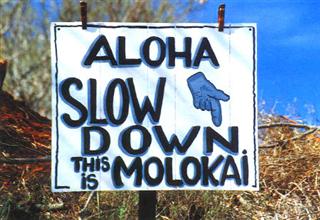
Anyone who is unfamiliar with the Hawaiian Islands is doubtless confounded by the supremely relaxed lifestyle affected by native islanders, a feeling most often expressed with the hand-gesture known as the 'shaka' (you can easily visualise it if you think of a traditional western 'thumbs-up' gesture performed with the pinky finger of the same hand extended; Australians would doubtless think of it as being the 'little prick' gesture with thumb extended). Among American youth today, the ‘shaka’ is as commonly used the same way the ‘thumbs up’ sign was used during the Second World War (or the ‘peace sign’ in Vietnam), since that uniquely Hawaiian symbol has been co-opted by nearly everyone. Although many mainlanders are vaguely aware that the term ‘Hawaiian Time’ means ‘very relaxed and slow-paced’, in Moloka'i time slows down even further than it does on the other islands. The local speed limits are 35 mph (45 max on the single main road that connects the ends of the island), and being 'on time' in Moloka'i means arriving within a few hours of the intended hour (or perhaps not at all, if the fishing or surfing is good). The bottom line is that those who expect the sort of glitzy Las Vegas titillation of Waikiki or Honolulu will be grossly disappointed. The streets roll up promptly at 6PM, there are no stoplights on the island at all, and a traffic jam on Moloka'i typically occurs when two locals stop on the roadway to 'talk story' (enjoy some relaxed conversation). If, on the other hand, you absolutely hate the fast-paced fantasyland life most Americans now experience nearly every waking day of their lives, you'll love the island. Moloka'i has on its western shore (near Kapuhi Bay) one of the longest (3 miles in length), most spectacular and most beautiful white-sand beaches in the entire Pacific (known as Papohaku Beach). This beach is typically almost entirely empty: usually not a single footprint disturbs it. When the notorious rip-currents of Winter are not dangerously active, it offers some of the finest surfing to be found anywhere in the whole Pacific region, as well an unmatched vista of seemingly endless white-sand beach. Thanks to imported Axis Deer and wild Peccaries that have since overrun the island, there is excellent hunting to be found on Moloka'i, which is forever waging a running battle against these over-proliferating, non-native species (not that I am a hunter myself, but for the locals who are, the hunting there is astoundingly rewarding, so I have heard). In fact, without the hunting to keep things in check, the local Axis Deer population would probably overwhelm the island’s fragile flora.
Moloka'i's most noteworthy characteristic, aside from its desire to remain undeveloped and easy-going, is its strong emphasis on community that has traditionally characterised ancient (pre-missionary) Hawaiian society. Since most of Moloka'i's inhabitants have intermarried extensively over the past decades, virtually all of the locals are related to each other--either directly or indirectly. Therefore, the communal ‘ohana spirit is particularly strong on Moloka'i--part of the reason why development and commercialisation interests most often run aground when they try to sweep in to buy up land and build new resorts, etc. The island's airport at Hoolehu'a receives all the inter-island commuter carriers, and flights to and from the other islands are easy to catch--usually in connection with Aloha Airlines and Hawaiian Airlines flights to and from the mainland.
In a recent revisit to the island, I was unhappy (but not too surprised) to find that land values have skyrocketed since 1990, with simple condominiums going for starting rates of $375,000 and most 2 bedroom, modern homes on prime (ocean view) sites selling for in excess of a million and up. A particularly disturbing development is the growing adolescent use of drugs and a particularly severe problem with substance abuse among high school age kids, who have discovered the 'cool' drug-culture of the mainland ('Ice', or crystal methamphetamine, abuses are most particularly severe). Complicating the problem is the fact that due to the high rates of intermarriage among local islanders, individuals are extremely reluctant to report substance abuse to the authorities, since most everyone is related. There's a very high chance, owing to that fact, that the offender may be a loved 'auntie' or 'uncle'! Recent reports in the 'Dispatch', published in Kaunakakai, indicate that at just about every other street has at least one (or more) well known 'drug house'. One of the local women I talked with in Stanley's Coffee Shop Gallery confided that she has 6 drug-using members in her immediate family alone--several of whom are in substance-abuse recovery status. She expressed shame and regret over this fact, but again restated the fact that because everyone is 'family', it is nearly impossible to get people to report the abusers to public authorities. This is a tricky problem to sort out, to say the least, with immediate solution in sight! Even the local Maui County sheriffs are flummoxed by this daunting challenge!
Among its many distinctive cultural charms, Moloka'i has the singular honor of being the birthplace of the Hula (or so it is vigorously proclaimed, since several islands make that claim). Each year this indigenous and beautiful story-telling art form is celebrated in a festival held at Papohaku Beach (in May). Although the typical clueless mainlander still thinks of bare-breasted hula girls dressed in scanty grass skirts and little else, the truth is that Hula is frequently performed wearing voluminous dresses (like the Mu'umu'u) that all but obscure the female figure entirely. We have the Christian evangelical missionaries of the 1800s to thank for that, since traditionally Hawaiian women went about bare-breasted--a condition those staunch conservative religious proselytizers found absolutely scandalous! An old song still sung today says it best...'watch the hands, not the lovely hula hips'...since in hula, the hands are almost as expressive as the human voice in ‘telling story’ and it is therein that are told the non-verbal ancient tales (mele), set to drums and other simple instruments. Hula is not simply a cultural avocation, either, since it is regarded by many as a complete way of life, with both men and women spending many years of study under a Hula kumu (respected elder teacher) to achieve the complex knowledge of the ancient chants and dance forms required of the truly proficient.
Hawaiians tend to be large individuals as a group and it is as common to find that older Hawaiian women are rather heavy-set. I have to admit I wondered about this a bit until I became accustomed to the local Moloka'ian diet. The characteristic Moloka'i meal has about twice the portion-size of food most mainlanders are used to. A typical side-dish includes two LARGE scoops of rice, breakfast, lunch, or dinner. Loads of carbs, needless to say. The average Moloka'ian woman therefore tends to be large (not quite as large as Samoans and Fijians, however!) and quite the antithesis of that lovely little stereotypical wisp of a (mythical) Polynesian girl that is a fixture of most mainlander male fantasies about the South Seas. Actually, it is those women in Hawaii who tend to have a stronger admixture of different races (non-native Hawaiian) in their blood that tend to be slender and often stunningly beautiful; many pure-blooded Hawaiian women are pretty, but are often large and heavy-set, with full-boned frames. While this has nothing to do with their inner nature, which is typically wonderful, extremely generous and good-hearted, it does tend to dash mainlander fantasy stereotypes rather quickly. My own personal observations have yielded the surmise that those Hawaiian women who have generous admixtures of Chinese, Japanese, and or Filipino blood in their family are more often among the seriously slender ones to be found--whether on Moloka'i or one of the other islands. Lithe slenderness is not, so my observations would suggest, an indigenous Hawaiian (or pure Polynesian) trait (unfortunately!). That having been said (and I am not one to pull my punches, usually), I am well aware that ‘slender, multi-racial beauty’ has nothing to do with the most important human qualities of the soul and heart that are all internal. I further have no doubt that pure-blooded Hawaiian women absolutely loathe the stereotypical anorexic ‘runway-model’ look that predominantly white mainstream American culture has forced upon them as a desirable physical model to emulate. [Finally, in saying all this, I apologise in advance to my Hawaiian brahs and sistahs who may take serious exception to comments of this sort, even coming from a haole malihini like me who tries hard to be hoko’ele; dese words could be cause foh one dakine bambucha stink-eye, auwe!]
Before anyone concludes that I seek to dishonor or detract from the many fantastic qualities of native (full-blooded) Hawaiian women with what might be misconstrue d as irresponsible sexist disdain, know that I am merely making highly subjective observations; what you make of them, of course, is your own business. My personal taste in women has always run towards those who are slender and smaller, and am generally not attracted physically by larger, robust, or overweight females; that's just my personal preference, a bias to which I am perfectly entitled (after all, I'm just as much a 'shallow Hal' as the next guy, as regards certain subjects...). Above all, I hasten to say that my observations are not intended to be a slam against pure-blooded Hawaiian women, since as we all know, every culture is vastly different in terms of its inherent values, diet, lifestyle, and levels of physical activity. In fact, generalized obesity has more often been regarded as a sort of ‘norm’ by many cultures and (aside from the fact that it is a problem throughout the United States that has only been recognised for the serious health threat it is, in fact, always been), ‘thin’ has never been a universal aesthetic standard until recent times.
On my recent return to Moloka'i, two aspects of island culture not unique to Moloka'i, but certainly concentrated there, were the renewed practices of ancient traditional Hawaiian religion and the traditional Hawaiian fighting art known as 'Ku'ia-lua' (or simply 'Lua'). Hawaiian adepts in Lua were reputed to be extremely strong and skilled in the art of killing by many methods. Lacking iron weapons, such as were common in 'civilised' western society, Hawaiian warriors developed a number of very physical techniques to kill their opponents with wooden and stone weapons, but they were especially skilled at subduing enemy warriors in hand-to-hand combat. The powerful strength required of many of the techniques used required much training under the instruction of special kahunas (priests/magicians/sages). So strong were some of these warriors that it has been recorded that they could pull out an enemy's intestines through his anus (now THAT’S gotta hurt!)! While that fact takes some imagining to fully appreciate, the strength required to do this does also. One must remember that the most recent period of traditional pagan Hawaiian religion (from the time of the Polynesian priest Pa'ao forward) required human sacrifice, so a recent resurgence of interest in the Hawaiian martial art of 'Lua' has occasionally prompted mild concerns over the darker aspects of the custom. There is today a small but devoted following of the ancient traditional Hawaiian religion that the Christian missionaries were so dedicated to eliminating, but these theoretical anxieties are mostly academic: the ancient art of Lua helps remind native Hawaiians of their origins and of that part of their culture that the invasion of Christianity has hastened to eliminate. Christians resist the cultural practice because it smacks of pagan heathenism (which is really so much Christian malarkey, of course).
The island of Moloka'i is (and has always been) known, as mentioned before, as a place of great 'mana' (spiritual power') among the islands and there are a great many sacred sites and other archeological sites in which to take an interest. Native Moloka'ians do not encourage non-locals to take serious interest in these parts of their culture, understandably being concerned about careless desecration of ancestral burial sites and religious Heiau (temples/holy grounds) by outsiders. Among the many strange things that can not be easily explained away by western logic or reason are the ghostly processions of 'night marchers' that occur frequently on the southeast shore of the island (between mile 8 and mile 20, close to the ancient Kawela Battleground and not too far from the Ili'ili'opae Heiau, a site of regular human sacrifice in olden times). People who have experienced these unearthly processions of ghostly warriors late at night, on certain nights of the lunar month, include highly respected and academically credentialed holders of PhDs, so the old stories that are so frequently repeated cannot be dismissed easily. [The Kawela Battleground was the site of a ghastly slaughter in 1736, when the numerically superior forces of invading O'ahu chieftains were routed by the powerful mana of Moloka'i kahuna. Ili'ili'opae Heiau was the site of a feared school that taught kahunas in the dark powers of the Moloka'i mana; it is reported to be one of the more notorious sites of human sacrifice (although not all agree on this) and may be visited on foot, providing permission to pass has first been obtained from the private land-owner (a local known as ‘Aunty Pearl’) on whose lands it exists. Further east and not that far from the Ili'ili-opae Heiau is the grove of sacred Kukui (AKA: 'Candle Nut') trees in which the most powerful Hawaiian kahuna of ancient times was buried (Lanikalua). The grove is fenced in today (it is enclosed on private property), as terrible things have happened to those unaware visitors who have desecrated the site in the past. Molokai'ian locals are not anxious for malihini (strangers) to poke around at any of the traditional sites of island mana, least of all this one!]
The 'night marchers' are often preceded by the sound of drums and nose-flutes, but sometimes they are not. This apparition reportedly takes form in the shape of rows of ghostly warriors marching from the high slopes of the cliffs rising on the Kamakou headlands down to the shore; one local person who witnessed such a procession stated that the long lines of warriors included both men and women, with 6 of each gender abreast of each other, and stretching back up into the hills. It is said that they march from the burial sites of the 'Ali'i' (royalty), which are hidden high up on the sheer faces, to their ghostly outriggers on the shore, and any living person who is found in their way is subject to being killed outright. Traditional custom, upon being unlucky enough to encounter night marchers in their processions, is for the person thus unwillingly confronted to tear off all his clothing and lie prone on the ground until the night marchers have passed (although he still may or may not be killed, according to the whim of the long-dead chief whose phantom warriors are passing by). People who live in isolated dwellings in this part of the island's coast are accustomed to the activities of the night marchers, but don't discount them any less for that fact. Some have even witnessed these phantasms passing through their back yards or through their homes. The strange goings-on of the night marchers is but one of many such anomalies on the sacred island of Moloka'i Pule-o'o. Traditionally, Night Marches may be for the Gods, or for departed high Ali’I (royalty), with differences in the appearance of the phantoms characterizing the event and accompanied by sudden changes in the weather (storms, high winds, lightning, etc.).
My frequent returns to lovely, old fashioned Moloka'i typically end all too soon and I usually find myself intensely regretting having to embark on the flight back to that state of semi-crazed 'civilisation' that is modern California. I usually bring back many new books on the Hawaiian culture for my reference library, but most importantly I am always able to re-experience the perfect peacefulness that is the Moloka'ian way of life once again, albeit for only several weeks at a time. It is my hope to finally retire on the island, a place where one may forget all about the increasingly insane activities and daily violence that Californians' today resignedly accept as 'normal life' at home.
Toward that end, I will be spending more wonderful months in future on the island that is (in my opinion) by far one of the best of the entire Hawaiian chain (as the locals as say ‘Molokai mo bettah. brah!’). While Molokai is about as close to the 'old paradise' that the islands used to be that may yet be found in Hawaii, no paradise is without its challenges and problems. On Molokai, one is treated exactly as a paraphrase of the old Christian 'Golden Rule' states it: you are treated as you treat others. If you are a kind, generous and giving individual, you will be as welcome as family (and the opposite may also be true ). The best way to make friends and maximise your Molokaiian experience is to remember that a simple smile is always the best passport to happiness, anywhere on the planet.
'Ukuli'i ka pua, onaona i ka mau'u'. ('Tiny is the flower, yet it scents the grasses all around').
Aloha nui, hoalo'ha.
-Kalikiano
|