Reflections on Vehicular Euthanasia
One of the popular phrases in use among my high-school era friends was “Four-cycles truck, two-cycles suck!”, but over the years I have come to hold an almost equal regard for all two wheeled vehicles (motor propelled as well as human powered). Although I am a lifelong and enthusiastic bicyclist, I will somewhat reluctantly admit to holding an irrepressibly fatal (hmmm: poor choice of words, obviously!) fascination for motorcycles. Before you write me off as one of those ubiquitously paunchy, balding, late 50'ish Harley-Davidson dudes (clad entirely in black leather embossed with the H-D logo), let me elucidate a bit.
As a child, I still have fond memories of my very first tricycle, a rather expensive and tricked-out boulevard bomber I got at the age of four. It had a screaming red paint job, a bike bell, solid rubber white-wall tires, chain-drive, a spring-cushioned seat, front fork suspension, and white steel spokes. It probably could have a taken a direct hit by a MIRV'd nuke warhead and survived, so sturdily was it built (like Pamela Anderson's chest) and lasted a good many years, in fact--unlike today's counterpart trike (injection molded polymer stuff with plastic wheels) that falls apart in the first week of use.
Although I started out my subsequent two-wheeled life on a kiddie-bicycle with training wheels a bit later, as most normal kids would, in my freshman year in high school I felt I was ready for a bit more excitement. Consequently, I managed to coax, wheedle, and beg (read: bother to distraction) my poor mother into letting me buy a Honda 50 (the model designation was actually a Honda C-110 ‘Super Sport’, with a honking 50 cc engine) motorbike. This was in 1961 (yeah, I am THAT old).
When my stern uncle found out about this, he caveated the whole question with a rather Hobbesian (not ‘Hobson’s’, which is a reference to Thomas Hobson, but the philosopher Thomas Hobbs) choice: I could have EITHER a Honda 50 motorbike OR 4 years of secondary school education at a hoity-toity private academy in Minnesota named ‘Shattuck Military School’ (http://en.wikipedia.org/wiki/Shattuck-Saint_Mary's). Despite the family’s military tradition (what good Irish or Irish-American lad wasn’t well schooled in the combative arts?), I chose the motorbike. This probably saved me from attending the US Military Academy at West Point, since that is where I had been groomed to head from birth by my career officer dad. It probably also saved me from ending up as a fresh young 2nd Lieutenant head-trauma (or fragging) casualty in Vietnam.
One of my casual friends at the time I faced this eventful choice was a rather sissified boy named Billy who, due to his coddled status as an overly protected, only child, developed a habit of trying to compensate for his somewhat ‘mama’s boy’ nature with a sort of ‘one-up’ type behavioral affect. Since Billy’s father was a Greyhound bus driver who was constantly on the road and therefore almost never around, Billy was raised for the most part by his mother, a mildly neurotic and ‘upwardly’ obsessed woman named ‘Euva Baise’, who was an elementary school teacher peer of my mother’s that came from a remarkably ordinary family.
Billy, mostly as a result of his mother’s pretentiousness and zealous effort to strive for a higher social standing in our little Podunk town (of 3,000), found her habits thoroughly ingrained in him, with the result that Billy unconsciously emulated her superciliously superior manner in his interactions with us, his own peers. The fact that he was a sort of delicate kid (who among other things had been taught to play the organ and violin—double yuk!) didn’t help increase the value of his pre-adolescent stock in our regular gang of neighborhood kids (read: little neighborhood thugs).
It was about this time that the Honda Motor Company of Japan revolutionalised the traditional ‘outlaw motorcycle gang’ (think Marlon Brando in the movie ‘The Wild One’) image that had grown up around motorcycling in the late 40s and early 50s. Introducing a new squeaky-clean concept in motorized two-wheel motor-bikes, the lightweight sporty 50 cc motorcycle (not quite a real motorcycle but neither was it a ‘MoPed’, or motorized pedal-cycle). Their famous marketing jingle ‘You meet the nicest people on a Honda’ instantly became as famous as that classic Volkswagen motto of the 60s, ‘Think small!’ Up to that time, the popular impression of motorcycling in the United States had been almost exclusively characterised by the Marlon Brando outlaw biker image affected by Harley-Davidson gangs. Fresh scrubbed, clean-living and all-American youths of that time simply did not ride motorcycles, and even the thought of one was enough to send most mothers screaming to the local village Pastor for advice on how to keep their precious little kid from becoming that most feared of adolescent 60s abominations, the juvenile delinquent.
One of my closer friends, a popular, good looking, blonde-haired kid whose father and mother were ethnic Germans from the Ukraine, had heard about the new Honda motor-bikes and turned my attention to them. Since Honda’s clever advertising campaign to cultivate a new market for these cycles emphasized wholesomeness and traditional American values (their advertising--“You meet the nicest people on a Honda”—showed an idealized couple of square looking American teenagers riding one of the new bikes and looking like something right out of the hokey old TV series Father Knows Best), it wasn’t hard to persuade our parents to seriously consider buying us one (the new bikes sold for about $225 at the time). So Steve and I started saving up our lawn-mowing earnings and allowance money (we made about $1.50 per lawn—that was considered BIG money in 1962 for a kid) so that we could each buy one of these cool and ‘politically correct’ machines.
Soichiro Honda, the prescient and forward looking Japanese genius behind the Honda Motor Corporation’s modern day succeses, began the major period of his life’s work in the ruins of the Second World War, when he cobbled spare bits of motor vehicle parts into simple, efficient, and cheap transportation devices for his countrymen. By the mid 50s, his small displacement four-cycle engines had started winning prizes in international motorcycle racing competitions. Very shortly after that commercially affordable versions of these motorbikes were ready for an attempt to cultivate the potentially lucrative American motorsports marketplace. The first of these small motor-powered Japanese two wheeled cycles started appearing in America in the late 1950s. Like most brilliantly popular ideas, it wasn't long before the clean-looking little Honda motorbikes started popping up in both urban and suburban driveways all over the country.
Meanwhile, as soon as our nemesis Billy Baise found out about our plan to get motorbikes of our own, he just about burst a sissy-boy brain-cell trying figure out a way to steal our adolescent thunder (as usual). Now just at a time when Honda was starting to sell these very high quality, well engineered and superbly manufactured lightweight new (four-cycle engine) motor-bikes to the American public, there were several other competing Japanese firms that were also trying to horn in on what the Japanese more or less simultaneously saw as a great big, untapped American market for high quality Japanese goods. Unfortunately, it wasn’t all that long after the American occupation of Japan had ended (only about 10 years had elapsed since VJ Day), and the ‘Made in Occupied Japan’ stigma still typified cheap, shoddy stuff to most Americans: products and consumer goods thrown together in a hurry, as Japan's devastated economy struggled to get back on its feet. Several of these competing motor-bikes were actually pretty crappy looking, flimsily put-together machines, fabricated from poor quality steel, made with less than adequate precision, and powered by irritatingly noisy, extremely dirty and grossly polluting two-cycle engines. One of these cheap knock-offs in particular was made by the Dihatsu Company and was marketed with the almost unbelievable (and very typically Japanese) model name of the ‘Run-pet Sport’.
While the high quality four-cycle Hondas were still in somewhat short supply and hard to get, there was quite a supply of the cheap Daihatsu two-cycle bikes available. Steve and I, both eager to get a quality motor-bike looked at the Daihatsu bike and quickly determined that there was no way either of us would want to be seen on that crappy little substitute for a real Honda. The difference in quality between the cheap bikes and their superior Honda counterparts was so apparent that even us 14 year old kids could easily make that distinction!
At any rate, good old organ-playing (no pun intended, I assure you!) and violin-torturing Billy was desperate to achieve the status of being the first kid in our little town of 3000 to have his own motor-bike, whether it was a Honda or not, and persuaded his father to buy him one of the wretched Daihatsus. The next day he showed up at school on the tinny little beast, complete with a nauseating light-blue paint job, fake blue rear Naugahyde saddle bags, and fenders that looked like they were made from a Japanese Army surplus aluminum cookie-cutter. Worst of all, the Daihatsu ‘Run-pet Sport’ used a noisy, smoky two-stroke engine, and not the refined and quiet four-stroke technology that the Hondas featured. Compared to the silky smooth and hushed nature of the 50 cc Honda four-stroke engine, the Daihatsu two-stroke sounded like what I imagine an insanely schizophrenic, trans-sexual chain-saw with menopausal hot flashes would. One look at Billy’s funny looking Crapponese motor-bike would have been enough by itself to send all of us into gales of scornful laughter, but it was the incredibly noisy sound of the thing that kept us all in permanent stitches. "Ring-da-ding-ding-ding-ding, RRRRrrrrring-da-ding-ding-ding-ding-ding-ding"…..well, you get the idea. We could see the clouds of black oily smoke and hear the ridiculous cacophony of his bike long before he finally drove into sight!
Yep. Billy achieved the dubious distinction of being first among his peers to have a motor-bike, but his decision to put being first on the block to have a motor-bike (even a poor one) before patiently waiting to get a much higher quality Honda simply confirmed what we merciless little neighborhood thugs had always sensed, all along: Billy was just a pretentious little wannabe wuuse and no amount of juvenile one-upsmanship would ever get him out of that distinct status! To this day, I will never forget how hilarious his appearance at school was on that little pile of post Occupied Japan produced tinker-toy, although in the years since that time age and the onset of maturity have forced me to be a LOT more forgiving of boyhood foibles and flaws in my reflections. In further subsequent ruminations on that fact, it has always struck me as highly ironic that by the time one matures sufficiently to finally accommodate the excesses of mass humanity unconditionally (with all their collective warts and blemishes), life is nearly over!
At any rate, this is a digression. After my very first Honda 50, I progressed through a whole range of motorcycles, each one of incrementally larger displacement and most of them Hondas, although I latter gained a profound appreciation for the classic German technology incorporated in those beautiful old BMW bikes (such as the R-69), the shit-hot, to-die-for Laverdas, Ducatis, and other exotic Italian expressions of the motorcycle art.
For us teenagers of the 60s era, motorcycles and surfing went together back in the 60s like missiles and nosecones, since both sports sprang into common awareness more or less simultaneously. Of course back in those days, driving conditions were one hell of a lot safer for anyone operating a motor-powered two-wheeled vehicle, since most of the cars on the road then were driven by mature (supposedly) adults, and almost every school required a driver safety training course as part of high school graduation requirements. Even if you possessed a teenaged brain, at least you were taught the importance of going through the motions of safe driving, with the hope being that some of it would stick. Today, by comparison, most teenagers have little if any awareness of the need for driving safety, despite or perhaps because of the ever increasing numbers of immature drivers on the roads and the gradual phasing out of most school driving education programs.
When I went into the Air Force (during Vietnam), my love of motorcycles went on temporary hold, but no sooner was I back in the States than I had acquired another motorcycle (a 4-cylinder Honda 750). For me and most of my friends, there were only two general groupings of motorcyclists worth regarding at that time: Japanese ‘crotch rockets’ and heavy American 'Hardly-Goodsons' (oops!..I mean Harley-Davidsons). My friends and I belonged to the former group and wouldn’t have been caught dead (well, maybe ONLY dead) driving big, clunky, overpriced Harley hogiron. I suppose this attitude was a latent reflection of sorts, of the corresponding status quo found in England of the 60s, with its ‘Rockers’ (delinquent types who drove grungy American Harleys and British cafe-style bikes) and ‘Mods’ (high-fashion modernes who preferred clean, streamlined, modern motor scooters). The Rockers, who affected black leather jackets and preferred stripped down, ‘café-style’, Isle of Mann motorcycle racer clones for the most part, religiously cultivated their desired image of being bad boy street racers. Their antagonists, the Carnaby Street, fashion-attired, and voguishly hip Mods, rode motor-scooters (Lambrettas, Vespas, etc.) and stringently avoided the motorcycle sub-culture as being thuggish, uncultivated, and a group expression of lower-class tastelessness.
My own group of friends preferred the fast and stylish ‘café racer’ look that derived directly from Grand-Prix motorcycle racing (such as the annual Isle of Mann road race), although we weren’t concerned about the ‘tough guy’ image that the Brits so studiously affected. The racing heritage of our bikes was reflected in their ‘clip-on’ handlebars, quarter fairings, race saddles, and such. I am absolutely convinced that inside each of our teenaged heads burned the hallowed image of Steve McQueen on his celebrated BMW, breaking out of the POW prison camp in ‘THE GREAT ESCAPE’. We were, so we thought, ultra cool.
Meanwhile, the hopped-up hippie biker image established by Peter Fonda and Dennis Hopper’s classic movie ‘EASY RIDER’ helped bring the Harley Davidson ‘chopper’ bike out of the identity-specific milieu of the motorcycle ‘bad boy’ gang era and into the newly popular and ‘gentrified’ context that it enjoys today. In fact today, the Harley Davidson motorcycle has become so iconic as a symbol of former youthful times to many old, fat and nostalgic baby boomers that the Harley has truly and permanently crossed completely over from its original disreputable status to the polar extreme. Accordingly, and attendant to the secure status image that fame has endowed the make with, Harleys are now so outrageously expensive that only highly paid members of the upper middle class (doctors, lawyers, and stockbrokers, etc) can reasonably (emphasis on ‘reasonably’) afford them. Anyone who takes the trouble of reading the history of the Harley-Davidson motorcycle from its earliest days of obscurity, through the its motorcycle gang image of the 50s, and on to the present day high-status the name now commands, could hardly fail to be smitten with a strong sense of the utmost irony.
As the sole surviving American motorcycle manufacturer (out of several that thrived back in the 30s and 40s), H-D has today created an unshakable niche for itself as ‘the only All-American motorcycle’. Regrettably, H-D technology has remained stuck in a time-warp sense of misplaced and over-glorified nostalgia for the old days and has little if anything in relationship to modern, state-of-the-art motorcycle engineering. For that reason, anyone who wants a leading edge ‘pocket rocket’ buys Japanese, German and Italian products these days, and carefully leaves H-D to capture its market share from seekers after pretentious status (hence the well-off doctor, lawyer, stock-broker owner image of H-D owners these days).
As for myself, I remain true to my roots as a lover of fine, classic European racing motorcycles, although I am sane enough to not want to sink a personal fortune into one of the unbelievably sophisticated two-wheeled racing-bike clones now available. I remain content to keep older bikes, such as the venerable early 80s Yamaha Seca XJ550 and Seca XJ750 bikes that occupy my garage, since these bikes are a very reasonable compromise between modern performance and classic traditions that won't break my personal Swiss bank account.
There are many other things to consider in this context, of course, since today’s roads and highways are now far less safe than they used to be. Some of these concerns make riding a motorcycle ANYWHERE in today’s United State more than a shade worse than an act of voluntary insanity (hence the apt term “suicycle” that none hears occasionally, in reference to all motorcycles), since although you can be one of the world’s most careful and safest riders, you cannot control that 5% slice of the odds that is most likely to make you a mortality (i.e. the dimbulb other driver). Further, as California has grown in demographics, more cars and other vehicles now fill the streets and roadways to the point where taking a motorcycle out onto any freeway, at any time of the day, amounts to physically acting out a death-wish. Further, with far more ‘older’ riders recapturing the nostalgia of their former youth by buying expensive bikes (most popularly the Harley), the motorcycle fatality rate has soared astoundingly over the past 10 years; a recent survey of motorcycle fatalities (accidents) spanning the last decade shows a startling 200% increase in the mortality rate among motorcycle riders! It’s an often overlooked and unhappy fact that as one ages, the reflexes slow remarkably (ask any 55 year old fighter pilot about why he is now out of the cockpit and flying desks instead!), making participation in any activity requiring acute situational awareness to stay alive risky beyond reason.
From my own experience, I’ve found that whereas when I was young, the motorists were generally cautious and moderately safety conscious, and the motorcyclists reckless and impulsive (generally speaking), today the reverse appears to be true . Motorists are increasingly careless and accustomed to traveling at inappropriate speeds in excess of posted limits, while motorcyclists (well aware, in most cases, of the substantial hazards implicit in two-wheeled vehicle use) tend to drive more carefully and exercise more ‘road sense’ out of sheer necessity. The bottom line is that it simply isn’t any safer to operate a motorcycle anywhere near large masses of automobiles and trucks on roads and highways now than it is to ride a bicycle within the highly congested modern urban street environment.
This is really a pity, since I used to really enjoy taking long, leisurely drives out in the country and across the state on my motorcycles when I was living in the San Francisco Bay Area (during the 70s and early 80s). Today, I still keep my motorcycles but drive them only very infrequently, due to the unavoidable hazards posed by all the car and truck traffic on the roads. So…I still have my toys, but it simply isn’t as safe as it formerly was to casually hop on them and sail off on a leisurely country putt. In the course of reading the local newspaper each day, I am unfailing struck (agains, a most unfortunate choice of words) by the noticeable increase in fatal motorcycle accidents to be found therein. A great number of them are attributable (in the police reports) to carelessness by automobile drivers who failed to see the motorcyclists, or didn’t yield and pulled out in front of them, resulting in the classic ‘T-bone’ collision.
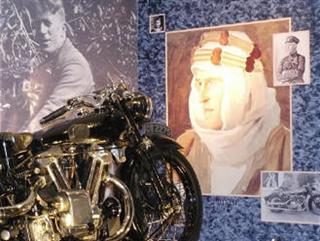
Interestingly, a great many famous public figures have also been captivated with motorcycles in former decades. Just as radicals seem to have been fascinated by cats (there are hardly any noteworthy radicals throughout history who did not keep and enjoy feline companions), a substantial number of modern 'radical' public personalities seem to have been drawn to motorcycles. One of my personal favorite motorcycle afficionados was T. E. Lawrence of World War One Arabian notoriety. Lawrence was obsessed with exotic motorcycles throughout his later life, taking great enjoyment in riding his custom-made Brough cycles throughout the English countryside at sometimes break-neck speeds on all too often ill maintained rural roads. Despite the relatively unsophisticated state-of-the-art of motorcycle technology in the 20s and 30s, highly refined, custom-made machines like the gorgeous black and chrome Broughs of the late 20s and early 30s were capable of achieving significantly high speeds. Lawrence owned no less than seven Broughs over the course of his life, each one newer and more advanced than the previous model, and writes of routinely reaching speeds of 50 mph (and frequently as high as 100 in several instances). Lawrence was so obsessed with the speed his Broughs were capable of that when the great George Bernard Shaw loaned Lawrence a sizeable sum of money to help buy some of his expensive machines, he recognised that given Lawrence’s single-minded obsession for speed, helping Lawrence buy a Brough was (as he put it) ‘not unlike giving a depressed man a loaded gun’.
Lawrence generically named all his motorcycles ‘Boanerges’, which means ‘Sons of Thunder’, and his cycles ranged from his first one, a 1922 Brough Mark 1, to his last, a beautiful black and chrome beast (a 1932 model GW2275). It was on this last Brough, costing Lawrence only 170 Pounds Sterling when he bought it, that Lawrence met his end on May 23, 1935. While coming over a rise at a great rate of speed, he spotted at the last second a pair of school boys in the roadway directly ahead of him. In his effort to avoid hitting them, Lawrence deliberately spilled the bike and suffered severe head injuries (that were unsurvivable by anyone not wearing protective headgear). Since hardly any motorcyclist wore a helmet in those days, such a result was almost a given, considering the circumstances and the inherent danger posed by all motorcycles when driven imprudently at unsafe speeds.
Lawrence’s last Brough, the one he sadly ended his adventurous life on, has recently been recovered and put on display in England. It is in excellent condition, having been repaired after the crash by the bike’s maker (Brough Motorcycles Ltd), and is still to this day a remarkably exotic looking and beautifully crafted example of 1930s two-wheeled engineering.
Some further information on Lawrence with specific regard to his remarkable Brough motorcycles may be found at: http://www.broughsuperiorclub.com/pages/news/tel_brough/tel_brough.htm.