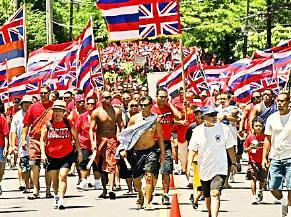
 Very recently (late March of 2008, less than two weeks ago) a major economic event occurred on the tiny but serenely beautiful island of Molokai, Hawaii. Largely the result of a highly contentious, ongoing clash between the island's outspoken cultural activists and the existing (albeit somewhat shakey) economic infrastructure, Molokai's population of about 8,000 people now faces one of the most severe crises they have experienced since the last sugar cane and pineapple plantations on the island folded up and disappeared in the late 1980s. It is, on a smaller scale, a classic analogue of the world-wide contemporary battle facing environmental preservationists everywhere, in a modern world overrun by rapaciously unconscionable commercial and corporate business activities. But it is also an eloquent if somewhat unhappy plea for a wise balance between economic opportunities and cultural preservation in the conduct of contemporary human affairs.
Revolt in Paradise Revisited:
A Molokai Reality Check
In a recent article titled ‘Revolt in Paradise’ I examined the status of the Hawaiian island of Molokai’s no-compromise activist resistance to commercial real estate speculation, in the form of the La’au Point development controversy.
To recapitulate the essential details briefly, Molokai Ranch Properties (MRP), owner of the extensive MRP land holdings (about 40% of the island’s total of 166,000 acres, or about 60,000 acres) on the island, had proposed to the Molokai Community that if allowed to develop 200 2-acre ‘high-end’ vacation home parcels on the island’s West End (specifically the Southwest La’au Point area), MRP would make certain substantial concessions to the indigenous Hawaiian people of the island. Among the concessions were the return of a number of specific geographic sites held sacred by ancient people of the island (most being on the West End and located on MRP property), along with about 30,000 acres of MRP property that would be placed in a land trust for native Molokaiians in perpetuity.
The deal (known as the Molokai Ranch Community Development Plan), as proposed by MRP, would allow MRP to develop the 200 exclusive vacation properties and then offer the plots to the public for prices of several million dollars each. For its part, MRP was willing to make the above accessions to the people of the island, which were deemed by some observers to be in fact quite generous. In this, the MRP CEO had the full backing of MRP’s parent corporate owner, the Singapore-based (main offices in Hong-Kong) Guoco Group Limited (an LLC incorporated in Burmuda). Guoco, with assets of many, many billions of dollars, is one of the largest and most influential investor real estate and leisure activity holding corporations in the world. With extensive current high-value holdings in China, Malaysia, and many other parts of the Far East, it is a very wealthy, major player in the world’s real estate properties market.
At this point, let’s pause to look back a bit further at the history of the island, so as to get a better comprehensive view of what larger issues are at stake here. Molokai is the 5th largest of the 8 main Hawaiian islands, measuring about 38 by 10 miles (260 square miles). At present, more than 16% of the island’s population are unemployed (quite a high percentage, compared to the rest of Hawaii), with the poverty rate being in excess of 26%. In 2004 about 33% of the island’s people received MedicAid, 25% received food stamps, and 28% of all food was acquired through subsistence farming, hunting, gathering, and fishing. About 20% of the population 18 years and older were determined to not hold a HS diploma. The population breaks down into about 55% native Hawaiians (including both pure-blooded Hawaiians those with a high percentage of Hawaiian blood), 35% Filipinos (brought in to work the old plantations), and the balance Caucasian (haole, mostly fairly well-off retired people). There are a few Chinese-Americans living on the island as well, but not in the large percentages found in, say, Honolulu and elsewhere in the islands. There are also a handful of Japanese-Americans.
The island is very special for a number of reasons, not least the fact that it is the site of the very earliest settlements of Polynesians who voyaged across the South Pacific Ocean from the Marquesa Islands group, many centuries ago (landing at Halawa Bay, on the East End of the island). Molokai was renowned in the island ancient culture for its powerful religious mana, or spiritual power, and there were several sacred sites (heiau) on the island that functioned as schools for the old culture’s Kahunas (priests or specially endowed shamen).
Owing to the fearsome reputation of the island’s Kahunas, Molokai escaped most of the relentless, near-continuous warfare that characterised the ancient pre-missionary Hawaiian culture. Whereas most of the other islands were forcefully taken by Kamehameha I’s koa (warriors), Molokai managed to escape dominance by this unifying Hawaiian king until well after most other islands had been conquered.
Molokai eventually came to be favored by Kamehameha V (a descendent of Hawaii’s original and unifying king) as a place to rest and relax in the mid 1800s. Kamehameha V had a royal residence and property maintained for him near the Kaunakakai Town harbor and he came to stay on the island occasionally. Although under ancient Hawaiian religious custom, care for the Hawaiian island lands was deemed the collective responsibility of all the people, it was regarded as being the divine property of the Gods; its actual custody came under the aegis of the King (who, as a quasi-divine entity himself, acted as a royal ‘custodian’ for the Hawaiian deities). The practical result was that the entire island of Molokai (and in fact all of the other islands) belonged to the crown, within that broad conceptual context.
In the mid-1800s, Hawaiian King Kamehameha III decided, under substantial pressure by powerfully influential haole malihinis (white mainlanders), to make the royal lands available to all people (native Hawaiians as well as outsiders) for ownership under the terms of what was known as ‘The Great Mahele’ (land redistribution act of the mid-1850s). Intended to allow the common Hawaiians to actually own the land they lived on and farmed, it eventually failed utterly in that objective since the concept of private land ownership was totally alien to the common people. As a direct result, most of the Hawaiian land was quickly acquired by sharp haole (white) businessmen and entrepeneurs--a status that maintains to this day. Another direct result of this tragic turn of affairs was that a large number of Hawaiians became homeless. At present, widespread homlessness is (along with methamphetamine addiction) one of the most serious problems faced by the modern State of Hawaii (a visit to any major beach on the main islands will reveal large numbers of local Hawaiians camped out on the beaches in tents and makeshift shelters).
Somewhat after that the 'Great Mahele', King Kamehameha V sold a large part of his personal land holdings on Molokai to a private western businessman. This extensive 66,000 acre holding that comprises what came to be known as the Molokai Ranch was owned and operated by its new private owner as a cattle and horse ranching activity that was at first limited to livestock raising, but that later came to include sugar cane and pineapple plantation crops. As an amusing sidelight, many visitors to the island in recent past decades were quite startled to find Hawaiian cowboys known as 'Paniolos' riding herd on the ranch's cattle. Looking like Texas-style rancheros, but adorned with Aloha shirts and leis, they provided a substantial amount of 'local color' for the ranch, in addition to performing a considerable amount of hard work associated with the herds.
While the cattle and livestock ranching aspect of Molokai Ranch continued relatively unchanged over the subsequent decades, in the late 1960s and 70s, first the cane growing and later the pineapple growing operations diminished in scale, before ceasing entirely. At about this time the original ranch owners sold the combined operation to a foreign investment company based in New Zealand and the name changed to Molokai Ranch Properties, or MRP. The Ranch’s commercial cane and pineapple growing operations coincided with the initial development of the other main Hawaiian islands as tourist recreational venues. In a move that fitted the changing economic patterns of the islands, Molokai Ranch later dedicated some of its corporate effort towards developing limited vacation accommodations and tourist vacation facilities. Part of this new phase of Ranch operations saw the establishment of the large Kaluakoi resort area on the island’s Northwest End, with its Sheraton Hotel, extensive golf and tennis resort facilities, and condominiums (the Ke Nani Kai development near Kaluakoi, etc.).
Still later, the old Molokai Ranch pineapple plantation town of Maunaloa (located on the Southwest End) was redeveloped by the Ranch (now known as Molokai Ranch Properties) into a low-key vacation home area, with a comprehensive refurbishment of some of the old shops and businesses intended to reflect the town’s traditional appearance and past This expansion included a movie theatre, an upscale restaurant, and the construction of an expensive new Molokai Lodge facility in Maunaloa. Overall, the modern MRP operation, with its 60,000+ acres of island land and vacation facilities, came to employ a small but significant number of the island’s locals (the total varying at times, but recently estimated at being about 170 or so individuals).
In my earlier article I alluded to the fact that whereas the rest of the main islands in the Hawaiian chain have more or less become hyper-developed by commercial real estate and foreign land speculators (both from the US mainland and Japan, the latter especially in the 1970s), Molokai somehow managed to remain untainted by most of the speculative real estate developments that have essentially dismantled the old island culture and substituted a Disneyesque parody of Hawaii in its place. The most reasonable explanation for this is the fact that Molokai has the largest percentage of full-blooded and near-full-blooded native Hawaiians to be found anywhere in Hawaii. Over the past century or two, the locals on the island have intermarried to such an extent (the current population is probably about 8,000 people only) that virtually everyone is now related to everyone else. As one large and extended ‘ohana (family’), Molokai (known as ‘The Friendly Island’) has managed to largely resist all efforts to change the character and ‘color’ of their traditional community.
With that sort of preservationist hegemony working for them added to the benefit of being somewhat ‘off’ the regular tourist path, Molokai has successfully managed to deflect the sort of developmental mauling that Maui, Kauai, Hawaii, and Oahu have suffered in past decades. Adding to the effect substantially has been the Molokaiians’ very strong desire to maintain the simple, old, and uncomplicated lifestyle that for so many decades characterised Hawaiian life (a lifestyle now almost complete gone on the other islands, replaced by major urban population density problems, out of sight real estate costs, commercial glitziness, and heavily mainland-influenced business activities). Efforts of real estate speculators, land developers, commercial interests, and just about anything smacking of ‘mainstream’ American cultural and land development have thus been vehemently resisted by the people of Molokai in their efforts to keep the island as it has always been—a quiet and unhurried little time-warp preserve of the old and slow-paced traditional island ways. When various tour operators tried to bring tourism to Molokai via cruise boats, the locals protested the intrusion and successfully kept them from making port calls and disgorging boatloads of noisome tourists. One of the activists’ main objections to the cruise concessions was the significant environmental pollution caused by the boats purging their holding tanks into local waters.
As recently as two years ago, the sale (via an offering in the Wall Street Journal) of a large parcel of land on the East End of the island that had been originally bought by computer software anti-virus guru John McAfee created a major disruption in island life as its inhabitants split into two very outspoken camps, one favoring the McAfee property sale and the other protesting what was perceived as yet another ‘sell-out’ of island property to ‘outside real estate speculators’. The protests and highly contentious public discord arising over that property sale (offered for $9.0 MM dollars) made national headlines and resulted in a third newspaper being established on the small island (this was The Molokai Times, essentially funded and paid for with covertly channeled McAfee wealth to support his property sale action).
Submerged within all of the local preservationist sentiment to ‘Keep Molokai Molokaiian’ is a very important aspect of the activism issues that is frequently overshadowed by the high-profile nature of the protest resistance to outside forces of development: namely the fact that Molokai has virtually no sustainable, local economy with which to support the island’s population and provide its population with employment and jobs. This critical and not-so-subtle fact of economic reality has been part of the central island issue for decades, ever since the decline of the pineapple and sugar cane industries folded (the last pineapple plantation ceased operations in the late 80s), depriving many field workers of even those menial jobs. Somehow, the necessity of having a supportable local economy that is capable of increasing public employment seems to been lost to the island’s most outspoken activist preservationists, in the midst of their fight to stave off development, who have seemingly failed to give it as much weight in their deliberations as it properly deserves.
Faced on the one hand with a strong and broadly supported popular commitment to preserve the island’s traditional ways from being overwhelmed by Honolulu style commercial over-development, and supported by an equal desire to maintain the old native Hawaiian (‘kanaka maoli’) bloodlines as much as possible, a great many of the island’s more prominent activists persistently refuse to acknowledge the island’s need for some sort of sustainable, long-term economic enterprise. Tourism, an ‘easy fix’ solution, is clearly unacceptable given the evidence of the appalling changes that have taken place on the other main islands. Molokaiians have seen and experienced enough of the ‘fantasy island’ pseudo-reality that passes for authentic Hawaiian culture on Oahu and Maui to recognise it as disingenuous and not want to abide it. Commercial real estate developments are another equally untenable solution, since the social and economic side-effects of escalating land prices and stratospheric real estate speculations create their own unique problems for locals, who find they are soon unable to afford the increased costs of living. They also find that given the high real estate costs, they can’t even afford to sell their property (should they want or need to), since they would then be forced to leave the island permanently.
A large section of central Molokai (near Ho’olehua) is the location of a substantial number of ‘Native Homelands Project’ holdings that, under legislation enacted back in the 1970s, designated certain parcels of Hawaiian land for homesteading use by native Hawaiians (with 50% or higher Hawaiian blood) who wished to farm the land, grow crops, or otherwise use the property for subsistence (small scale agricultural) purposes. Enjoying some limited success, that project today has resulted in promotion of freeholder (family) farming that produces a surprisingly significant share of the fresh produce consumed by Molokai and the other islands. Still, the scale of the farming is not sufficient to sustain reasonably profitable margins of income or to provide employment for more than a very limited number of families. Aside from this sort of small, ‘homestead-style’ farming done on this 38 x 10 mile island, there simply is no other economic activity of any substance now that the plantations are gone (aside from a small coffee growing and macadamia nut growing operation). Thus, the unemployment rate is substantially high (not just on Molokai, but also on the other islands among native-born Hawaiians) and there are no long-term solutions to these critical needs to be seen on the immediate economic horizon.
Given this background, the events of this past week (March 2008) on Molokai are truly earth shaking in terms of both their immediate impact and the island’s future. Simply stated, Molokai Ranch Properties, a wholly owned leisure group subsidiary of the parent Guoco group in Hong Kong, declared that as of the first of April, it will cease all of its activities on Molokai, close down its vacation and tourist facilities, limit access to its property holdings in their entirety, and discharge the approximately 160 local island employees they have on the MRP payroll.
To a casual reader of the Wall Street Journal, or any other individual with a passing interest in the markets, this might seem a trifle, a sub-seismic economic event having little significance to anyone not living on the island of Molokai itself. To the people of Molokai it is the economic equivalent of what the Great San Francisco earthquake of 1906 was physically to that California city.
As a result of this action, practically the sole economic source of jobs on the island has vaporized, leaving at least 160 families on the island facing financial ruin, to say the least. With mortgages to pay, families to support, feed, and house, the MRP action is unprecedented in the island’s recent history. It certainly ranks up there alongside the final closure of the island’s plantation-based economy, back in the 80s. Considering the fact that those 160 plus families who now are jobless also support many relatives and extended family members who are unemployed (with no other source of income), the effects are not limited in either their immediate effects or in their greater, collateral impact on the entire island’s future. Regrettably, the only other significant revenue producing activities on the island are Coffees of Hawaii’s modest Molokai coffee growing business and Purdy’s Macadamia Nut Farm. These two activities, while healthy and viable, are not large enough to provide anywhere near the sort of employment needed on the island, subsequent to the MRP closure decision.
With the cost of importing consumer items (including fuel, foodstuffs, and other necessities) to the island already high, the closure of MRP’s operations on the island will assuredly contribute markedly to further increases in living costs. Further, since the main water supply aquaduct that brings rain water from the 5000 foot high East End mountain summits to the arid middle and West End areas of the island is located on MRP property (with MRP taking care of water supply maintenance issues on that vital line), if anything happens to interrupt flow of water through that system, very severe consequences are indeed likely.
Guoco, the parent investment holding company in Hong Kong, is, after all is said and done, a corporate entity interested only in safeguarding and increasing its shareholder profits; they are not in the business of providing extenuate humanitarian economic relief. With headquarters in the Far East (Hong Kong), they see no reason to maintain extraordinary enlightened interest in the plight of the locals, or to extend special consideration to their former employees. Further, being an Asian corporation, by their cultural business logic there is little compelling reason to consider those finer and more humane nuances that even larger Western commercial companies would be forced (by potentially adverse publicity considerations) to recognize. Chinese business practices tend historically to be very unphilanthropic and singularly cut-throat in their approach to economic matters, by nature and by past custom. Therefore, the decision to suddenly cease all MRP operations and activities came with almost no warning beforehand, creating quite an unanticipated shock for the Molokaiians.
The immediate effects of MRP’s announcement on Molokai are a wave of outspokenly angry accusations by those who supported the MRP ‘Molokai Ranch Community Development Plan’ (as a forward-looking, progressive compromise between preservation sentiments and the need for secure economic conditions) against the activist preservationists who advocated an ‘all or nothing, no compromise’ policy in dealing with the MRP’s master plan. Apparently, the possibility that MRP would take such a drastic and draconian step in direct response to the local activist resistance to their proposal does not seem to have occurred to those on the island. For yet another time in the island’s history of contentious issues, the old-time communal hegemony that has characterized ‘The Friendly Island’ is again being ripped apart by this formidable new crisis.
I don’t need to reiterate the litany of world-wide economic problems that are attributable, either directly or indirectly, to the US economy’s receding solvency, consequent to the basic greed and corruption that has recently shaken it to its core. It hardly seems necessary, either, to point out that with the whole world teetering on the brink of an uncertain economic fortune, what has happened on Molokai to MRP just this past week is not an unrelated and/or totally disconnected event. What does need to be emphasized is that Molokai, that lovely vestigial bit of old-fashioned, time-warp Hawaiian culture, has just had the struts kicked out from under what little economic stability it formerly had. It now remains to be seen just how successfully Molokai and its people will be able to recover from this latest serious setback, as yet more dominos collapse in the greater world-wide economic playing board.
Among those locals receiving most of the blame for Molokai’s misfortune is outspoken activist Walter Ritte, for many years the leading proponent and most strident advocate of preservation on the island. In his mid-60s, and a well-known and long-time island resident, Ritte now seems to be the target for a growing wave of frustration and anger by locals and formerly employed MRP workers over what has happened. While some of that bitterness is doubtless deserved, a large amount of it should perhaps be interpreted as a stinging vote of no-confidence by many Molokaiians over what many now see as an unreasonable insistence on preserving the ancient heritage, against the pressing, real-world needs of people for basic economic security. In a remote locale where there is not much else in the way of economic alternatives to choose from to replace what has been lost, hindsight would appear to be uncomfortably acute. To some, the preservationists having forced MRP to take this unanticipated radical action appears to be a classic case of killing the goose that laid the golden eggs.
As a former occupant of the People’s Republic of Berzerkeley back in the 70s, and a person naturally given by inclination to taking a biased, pro-environmental overview of life, I am in full empathy with Ritte and with all those who have so strongly resisted social, cultural, and economic change on Molokai. Having personally observed, since my birth in 1946, the United States I was born into undergo an ugly and unbecoming metamorphosis from a nation of highly principled people into the world’s largest capitalistic bully, I too hate to think of that last bastion of ‘old Hawaii’ finally succumbing to the forces of the philistine market-economy and the corporate hit-men of commercial greed.
At the same time, I am also old enough and wise enough (hopefully) now to understand rather more completely how a delicate balance between environmental good and economic prosperity must be maintained and sustained, if the greatest good for all concerned is to be achieved in a modern world with an ever-larger population and decreasing resources. It would be so nice to simply withdraw from reality altogether and retreat to the world of perhaps 100 or so years ago, with its proportionately less complex and less urgent problems. Regrettably, such wishes are as insubstantial as they are unrealistic, and as author Thomas Wolfe so aptly phrased it in his book, ‘You can’t go home again’.
What Molokai most needs in the immediate and somewhat shocking aftermath of Guoco’s blunt decision to pull out of its MRP operations is a comprehensive plan to develop a sustainable economy for support of the island’s population. One option that has been suggested (although it remains as vague and wildly euphemistic as the African nation of Darfur’s hope for lasting ethnic peace) has been proposed by the Molokai Land Trust on the island. Under this proposal, a sum of $200.0 MM would have to be raised for the purpose of buying out the MRP holdings and transacting a permanent acquisition of all of MRP’s 60,000+ acres for the people of the island to use in a carefully implemented plan of pro-Molokai economic development. Seeming nearly impossible, it would require some large benefactor like a Bill Gates or a Warren Buffet to step forward and undertake a single act of philanthropy yet unequalled in the world. Either that or a consortium of benefactors dedicated to the same end. Both possibilities are extremely unlikely and in the short term there will undoubtedly be a great number of severe problems related to the island’s loss of MRP jobs.
Although my own small slice of the island is only one hundred and sixty-five by sixty feet, I cannot help but share the sadness that has resulted from MRP’s sudden declaration. Despite the fact that it is not my job or my well-being that is directly impacted, I can certainly understand and appreciate the substantial ramifications of what has happened and my empathy is strong for my Molokaiian friends. In saying this, I am mindful of the cynicism of the corporate executive who glibly says ‘I share your pain…’, without so much as a single genuine care for the misfortune of those who are afflicted.
What conclusions can one safely draw forth from all this? Perhaps that nothing is ever as simple as it may seem and that all it takes is one miscalculation to loose a string of complicated misfortunes that are closely interrelated to a single significant event. These days, as the United States’ economy continues to find itself eclipsed by that of much of the rest of the world (owing, in my opinion, to the largely unconstrained forces of American corporate greed and commercial avarice), the larger lesson should become clear that no nation and no single form of organized human society can remain inured to the basic needs of all people everywhere for peace, harmony, economic security, and still expect to endure itself. In America we tend to view our unique form of capitalistic democracy with tremendous pride as the ‘greatest form of government’ every conceived, but in our supremely self-centered smugness, we often overlook the fact that every great civilization in history has maintained the same exact deluded self-regard, even as it was toppling in ruins.
In that context, what has happened on tiny little Molokai, way out there by itself in the mid-Pacific ocean, could happen here on the mainland in the not too distant future, if we continue to fail to recognise the importance of basic human needs of the masses as a fully coequal component of our desire to achieve economic prosperity.
‘Malama pono!’ (‘Do right, be right!’)
|