In Defense of the Brain: Some Reflections on Cranial Protection
By Kalikiano Kalei
INTRODUCTION
As someone who has spent a life considering the relative merits of various methodologies employed in protective helmet technology, I found myself this past week once again returning to this recurrent topic of interest and mulling over the same set of questions for perhaps the 1000th time. This most recent reflection on protection for the human head sprang back to mind after taking a look at some of the current crop of protective helmets designed specifically for use by motorcyclists on unforgiving, paved roadways.
Being centered on military aviation cranial protection, it hasn’t escaped me that a significant number of the helmets being presently sold on eBay specifically intended for use by cyclists affect a sort of flight helmet appearance in what seems a fairly transparent attempt by some manufacturer marketing groups to capture a bit of the perceived glamour of military aviation and instill their more pedestrian ground-level applications with that essence.
One of the most familiar examples of this type of helmet is an open-face model (three-quarter shell) with a semi ‘P-helmet’ type visor on it the sellers describe as being an ‘F-16 style’ design. Decked out with rather unimaginative, tacky decals and graphics, it is about as far from having the appearance of a genuine flight helmet as a ‘bone-dome’ could be, but the sexed-up descriptive remarks associated with it still seem to capture a few unwary buyers (read: non aviators who think wearing a flight helmet is the ultimate ‘coolness’).
The most obvious current example of this genre is the plague of Chinese TK-2 type motorcycle helmets that most PRC sellers persist in describing as ‘Chinese Air Force Flight Helmet’, rather than ‘flight helmet styled motorcycle helmet’. One would think that with all the Chinese sellers hawking such items on ebay (for prices ranging from US$0.99 through about US$ 80.00), several things would obtain: 1) an acknowledgement that the bogus nature of these items is so well perceived by eBayers that further duplicitousness of this sort is both unwarranted and a waste of their time; 2) that prices would drop to what such a cheaply made knock-off helmet of this sort is actually worth on the retail market (about US$ 36 or so at best); or 3) that the number of on-line sellers of such items would realise that the existing supply and demand overkill status quo would assure that few sellers will ever make much money selling such items. Yet mysteriously nothing changes and we are daily treated to hundreds of these helmets being offered on eBay in apparent stark contrast to the fact they are definitely not hot sale items among consumers.
The differences between East and West, not least among them being differing logic processes, polar communications contrasts, and radically disparate modes of selling/consumption methodology, seem to effectively work against the glut of these items being offered for sale resulting in profitability. I will refrain from making any prejudicial remarks about the inscrutable Asian mind here, since clearly that would be regarded by many as evidence of a racist bias; but if I may be allowed so say it, there are nonetheless distinctively different perceptions and understandings to be found in modern (Communist) China that have much to do with cultural, socioeconomic and political factors.
All very interesting things to think about, of course, but to return to my original line of thought, shortly after I found myself musing over these ‘made-in’ China’ helmets, I soon began to reexamine state of the art theory and technology used in present-day protective helmets, whether designed for motorcycle blunt trauma protection, bicyclists, or as protection against the sort of cockpit specific forces characteristic of aviation aircrew applications. What I found in that last regard was quite interesting.
BIOPHYSICAL DESIGN CONSIDERATIONS: The basics
Modern protective helmet design concerns itself properly with the following closely linked areas of focus (not necessarily in the order of importance), since the head is not just a housing for the human brain, but the site of its most important sensory perception systems as well (hearing and vision): 1) Protection for the eyes; 2) protection for hearing; 3) protection for the brain mass; 4) protection for the cervical spine; and 5) comfort of the wearer. Protection of the facial structure (including the lower jaw) is also extremely important, naturally enough, but this added area of focus may sometimes be partly sacrificed by the need to maintain clear fields of vision (or in the case of military aviation, the use of an oxygen mask). In non aviation applications, there is no compelling need to do away with the greater degree of protection that a so-called ‘full-face’ helmet embodies, although three-quarter and half shell helmets are frequently preferred on the basis of personal preference. Attempts in the past to provide ‘full-face’ protective military flight helmets (the most well-known would be the Navy’s integrated helmet and oxygen system HGU-20/P ‘clamshell’) have run afoul of aircrew complaints about weight, restriction of vision, and comfort and for those reasons a three-quarter helmet shell has remained the preferred aircrew protective helmet model.
On the ground, specifically for motorsports, motorcycling, and bicycling activities, a half-shell or two-thirds coverage shell has remained preferential. Collateral considerations for successful ‘ground’ use helmet (i.e. wheeled) applications are typically 1) safety; 2) comfort; 3) freedom of movement; 4) ventilation/cooling; 5) weight; and 6) styling. In older previous eras, such as back in the days of simple leather or fabric aviation helmets, vision was protected by conventional goggles made from tempered and/or safety-type glass. The development of newer polymeric materials beyond simple celluloids (post 1930s) resulted in rubber-framed aviator goggles that used plastic lenses; these were usually worn as a separate accessory, although they continued to be used up through the very first hard-shell (rigid) protective helmets period (e.g. the first USAF and USN designs, such as the USAF P-1/3 and USN H-1/4 types). In the early 1950s, due to development of advanced emergency military egress systems installed in the new turbojet powered aircraft, protective vision components were for the first time integrated into hard-helmet shell design, where they have remained as part of the overall concept through the present.
THE PHYSICAL MECHANICS OF CRANIAL PROTECTION: cranial shells
The most basic founding theory underlying modern protective cranial helmets of all types involves two principal tenets: 1) a crushable shell that reduces the moment inertia forces encountered by the wearer on first impact and 2) a semi-rigid cushioning inner layer that both helps absorb and disperse the secondary crash forces that act upon the human brain in an impact. This basic two-phase impact protection approach to helmet construction has remained literally unchanged since the early 1950s, when military aircrew research scientists first conceived of the technology. Even today, there have been almost no substantial improvements to this approach, with the single exception of a fairly new development originating in Britain that involves a layer of elastic polymeric material (with physical characteristics of human skin) applied to the outer shell of a helmet (more about this shortly). Otherwise, excluding the fact that materials technology has enabled vastly improved helmet designs, the science of head protection has not progressed that far from where it was back in the late 1940s.
Prior to the 1940s benchmark research carried out by such noted cranial protection scientists as Dr. Charles Lombard and his colleagues, protecting the human head from impact trauma had existed for decades as a rather static and primitive art, totally bereft of any scientific method and mostly prompted by comfort factors. Most World War One aviators wore simple fabric or leather helmets that fitted the human cranium quite closely, so as to exclude the cold and wind experienced in open cockpits, out of sheer necessity. They were often lined with soft and insulating natural materials such as fur and sheepskin, but again these helmets were intended principally as fundamental protection against the severe cold exposure encountered at higher altitudes and little real thought was given to protecting aviators from potentially lethal crash forces.
It wasn’t long, however, before the need for some sort of protection against crash forces was recognized as speeds and altitudes increased and this line of reasoning resulted in modified helmets that included thick bands of semi-rigid material like cork (lined with felt) that radiated vertically or horizontally around the outside of the helmet. Examples of this concept may be readily seen in images of aviators of all nationalities during the First War, but the approach seems to have been quite popular among the French and British (especially during initial flight training of fledgling aviators). Helmets of this type were closely related to other protective helmets already used in polo, auto racing, by English police ‘Bobbies’, and even by soldiers—all of which featured cork material and felt padding extensively in their design.
Interestingly and somewhat surprisingly, despite recognition of the need for more adequate aviation aircrew headgear by European nations, the United States military aviation organisations came to this conclusion rather later than most, with simple unlined leather helmets being routinely issued to US airmen almost up to the Korean War Era. It wasn’t until Lombard and others with similar scientific and medical backgrounds in the USA recognized the elevated dynamic of physical harm that the new turbojet engine aircraft could pose (with their greater speed potentials) and began their experiments with enhanced head protection in the post-war period. Part of the renewed impetus for this research came to the West in the form of the vast body of German wartime experimental data and documentation acquired when the German Reich finally capitulated in 1945, since German RLM aeronautical researchers had already begun investigating advanced helmet design that would protect pilots from both crash forces and ballistic projectile trauma (i.e. bullets and shrapnel). The principal feature of the proposed experimental German helmet consisted of a rigid outer aluminum shell with two layers (each separated by a thin air space) and traditional internal padding materials (such as felt and cork) were also used inside the shell. The first German designs were produced as a modified steel shell (a standard German Army helmet) to be worn directly over the existing leather flight helmet, but while it was recognised that weight was an important consideration, more focus was put upon protecting the head of aircrew from projectiles and shrapnel than from blunt crash trauma. Early plastic materials had been investigated by the Luftwaffe researchers, but rejected as ‘inadequate’; it should be noted that materials technology simply had not evolved far enough by the end of the war to permit more effective designs.
It is interesting to note here that the first standard issue Russian (Soviet) rigid flight helmets (ZSh-3, et al) more or less followed the same German methodology (use of aluminum as an outer shell material secured over an inner soft communications helmet) , including later model pressure helmets (such as the GSh-4 and 6). Due to the fact that synthetic materials technology such as polymeric resins and glass-fibre shell materials came into common industrial use only in the post-war period (1950s), aluminum remained a favored principal protective cranial material in the Soviet Bloc nations even as the West was perfecting its first molded canvas fabric & resin shells (as used in the USAF P-1 and P-3 helmets) and shortly thereafter glass-fibre and resin shells (AKA Fiberglass), as in the USAF P-4A/B and early HGU series.
DR. CHARLES LOMBARD’S PROTECTIVE HELMET RESEARCH: The TopTex
Dr. Lombard’s researches into cranial crash protection showed that in order to successfully absorb the most severe survivable impact forces, the outer shell of a protective flying helmet should be crushable at or slightly beyond a certain critical G level. Aluminum would simply dent (and not progressively crush) and therefore did not help absorb impact forces as effectively as the newer synthetic materials coming into use for helmet shells in the West. For this reason, the early Russian approach to producing an integrated aircrew flight protective helmet incorporating the two-part German process mentioned earlier was explored (US Navy H-3 and H-4 helmets, and the US Air Force P-2 prototype), but after some further review in the West this system was rejected for an integrated one-piece assembly consisting of an outer semi-crushable shell (to which earphone receivers were attached) that cradled the skull within it in a suspended ‘sling’ made from nylon and leather. The original US Air Force ‘P-series’ helmet (P-1 through P-3) used the integrated design and was not unlike regular military combat helmets in function (combat helmets use a rigid outer shell with a head ‘sling’ suspension within). Although a marked improvement over earlier soft leather and fabric helmets, this system still did not provide truly substantial defense against the sort of severe impact forces typically encountered in an aircraft crash situation.
However, simultaneous with the adoption by the US Air Force of these early USAF ‘P-helmets’, Dr. Lombard’s research team continued to evaluate further advanced models for cranial protection that would shortly set the benchmark standard for decades to come. One of his arguments for this was the fact that more often than not ill-fitting or poor sizing of a helmet to its user’s head can significantly exacerbate and/or amplify potentials for cranial impact injury. Lombard’s unique design featured a rigid external three-quarter shell made of glass-fibre that was lined with a semi-rigid but impact absorbing, custom-fitted layer made from synthetic crash-absorbing material covered by a soft leather lining. Very soon Lombard’s ‘Protection Incorporated’ company began producing what would soon become known as the preferred helmet of flight test pilots, the ‘TopTex’ flight helmet. Each TopTex helmet was made for and individually fitted to the wearer in a custom-sizing process, a technique that while substantially more expensive than helmets produced in only three main sizes (small, medium, or large), assured the best possible fit and protection available for pilots of the fast new jet aircraft. It is interesting to note that despite several decades of further helmet developments following similar concepts underlying the early P-series sling suspended helmets and later improved by the succeeding ‘HGU-series’, the United States Air Force eventually returned to the original Lombard process with the introduction of the custom fitted HGU-55/P design in the early 1980s, a helmet that used a custom fitted internal liner that was faced with soft gray leather. [It should be pointed out that one of the principal reasons for this ‘return to the future’ action was the development of new materials that made custom fitting of flight helmets far less costly and time-consuming than had previously been the case.]
Dr. Lombard has since passed on, but were he to know exactly how important his researches and subsequent developments would become to the field of human cranial protection sciences, he would doubtless feel his life’s work has been significantly vindicated. One of the most important offshoots of he and his colleagues’ pioneering work was the establishment of their basic protective head protection criteria and findings as the foundation upon which all military and civilian areas of modern cranial safety gear have since patterned themselves.
THE US NAVY APH-5: Precursor of the ‘modern flight helmet’
Despite the cogent logic of Lombard’s advancements in custom fitted personal helmet technology, the standard US Air Force protective flight helmet of the early 50s was itself replaced in the late 1950s not by helmets modeled on the TopTex design, but by an adaptation of a new US Navy design known as the APH-5 (Aircrew Protective Helmet #5) helmet (first issued in late 1957 and 1958). After having produced four distinctly different earlier rigid helmet designs for its Naval Aviators (the integrated H-1 and H-2 helmets and the two-part H-3 and H-4 helmets of the late 40s and early 50s), the integrated (by ‘integrated’ it is meant that the helmet does not use a two-part approach, such as was the case with all rigid shells intended to be used over a conventional soft helmet) APH-5 helmet emerged as the early ancestor of almost all modern aircrew flight helmets, until only very recent developments came along involving new ‘modular’ helmet technology.
The new Navy APH-5 helmet replaced the earlier rigid shell and sling suspension system with a design that featured the favored glass-fibre (crushable) external shell with two internal liners. The first internal layer consisted of a force absorbing and progressively yielding polymeric foam (a special formulation of commercially available Styrofoam), with a second layer of soft foam pads next to the skull for sizing and correct fitment. Although a marked improvement of state-of-the-art in flight helmet technology, the Navy helmet was quite heavy (due mostly to the early glass-fibre construction techniques employed) and the original Navy soft-foam fitting pads were not conducive to ventilation (resulting in considerable complaints of wearer discomfort due to heat buildup in hot weather and in bright sun under exposed Perspex canopies).
Despite a few criticisms that were quickly addressed, initial assessments of the new helmet were by and large quite favorable and the new helmet was soon issued in about 1957 to certain front-line units within operational Naval Aviation wings, with other secondary units (training, transport, etc.) receiving them as production increased. After investigating the new Navy helmet for possible Air Force use, a decision was quickly reached by the Air Force to adopt a modified version of the Navy’s APH-5 design, albeit with some slight improvements involving different fitment pads, a less complicated sun visor, and improved chin and nape strap components. This helmet would be designated the US Air Force HGU-2/P and it was first produced as a standardized issue item for USAF aircrews in 1960. In terms of its functional protective capabilities, the HGU-2/P helmet was almost exactly congruent with the APH-5 Navy helmet that inspired it and featured a rigid three-quarter, crushable (glass-fibre) external shell, lined with a thick, impact absorbing polymeric foam (Styrofoam) and incorporating adjustable, soft foam fitting pads for a semi-custom fit (that allowed enhanced ventilation). Over the following several decades a number of successive military aircrew protective helmet designs for both Air Force and Naval Aviation applications emerged, but all followed the primary design methodology advancements that enabled the Navy’s benchmark APH-5 aircrew protective helmet.
NEW MATERIALS TECHNOLOGY PERMITS ADVANCES IN DESIGN
In the decades that have followed since the adoption of these second generation rigid US military aircrew helmets in the late 1950s, the basic science of cranial protection technology in the United States has remained surprisingly static, although development of new materials has contributed measurably towards improving aircrew helmet safety. In the former Soviet Union (now the Russian Republic), cranial protection technology developed in the same period of time along a slightly different path, although the level of protection provided by Russian helmets was at least on a par with or even slightly better than the American counterparts. A noted characteristic of the Russian technological approach has been use of simplified materials and techniques whenever possible, without sacrificing functional integrity and effectiveness. Also notable has been the fact that whereas in the USA aircrew safety items such as helmets, oxygen masks, and other flight gear are designed and produced by a wide range of independent and competing contracting companies, in Russia a single company has produced throughout past decades not only all Russian aircrew flight gear, but the egress (i.e. ejection seat) systems they are meant to be used with in aircraft. The result of this last fact has given Russian pilots a slightly improved theoretic safety edge over Western pilots in that all life support items used by Russian aircrew have been designed and tested (by the same company, the large ‘NPP ZVEZDA’ research and development concern) to work seamlessly together, so as to assure aircrew the highest possible level of safety in flight. The use of simplified materials and design technology in Russia has resulted in similar protective qualities at markedly lower cost, a mandate often associated with former USSR program directives to produce highly functional results, despite the necessity of more austere economic funding wherewithal. In terms of the practical outcome of the Russian and Western protective helmet research and development programs, it is perhaps best stated that both approached the same identical challenges from opposite directions and using different materials, yet still arrived at the same end objective: exceptionally functional aircrew protective gear.
It is interesting to note that In Russia, protective flight helmets continued to be produced that made substantial use of inner leather helmet components and even in one of the latest Russian designs, the ZSh-7 helmet, a rigid outer shell has been bonded to what amounts to a suitably padded skull-fitting internal leather helmet. This approach, in use from the very first Russian rigid flight helmets (notably the mid-50s ZSh-3 that used a conventional Russian ShL-X leather flight helmet over which was worn an aluminum outer shell) through the present day ZSh-7 (in considerably modernized and improved form), has proven to provide protection levels similar to, or as good or better than the best modern Western aircrew helmets. It should be noted here that in opting for this approach, Russian aircrew life support scientists were careful to examine and compare the relative merits of corresponding Western methods and products. In fact, one of the now rare and earliest Russian rigid helmet designs (the ZSh-2) was for all practical purposes an only slightly improved copy of the US Air Force P-3 helmet. This helmet was produced for evaluation and flight testing alongside Russian indigenous designs of the early 50s, but after much analysis involving cost and production factors, the decision was made to adopt the two-part rigid helmet approach first evaluated by the German Luftwaffe. The resulting Russian ZSh-3, aluminum shelled aircrew helmet assembly (used over the existing ShL-50/81 leather helmet) remains today as the most produced aircrew helmet design in the world, successfully meeting the flight safety needs of a number of different nations over many decades.
DEFINING ‘SURVIVABLE CRASH FORCES: Plus la change, etc....
As observed earlier, the basic concept of cranial protection for pilots and ground vehicle operators (motorcycles, automobiles, bicycles, et al) has remained essentially unchanged since at least 1960 and almost all Western cranial protective helmets produced today use quite similar and only slightly varying designs that all employ the rigid external shell lined with semi-rigid, impact absorbing polymeric foam (with custom sized provided through use of soft internal fitting pads). It is important here to note that given the extreme potential for creating severe crash and impact forces modern, high-performance turbojet and rocket powered aircraft have, distinction must necessarily be made between what are determined to be ‘survivable’ and ‘non-survivable’ impact related crash injuries. A fact all too often overlooked by those who are not involved in head protection research studies is that there is no such thing as a crash protective helmet that can permit a human being to survive once a certain level of adverse G-force has been sustained. For this reason, and also given the extreme impact forces resulting in many aircraft (or automobile, cycle) accidents, head protection capabilities beyond a certain point almost become redundant. Recognition of this inherent physical ‘limiting’ factor is perhaps partly responsible for the relative lack of further substantive improvements in cranial protection over the past 50 years and today’s modern ‘crash’ helmets are, at least in the case of flight helmets, recognised as being intended more for protection against relatively minor cockpit buffeting forces (i.e. produced by high-G maneuvers, turbulence, et al) than against the sort of severe forces generated in extreme crash situations. So too are motorcycle and bicycle helmets not intended to do more than provide a reasonably good chance of surviving impact situations up to and below a certain point. Again, when the crash forces are severe enough, no helmet is adequate to the task of completely assuring positive survival.
With this inexorable fact in mind, examination of many of today’s cheaply made protective helmets (i.e. the Chinese motorcycle helmet masquerading as a flight helmet, found commonly on eBay) will reveal that all other things being equal, the shell assembly they use is arguably likely to be as adequate for protection against forces up to a certain critical initial onset-G level as just about anything presently on the market for either military or civilian applications. Obviously this statement is a gross generalization and ignores all the several levels of safety certification and testing that both domestic American civilian and military protective helmets undergo that result in their certification for consumer use (i.e. The Snell Memorial Foundation certification is perhaps the most rigorous of several, with basic ‘DOT’ certification for sale in the USA being the lowest standard).
The extreme cost of many helmets being sold today is often attributed (at least by the leading protective helmet makers such as Bell) to the high cost of extensive research and exhaustive testing that has gone into the product (the same rationalisation is used by the pharmas to justify the high retail cost of their medications), but this is a somewhat specious claim when examined critically, as those costs have long since been recaptured through sales and much of that excessive cost undoubtedly ends up as pure profit, once overhead has been factored out.
An examination of the extremely high per unit costs of specific military contract applications will similarly reveal that the chief rationalisation for an aircrew flight helmet unit-cost of several thousand or more dollars is that ‘Mil-spec’ products are subject to far tougher and more demanding criteria than are corresponding civilian counterparts. The air can be let out of this particular balloon to some extent by citing an example from the medical world: A certain type of pressure-reducing compressed gas regulator in standard use for commercial welding applications may cost $250 retail, but when that same exact regulator (with no alterations, modifications, or changes in its design) is sold as a medical product for use in hospitals and clinics, the price soars to something in excess of $900. Although absolutely identical in every way, the application of the referenced item (including liability concerns) is used to determine the ultimate cost and by this token, military items (even though supposedly produced under a ‘lowest bid’ understanding) end up costing the government far more than any intrinsic value or usefulness (viz. safety or protective efficacy) they may actually represent.
That having been said, there is no reasonably justifiable argument for producing helmet visors for motorcycle use that are any LESS sturdy than aircrew protective visors other than production cost savings, since only the strongest and most impact resistant materials should be used in helmet visor manufacture (Lexan polycarbonate plastic is the present Western standard), whereas visors made in China are more likely to be made of far less sturdy material (read 'cheaper'), with less quality assurance oversight in their production. As export trade increases with the West, a consequent change will occur with regard to foreign safety products meeting extant US standards, simply by virtue of the basic, motivating economics of the market and the dynamics governing competition for consumer market share, if not for more altruistic concerns over assuring user safety.
A PERSONAL EXPERIMENT WITH AN ‘OFF-THE-SHELF’ DESIGN
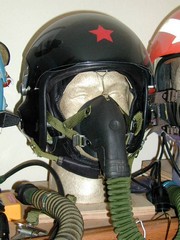
Were it not for a few of these observations, one would almost be tempted to adapt an imported ‘Chinese motorcycle flight style helmet’ off the shelf (paying the actual cost it may be worth, which is about $25 at the outside) for use as an actual flight helmet simply by installing a communications set and rigging the item for use with an oxygen breathing mask. Several years ago, in fact, I actually did this to prove a point to myself and confirm my foregoing conclusions, by buying a black Chinese ‘flight style’ motorcycle helmet from an overseas (Chinese) seller, fitting a communications system and installing a Russian style breathing mask (in that case a KM-32 or KM-16H pressure-demand mask). The helmet could and would have served its purpose as adequately as its Chinese PLAAF military aviation version (with the exception of its non-locking, simplified sun visor, a factor that would be important in an egress situation to protect against wind-blast) in terms of its shell/impact utility. Of course in China, many of these ‘flight helmet style’ motorcycle helmets are produced by the same companies that produce the certified flight-worthy PLAAF aircrew helmets; the same materials are used and the quality of each is nearly identical. Whether the Chinese 'motorcycle helmet' visor would be suitable for actual flight use remains an unanswered question, but it was still a very interesting experiment in my opinion (the modified helmet in reference is shown in the image appearing at the start of this article, mated to a Russian KM-16H mask and Chinese leather flight helmet of the Russian ShL type).
Reiterating a previous observation, it is important to note that impromptu and casual ‘experiments’ such as the one described here are not reliably precise enough to justify ‘adoption’ of cranial protective apparel for purposes other than that which they were designed for originally. In the case of helmets being produced in nations which lack a stringent regulatory oversight standard for quality (such as established in the USA assuring mandatory compliance with minimum safety requirements: OSHA, DOT, Snell Foundation, etc.) this is doubly true , since uniform quality assurance maintenance has yet to be instituted in some nations like the People’s Republic of China that are comparable to those already long established in the United States. The resulting variability that some production methods and manufacturing processes permit tend to further the uncertainties posed by some types of foreign produced safety equipment (e.g. safety helmets in particular).
NON AVIATION APPLICATIONS: Different design considerations
At present, cranial protection technology for bicyclist applications shares similar criteria to those utilized for the design and production of motorcyclist helmets, the main exception being that because manually operated two-wheeled vehicle riders generate significant body heat, ventilation quickly becomes almost as important a factor as intrinsic impact protection. Accordingly most high-end bicycle helmets typically feature a great number of ventilation orifices (perhaps an indirect affirmation of the fact that most bicycle riders ride bicycles during fair or warmer weather, when keeping cool is a very relevant concern). Bicycle helmets also tend to be lighter, since excessive weight on the neck while exercising strenuously can be tiring and taxing—more so than in the case of a passive operator of a motorized vehicle, at any rate. Looking at the high cost of the more expensive ‘high-status’ bicycle product brands (Giro, Bell, et al), one again has to feel that much of that disproportionate expense (i.e. high retail cost) is contributing to profits more than to any other factor, since just as adequate cycle protective helmets may be purchased for FAR less than the usual $150+ upper end models; the retail cost dynamics of corporate ‘branding’ and ‘market positioning’ are very likely contributing factors, as well.
Despite the fact that there has been very little real advancement in the art of cranial protection on all fronts (civilian sports applications as well as those for military aircrews), very recently a distinctly unique and rather interesting twist on protecting the head has arisen in the form of a new helmet design to protect riders of motorcycles and bicycles. The innovation I refer to comes from the Belgian LAZER Company, one of the oldest producers of protective helmets in Europe although not well known in the United States, and is named ‘SuperSkin’; it functionally addresses a phenomenon known as ‘rotational injury’ that is specific to ground impacts while riding wheeled vehicles (motorcycles and bicycles).
THE NEWEST ‘WRINKLE’ IN PROTECTIVE HELMET DEVELOPMENTS
Pioneered by a Dr. Willinger of the French IMFS Institute, ‘SuperSkin’ is an interesting artificial skin applied to the external surface of a helmet’s shell that helps reduce the possibility of axonal and tangential rotational injuries resulting from a helmet’s impact with a hard surface (a factor in crash impacts on wheeled vehicles that is of exceptional significance). The new artificial ‘skin’ functions similarly to human skin in that human skin has a certain elastic resilience (or ‘give’) when it bumps or slides over frictional surfaces. The ‘give’ dynamic of the skin-like material helps absorb, spread out and/or reduce the critical moment of initial high-G/high-onset force that is most likely to create an axonal or rotational injury of the cervical spine; it also lowers intra-cerebral shearing forces (by a reported 68%) acting on the brain itself, within the skull. Think of this process as significantly reducing intra-cranial torque, or abrupt inertial movement within the brain case, in addition to substantially reducing injuries caused by hyper-rotation of the head during an impact with the roadway. In performing all of this, the new technology is indeed a substantive innovation.
In this last regard, it is generally felt that well designed bicycle and motorcycle helmets should feature perfectly smooth and rounded surfaces that will reduce the possibility of a sharp edge ‘catching’ on an uneven snag in the roadway, thereby jerking the wearer’s neck tangentially. Unfortunately, this advice (based upon sound principles of physics) seems to have been ignored by almost all commercial bicycle helmet manufacturers, who all persist in creating helmets with what are best described as ‘swoopy’ ridges at the rear. The ‘swoopy’ ridging features serve no purpose whatsoever and are purely a sop to styling, since few bicycle riders wish to look any more ‘dorky’ than they need to be (so they think). Efforts to induce leading, high-status bicycle helmet manufacturers to create lightweight, well-ventilated, but smoothly rounded helmet shells have thus far been largely unheeded. With the new ‘SuperSkin’ technology, a helmet shell thus configured still needs to have a smoothly rounded external shell, but at least in Europe, safety and functionality are considerably more highly regarded than in the USA. The Belgian LAZER Company now has a line of both motorcycle and bicyclist helmets available for retail sale that feature the new ‘SuperSkin’ technology and in that sense, this recent development represents the first truly unique advancement in motorized vehicle helmet design in at least 40 years.
In the military areas of cranial protection technology, the recent introduction of the ‘smart modular helmet’ seems to represent the most recent advancement in aircrew state-of-the-art helmet technology. Using the modular aircrew helmet concept, a standard, basic foundation helmet has been developed permitting indivisualised custom fitting that takes a range of interchangeable ‘mission-specific’ upper helmet component shells. The mandates of the program leading up to the new concept included extreme light weight (so as to reduce G-loading on the wearer’s neck) and to a great extent, this has been permitted through the application of newer materials technologies that previously didn’t exist, or which were formerly too expensive to realistically consider. With the latest modular aircrew helmet coming into use, among other things it will be possible to do away with a range of different helmets and variations that have existed for more than half a century. Naturally, the new ‘smart’ helmets will carry a much steeper price tag than their vastly simpler predecessors, since they will be far more complex and technically advanced, but they will undoubtedly offer not much more basic cranial impact protection for the aircrewman’s head than the older (‘dumb’) helmets do now.
LOOKING FORWARD: End of the need to protect aircrew with helmets?
Of course, taking things a step further yet, with the growing advancement of sophisticated and smart’ remotely piloted air vehicles (and despite the understandable resistance of flight-rated ‘pilots’ who will insist that a mere machine will never be able to perform certain mission tasks better than a human occupant can), it isn’t impossible to contemplate a time when the whole career field of aircrew life support technology may be threatened with its own demise. Hopefully that day is still a bit far off in the future, but there’s no arguing the advantages offered by being able to eliminate the costly and weighty burdens of supporting human life in the inherently hostile environment of atmospheric and high altitude flight.
Even if the above scenario does occur and human crews are no longer needed to operate high-performance military atmospheric craft (read: combat aircraft), the need to continue to provide suitable protection for the human brain remains with us and shall remain with us in perpetuity.
Just as important as the actual research science and technological development that attends helmet design is the need to educate individuals on the need for and benefit from use of a protective helmet. A helmet…any helmet…is only effective when actually worn. Although that seems like a childish proposition, there is still too much ignorant reactivity to the wear of protective helmets by civilians engaged in potentially hazardous activities (such as sports, etc.). Protecting the brain is perhaps one of the most important things a person can do to assure a long and productive life. In one sense, failure to wear a helmet may fairly be regarded as a genuine ‘no brainer’…