WAR FROM THE GERMAN PERSPECTIVE: A MATTER OF DIFFERENTIAL HISTORY
By Kalikiano Kalei
One of the great truisms in the study of history, any history, is that since history is written after the fact (in most cases well after the fact), all historical accounts reflect the biases and assumptive interpretations of the writers authoring them. Therefore, in reading these accounts of events past, one can only hope that the ‘interpreters’ producing a historical chronicle of events have made a serious effort to remain as fair and unbiased as possible in cobbling together the various realities of an earlier era into a coherent recounting of factual material. Sadly, that is not always the case, since given human nature and the vagaries of human emotion no person is ever entirely objective, and historians are all individuals.
As a historian myself, albeit one of modest stature and accomplishment, I have always been (in the past) very careful to avoid ‘affective history’, feeling that history is best written from the academic approach and one that reflects the dogma of the ‘political interpretation’ school that has been prevalent among students of history since the earliest beginnings of our modern age of science and technology. It has therefore been only recently that I began to examine ‘affective historical’ interpretation as an equally allowable mode of attempting an understanding of past events.
Further, in past decades, although I found the concept of ‘living history’ (‘affective interpretation’) inherently fascinating, I tended by reflex to regard ‘living history’ reenactions as being for the most part a sort of glorified adult play-acting activity. Call it ‘Cosplay’ with an erstwhile ‘serious’ purpose, if you wish, but it involved grown men (and women) engaging in the sort of play-acting children might partake of, albeit with a far broader range of knowledge, interest and focus. If it helps to conceptualise my bias with an analogue, think of little girls collecting Barbie Dolls or of small boys collecting toy soldiers. Then imagine adult men collecting small 1:6 scale but highly detailed (and quite expensive) model replicas of fighting men and 1:18 scale tanks, airplanes, etc. The analogue is reasonably plain and no amount of obfuscative denial or rationalization could possible disguise the fact that at the bottom of all this, there really is no difference between the puerility of all those children and the ostensibly grown-up earnestness of people engaging in historical play-acting in this analogue…except perhaps 20 or more years of difference in their ages. I think my point is clear enough. The powers of human rationalization are far greater than most of us realize and there is always a healthy dollop of the child in the most mature and ‘grown-up’ amongst us.
At any rate, after years of regarding ‘living history reenactment’ as being little more than grown-ups playing like children (albeit with a degree more of sophistry), I experienced a sort of personal epiphany and found myself taking a far closer look at the modern phenomenon known as historical re-enactment (AKA: living history), something I once termed ‘hysterical recreation’. In my particular case, I found myself attracted to the Second World War period, widely acknowledged to be the single largest and most important expression of global warfare in all of recorded history.
As a person born in 1946, I personally never lived through any of that war. My earliest personal associations with the history of war began in the 1950s, with the ‘UN Police Action’ in Korea and somewhat later with a far more intensive association with the ‘Cold War’ and Vietnam. My interests outside of the area of general history (i.e. military history) naturally evolved along these modern timelines, and the Second World War (known as ‘Die Zweite Weltkrieg’ to those of German extraction) period for me remained principally an earlier era that I found quite interesting, but had no greater desire to understand and explore intimately.
Yet, as a person of both Irish and German ancestry, I found myself studying the culture and history of both nations, partly, I suppose, in order to understand my own formative ancestral influences. Thus I studied German language in school and took courses in German political, social and economic history. Since my own maternal German relatives came from Southern Bavaria, I began to take considerable interest in that region, joined various German-American associations and several European (international) groups (such as the various alpine clubs and the Naturfreunde/Touristenverein, the latter of which began in Austria as a socialist organisation to provide camaraderie and recreation for German-speaking factory workers; it is today an international outdoor recreation group with no political orientation whatsoever).
In particular, I found the history of Germany’s educational system of great interest, most particularly certain aspects of the role higher education (university study) played in German society and the fascinating influence German student organisations (‘studentenverbindung’) had on the greater educational development of university students (and by extension, of German society). At one point in my academic studies I even undertook a summer study program at the University of Heidelberg, where I closely investigated the German student dueling societies that were an important part of many of the student organisations. It was quite an immersion in German culture to say the least and the budding historian in me luxuriated in all of the culture and vestigial traditions to be found in German speaking Europe.
Perhaps understandably then, the further I progressed with my study of German Kultur, the harder it was to ignore the profound socio-economic circumstances that helped bring the German National Socialist Movement (NSDAP, or ‘National Socialist German Workers’ Party’) of the 1930s into being. Regardless of my efforts to avoid or sidestep Hitler’s Third Reich, sooner or later I would find myself plummeting full smack into that unpleasant crucible of political extremism that was Naziism.
Harkening back to my own childhood, my mother’s brother had been an Army surgeon fighting against the Axis, first in North Africa and later in Italy under General Mark Clark’s command. By the time the war came to an end, ‘Uncle Charlie’ had been part of the force that liberated what soon became West Germany. He had also been one of the first medical officers to discover first-hand the stark horrors of the German extermination camps, with their still warm crematoria, mass-graves of half-buried corpses, and thousands of gaunt & emaciated, hollow-eyed survivors. It was a sight that permanently affected him to the extent that he took great pains to ‘educate’ me and my cousins on the full extent of the atrocities that had occurred in German throughout the war when we were finally old enough to comprehend the information intelligently.
As a relatively sensitive child, his stentorian lectures managed to inculcate within me a strong sense of moral revulsion over what the Third Reich had done to eliminate Jews and ‘other undesirables’ throughout Europe from 1930 through 1945, and this became a rigidly fixed part of the mental baggage I carried with me into adulthood. It shouldn’t be too hard , therefore, to imagine how awkward it was to find myself fascinated by a culture (part of my own heritage) that clearly had perpetrated (as far as I knew at that time) some of the world’s greatest ‘crimes against humanity’.
But of course, having not yet studied the entire history of the world to any great extent at that time, despite being widely, perhaps precociously read for my tender years, I was then still largely unmindful of many other mass atrocities carried out against human beings by brutal dictators that were in some cases even more profoundly malevolent (e.g. Stalin, Pol Pot, Mao Tzedung, and many others who managed to kill far more people than the Hitler regime). I was also largely unaware of the broader, pervasive history of anti-Semite bias that had long been a part of European and Russian culture, centuries prior to the rise of the Third Reich. For these reasons, I, like most Americans who had not previously studied history to any extent, held the popular misconception that Hitler and the German National Socialist movement constituted a profoundly unique singularity, an isolated collective aberration of the human spirit and instance of extreme inhumanity with no peer.
However, as my studies in world history progressed, I soon began to suspect that I had not been given the whole story, that the Hitlerian excesses of the 30s and 40s were not by any means isolated in terms of the magnitude of their intrinsic malignancy when compared to other regimes of other eras. This in turn made me curious about why exactly that was the case and the more I learned, the more I realized that the German National Socialists have been so profoundly and exclusively demonised since war’s end thanks to a massive and continuing effort by people of the Jewish faith (notably by Jewish interest organisations such as the Anti-Defamation League, the B’nai B’rith, and other Jewish/Israeli advocacy groups dedicated to strident, near militant perpetuation of the ‘Never Forget’ sentiments they espouse). So voluminous has been this effort to isolate and demonise ‘Hitler’s evil regime’ that the actions of all other equally brutal dictators (e.g. Stalin, who is reputed to have killed well over a hundred million of his own people, and Mao Zhedong, who may have killed even more) pale in the average person’s awarenesses.
The reasons for this are, of course, many and varied. There is the fact that the entertainment/media business is (and always has been) dominated by people of the Jewish faith. There is the fact that strong ‘pro-Israel’ lobbies today exert tremendous political influence on the American Government to support the Jewish state (and by extension, all Jewish causes). And there is the American ‘political correctness’ movement that, in its haste to ‘un-offend’ everyone, regards even a balanced and scholarly discussion of these subjects as somehow constituting a potential hate crime in the making. The point that should emerge here is that ‘Nazis’ have become the world’s favorite criminals in the minds of most people, thanks largely to overemphasis of certain facts and incitement of gross confusion over broader, far more complex realities, and despite the fact that as far as genocidal maniacs go, Hitler was a mere amateur.
Further, in its enthusiastic campaign to vilify the National Socialist regime of Hitler’s Third Reich, one of the things the many American organisations that promote Jewish ‘self-interest’ agendas have succeeded in doing is making the terms ‘German’ and ‘Nazi’ synonymous, interchangeable and mutually inclusive. Given the fact that most Americans are abysmally ignorant of history in general and prone to possess the most simplistic of outlooks on the most complex and complicated of issues, this effort has succeeded beyond the wildest imaginings of the pro-Jewish agenda lobbies. Today, almost all Americans still regard ‘the German people of World War Two’ and ‘German National Socialists’ as being perfectly congruent entities. In reality, it isn’t quite that simple and nowhere is this more important a distinction to make than with regard to the matter of German military services serving in that war (the German world for ‘military services’ is ‘Wehrmacht’, or ‘military might’).
When I finally began to take an interest in German military history, and especially concerning WW2 living history reenactments of the period, this fact quickly settled in on me with uncomfortable emphasis. At the same time, it became clear that Americans have viewed the Second World War from a distinctly myopic viewpoint ever since the war ended: that of the victor over a politically corrupt and evil regime that was so despicable as to have absolutely no redeeming human qualities whatsoever. Consequently, up until recently, almost any veteran of that war who somehow survived its carnage and savagery has seldom given a thought to the humanity of his opponents. The elderly 8th Air Force vet who spoke at the museum last week on his experiences suffering horrendous rates of bomber attrition from German air defense forces manages to paint a rather evocative picture of what it was like to be forced to sit there for unending hours in a large multi-engine bomber undergoing trial by murderous FLAK and merciless fighter attacks. It was terrifying, of course, since the chances of aircrew survival were probably less than one in four at some points during the massive late war Allied bombing raids on German cities, and the aircrew losses were always horrific. But it illustrates a profound lack of awareness that all sides suffered near equally in the airwar.
From his highly nostalgic vantage, however, this vet basks exclusively in the vivid personal recollections he still harbors of managing to avoid being hit, despite the fact that ‘all those Nazis’ were trying to kill him, and he scarcely regards the ‘enemy’ as being little more than ‘…the $#&^*! Nazis, who fortunately lost the war’. In that context, one can hardly blame him for this rather short-sighted awareness of the broader picture, since all that mattered to him at the time was staying alive to get back from his mission intact, the same preoccupation any combatant has in the thick of war-fighting, regardless of the era or the conflict.
One casualty of all of this one-sided focus and concentration on survival by ‘our WW2 heroes’ (often termed the ‘Greatest Generation’) in such actions is the fact that there were two sides to the war (with each participant suffering equally disproportionate losses), a point that is completely lost on most younger Americans today. Moreover, not being widely read, most younger Americans (of all ages) have never made an attempt to learn another language (such as German) that might enable them to read recent works written (in German) by German veterans of the war underscoring that fact. One result of this has been that until recently there have been very few books available in English about the German wartime experience.
Sadly, younger Americans are invariably not interested in factual or documentary histories of warfare as much as in sleazy ‘action genre’ movies filled with gratuitous machismo, extreme violence and improbable feats of steroid-enhanced, testosterone-spurred recklessness (thanks a lot, Hollywood!). In most cases, whenever a German soldier is featured in a movie, he’s typically portrayed as the archetypal evil Nazi, a sneering android who goose-steps in his sleep and tosses out Hitler salutes in his dreams like confetti at a parade (there are rare exceptions to this gross movie stereotyping, of course, one such being Peckinpah’s memorable film ‘Cross of Iron’). The fact is that very few, only a small number in fact, of the German military forces fighting in the war were members of the Nazi Party. Also little known is that the ‘German Defense law of 1938’ actually proscribed party membership for members of the Wehrmacht (this is not to say that party members did not serve in the armed forces, but their numbers were quite small and most were uniformly castigated by the non-party members in those groups, who regarded political cadres with disdain and disgust).
With regards to Hollywood’s grossly biased portrayal of German soldiers in films, if the character in question isn’t made out to be a blatant icon of evil Naziism, he’s typically characterised as a bumpkin or fool (examples abound in the popular 1960s TV series ‘Hogan’s Heroes’ and in Mel Brooks well-known ‘The Producers’). There are so many examples of this tendency in American film media that I do not need to dwell on the point. Who could ever forget, for that matter, perhaps the two worst such films ever made: ‘Surf Nazis Must Die’ and ‘Werewolf Women of the SS’! Or a third (equally wretched), 'Ilsa: She-Wolf of the SS'?
However, to return to the earlier point of departure in ‘affective’ or ‘reenactment’ history, whereas there are few, if any, delicate areas of doctrinal difference to deal with in historical reenactment of most other eras of warfare, when it comes to the Second World War and the fact that the Axis powers are (still) broadly regarded as ‘Nazis’ (whether in part or wholly), one immediately encounters the necessity of distinctly differentiating the fine distinctions that define degrees of ‘Nazism’ in reenacting Axis history.
Ideally, one would need to undergo a comprehensive academic course on German National Socialism to fully understand the difference between ‘ordinary party members’, members of the overly stereotyped ‘SS’ (universally typecast as a supremely evil nucleus within German National Socialism that totally lacks redeeming human qualities) and regular members of the German Armed Forces (typically not members of the party and often actively antagonistic to the National Socialist Movement from about 1942 onwards). Only after one gains a glimmer of understanding that Germans and Nazis are not one and the same can one even be expected to appreciate the fact that a predominant number of Germans suffered severely throughout the war themselves, no thanks at all to a political party that (shortly before war was declared) rigidly controlled all aspects of German society so harshly that overt dissent was nigh impossible (and in most cases regarded as highly treasonous activity that warranted an immediate death penalty).
Today, some 68 years after the end of the war, thanks to the low-profile but wildly successful campaign to forever vilify Germans as unrepentant Nazis (and blur the all-important distinctions therein) by Jewish-American interest groups and pro-Israel lobbies, it is still difficult to approach the subject of the German military actions undertaken during that war and discuss them intelligently without running a gammut of the insinuative political/doctrinal baggage in reference. For anyone attempting to portray a German Wehrmacht soldier, this serves as a doubly frustrating obstacle in that before any objective understanding of facts and historical events may be presented to, appreciated and/or understood by a largely ignorant public, the political aspects must first be dealt with and cleared away. It is an exhaustive and disappointingly demanding challenge for most WW2 German Wehrmacht reenactors, to say the least.
Very recently the ongoing attempt to clear away the obfuscative haze of the National Socialist bugaboo has been greatly aided by the appearance of several important new books dealing with war history from the German side of the conflict, an outlook that has never before been given a fully objective airing in America. Among these are two books in particular, each produced by a former participant in the German Luftwaffe air war who managed to survive the slaughter aircrews faced in that branch of service as the war ground to a close. The first book, written by Adam Makos, is titled ‘A Higher Call’ and focuses on the life of a remarkable anti-Nazi Luftwaffe officer named (Leutnant) Franz Stigler and the incredible encounter he had with a severely damaged American B-17 bomber late in the war, over the German coast. The second book was actually written by another surviving Luftwaffe fighter pilot, (Leutnant) Gottfried Dulias, who today at 88 years of age, is an American citizen (titled ‘Another Bowl of Kapusta’, ‘Kapusta’ was the cabbage-based, thin gruel fed by Russians to their captured German POWs in work camps, providing just enough sustenance to keep them alive). In Dulias’ case, he was captured by the Russians after being shot down on the Russian Front in 1945 and sent to Russia, where he was held for four long years after the war ended; given the fact that the Soviets deliberately starved their captives, that he was one of only 600 out of 4,000 German captives in his group who managed to survive the work camps is almost miraculous.
In both of these seminal works, one sees the terrible violence of war through the eyes of these actual German participants in no uncertain terms and it quickly dawns on all but the dullest readers that German soldiers were in fact NOT those raving Nazi stereotypes that are so popular in movie portrayals, but ordinary individuals just like us who only wanted to get through a doomed war alive and intact. In both of these cases, the principal characters were profoundly and actively anti-Nazi, despite the fact that their rejection of the prevailing NSDAP political doctrines could easily have resulted in the death not just of them, but of their entire families, friends and acquaintances. I cannot recommend reading both of them highly enough for the sense of ‘humanity’ that comes strongly through the pages of these two works.
There are many other books written both in English and in German that paint the German war experience in terms that make it very clear that all participants suffered near equally. In the case of the German people, as the war closed in on them, the brutal events consequent to the fall of the German Reich (due largely to the vicious and vindictive actions of the Soviet ground forces, but also as a result of the highly controversial mass bombing campaign against German civilians and their cities by the Western Allies) make it very clear that despite the fact that German actions had set the war in motion, its disastrous end (and the grievous consequences suffered by all Germany as a result) was terrible beyond comprehension.
One particular book that makes no false arguments in its portrayal of this ‘Gotterdammerung’ is war historian Richard Bissel’s excellent ‘Germany 1945’, a book that focuses on the last year of the war and Germany’s reemergence from the total devastation it suffered when the war finally ended. Anyone who feels that ‘those dirty Nazis got what was coming to them’ after reading it is either a complete fool, a heartless and retributive idiot, or a completely unread individual with no greater knowledge of the events that led to the war. Lest there be any misunderstanding, the toll of death and total destruction wreaked upon Germany by May of 1945 was near unfathomable and dulls the senses in any effort to get one’s mind around the facts and figures concerning human losses and urban infrastructure in wars of this global magnitude and scope. Avoiding both of two common attitudes (one postulating that that Germany deserved its fate and another that Germany suffered unfairly), Bissel manages to remain factually objective in his history.
One greater point emerging from all of the above is that due to all the highly emotional sentiment still associated with the German National Socialist racial cleansing doctrine that threatened Europe’s Jews with extinction, virtually every other aspect of that war falls away, either little regarded or completely ignored. Given the fact that the Jewish people are so adept at making their eternal mistreatment at the hands of others known, few other voices emerge from the extreme violence of that war that speak so eloquently or so clearly. In that context, a grave disservice is done, for the German people are not (nor have they ever been) a unified mass of heartless, evil-minded people. One can no more fairly lump all of Germany in together with the vile political philosophies of 1930s German National Socialist doctrine than one could accuse all Russians of being Stalinists or all Chinese of being mindless followers of Mao Zhedong. To attempt to do so would be indictful of gross ignorance and misunderstanding of the worst sort in Americans (but then, sadly enough, many ‘average’ Americans do seem to be of this type, so that’s not saying much).
With due reflection on all the above points, it should be further apparent that any and all portrayals of Second World War Wehrmacht soldiers (in a reenactment context) are fraught with inherent challenge (say, as opposed to portrayals of Civil War era Confederate States soldiers or British Imperial soldiers of the American Revolutionary War era), posing a number of thorny obstacles in the undertaking. Despite the fact that the German Air Force is not usually thought of as being an inherently ‘Nazi’ branch (rightfully so, as I shall explain), given the widespread misapprehension that still exists between the definition of a ‘Nazi’ and a Luftwaffe pilot (for example) on the part of most of the public today, affective historical reenactment of war-era Luftwaffe personnel does contain the occasional paradoxical exception to the rule.
It will become clear to any student of history studying the war that although at the outset (mid-30s), the German Air Force was at the onset perhaps the most National Socialist of all the German Armed Forces (simply because the ‘air weapon’, as the latest and most scientific technological advance in warfare, had never really existed prior to that time, if one discounts the rather primitive state of the German Air Service in the First World War), due to its being the newest service (and one that had come into being at the specific behest of the new Reich). However, as early as 1942, with the German invasion of Russia underway, and with America joining in support of the Allies, it is safe to say that virtually no one (except perhaps Hitler) much doubted that Germany was already doomed. There was simply too much materiel advantage on the side of the Allies for the war to end otherwise, and Hitler’s immensely (and unrealistic) self-serving delusions (coupled with his supreme power) led him to commit the German nation to plot an unrecoverable strategy of multi-fronted war that progressively (and surely) led to Germany’s eventual downfall.
By the time the war began terminally closing in on Germany (1943-44), the Luftwaffe had long since recognised that while its tactical leaders (wing, group and squadron) commanders were quite gifted and often brilliant aerial tacticians, its highest leaders, most notably Reichsmarshal Göring and some of his OKL appointees (Oberkommando der Luftwaffe), were grossly inept and lacked any conception of a truly strategic plan for winning the war. The anti-Nazi sentiment became strikingly emphatic within the Luftwaffe at that point, as the Luftwaffe began to waste away, a good illustration of which may be found towards the end of Makos’ excellent book (‘A Higher Call’), wherein the Luftwaffe Fighter Command literally rebelled against its leadership (Goring) in a mutinous refutation of his policies.
All of these distinctions while readily understood by any serious student of World War 2 history, fail completely to penetrate the awareness of an uninformed public who may attend historical reenactments involving German Wehrmacht soldiers, and any effort to be instructive in correcting these misperceptions may be far more exhausting than is worthwhile for most to undertake. For many ordinary people, ALL German Wehrmacht soldiers will forever remain 'Nazis'.
These are just a few of the challenges awaiting anyone who takes a serious interest in wartime history viewed from the German side of the conflict and attempts ‘affective reenactment’ of Luftwaffe history through the creation of personalised ‘impressions’ of Luftwaffe pilots and personnel. Sadly we can’t all be students of history who have long-since taken the trouble to understand the complex and challenging backstory of social, political and economic events that gave rise to the war, but lacking that, one must never lose clarity of the fact that, despite recurrent and shrill insinuations of anti-Jewishness and anti-Semitism that typically attend any reenactment activities associated with the WW2 German Wehrmacht, a convincing ‘impression’ will always factor this into the equation beforehand and mandate a serious effort to deal with the matter fairly, reasonably, and objectively (despite any hysteria that arises).
As we veer farther away from the events of the Second World War with the lengthened passage of time, it will very likely become a bit easier to engage in WW2 historical reenactment involving the German Wehrmacht, since as we all know time has a tendency to bring about both forgetfulness and forgiveness. While no sane individual would ever want to experience a recurrence of the disastrous political policies that gave rise to the outrages committed by German National Socialism (a just echo of the Jewish ‘Never forget!’ sentiment), and no sane individual could ever condone the genocidal excesses of the Nazi Party, it may become a bit easier to broach the subject with more balanced objectivity in the immediate future as more information surfaces about the extent of Stalin's evil pre-war machinations. To continue to pretend that the German people are (and ever shall be) all irredeemable beasts and to completely ignore the role Stalin's Communism played in precipitating war is a gross miscarriage of reason and wisdom (despite however well it suits Jewish sentiments). At the very least it is certainly not a recommended perspective from which to recount and detail past events for any truly wise and reasonable individual to assume.
History demands that we be able to discuss matters such as the Second World War freely and openly in order to do full and impartial justice to truth and the factual events of past decades…from both sides of the conflict. Any other approach is ultimately futile and highly duplicitous to an extreme, but excellent evidence that sifting through history to formulate a truly comprehensive and balanced analysis is something not easily undertaken until well after all the facts have finally been made available from the full complement of antagonists involved.
------------------------------------------------
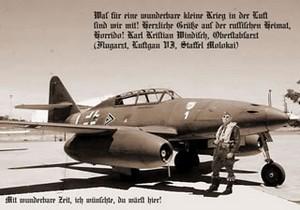
For any who may be interested in historical reenactment ‘living history’ activities of WW2 German Luftwaffe personnel, I might suggest getting in touch with LARA (Luftwaffe Aircrew Reenactor Association) in the United States, or with LARG (Luftwaffe Airfield Reenactment Group) in the UK. These are the two primary living history groups committed to portraying impressions of wartime Luftwaffe personnel. Both are actively involved with aviation (restored or recreated German vintage ‘warbirds’) and quite rewarding to associate with. Lest anyone have reservations, these groups strictly forbid any embrace or espousal of Third Reich political doctrines and are focused solely and exclusively on attempting to convey visual ‘affective’ enactments of what it was like to be a wartime Luftwaffe aircrewman, fighting an ultimately hopeless airwar against overwhelming odds for Germany.