Der Fliegeruhr: Fliegerchronograph und B-Uhr
Much has been said about the planes and the men of the German Luftwaffe, but there has never been, somewhat surprisingly, a definitive history written on that most basic tool of German wartime airmanship, the Luftwaffe aviation watch.
As far back as the early 1900s, with the introduction of airplanes as weapons of war, it had become clear that the air age would require a new generation of precision time keeping instruments. As Germany covertly developed what would become the new Luftwaffe in the 1930s, it was readily recognised by the Reichs Luftministerium (RLM) that both aircrews and aircraft would need high quality timing instruments to carry out military navigation duties and to fly missions with accuracy and precision. Thus, a plan was initiated by the RLM to produce, in addition to aircraft cockpit clock instrumentation, wearable aircrew watches that would provide pilots and navigators with the timing capabilities demanded by modern flight. Orders for several thousands of each type were therefore initiated.
In the 1WK, Imperial Air Service pilots often flew with conventional pocket watches modified with a wrist strap that allowed them to be viewed instantly, without the distraction of reaching into a pocket. The large size of these early watches (often from 50 to 55 mm in diameter) enabled them to be easily viewed in difficult lighting, among other things, and thereby a precedent was established for the ‘large-face aviator watch’.
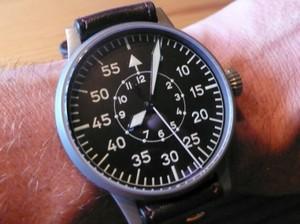
When the RLM initiated an order for production of high quality aircrew chronographs in the late-1930s, two types of wearable watches soon came into being: the slightly smaller ‘Fliegerchronograph’ (case 40 mm in diameter) and the larger ‘Beobachtungsuhr’ or Navigator/Observer Watch (known as the ‘B-Uhr’ with a 55 mm diameter case). The former watch was intended principally as a precision wrist-worn, zero hacking, fly-back watch for single-engine or fighter type aircraft pilots (Me-109, FW-190, etc.), whereas the larger (and also wrist-worn) ‘B-Uhr’ watch was intended mainly as an adjunctive precision timing instrument for navigator/observers in multi-engine/multiple-aircrew bomber aircraft, such as the Heinkels, Dorniers and Junkers.
The original producer of the ‘B-Uhr’ watch, Lacher & Company (LACO), found that the early production order outstripped their ability to produce the required large numbers and as a result several other manufacturers were given movements and components and also produced the watches (including IWC, Stowe, Wempe, and Lange u. Sohn). The ‘B-Uhr’ watch was produced originally with what is termed the ‘A-Dial (conventional, large 12 hour dial face) but was produced later in the ‘B-Dial’ (large outer minute dial and concentric smaller inner hour dial). Today, the most readily recognised ‘B-Uhr’ watch by aviation history buffs has the ‘B-Dial’, in the 55 mm diameter case. These oversized watches were produced with very large winding stems so that they could be operated with flying gloves on.
The somewhat smaller ‘Fliegerchronograph’ was originally produced by two companies, Hanhardt originally (in 1939) and later Tutima (Glashütte) in 1941. It featured a 40 mm diameter case, a 17 jewel mechanical movement of very high quality and a two-button, flyback timing mechanism for display of elapsed minutes and seconds (using two smaller dials within the larger peripheral 12 hour display dial). Whereas the larger navigational ‘B-Uhr’ watches were typically worn with large adjustable leather wrist bands that permitted use over the sleeve of a heavy flight jacket, the smaller Fliegerchronograph was more typically worn directly on the pilot’s wrist with a fitted, adjustable leather strap. This type of watch was most favored by dive-bomber (Ju-87 Stuka) aircrews and fighter aircraft pilots.
Due to the high precision of these watches (both types) and their relative cost, they were signed out selectively to aircrew and carried on aircrew Soldbuch logs as issued personal gear. Only navigators and those serving in a similar critical capacity aboard an aircraft were usually issued the ‘B-Uhr’ type watch, although it should be remarked that these watches were regarded as a type of high-status symbol by many high party members, RLM personnel and higher level Wehrmacht staff.
Both types of watch were typically produced in nickel-plated brass (anti-magnetic) casings, stainless steel not being introduced until well after the war, and most were not water-proofed. Much sought after as war souvenirs by Allied soldiers, many were brought back by returning Soviet and GI soldiers.
When the war ended, many precise Wehrmacht watch manufacturing factories (the Tutima plant in Glashütte being one) ending up in the Russian occupied zones were physically removed and sent in their entirety to Russia, where they were reestablished on Russian soil and used to produce copies of the German originals. Today, many Russian copies built up through the 1960s (by Moljna, et al, for the Russian Air Force) are obtainable at relatively low cost that externally look almost identical to the original German types. The Hanhardt company, lying within the French occupation zone, was quickly put to work at war’s end making aviation watches for the French Air Force (as Vixa).
Due to the origin of the war era RLM specification, no one company may trademark either the ‘Fliegerchronograph’ or the ‘B-Uhr’ design, hence a number of companies today produce aviation watch copies that greatly resemble the originals (i.e. Zeno in Basel).
Very recently, Larcher & Co (LACO) produced a special limited run of the first RLM specified 55mm ‘B-Uhr’, authentic in every detail to the original, for about US$ 3900. Hanhardt did much the same with its limited edition ‘Fliegerchronograph’. As a special note, most ‘B-Uhr’ grade watches were identified either on the inner bottom or outer bottom case as a ‘Beobachtungsuhr’ timepiece, on their sides with an engraved FL-numerc, and original examples are very much sought after by both watch collectors and reenactors alike.
Accordingly, both types of aviation watch have today achieved fame as ubiquitous symbols of the wartime Luftwaffe ‘Experten’.