Die Impression: Luftwaffe Militärisch Kultur
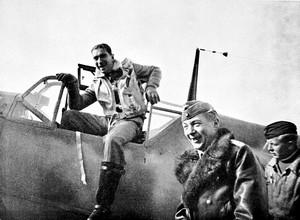
Perhaps contrary to the casual observer’s (i.e. non-reenactor) initial opinion, there is far more challenge presented to a reenactor attempting to create an accurate impression of a German Luftwaffe officer (pilot or otherwise) than might first be imagined. Although the first notice an observer takes of a reenactor usually registers visually (i.e. uniforms and weapons), the true core of successful reenaction impression lies closer to the focus of a professional screen actor who has spent many hours studying his character and getting in touch with his ‘inner motivation’.
Although reenactment today includes a broadly diverse range of individuals, from many walks of life and all with differing social and academic backgrounds, the putting on of some kit and striking a pose is merely the figurative tip of the historical iceberg, or, considered another way, the virtual ‘trailhead’ of a potentially arduous journey towards achieving true authenticity. Renown military historians such as Williamson Murray and Jörg Muth have frequently reiterated the fact that there is no such concept as a ‘uniform military culture’, or a universal cultural Rosetta Stone standard whose definition applies to the military organisations of all nations, since the military culture of each nature is distinct and uniquely different.
Nowhere is this true r than in the military culture of the German Luftwaffe of 1935-1945, an organisation that in a brief ten year period of intense conflict underwent a sea-change transformation in terms of attitudes, affects, political outlooks and operative philosophies. At the time of its establishment (and in the years immediately prior to the outbreak of hostilities), there is little disagreement among historians that the ‘new’ (post 1WK) German Air Force was the most profoundly empathetic of all the German military services to the dynamic socio-economic philosophies of National Socialism. The Luftwaffe was, after all, the direct descendent and beneficiary of the pre-war ‘civilian’ soaring and flying training activities (e.g. the DFV and NSFK), a pervasive program rigorously administered, tightly orchestrated and logistically dominated by the NSDAP. One did not become a student glider pilot or enter ‘civilian’ flight training casually; in most cases youthful pilots were fostered through the Hitler Jugend, typically at the behest of an official in those groups who carefully monitored the ‘political correctness’ and doctrinal suitability of his youth trainees.
Thus, by the time the war actually began, the Luftwaffe had become the most profoundly National Socialist influenced of all three German armed forces. This was to change in due time, as noted above, but it is a fact that we must nevertheless accept and deal with in the preliminary course of our efforts to enact convincing impressions as personnel of the 2WK German Air Force.
Jörg Muth, in his excellent work on the comparative military cultures of wartime Germany and the United States, stops short of actually stating it, but in order to really mirror the causative influences and elements of the Luftwaffe officer class, one must be far more than a skillful actor. In order to truly ‘feel’ the impression, it would be helpful to include among one’s assets a comprehensive knowledge of classical and modern German history. It wouldn’t be too much of a stretch to insist that that knowledge also include, if not an actual degree from a German University, at least a western course in the history of German educational institutions, since officers of the German armed forces were typically highly educated and culturally literate.
Prior to the rise of the NSDAP, the German military establishment had been dominated by the traditional Prussian ‘Junker’ class, but with the rise of the new National Socialism, the German military found itself held somewhat uncomfortably at arm’s length by Hitler, a political interloper who maintained an intense, if vague distrust of the powerful institutional command traditions of the Wehrmacht. As a traditional occupational option of non first-born sons of upper class social class, the German officer corps most often drew its candidates from well-to-do families, who invariably held academic degrees from the older and more prestigious universities. In the case of professionals (such as doctors), advanced degrees from institutions such as the University of Heidelberg’s medical program were virtually de riguer. In such institutions, social class distinctions were paramount.
One must remember that the German Universities of the early 1900s had strong pre-existing martial traditions that were the product of more than a century of non-secular, socio-political conservatism , a situation not insubstantially augmented and reinforced to a substantial degree by the popular and aristocratic student association traditions (Studenten Verbindung). Thus, most candidates for the Wehrmacht (and almost all for the Luftwaffe) were by and large well-connected, well-educated and significantly acculturated in the highly emotional appeal of the new ‘nationalismus’. As heir to the newest area of advanced military technology, aviation, the Luftwaffe was truly an elite organisation.
With the emergence of the NSDAP, the new right-wing political ideas were in many cases passionately embraced by large numbers of university students, although these influences opposed at the onset to varying degrees by the established German Roman Catholic Church and Catholic-aligned student organisations.
At a time when the rest of the world was reeling from the effects of the depression-era market, the emergent NSDAP exuberance proved highly contagious as a counterbalancing panacea to economic hard times, conveniently exploiting as it did both a popular and widespread fixation on Jews being a major source of Germany’s misfortunes, and the semi-mythic legends and fables of ancient Germanic folk-heritage. The combined allure was most intoxicating, to say the least, and it was very easy for large numbers of the German people (including military personnel) to fervently embrace the promise of the new National Socialism against this backdrop.
All of the above, however, is merely backstory and an explanation of why sentiments developed as they did in Germany, prior to the war; it is also history that has been heretofore exhaustively researched and covered by a number of writers and researchers. For our purposes as reenactors, it should suffice only as a spur to general awareness of causative events that will impact our efforts to ‘reenact’ history, no matter how careful we are to sidestep the Third Reich’s inflammatory political doctrines and dogma..
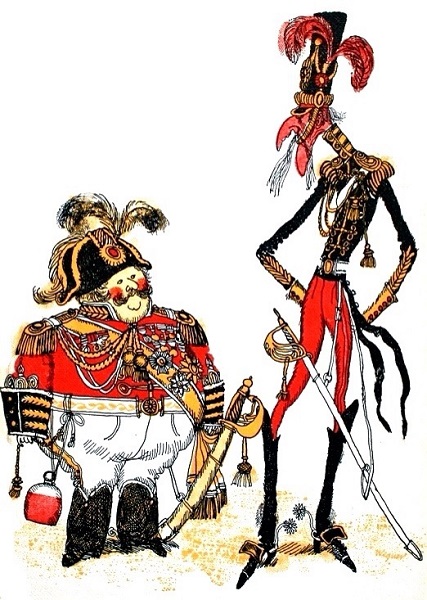
Mindful of the above, it should be clear that the officer class in the German armed forces was a distinctively elite element comprised of well educated, highly cultivated ‘gentlemen’ officers. Although later in the war the dire constraints of diminishing manpower pools relaxed the mandates and requisites for entry into the officer class somewhat, the remnants of the traditional Prussian military influence remained palpable and rigidly reinforced the status of German officers at all levels throughout the conflict.
Consequently, anyone who strives to construct and inject a successful level of authenticity into a Luftwaffe officer impression must be always aware of the need to cultivate and manage these social class qualities whilst working up an impression. By contrast, although a fair number of lower and mid-level US officers in the 2WK had some higher education background, a predominant majority were actually quite ungraced by either higher social class attributes or modest higher educational assets. In strong contrast to the German Wehrmacht’s professional officer corps, that of the United States paled remarkably in terms of its social and academic erudition.
To what extent one achieves a believable ‘impression’ as a Luftwaffe officer (and/or pilot) will reflect the dynamics discussed in the above paragraphs. The fact that all of these things changed profoundly as the fortunes of war turned in upon Germany serves to simply complicate an already complex area of historical ‘reenacting’ that we should all be quite mindful of when we don the uniform, unlimber the ‘Storch’ and try to present the human side of what is by any definition perhaps the most inhumane activity human beings engage in: organized warfare.








enjoyed the read, nice informative article
i like the preservation of history via reenactors, when younger i was a Civil War/War Between the States reenactor,
Never stop writing!!
m