Sänitatsdienst der Luftwaffe: Medical Flight Readiness 1935-1945
From the time the National Socialist Party (NSDAP) gained control of Germany (1933) through the year 1937, the medical services division of the Luftwaffe (established officially in 1935) was a very small organisation that served two distinct commands, the Army Medical Inspectorate (for professional concerns) and the Chief of the Luftwaffe General Staff (for administrative affairs).
In 1937, aggregate Luftwaffe medical services were granted their own organizational command autonomy within the Oberkommado der Luftwaffe (OKL). This was the Luftwaffe Inspektion des Sanitatswesen (German Air Force Medical Inspectorate), designated in abbreviated form the L.in.14, comprised of three sub areas of specificity (medical, organisation, and personnel). As it became clearer that Germany was about to enter into a state of war, the development of the L.in.14 expanded rapidly in order to be fully prepared to support combat operations and continued to develop throughout the following years (until about 1944).
In October of 1939, archival documents show an authorized allowance (Sollstärke) of 2,500 medical doctors; of these, 2,000 were immediately available for field operations and about 500 were still completing internships. By 1944, at peak strength, about 7,500 medical doctors and surgeons were on the rolls of L.in.14, of which about 1,500 were dentists.
Prior to about 1930, the German military forces of the Reichswehr had had no direct experience with aeromedical evacuation (called ‘Medical Air Readiness’, or MAR, in Germany) of combat casualties to rear treatment areas, although in contrast France had already developed one of the earliest forms of air-lifted casualty treatment. The reason for this is clearly attributable to the strict limitations imposed by the post 1WK Versailles Treaty Agreement on the German nation.
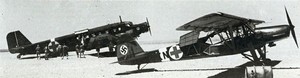
With the establishment of the German Luftwaffe in 1935, Surgeon General (Generalarzt) Erich Hippke presciently took the matter into hand and laid the groundwork for establishing a Medical Air Readiness service for the Wehrmacht (principally serving the Heer und Luftwaffe) using the new Junkers Ju 52 tri-motored transport aircraft. Developed at the outset ostensibly as a commercial air transport, the many military applications of the Ju 52 were well foreseen and it was deemed the perfect ‘workhorse’ for future MAR operations.
Using a Ju 52 aircraft outfitted with four patient stretcher stations and operated by the German ‘BAYER’ corporation, the Luftwaffe seized upon this concept as a prototype for use by its own anticipated MAR units. First tested in 1932-35 on an experimental trial basis in South America, the Ju 52 proved excellent for this application. Thereafter, the concept gained further operational validity during the Spanish Civil War for transport not just of wounded Republican forces under Franco, but of ‘Legion Condor’ personnel. Wounded soldiers were transported to the rear for medical treatment, but were for the first time also evacuated from Spain to Germany for more specialized treatment.
As the concept developed, it was found that modifications to the basic Ju 52 aircraft permitted higher altitude flights over the Alps up to about 20,000 feet (6,000 meters); these modifications included better thermal insulation against cold, improved stretcher stations and medical treatment equipment that included supplemental oxygen for patients. Despite a wide range of pulmonary, cardiac, burn and overt trauma injuries, there seemed to be no significant untoward effects on patients from this exposure during evacuation.
With combat casualties increasing, it quickly became apparent that more specialized MAR units were needed. This proved especially to be the case in combat zones such as the Eastern Front, where both the fighting and the weather were extreme and severe. As the concept expanded, teams of MAR personnel were put together consisting of enlisted, NCO and physicians who were trained to triage, stabilise and load patients within eight to fifteen minutes in most cases. As operations grew within the various Luftgau, additional aircraft were put into service for MAR use. These included the brilliantly designed, lightweight Fieseler Fi 156 ‘Storch’, which could manage several stretchers per flight after landing on small and rough forward areas, and the Focke-Wulf FW-200 ‘Kondor’ that permitted far more patients to be carried per flight. In certain other areas, amphibious aircraft such as the Blohm u. Voss BV 222, the Do 18/24, and the BV 238 (among several others) were also used for MAR maritime operations.
All Luftwaffe MAR units were headed by flight surgeons (Flugarzt) who were dual-rated physician/surgeons and pilots, an arrangement that was unique to the Luftwaffe. Each MAR unit contained from 30 to 140 personnel of all ranks and included male orderlies, German Red Cross Helferinen, flight support personnel, ground crew and doctor-pilots. Unique to the Luftwaffe medical services, all MAR operations came under the command authority of the L.in14 and took their orders directly from that division of OKL and not from regular Luftwaffe flight personnel command headquarters. Each MAR unit commander had command responsibility for not just the unit’s personnel, but for all the casualties being evacuated. Similarly, each aircraft commander flying MAR missions was a medical physician-surgeon and rated pilot who wore the ‘cornflower blue’ waffenfarbe (not the gold-yellow waffenfarbe worn by regular air personnel).
Missions flown by MAR units were frequently extremely hazardous, fraught with danger and demanding of the highest levels of both medical and flying skills. Sadly, few if any of these brave individuals in MAR units ever received the full public or private acknowledgement they deserved for such exceptionally meritorious service, while more glamorous fighter pilots typically basked in luxurious public adulation back in the homeland.
Originally marked with large, conspicuous red crosses on a white overall paint scheme, MAR aircraft were in too many instances nonetheless deliberately sought out and destroyed in many theatres, ultimately necessitating a change to more obscure markings. Quite often, as a result, MAR aircraft joined regular transport flight formations to further conceal their identity.
The Luftwaffe’s MAR units served throughout the war with great distinction and well deserved the gratitude of the many thousands of lives they helped save, despite the fact that to this day theirs is a little known and less often repeated story in the annals of Luftwaffe history.