MAKE OLE: YELPING JOYFULLY INTO THE DEEP FOREVER NIGHT…
‘Make Ole’ is Hawaiian for ‘death’. Personally, I’ve never handled death very well. It’s the reason I studiously avoid funerals, memorial services, and any other social gatherings associated with or celebrating the end of someone’s (or something’s) life. The only memorial service I truly regret having missed is the paddle-out for Auntie Rell Sunn, back in 1998, but that was an impossibility for me at the time.
When my father died (I was 4 years at the time), I was at least spared whatever possible latent psychological problems that event might have posed, by not being forced to attend the burial. In fact, I didn’t even know about it until some years later. Death was a taboo subject in my household and that was both a good and a bad thing, as I now recognise.
Years later, when my mother died, the subsequent details were taken care of by others; there was no ‘viewing’ of the remains, no eulogy, no service, and cremation obviated the need for a burial. I remained largely sheltered from death, from that end to life that all living beings undergo and that all sentient beings reflect upon until their own appointment with the reaper occurs.
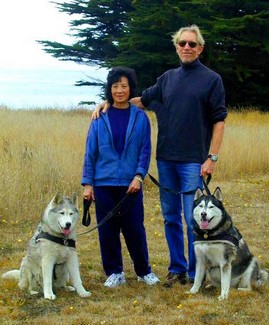
My first real introduction to death and the emotional loss it creates came when the first of my wonderful Siberians passed on, about 8 years ago. The name on his pedigree was ‘Dylan’s Dynamite Junior’ and he was the offspring of two champion Siberians; to us he was always just ‘Deejay’. We had acquired Deejay as a companion to our first dog, an un-papered but pedigreed gray & white female Siberian we named ‘Laika’ (after the famed Russian space dog sent into orbit on Sputnik 2 on November 3rd 1957), mindful of the need these highly intelligent dogs have for companionship and our absence from home during the workday.
Deejay came to us in 2007. We had hoped that he would prove a good companion to Laika, our family’s ‘alpha dog’, and help keep her diverted during the day when we both were away at work. Since Siberians are quite clever and smart, they become easily bored from lack of sufficient stimulation, so we were hopeful that Laika and Deejay would bond together as pack mates (since both were ‘fixed’, we had no greater expectations than mere amicability).
Deejay was a most unusual dog in many ways, not least being his size. Standing a good 2 inches in excess of the AKC show standard maximum allowable height at 25 inches, Deejay was sold to us as a pet, despite his being a magnificent and highly attractive dog. Deejay was so big even knowledgeable dog people frequently mistook him for a Malamute; those blithe souls who knew little about northern working dogs thought he was half-wolf, although his demeanor and personality was hardly wolfish. Deejay was in fact a canine creampuff, just a handsome and loveable ‘glamour-boy’.
Deejay seemed to recognise a camera as soon as it appeared in someone’s hand, and owing to that trait, he was one of the most photogenic dogs I’ve ever known; a real ham who would assume a perfect camera pose at the drop of a hat. With that wonderful ‘husky smile’ he habitually wore on his muzzle, Deejay would typically charm the socks off anyone who came near him. It was almost as if he had been a movie star in a previous life, so genuinely appealing was the inherent and natural ‘glamour’ affect he possessed.
Despite his formidable size and appearance, in terms of being a courageous protector of his family Deejay was a complete flop, since he was by nature a very timid guy. His timidity was almost legendary, given the fact that he would go to any possible lengths to avoid associating with other dogs or people. For reasons unknown to me, he seemed to be palpably fearful of blacks, despite the fact that he had never had any contact with blacks in his entire life. Ditto for cigarette smoke, the merest scent of which was enough to send him hurriedly in the opposite direction, tugging on his leash in a near-panic-stricken effort to get as far away as possible from the smoker.
Deejay was always somewhat anxiety prone like that, a tendency that complemented his rather timid (but oh-so-loveable) personality quite well in retrospect. Loud noises were extremely discomforting to him, a nuance that peaked on July 4 and on New Year’s Eve with their loud fireworks effects. Even a shout was enough to visibly startle this great big guy, who loved nothing better than to sprawl decorously out on the family room carpet, surrounded by peace and quiet. [In all fairness, I should add that a friendly nature (even to strangers) is a bred-in Siberian characteristic, since thousands of years ago they lived with the Siberian people in villages where total strangers would frequently come and go. Deejay was just a gentle giant—a sort of canine version of ‘Ferdinand the Bull’, from the old children’s story about a Spanish bull bred to fight in the ring, but that wanted nothing more than to be able to be left alone so that he could smell the flowers out in the pasture.]
Laika, on the other hand, was clearly the ‘alpha female’ of the family pack, having demonstrated a tendency towards totally self-centered gratification in her earliest days of puppyhood. When we first looked around for a Siberian, we encountered Laika as one of a six puppy litter produced by a local area person’s two pure-bred, but un-papered Siberians. When I went to their house to look at the litter, after answering an ad in the paper, I was immediately impressed by her behavior among her litter-mates: instead of coming over to me like her brothers and sisters, she couldn’t stay far enough away to suit herself, waddling across the floor to huddle against the far wall of the room. Clearly, all the signs indicated that this was a very independent-minded pup who would never allow anyone to become too close to her, and then only on her terms.
At that time, however, I was convinced that this ‘independent’ nature was a good sign, since I have always admired independent personalities in people (especially women). Instead of picking one of the other palpably gregarious pups, who all came over to sniff and lick my hands, I selected that little ‘loner’ of a Siberian girl we ended up, whom we named Laika. It was my first inkling of what would follow in terms of her subsequent social development, but the second clue occurred almost concurrently, since I had visited the pups at their breeder’s home just before dinnertime and the meal was about to be served.
Both of Laika’s parents were at the house and the sire seemed to be a somewhat formidable and not particularly friendly guy. Not that he was aggressive or overtly unfriendly; just that he conveyed the impression of a dog that kept his ‘leader’ dignity under tight check and remained somewhat aloof from his female and her pups.
As soon as his food bowl was filled, Laika’s ‘Dad’ started to eat, but no sooner had the food been placed there than little 8-week-old Laika waddled right over to his dish as if it were her own (the pups were fed separately from the parents). Giving her a look as if he didn’t believe what he was seeing, Laika’s sire glared at her for a second or two as she approached his dish, clearly eager to gobble whatever choice tidbits had been placed there for her pop. His look should have stopped the pup in her tracks.
Then, before any of us fully understood what was coming, Laika’s sire had snapped at her face and connected with the front part of her muzzle with his teeth. In a split second the air was rent with absolutely anguished puppy sounds of pain as he bit into her nose hard enough to create a small gusher of blood! It was over in an instant and we merely looked on stupidly, as if unable to fully comprehend what had just happened. Poor, greedy little Laika scampered, howling in a most heart-wrenching manner, to the corner of the room as we all watched dumbfounded. It was over in a fraction of a second, and ‘Dad’ went about eating his kibbles calmly thereafter as if nothing unusual had happened. Knowing very little about what vets humorously refer to as the ‘drama queen’ personality in some Siberians, we thought she had been mortally wounded. But in fact, the wound was not at all as serious as it was an unanticipated shock to the poor little pup.
We had already agreed to take Laika and had even paid for her ($250 at the time in 1993) in advance, but the owners were apparently so flummoxed by this unexpected display of canine interactive behavior that they immediately offered to return the money, expecting us to want to select another, uninjured pup from the litter.
I would have nothing of their offer, of course, since I had selected her for her unique personality and the injury really didn’t matter at all, by my reckoning. As a result, we merely left her with the owners for a few weeks more, since they offered to have her treated by the local vet to repair the damage. And damage it was, for her sire had landed quite a forceful bite on her poor little nose. The repair required a number of stitches and the resulting scar remained visible on her muzzle right to the end of her days. Most pups would have learned something from this experience, but not Laika!
A few weeks later, we picked up strong-willed, greedy, headstrong, and somewhat antisocial little Laika to take her home with us, whose nose had by then healed well enough. She remained with us for fifteen and a half years, finally passing over the rainbow bridge just a few days ago (October of 2008), remaining the undisputed ‘alpha dog’ of our family pack to the very end.
In 2004, Deejay, our great big good-natured goofball of a russet colored Siberian male crossed over the rainbow bridge, the first of our Siberians to depart. He had contracted a strange malady that was likely, seen in retrospect, a rare if severe, immunological disorder that quickly progressed to the point where he had wasted away appreciably in his final days. Many expensive sessions at both the local vet’s hospital and even at the highly specialised UC Davis Small Animal Clinic failed to reveal any sensible working diagnosis that fit any recognised canine syndrome. After trying everything we could think of to reverse his mysteriously rapid decline, Deejay, having brought inestimable happiness into our lives, was only 13 when he passed over that rainbow bridge. In retrospect, his problem may have been linked to a zinc deficiency that Siberians are sometimes prone to.
Laika, for her part, never accepted big, lovable Deejay as being any sort of peer for all the time that they were together, much to my intense regret. Despite weighing a mere 65 pounds to his 115 (he was truly a giant for a Siberian), she led him around as if he had a ring in nose and never once let him get near us while she was around. It was almost as if she were trying to ‘protect’ us from receiving his love and affection, despite the fact that he was an extremely affectionate guy who clearly wanted our attention. With true canine stoicism, however, Deejay accepted Laika’s incontestable ‘top dog’ status in our household and always deferred to her in all matters. It is, after all, the natural ‘way of the pack’ to work out such alpha and omega hierarchies, and northern working dogs still retain many of their ancestral wolfish instincts and primal intuitions, despite having been genetically separated from true wolves for more than 20,000 years ago. [Recently, with advances in genetic science, it has been determined that all modern dog breeds still have about 99.98% of their ancestral wolf DNA!]
I am convinced that in order to ‘work around’ this constant attempt by Laika to deny him access to our proximity, Deejay adopted a natural and unforced mechanism of artfully clever deceptivity. Something on the order of the behavior of a small child who, although constantly getting into trouble, puts on a great big ‘it’s OK’ smile to deflect attention while continuing his mischief. This somewhat deceptive affect, mild and amusing as it was, was enough for me to take notice of it in Deejay, and the result was my ‘familiar’ name for him: ‘Deejay Dishonest Dog’. I suppose part of that unique appellation stems from my recollections of the ‘Beany & Cecil’ kiddie show of the late 50s, the chief antagonist of which was a bumblingly sinister cad named ‘Dishonest John’, but it seemed a perfect fit for Deejay and it stuck. Deejay remained forever (and affectionately) ‘Deejay Dishonest Dog’.
Deejay was, by the way, one of the most ‘vocal’ Siberians I’ve ever encountered, among a breed that is almost legendary for its tendency to vocalise with a sort of modulated ‘talking’ (rather than barking, which Siberians rarely if ever do).
Perplexed and greatly saddened by our loss of our lovable canine clown Deejay in 2004, we were again left with willful little Laika, our irrepressible alpha dog, about as close to famed writer H. Ryder Haggard’s ‘She Who Must Be Obeyed’ character as a dog may be. Still, and despite indications that she might well be one of those rare dogs who preferred single-dog households to gregarious ones, we still felt that leaving Laika alone all day by herself (since we both still worked) would not be good for either her or us. Thus, I began looking around for another companion for Laika.
In August of that year (2004) I happened to connect with a Siberian Husky rescue group in northern California named NorCal Sled Dog Rescue, by surfing the internet one day in a moment of indolence. There I found a beautiful black & white Siberian male—estimated to be about 9 years old—that was up for adoption after having been rescued from a nearby community’s animal pound. The dog in question was certainly a pure-bred Siberian, judging from his picture, but strangely he had had almost all of his heavy coat from his neck downwards sheared off by his previous owner!
Expressing interest, I was warned in advance by the group’s contact person not to be ‘put off by his appearance’. It had been a very hot Sacramento summer (not atypical for California’s ‘Great Valley’). Sure enough, upon my arrival to see him in person, I found that he had indeed had most of his heavy coat shaved clean! The incongruity of this bizarre act was perplexing, but he really was a beautiful guy and we seemed to hit it off immediately; in fact, our mutual attraction was, as far as I can tell, instantaneous! His name had been ‘Cherokee’, according to the group’s records and it was only after his having been repetitively found in the pound several times (Siberians are all escape artists, if left unsecured) that he was finally rescued from an apparently careless owner by the group. Details about his incarceration there were sketchy, but he apparently had a strange sort of benign but actively growing neoplastic tumor on his left foreleg. Several expensive operations had been required to remove it, all quite costly to the rescue group. We happily paid the bills for his care and I brought our new guy home to meet Laika, the reigning ‘queen’ of the house.
Cherokee was, in my opinion, a terrible name for a dog or any dog, since effective dog names need to be no more than two syllables in length, with a good firm and clear ring to them that a dog won’t confuse with other words. However, not wanting to confound the poor guy, I decided to rename him ‘Raki’, which although suitably short and succinct, is not all that far off from the last syllable of his former name, ‘Cher-o-kee’. Regardless of what Raki felt about being renamed, he warmed up to it right away and thus began a four-year relationship that was probably one of the best and most fulfilling I’ve ever enjoyed with a dog.
As might be easily understood, the average person who heard us use his name invariably thought the name was spelled ‘Rocky’ (as in ‘Rocky Balboa’ of the Sylvester Stallone film), but in fact it was an allusion to a style of uniquely fired traditional Japanese ceramic ware known as ‘Raki’. This fact required explanation repeatedly throughout the following four years, but I humor myself into thinking that a number of people we explained this to had their awareness expanded in a positive manner by that information.
Raki was a genuine joy. Everything that Laika lacked in terms of being affectionate and loving, Raki had in spades. If Laika’s chief aim in life seemed to be escape (from attention and affection), Raki’s seemed to be the opposite. I often suspect that Raki recognised acutely the difference between a loving, caring, and positive owner and one who was not, by virtue of his former experiences in the prior 9 years of his life. Although Laika tended to demean him with her air of assumed superiority, just as she had Deejay, when she wasn’t around Raki was eager to come close and was a positive delight to have near.
Sadly enough, Raki’s problem with the strange non-cancerous growth on his leg had not been fully resolved and the growth grew back several times after we got him, each recurrence requiring further expensive surgery and recovery care. Finally, however, the treating vet facility seemed to have gotten all of it removed with one last surgery and it finally went into remission and stayed away. We were just congratulating ourselves on having won that battle when a more disturbing problem turned up with Raki. Blood tests revealed that he had sustained a rather severe diabetic state (ketoacidosis, also known as ‘brittle diabetes’) characterised by an unusually rapid onset. We put Raki on injectable insulin right away, but despite daily blood glucose testing, his blood sugar levels seemed extremely hard to maintain at a reasonably good level. It wasn’t long before he descended into an intractably resistant form of ketoacidic diabetes.
In addition to the diabetes, Raki also developed a rather strange condition in which his footpads curled out to the side in the form of big ‘corns’. The term for the condition is ‘hyperkeratosis’ and research revealed it isn’t too uncommon in Huskies, although it is usually Zinc-responsive. In Raki there was no response to Zinc therapy, however, and this problem remained with him to the end, poor guy. Diabetes and a severe foot pad problem: we felt that was probably enough burden for any dog to have to bear, but things continued to get worse in short order.
All of this required careful veterinarian management and the level of care Raki received was probably better than that many people have with their regular health insurance programs. But it was also expensive, and I knew from my experience in human medicine that regardless of the care he received, diabetes is invariably a terrible thing for any living creature to be afflicted with. It is more so for an animal, since they can’t communicate directly with care-providers about symptoms, feelings, and other important parts of the problems in a meaningful healthcare feedback loop.
After four wonderful, full years of life with us, Raki’s conditioned rapidly worsened due to his severe diabetic state. Soon enough what had appeared to be merely some haziness in his eyes turned into full blown, opaque cataracts, and while cataracts could have been surgically removed, no ophthalmological veterinary surgeon would have willingly performed the procedure unless his diabetes were first under good control. And of, course his diabetes was anything but that. Our wonderful Raki quickly became blind as a result and it ripped our hearts out to see such a magnificent guy rendered so helpless, with no possible recourse to restore his sight. Our sorrow was, however, not native to Raki’s happy personality, which was remarkable…just like his constant, good-natured smile.
Toward the end, Raki additionally suffered a stroke, resulting in a severe impairment of his balance and hindquarter motor control to the point where he could hardly stand by himself and couldn’t walk without careful and attentive assistance. At that point, Raki having reached the age of 13 years, just like Deejay, we felt that the kindest thing we could do to spare Raki any further misery was to send him across the rainbow bridge, as we had done with his predecessor, Deejay. Although the decision to do that was among the hardest I’ve ever had to make, clearly it was for his own good, as the quality of his life had deteriorated to the point where it was the only reasonable course of action to take. Thus, we said our sad goodbyes to Raki on September 4, after spending an entire two days by his side at home. I even slept on the floor of the family room with him, letting him crowd me off the thin foam mattress willingly, knowing that in a few short hours our great-hearted and much-loved family member would be nothing more than another cherished memory. It was the saddest experience I can ever recall having in my life. I didn't have a dry eye all day.
The day we took Raki on his final car-ride to the local veterinary hospital, Raki was met by there by our vet, a wonderful woman vet who had a great and abiding affection for dogs. It was she who administered the fatal injections that put him to sleep forever. I’ll never forget her marvelously thoughtful comment as she listened to Raki’s chest with her stethoscope while the final bolus of Potassium took its irreversible effect. “It’s as if he’s just walking slowly away from us toward the Rainbow bridge.” I am admittedly a dreadfully sentimental person but even now that inspired and tender thought brings a tear to my eyes.
As affirmation of what a uniquely wonderful dog Raki was, the entire staff of the Mueller Animal Hospital in Sacramento sent us a beautiful card on which everyone had penned a few words reflecting on Raki’s wonderful personality. He had made many, many friends there and all, from the vets down to the part-time kennel cleaners, were saddened to see him leave. We were both surprised and pleased to receive a number of other sympathy cards from friends of ours who had come to know Raki in his four years with us. They too, clearly recognised the exceptional uniqueness of his buoyant spirit and affectionate nature.
Raki’s final departure left a huge gaping hole in our hearts (and one that has never fully healed), but we at least still had Laika, the female Siberian we had raised from puppyhood. At an age of 15 plus, she gave every indication of being bomb-proof and immortal up to the time we lost Raki. By come strange coincidence, the very day we said goodbye to Raki Laika seemed to experience a severe nosebleed. This was mystifying, although she had been sneezing a lot before then. leading us to believe she might have gotten a foxtail in her nose. For a Siberian, 15+ years is getting very old indeed, with the average age of most Siberians reaching about 13 or so. Laika, by this time had lost about 98% of her hearing, but aside from an occasional bad stomach, seemed in reasonably good health.
In the following weeks, she seemed to slow down remarkably and rapidly, and one cannot help but speculate that at least part of this was attributable to losing Raki, the begrudging partner she had shared our house with for four years. Although they were rarely more than the ‘best of enemies’ (Laika being always true to her typical antisocial self), she clearly ‘missed’ Raki and it showed clearly in the amazing rapidity with which she seemed to suddenly age years in the span of a few weeks after Raki left us. Her appetite, never good for ‘regular’ food (since she was so spoiled by receiving treats and bits of our food), fell off remarkably and her energy level diminished noticeably.
Visits to the vet and a new round of health exams soon showed that our poor little pup (we called her ‘the pup’, despite her advanced years) suffered from severely advanced adenosarcoma of the sinus region. The condition is virtually untreatable, due to its location just under the brain pan, and survival rate rarely exceeds 120 days at most, according to the literature.
A series of skull xrays and a rhinoscopic exam confirmed that the cancer had likely already penetrated into the cranial space housing her brain and it was clear at that point that Laika would have little time left with us as a result. There was really nothing we could do to arrest the progression of this condition. ‘Heartbreaking’ is hardly an adequate term to use in describing such situations, but the evidence was clear and the outcome predictable: it would be best to send Laika on to join Raki and Deejay in that mythical pasture dogs go to, across the rainbow bridge where there is always sunshine, food, and companionship.
Laika joined Raki less than 30 days after Raki had gone, leaving us with a suddenly quiet house; it was a situation we hadn’t really anticipated in all the years we had had our canine family members, since one really never thinks seriously about death until forced to or confronted directly by it.
The pain of loss and the grieving process is always acute for human beings, since our cursed ability to reason opens up endless doors into areas of melancholy speculation that animals, unable to reason, are spared from. After much involuntary thought on the subject, I feel that we humans grieve mostly due to a sense of our being deprived of the joys of companionship with other living creatures. That is, we grieve not for the lost friends or animals themselves as much as for ourselves. It is a selfish sort of thing. Left in the vacuum of kindred company that the departed have suddenly created in our lives, we somewhat selfishly mourn ourselves and feel sad for our own misfortune. Having managed to avoid responsibility all these years of my own life for the necessity of coming eventually to terms with death, I have in the past month been rather rudely brought to a denouement…as all of us must… with the angel dressed in black.
Having lost considerable faith in my fellow human beings over the past 6 decades, I have grown to appreciate animals more than my own kind, for while human beings have been imbued with the ability to reflect upon their lives (positively or negatively) and make balanced, rational decisions, animals are purely instinctual and live according to the direct input of their senses and intuitive resources. There can be little if any beguilement or deception possible among animals, unlike among humans. For that reason (among many), our pets have grown to mean much to us in the otherwise highly deceptive reality that characterises the ‘religion’ of modern capitalistic materialism that most Americans embrace.
Life therefore without dogs is almost inconceivable to me and I am already looking into acquiring two new Siberian family members from NorSled. They won’t take the place of my wonderful former companions Laika, Raki, and Deejay, but at least the new guys will keep me preoccupied and less inclined to reflect on the loss we’ve recently undergone. Before long and in beautiful accordance with nature’s natural processes, our new team-mates too will become a critically important and vital addition to our household pack; with any luck we’ll all pass over that final rainbow bridge together, at long last, all howling joyfully into the Great Unknown Forever that we benighted mortals may all only speculate endlessly about to our last breath.
We did in fact soon acquire new pack-mates named ‘Sooka’ and ‘Walter’, two middle-aged Siberian male litter-mates that were rejected by the Los Angeles Pound due to their being categorized (soley on the basis of their status as ‘seniors’) as ‘unadoptable’. When they were rescued by our NorSled Husky rescue group, they were a mere couple of hours away from being put down! They quickly came to be known to us as ‘The Fabulous Flying Furry Fuzz Brothers’ and their story constitutes a whole separate chapter in our lives.
Sadly, Walter rather quickly succumbed to cancer, leaving Sooka (who was quite attached to his brother) visibly shaken. Sooka went on, however, to live a wonderful full life with us, finally expiring at the incredibly ripe old age of almost 17 years!
A wonderful, mellow fellow, for the last four years of his life Sooka shared our home with yet another new rescue, named ‘Nala’. Nala is, by the way, another female ‘Alpha’ dog (I seem to have a talent for picking strong-willed Siberian Huskies!) and we were told by our rescue group that she received her name from the popular children’s film ‘The Lion King’, so we elected to keep it.
That was about 7 years ago and Nala is now the equivalent of 88 human years (about 11 dog years); despite her age you’d never know that she’s an older matron, since she relapses into puppy moods quite regularly and is quite unhappy if she doesn’t get at least three good walks every day (her dog-team mushing days are now at an end). Nala sleeps under our bed, when she’s not lazing immodestly on her back under my desk, at my feet. But her story is yet another (largely untold) chapter in the continuing story of our many wonderful Siberian huskies.
If I were a religious person (which I am most definitely NOT), I’d be tempted to say that our lives have been blessed by all the faithful companions our marvelous husky dogs have been to us. I’ll settle instead for the secular (but no less grateful) thought that we’ve been fortunate, most fortunate indeed!
[In memory of Laika, Deejay, Peary, Raki, Sooka and Walter; more faithful four-footed friends one could never hope to ask for!]
---------------------------------------------
“If dogs don’t go to Heaven, I want to go where they go when I die!” -quote attributed to Samuel Langhorne Clemons (Mark Twain)
“They do not mush quietly into that final deep and darkened pale of Arctic winter; howling and yelping joyfully, all pulling together towards the glowing wonder of the timeless Aurora, they vanish from our sight…but not our hearts!”-quote not attributed to Jack London, Dylan Thomas, or in fact anyone, but it’s a neat thought!













When I lived in that small country community in West Virginia, I had the good fortune of having neighbors with dogs. One medical doctor neighbor had two very aggressive German shepherds that scared everyone away from his beautiful, often bikini clad, wife. I recall one salesman having to climb up on the top of his car to escape them. When they would charge me, I would pretend to be humble and bend low. They then would come up to me and greet me with wet kisses and accepting my petting them. I never had any trouble with aggressive dogs. Guess I didn't show any sign of fear or running away.
Anyway, the bodybuilding neighbors up the hill from me had an appropriate pet. A very lovable and huge malamute lady. I really enjoyed wrapping my arms around her wool blanket covered warm body in a bear hug. But I wouldn't want the cost of feeding her or her vet bills. Another neighbor, I didn't know which, owned a young husky male. He came up to me a couple of times very close, but I don't recall petting him. What got me was his pale blue eyes searching me like a baby child. What magnificent animals huskies are. And then a student had a pair of samoyeds. So beautiful in their white fur.
But it's torture for them with their northern origin to live here in Houston with our high humanity and heat in the summer. I was given a purebred black pomeranian already named, Jazz, as a result of the divorce that the African graduate student of mine had. I don't know how old Jazz was, but he had spent his entire life on a concrete patio and was freed up by my huge house, doggy door and fenced in yard that he could run at leisure, keeping his toenails wore down from exercising after birds in the yard, lizards on the windows and kids coming to the front gate. He required no grooming, just dry dog food, water and enjoyed finding a favorite warm or cool place to sleep in any kind of weather. He was lonely during my time at work, but the outdoor environment kept him occupied. His favorite place when I got in a wheelchair was directly under it until he heard the relay click and he was gone, to avoid his fur from getting caught under the wheels.
Jazz was with me eight years and was still a very active puppy with a graying muzzle at his untimely death. He only suffered from an abscessed tooth that was pulled and fleas that were corrected by a monthly pill along with his heartworm pill. But he was attacked three times. The first time by three pit bulls. He didn't go to the vet and recovered in a week. The second time by a huge labrador/mix that he recovered from without going to the vet in less than a week. But a year later, he was killed by the same dog whose teenage owner I had chastised for letting his dog run free. I wrote about the tragic day here in my story, Jazz's Death. I didn't have the heart or inclination to replace him. It is very hard for me to take good care of a dog from a wheelchair.
http://www.authorsden.com/visit/viewshortstory.asp?id=3718&authorid=3918
Ron