‘FIRST MAN INTO SPACE!’ (Recollections on the threshold of space)
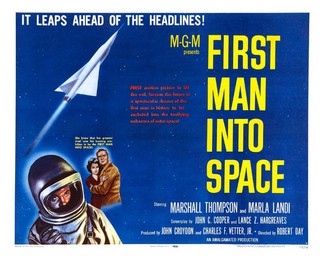
As I sit here, carefully picking bits of hazelnut from my teeth that were originally part of a 100 gram Ritter Sport Schokolade mit Haselnüssen bar (amazingly, some of the very best German chocolate that money can purchase, although somewhat hard to source), I am abstractly gazing at an old Hollywood movie marquee poster from the late 50s.
On it are depicted a space-suited astronaut, a stylized, winged Rocketship, and a grotesque, human-sized monster thickly coated with what looks like moon-cratered chocolate sauce, from head to foot. As things turn out, it was not. The title of the film is ‘First man Into Space’ and it was a seminal film for me, as an aviation-struck young man of the 1950s.
Growing up as I did near the fabled Mojave Desert flight test area known as Edwards Air Force Base, I literally lived and breathed fast jets, rocket-planes, test pilots and all the dazzling glamour & excitement that attended America’s fledgling post-war high-altitude flight research program.
Having reaped the benefits of Nazi Germany’s technologically advanced wartime aviation research, American aeronautical scientists and engineers at Edwards (then still named Muroc Army Air Field…it wasn’t renamed ‘Edwards Air Force base’ until late 1949, to commemorate the death of test pilot Glen Edwards who was killed in the crash of the jet-powered Northrop XB-49 ‘Flying Wing’) were poised to fly higher and faster than anyone had ever before been, or so it seemed, as nearly every week the newspapers brought us new breath-taking accounts of secret experimental aircraft that had reached incredible speeds and ascended to unimaginable heights in the Stratosphere that had previously only been dreamed about.
Our heroes of that period were test pilots named Crossfield, Goodlin, Hoover, Yeager, Boyd, Ridley, Murray, Apt, Kincheloe and Kittinger and the aircraft they tested were generally all part of what were known as ‘X’ aircraft (for ‘experimental’), prototypes of what Germany was developing to combat the threat of Allied air superiority late in that war. Most of these were gleaming white projectiles with sharply pointed noses, short, stubby wings and engineered to achieve supersonic speeds at a time when the so-called ‘sound barrier’ was still thought to pose a near-insurmountable barrier to ultra-high speed atmospheric flight, and they oozed glamour and ‘sex-appeal’, although to us pre-pubescent kiddies, the full force of that hormonal force hadn’t yet washed over us! All that my juvenile buddies and I knew was that these feats were about as keen, swell and ‘super-neato’ as anything could possibly be, by our admittedly child-like reckoning!
Like all the pint-sized peers who constituted my gang, I had shelves in my bedroom crowded with dozens of scale plastic models made by the Monogram, Strombecker, Revell and ‘Lindberg Line’ companies…all of new jet planes. Propeller-driven aircraft were at that point considered passé and I can’t recall a single little friend in my cohort who wasted any of his time building models with propellers. The hottest, most exotic things in the air were the new jets and rocket-powered aircraft that capture our fancies like few things could in that age.
All told, it was an age of sheer wonderment and fascination for us as we obsessed on these beautiful new objects of flight.
Nearby Edwards Air Force Base was, of course, where all of these developments were taking place and I was far luckier than most kids of my years in that the base was literally in the ‘neighborhood’. Every time an opportunity presented itself I would hie myself off to the base to bask in the reflected glory of all those amazing aircraft and their fearless pilots. These opportunities usually presented themselves in the form of Edwards AFB ‘Open Days’ (Memorial Day and Armed Forces Day, typically, when the base would put all its advanced flight test aircraft on display and even provide the public with a special air show featuring some of them), but every now and then my Boy Scout Troop would schedule a special trip to the base, where the base public relations office would go to great lengths to provide an interesting itinerary that would keep us all dazzled for hours at a time.
Probably the highlight of these many trips was a group-photo the base photographer took of us clustered around the sinister black nose of the North American X-15, which in the 60s achieved hypersonic speeds in the range of Mach-5+ and record-shattering altitudes well into near-space. Another time I was able to actually try on Scott Crossfield’s flight (TopTex) helmet and (MS22001) oxygen mask, oh heart be still! I still have photographs of me in my Scout uniform wearing this gear that are among my most treasured images!
At any rate, most of my summers were also filled by preoccupations with flight, as a next-door neighbor kid’s father had been a WW2 Air Force pilot and belonged to the Air Force Association (as many of his peers did, back then) who had a whole attic filled with back issues of Air Force Magazine (a glossy publication with military aviation news and filled with images of the Air Force’s newest and latest aircraft; even the advertisements in it by the aircraft manufacturers were exotic and colorful). Many a hot Idaho summer day was thus spent in that attic reading these fabulous magazines and soaking up their exciting stories and images.
I had, of course, early-on resolved to be a jet pilot myself, beginning back in the late-1940s, when my father had pushed me down the street in a kiddie-carriage (I was barely 2 or three at the time, I vaguely recall), past the large window of the local Air Force Recruiter’s office. I could swear that when I passed the recruiter’s window, the shiny silver model of a Lockheed P-80 ‘Shooting Star’ caught my eye and transfixed me, although perhaps the ‘memory’ was later enhanced a bit by the father’s recounting of the incident. Whether apocryphal or not, at that moment I think my mind was made up to become an Air Force pilot!
Regrettably, the US Air Force ended what it called its ‘Aviation Cadet’ program just as I was entering college (two years of college was a ticket into the flight training program), a move that prevented me from going on to fly jets via that program and I resolved to graduate from college, get my four-year degree and then apply for flight training. But, as luck would have it, the US involvement in Vietnam was ratcheting up so quickly by then that when I was in my sophomore year I faced the ignominy of shortly ending up with an M-16 rifle in my hands, face-down somewhere in a rice paddy in South East Asia (unless I either fled to Canada as a war protester, which I definitely was, or joined the Air Force as an enlisted man, which I ended up doing).
That put an unfortunate end to my dreams of being a military pilot of fast jets, but in other ways it resulted in my gaining a new professional career as a medical person, since I was selected for training as an Air Force medical specialist and before long wound up in aerospace medicine, an exciting part of the ‘new’ Air Force that also allowed me to fly in conjunction with my duties.
Viewed in retrospect, it’s probably just as well that I didn’t end up in the cockpit of a hot, Mach+ fighter as a pilot, since I eventually discovered that I lack the icy nerves and cool, calm steadiness required of pilots when things get sticky in a hurry at high-Mach. Better I left such responsibilities to the people I was taking care of: the pilots themselves. I also had a semi-persistent Otitis Media condition (middle-ear problem) that further made piloting problematic, as I later discovered. Sigh! Some things just weren’t meant to be, so it seems.
But to return to ‘The First Man in Space’ film that had so inspired me back in 1959, even at that relatively tender age (12 or so), I was already considerably well-versed in many aspects of modern military aviation. I knew, for instance, all about then-extant ‘space technology’ (primitive as it was, back then. Compared to today) from avidly following the Walt Disney specials on space exploration that drew heavily on co-operations with German national Wernher von Braun and scientists such as Isaac Asimov and Arthur C. Clark. I was also a youthful sci-fi fan who knew all the early TV ‘space opera’ serials (such as Tom Corbett, Space Cadet and Flash Gordon, to name just two) practically by heart. And of course, I eagerly followed all the latest developments at the nearby Edwards Flight Test Center.
Consequently, I was a fairly astute judge of what differentiated space opera from more factually accurate extrapolations of space science and that critical awareness extended to things like how ‘real’ life support systems differed from the more fanciful Hollywood simulations. From my vantage as an informed amateur expert on what current life support systems comprised, I absolutely deplored Hollywood’s tendency to cobble together a ‘spacesuit’ from odd bits of plumbing and piping, knowing full well how implausible such hokey stuff really was.
Back in the early 50s, Hollywood producers and directors such as ‘B-movie’ magnates like Samuel Z. Arkoff, threw together purported ‘spacesuit’ props that were, from my sophisticated vantage, a disgrace to even the poorly informed public. Typical were things like pressure helmets made from plastic fishbowls that had a large rectangular section in front of the nose & mouth cut away (to allow the actors to breathe)! I was insulted to reflect, even at that tender age, that Hollywood obviously didn’t care if their depictions of science wouldn’t hold any more water than such jury-rigged contraptions themselves!
Another favorite trick used extensively in early, low-budget 50s films about space was to acquire old, used US Air Force flight helmets and stick on a corrugated hose or two to them, that projected from a small cylinder worn on the back like a SCUBA setup. A life support system?! I think not! And then, getting one step further along in the reality department, several studios managed to acquire ordinary Air Force ‘partial-pressure’ suits (known in the life support trade as mechanical pressure suits) and their helmets that, while perfectly adequate for functional, short-term high altitude atmospheric flights, were completely unsuited to supporting human life in the total (or near total, since even space has a slight residual vestige of atmosphere, however infinitessimal it might be) vacuum of space for protracted periods.
While these far-fetched Hollywood spacesuits may have easily captured the unknowledgeable public’s imagination, from the standpoint of a well-informed youthful ‘authority’ like me (ah!..the vanity of youth!), they stood out painfully as the most patently false nonsense! Thus, when I spotted the ‘First Man in Space’ poster on the local movie theatre’s marquee one week, I was absolutely thrilled to death, for the space-suited protagonist appeared to be wearing what I could have sworn was a close approximation of the genuine and very real US Navy Mark IV Full Pressure Suit…an actual Navy ‘spacesuit’ that would soon serve as the inspiration for the Project Mercury ‘quick-fix’ orbital suits worn by the Mercury-7 astronauts! I wasn’t completely sure, but it sure looked convincing to me, possessed of just enough knowledge at that time of real space life support systems to feel it might be the ‘real article’. And at that time, the Navy’s high-altitude full-pressure Mark IV ensemble was leading-edge, ‘state-of-the-art’ stuff! Yoiks and zounds. I was thrilled to death!
Needless to relate, I was first in the queue at the local theatre to get a seat when the credits for this film rolled on the movie-house’s silver screen, announcing that Saturday’s matinee was about to begin!
All my little 12-year-old buddies, lacking even the slightest vestige of knowledge about real developments in space life-support technology, took it all in with a sense of unquestioning, total awe and even I, deigning to affect a superior attitude towards such things as I did, had to admit…the movie was exciting as hell!
Made by an English production team with a very low budget, the producers had incorporated real Navy and US Air Force flight test footage of such radically advanced (at that time) experimental aircraft as the Bell XS-1 (the first rocket-plane to ‘officially’ break the sound barrier with Chuck Yeager at the controls, even though it is generally acknowledged today that early flight tests of the North American XP-86 ‘Sabrejet’, piloted by North American test pilot George ‘Wheaties’ Welch, had inadvertently gone slightly faster than Mach-1 in a dive, at least once prior to Yeager’s ‘official record flight in the XS-1) and the subsequent Bell X-2 aircraft (the first rocket-plane to exceed Mach-3 and which killed flight test pilot Milburn Apt on 27 Sep 56). Skillfully mixing studio cockpit images in with the real footage of those flights lent a certain degree of authenticity to the film, an effect that was enhanced by the studio’s ‘spacesuit’ and interior of what appeared to be a fairly close approximation of an actual flight test aircraft’s cockpit.
Only many years later, upon subsequent viewing, were several glaring discrepancies in the film apparent to me, one of them being the shots of the ejected nose of the crashed flight test vehicle’s forward section (‘YX-3’) as it stood among the trees, cloaked in darkness and draped in what was supposed to be its drogue chute. Appearing to be a rather hastily fabricated construction, the flimsy fabrication of the nose section revealed wooden stringers under what looked to be a tightly stretch fabric ‘skin’…something that at the time of my first viewing hadn’t made much of an impact on me.
One thing that did strike me as quite false back in that 1959 neighborhood theatre, however, was the cocky ‘hot-rod Harry’ attitude of the Navy pilot whom we were repeatedly reminded wanted to push his craft higher than the mission’s specified safe maximum altitude so that he would go down in the aviation history record books as ‘the first man in space’. Even at age 12, I knew fully and completely that such insubordinate and unrealistically reckless willfulness on the part of a flight test pilot would never be permitted in the real-life business of testing dangerously unpredictable experimental aircraft! For me, that phoniness stood out like a sore thumb!
As those who have never seen this film may be unaware, the main plot gimmick of this tantalizing film (and the aspect that embodies its ‘monster’ element) concerns the weird transformation the craft’s pilot undergoes when his 300-mile-high flight into space passes through what seems to be a large cloud of meteor dust. The cloud dissolves his canopy’s transparency (Perspex), as well as the visor on his helmet, covering him with a strange coating of some impervious, but flexible substance that has the appearance of thick chocolate syrup, pock-marked by miniature lunar-cratering effects. This fact isn’t revealed until some time later, after the craft has crashed (the pilot separates his escape capsule nose section in the manner of the real Bell-X2 rocket-plane, which comes to earth under a drogue chute), since the capsule is found, also covered in the strange alien material, but empty.
To summarise here briefly, the pilot had undergone a physiological transmogrification due to his exposure to the meteor dust that made respiration at earth ground level extremely difficult, hence he roved about the New Mexico landscape randomly killing animals and people to drink their blood (this, we’re told, ‘replenished’ his own blood and helped sustain his life). At the end of the movie, the pilot’s brother (who is also a US Navy officer) gets him into a hypobaric pressure chamber in New Mexico’s Naval Air Development Center lab at the University of New Mexico, where efforts to save him ultimately fail, but not before he manages to relay a perfunctory explanation of what he experienced up there before dying on the floor of the chamber.
Of course, the costume that covers him (that has the pock-marked ‘chocolate syrup’ look) does indeed look somewhat ‘monstrous’ in that it leaves him with one horribly exposed eye and a head that is a shapeless mass of semi-amorphous ectoplasm. This is where the plot embraces the ‘monster’ element of the plot, naturally, but even though it’s a far-fetched gimmick indeed, in 1959 it achieved just the right mix of scientific fact & horror-fiction that managed to titillate everyone who saw the film (and doubly so for kids of my age!).
Seem much later as an adult, that pseudo US Navy Mark IV pressure helmet the pilot wore that initially roped me into this film reveals itself to be a reasonably clever fiberglass approximation of the real Navy Mk.IV suit helmet, but at that time, it really raised my level of enjoyment far beyond that of my little peers. [I might add that I eventually ended up with several specimens of the genuine US Navy Mk.IV suit of my own, after I had gone into the specialty of aircrew life support…ALSE…in the military.]
To this day, that seminal early ‘space film’ still gives me a small thrill when I watch it, mindful of the role it played in further spurring along my nascent interest in high altitude physiology and space human factors technology.
I will end this by reprinting an article that one Michael Lennick wrote, back in 2007, that adds a lot to the discussion here, albeit from a slightly different perspective. Lennick also watched that film as a very young man way back then and his insights are well worth repeating here for your enjoyment.
Finally, if you ever have occasion to watch this film, please do so. It serves as a very striking example of the wide-spread fascination the American public had with the yet-unknown possibilities of space flight, as we stood on the very verge of orbiting the first manned space vehicle. If you are, or were formerly, a science-fiction fan who has never seen it (unlikely), I need urge you no further to enjoy it!
-------------------------------------------
‘First Man in Space’ or ‘How I Learned to Stop Worrying and Began to Seriously Contemplate Marrying a Monster from Outer Space
By Michael Lennick, 22 Jab 2007
“Looking back fondly on First Man into Space, I’m forced to acknowledge that time has been slightly less than merciful to us both—and I’ve been around seven years longer than it has.
“First Man into Space" (1959) emerged at a very odd moment in human history—post-Sputnik but pre–Gagarin, Shepard, Glenn, and all of that. From our lofty vantage point in an era that regards the Apollo moon missions as ancient history, it might be tough to believe in an age when a title like First Man into Space could evoke great passion among young, expectant filmgoers, but these were the matinees we lived for. Each and every Saturday afternoon we’d venture far from home (six blocks in my case), recalcitrant sibling or two in tow, eager to see the future laid out before us, sometimes awash in glorious Technicolor. The ideas underlying thoughtful genre offerings like The Day the Earth Stood Still made their way into our evolving worldviews, while grand, hugely enjoyable epics like Destination Moon, Conquest of Space, Forbidden Planet, and This Island Earth were promoted as Significant Events. We paid each its due reverence, but on some gut level it was the B pictures like First Man into Space that really delivered the goods week in and week out. (In those days, a double feature at the Glendale Theater in Toronto set you back a quarter, plus popcorn. Science-fiction actioners were usually paired with monster flicks, though quite frequently—as with First Man into Space—you’d be lucky enough to get both in the same movie.)
“Although I didn’t know it at the time, the theme of hubris that most of these films turned on had been a plot staple at least since Mary W. Shelley employed it to such tragic effect in her 1817 masterpiece Frankenstein, arguably the first true science-fiction novel. There was a very comfortable predictability to First Man into Space and its many peers. They all opened so optimistically, as our hero prepared to assault the boundaries of human knowledge in order to break free of the atmosphere, capture some never-before-seen creature, teleport across the room, keep his dead sweetie’s head alive in a photo developer tray, or whatever. Despite their futuristic themes and settings, these films were really old-fashioned morality tales in which the central character revealed himself early on to be not the hero of our story at all but the patsy, the self-important dreamer who dared to push beyond the natural limits set by God or the physical laws of an uncaring universe. The consequences of such supreme cockiness were rarely kind to our patsy, who usually spent the third act lumbering around his air force headquarters, laboratory, village, or sweetie’s place covered in goopy makeup, emitting horrible sounds, and trying desperately to reverse the effects of some experiment—or maybe just to suck the life force out of whatever unfortunate guards, janitors, or insatiably curious ex-girlfriends happened by. If our central patsy was lucky, his humanity might be restored in his (and the film’s) dying moments, providing a bit of solace to his loved ones. If he wasn’t quite that fortunate, the odds generally favored seeing him and all remnants of his doomed venture crushed into guacamole in a burst of necessary sacrifice, usually triggered by one of those very same loved ones. Either way, balance was restored, the survivors were reassured that their universe was secure (so long as nobody else was fool enough to attempt such folly again), and all was at last well—at least until the patsy’s son signed on for the sequel.
“Beset by the same time and money woes that constricted most of these films, First Man into Space remains an economic marvel of the genre. Director Robert Day, executive producer Richard Gordon, and producers John Croydon and Charles Vetter Jr. managed to film a tale that takes place on a U.S. Air Force base and surrounding territory in the New Mexico desert (not to mention outer space) using little more than a small house in London as their prime location—during an English winter. Newly released stock footage of Edwards Air Force Base and various X-1A flights (coincidentally enough, the rocket-¬powered aircraft that nearly killed Chuck Yeager, the real-life hero who broke the sound barrier) set up the story of Bill Edwards’s ultracocky test pilot, behaving more recklessly than any test pilot of the day could have gotten away with (and that’s a lot). Not even his brainy and beautiful girlfriend (Marla Landi) or his über-stalwart brother-commander (the always reliable Marshall Thompson) can thwart our young hot rod’s passion to pilot his craft out of the atmosphere and become the titular first man into space. And darn if he doesn’t actually pull it off! Sadly, in those days most flights into space tended to (a) hurl the unlucky explorer back in time, (b) convert him and/or his entire family into cosmic-ray-enhanced superheroes, or (c), as in the case of our rocket ace (and quite a few others, come to think of it), gradually mutate our hero into a rocky/hairy/gooey blood-sucking, girlfriend-traumatizing monster—the better to conceal his still-beating heart of gold until the film’s last few moments.
“Producer Richard Gordon and his equally film-obsessed older brother, Alex, were responsible for a remarkably wide range of work during the classic age of science fiction–horror that circumscribed my own misspent youth.
American International Pictures cofounder Alex Gordon’s early screenplays for the Ed Wood classics Jail Bait (1954) and Bride of the Monster (1955) gave little forewarning of his later work in film restoration at Twentieth Century Fox, where he rediscovered more than thirty films long considered lost. Richard Gordon, First Man into Space’s uncredited executive producer, enjoyed a career as a producer and film distributor that led to such signature works as Fiend Without a Face (1958) and The Projected Man (1967), as well as the Boris Karloff classics The Haunted Strangler (1958) and the deeply resonant Corridors of Blood (1959). Although their basic story lines rarely varied, all the Gordon brothers’ films shared an abiding love of the art form that often seems underrepresented today. Their films stand as icons of a very specific and unique style, identifiable as the work of true movie fans even when the Gordons’ credits went missing, as they so often did.
“Given the inherent fantasy of its central story, First Man into Space actually hangs together quite well after all these years and so much history—a tribute to the foresight and talents of its producers, director, and cast. The film clips along at a sprightly pace, with nary a wasted shot or edit, delivering several nicely choreographed, and thus well-earned, shocks and some genuine pathos at its climax. Far more than the standard monster fare it was initially sold as, First Man into Space can now be seen in its larger context, as an outstanding example of those goofy-yet-earnest speculations the Saturday-afternoon astronauts of my generation couldn’t get enough of—for these were the films that inspired the dreams of our own inevitable future among the stars.”
----------------------------
A closing note:
The film, ‘First man in Space’, was a sci-fi fantasy produced in 1959, that although originally conceived as a Hollywood ‘horror flick’, served to provoke further contemplations, nonetheless, as America paused on the edge of space to wonder what the actual future held in store.
Less than two years prior to its release, the very first living Earth creature was boosted into an Earth orbit. That creature was a street-dog from Moscow in the USSR named Laika, who most unfortunately was sent on a one-way voyage due to both needless Soviet ambition and the non-existence of an adequate recovery system for its occupant.
Brave little Laika’s sacrifice was not wholly in vain, however, as she blazed a trail for the very first successful insertion of a human being into Earth orbit, that individual being Russian Cosmonaut Yuri Gagarin, whose historic flight took place on 12 Apr 1961…only two years after ‘First Man in Space’ came out.
Very soon after that, on 20 Feb 1962, American Astronaut John Glenn became the very first American to orbit the Earth…just short of a year after Gagarin’s flight had taken place.
Then on 20 July 1969, almost exactly 10 years after ‘First Man in Space’ appeared, American Astronaut Neil Armstrong became the first man on the moon. Such were the incredible advances in space flight technology made in the short decade spanning 1959 and 1969. It is good to keep that fact in mind when one watches ‘First Man in Space’, regardless of its original intent to titillate our sense of the macabre. In this context, if possibly in not much else, this film deserves to be seen and occupies a special place in the realm of classic cinema works about man’s quest for the stars.