A casual history of US Air Force Medical Service operations at Minot Air Force Base, North Dakota, (1962 – 2023)
[But first, some backstory on Minot Air Force Base (MAFB, ND)]
Minot Air Force Base was conceived in the early 1950s and developed initially as an Air Defense Command installation, at which interceptor aircraft would be based that could, with the aid of aerial refueling, defend a large swath of the north-central border of the Continental United States against a feared attack by Soviet nuclear-armed bombers. In the early 1950s, it had become obvious that our former WW2 ally (the Soviet Union) had become the emerging ‘new threat’ to America…a circumstance brought to crystal clarity by the ‘Korean War’ conflict that pitted Communist affiliated nations (China and North Korea) against the United States and the United Nations of the free world.
Construction of the new base was begun in July of 1955, after a cooperative agreement between the City of Minot and the US Air Force was reached that permitted the base’s to be built on farming acreage (approximately 14 miles north of the city) that lay on the perimeter of Minot, after purchase of the first portions of private property had been completed. According to official accounts of the transaction (including stories in the Minot Daily News), it was a huge economic win/win for both the Air Force and the people of the Minot area.
In 1957, two years into construction of the 7-million-dollar complex, the first Air Defense Command (ADC) unit was assigned to the base. This was the 32nd Fighter Group, along with its component 32nd Materiel and 32d Air Base Squadrons. There were at that time still no fighter aircraft scheduled for assignment to the new base’s 32nd Fighter Group, although two years later (1959) a special TDY (Temporary Duty) detachment (Detachment 2, 4080th Strategic Reconnaissance Wing of the highly classified, high-altitude Lockheed U-2 aerial reconnaissance aircraft, based at Texas’s Laughlin AFB) was temporarily stationed at the new Minot base. Their mission (code name “Operation Crowflight”) was ostensibly to monitor the atmosphere for signs of Soviet nuclear testing throughout the Western longitudinal hemisphere from altitudes of about 70,000 feet.
In 1959, the very first aircraft to be assigned to MAFB was a KC-135 Stratotanker (named ‘Miss Minot’). In addition to two Kaman ‘Husky’ HH-43 crash-rescue/fire suppression helicopters (with unique contra-rotating, intermeshed rotors), the base’s first combat-ready fighter squadron (the 5th Fighter Interceptor Squadron) was reassigned to Minot Air Force Base from its former station at Suffolk County AFB, NY. As part of the 32nd Air Division’s 52nd Fighter Group (ADC, activated 8 Feb 57) with its 433rd Fighter Interceptor Squadron not yet allocated any aircraft), this marked the beginning of almost 28 unbroken years of successful North American airspace defense operations. Flying the new Mach 2.4 Convair F-106 ‘Delta Dart’ interceptor, the 433rd FIS was soon redesignated as the 5th Fighter Interceptor Squadron, and would remain based at MAFB until it was inactivated in 1988. [In 1986, the Convair F-106s were retired from active duty at MAFB and the squadron flew F-15As until the squadron inactivated in 1988. In subsequent years the 5th FIS was reactivated in a new identity (and at a new location), as the 5th Fighter Training Squadron, a role it continues to play today.]
When Strategic Air Command’s 810th Strategic Aerospace Division subsequently assumed MAJCOM responsibility for the base in 1962 as the new host command, it brought SAC’s 450th Bombardment Wing to Minot the next year, in 1963; ADC, meanwhile, retained the 5th Fighter Interceptor Squadron on the base as a tenant unit on 24 hour alert. The 450th BW, flying the new B-52 Stratofortress strategic bombers (‘BUFFS’ in the colloquial USAF idiom), would in its turn be inactivated and replaced by the 5th Bombardment Wing, Heavy in 1968.
Additionally, as the threat of newly developed Soviet intercontinental ballistic missiles (ICBM) grew more imminent each month, MAFB was selected in 1961 as part of the ‘TRIAD’ ICBM land-based nuclear deterrent element; launch control facilities for the new Minuteman I ICBMs were soon constructed at the base in outlying areas of its perimeter. In 1962 the base’s 455th Strategic Missile Wing was activated, along with the 455th Missile Maintenance Squadron. Not long after this, three associated Minuteman I squadrons (the 740th, the 741st and the 742nd) were subsequently activated.
With the new MAJCOM command change, further changes occurred in 1962, which included the establishment of 862nd Combat Support Group as host unit for the base. Other new subordinate units included the 862nd Civil Engineering Squadron, the 862nd Combat Defense Squadron (later redesignated the 862nd Security Police Squadron), 862nd Food Service Squadron, 862nd Operations Squadron, 862nd Supply Squadron, and the 862nd Transportation Squadron.
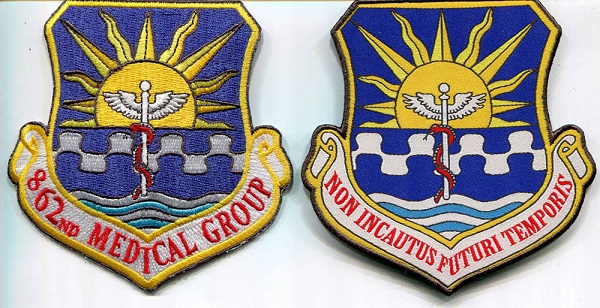
Another new unit, the 862nd Medical Group, was also formed in 1962, although it reported directly (and independently) to the Commander of SAC’s 810th Air Division. The 862nd Medical Group had responsibility for both the operation of the combined VA and Air Force John Moses Hospital in the city of Minot and the USAF Medical Clinical services on base, although only for a fairly short seven years’ time (until 1969). In 1969, the 862nd Medical Group was inactivated and (the John Moses Hospital) was redesignated the USAF RGN. HOSPITAL – MINOT.
In 1972, the 862nd Combat Support Group was inactivated and base host duties were assumed by the 91st Combat Support Group (missile), since air units were considered ‘mobile’ elements and land-based missile units were regarded as ‘fixed’ installations. Thus, the base now had two major sub-commands of SAC weaponry on the Minot base.
When this change in the command structure occurred, the renamed ‘USAF RGN. HOSP – MINOT’ was consequently subordinated to the base’s 91st Strategic Missile Wing host and renamed the 91st STRATEGIC HOSPITAL, accordingly. It is noteworthy to observe that in 1968, when SAC reorganized its nuclear bomber force, the 450th Bomb Wing was briefly otherwise redesignated, and then 6 months later again inactivated (and further redesignated as the 5th Bomb Wing). At this time the reordered unit responsibilities found MAFB’s organizational structure again considerably shaken up and lines of authority redrawn.
In 1992, with Strategic Air Command’s formal stand-down, a major reshuffling of units again commenced, with the new AIR COMBAT COMMAND taking over the base. When this occurred, the base’s medical command authority reverted to that of the 5th Bomb Wing and the base’s medical services collectively became designated as the 5th Medical Group.
[At this point it should be clear that given the massive reorganizing, the complex command restructuring and the radically changing nature of the US Air Force’s global readiness commitments over the past 6 decades of Minot AFB’s existence, tracking all the resulting unit statuses (inactivations, reactivations and redesignations of units) from a historical standpoint can be a challenging task indeed for historians, both amateur and professional! One of the less-than-optimal results of this is that base history offices are often unclear as to the changes that have occurred over time, since many lower level enlisted personnel do not reenlist and the minimal awareness of historical continuity that may exit suffers, when questions about lineage and traditions are directed to that base’s history office.]
Air Force Medicine at Minot: The John Moses Veterans and Air Force Hospital
Dedicated on 11 June of 1950, the John Moses Veterans Administration Hospital at Minot, North Dakota, began operations in July of that year. Intended to serve veterans from several wars, the 7-floor hospital was conceived and designed at the outset so that every patient would have an ‘outside’ room with a view. At the time it was built, it reflected state-of-the-art planning and infrastructural design.
After the First World War there had been several thousands of US Army veterans, many of whom had severe, long-term wartime injuries and disabilities from chemical weaponry used in that war, as well as disabling trauma injuries sustained from the murderous artillery fire directed at the trenches.
The first regional care center for vets was established, therefore, in Fargo. By the time the Korean War had begun, it was clear that a second such facility was needed as well. The proposed John Moses VA Hospital, named after a former Governor (and State Congressman) of North Dakota, was part of an ambitious effort by North Dakota American Legionnaires to promote treatment projects to care for all these veterans and in 1950 the new Minot VA hospital was completed.
When the new Minot Air Force Base began to take shape in 1955, the VA’s John Moses Veterans Hospital had seemed an ideal option for US Air Force planners to consider, as a solution to its lack of an adequate medical support operation at the base. The VA administered John Moses Veterans Hospital at Minot was at that time operating at only half of its full 162-bed capability and in taking over the administration and medical care services of the hospital, the Air Force proposed that it assume full responsibility for operations of the hospital, additionally providing roughly half of the total requisite operating staff from its own military medical personnel. Thus, it would gain a fully equipped, ready-made hospital to serve the future needs of the new base. The transfer was soon agreed to and although the hospital remained locally known as the John Moses Veterans Hospital over the years, it was officially designated by Air Force Headquarters as the ‘32nd United States Air Force Hospital’, given that the new Air Defense Command host unit at the new ADC base was initially the 32nd Fighter Operations Group.
Under this mutually beneficial agreement with VA, the Air Force leased the 8-story/7-floor VA facility located in downtown Minot (at 1500 University Avenue, Minot, ND) and agreed, under the new arrangement, to provide care for both vets, US Public Health Service recipients (mostly Dept. of Indian Affairs patients) and the base’s several thousands of anticipated Air Force personnel and dependents. [To its immense credit, the current 5th Bomb Wing’s 5th Medical Group still honors that agreement today (2023).]
Thus, effective 1 July 1959, the VA Administration turned over the hospital to the air Force, which placed it under the command of Col. William Bradley (MD), the hospital’s first Air Force Commander, and the 32nd USAF Hospital began its new combined mission with the full approval of the City of Minot and its citizens. The economic benefit to the people of Minot was soon made readily apparent.
When the 32nd Operations Group was inactivated (in 1962), concurrent with the 450th Bomb Wing (SAC) assumption of base air ops, the newly activated 862nd Medical Group (as an autonomous unit independent of the 862nd Combat Support Group) became the primary medical support unit for both the hospital in town and the MAFB clinic (on the base, 14 miles north of the town). With the turnover of MAJCOM responsibility for MAFB (from ADC to Strategic Air Command, under the air operations aegis of the 450th Bomb Wing), the new 862nd Medical Group continued the agreed-upon medical service responsibilities at both the John Moses Veterans Hospital in town and at its adjunctive clinical facility on the base itself. Services at the base clinic included a crash rescue and trauma/emergency capable ER, ancillary out-patient medical services (such as lab, pharmacy and radiology), and the base's Flight Surgeon's Office (FSO); it also provided ongoing full out-patient clinical care for base dependents (with acute in-patient care for all base personnel and dependents provided by the John Moses Hospital facility in town) until 1969, when the 862nd Medical Group was inactivated.
Part of the in-town hospital’s services consisted of coordinating air-evac support of patients, to and from the base, as needed and weather permitting. A new hospital helicopter pad was established not far from the hospitals’ main power and heat generating building (with its characteristic, tall red-&-white-striped chimney…a Minot landmark for many years), operating Bell UH-1H Iroquois ‘Huey’, all-weather rotary-wing aircraft. As the John Moses Hospital site grew, additional outbuildings were added that included a large enlisted barracks structure, a separate nurses’ quarters building, officers’ (medical and administrative staff) quarters, and private individual residences for the hospital’s Commander and Vice-Commander. At the rear of the main facility, a fully equipped receiving trauma-center/Emergency Room stood by to take air-evac patients to and from the base via helicopter (such as might occur in an on-base, mass-casualty aircraft accident).
In 1969, after only 7 years of activation, the 862nd Medical Group's mission at MAFB came to an end when its medical support mission was subsumed within the new (5th BW) air wing's 5th Bomb Wing's 5th Medical Group, a newly (re)activated unit, in July of 1969 at the base (where it currently continues), as part of the 5th Bomb Wing host organisation.
By 1988, the original John Moses Hospital building (which was also known as the 'John Moses Veterans and Air Force Hospital', but officially as the ‘USAF REGIONAL HOSPITAL, MINOT’) was now 38 years old and much in need of considerable updating and improvements; it was also clear that the base itself needed an on-site hospital. Ground was therefore broken in 1985 to build an entirely new combined hospital and clinical facility on the base itself, a decision prompted to no small extent by continuing difficulties transporting patients during the frequently severe Minot winters. The decision was simultaneously made to demolish the old John Moses Hospital shortly after as the new on-base, 3-story hospital was completed and operational (in 1988).
In 1969, concurrent with the inactivation of the old 862nd Medical Group, the John Moses Air Force & Veterans Hospital had been renamed 'USAF REGIONAL HOSPITAL - MINOT'. In 1987 the hospital was once again redesignated as the '91st STRATEGIC HOSPITAL', indicative of its subordinate status to the 91st Strategic Missile Wing's (SAC) command authority. This 'new' designation remained in use only for about a single year before being inactivated in July of 1988 (when the new on-base hospital was completed). Nearly simultaneous with the initiation of full-scale hospital operations on-base, the old John Moses veterans’ structure in town was at last demolished in 1992 (the old site has been since occupied, as of October 2023 at least, by the Federal 'Quentin N. Burdick Job Corps Center'). To many of Minot’s citizens, the razing of that imposing structure marked the passing of a memorable amount of the town’s recent history.
After several years of operation (beginning in 1988), the base’s new 47-bed hospital (later expanded to roughly 75 beds) closed-down its in-patient and acute services and dedicated the entire on-base site to emergency services, clinical out-patient services and emergency aircrew support services. Surgical patients were thereafter immediately referred to both Trinity and Saint Joseph’s Hospitals in the city of Minot (as required and transported by all-weather-capable Huey air evac helicopters).
The new on-base hospital/clinical complex continued to use the 91st strategic Hospital heraldic emblem (Note: see Plate IV in illustrated version of this article) until 1988, when the facility adopted the heraldic emblem of its parent organisation, the 5th Bomb Wing (becoming known as the 5th Medical Group). This emblem, which uses an updated variant of the 5th Bomb Wing’s historic heraldic design, has been seen with both the ‘5th MEDICAL GROUP’ legend and the 5BW’s motto (‘Kiai O Ka Lewa’, which is Hawai’ian for ‘Guardians of the Upper Realm’) emblazoned on the scroll at its bottom, at various times. As most know, today any changes in Air Force unit insignia must be authorized by the Air Force Historical Center and comply with strict guidelines summarized in 1985.
With SAC’s stand-down in 1992 (and transfer of the base to its replacement, the Air Combat Command), the base’s medical support unit has remained the 5th Medical Group, a subordinate unit of Air Combat Command’s 5th Bomb Wing, and a status that continues through the present with the new US Air Force Global Strike Command (replacing Air Combat Command, a major command shake-up occasioned by a subsequent nuclear weapons handling incident that occurred at MAFB in 2007).
--------------------------------------------------------------------
Medical unit emblems at MAFB (details, 1962-2023)
-The unit emblem of the 862nd MEDICAL GROUP was in use for only about 7 years (1962 - 1969). The 862nd MG was inactivated 1969.
-The hospital emblem of 'USAF REGIONAL HOSPITAL - MINOT' appears to have been in use for about 17 years (1969 - 1987).
-The redesignated '91st STRATEGIC HOSPITAL' emblem seems to have been only in use for a single year (Jul 87 to Jun 88). [Note that the only difference between the USAF REG HOSPITAL - MINOT emblem and its 91st STRATEGIC HOSPITAL iteration is the substitution of '91st Strategic Hospital' legend on the unit scroll in place of 'USAF Reg. Hospital - Minot'. Otherwise the heraldic shields on both are identical (the latter is therefore not illustrated in the attached plates section.]
-The current MAFB medical unit, the 5TH MEDICAL GROUP, supporting the 5th Bomb Wing, has been active from 1988 through the present (2023?). A variant of the patch bears the 5th Bomb Wing motto, “Kiai O Ka Lewa”, which is roughly translated from Hawai’ian dialect to ‘Guardian of the Skies’ (or “Guardians of the Upper Realm”) on the scroll under the 5th Bomb Wing heraldic emblem. With USAF Global Strike Command’s changing mission requirements, there have been many challenging demands put upon the 5th MG’s personnel and services…all of which it may be justly said, have been met with true professionalism and dedication to mission.
------------------------------------
Please note: This is at this time (November 2023) merely a working draft that may be subject to updating and future revisions. Any and all corrections would be very welcome. Given all of the immense changes both in command transfers, unit structures and activation/inactivations that have taken place over the past decades, trying to accurately track all these data and present them in a chronologically correct and accurate manner can be somewhat daunting, to say the least. If anyone wishes to ontain actual specimens of the half-dozen or so 862nd/5th BW Medical Group heraldic (embroidered) emblems in period-correct 4-inch size, they are available for a small fee from the author of this article. Contact me for details, through Authors' Den. [Please further note that this version of the article is not accompanied by illustrations, whereas they are in another version of it. Versions of that fully illustrated article are available upon special request to the author.]
Thanks, and AIM HIGH!
------------------------------------------------
Veteran's Day Postscript (11 Nov 23)
As I noted above (hopefully), I had some very good times up at the USAF Regional Hospital - Minot (unlike almost ALL the other frozen souls who served on the base). I was even inspired to wax lyrical, occasionally, and write some poetic pieces while there. There's an example at the below URL, if you're curious:
WINTER IS COMING