Random notes on the forgotten art of staying warm
Back in the heydays (for the curious, the term ‘Heydays’ derives from an old Germanic word, “Heyda” which translates roughly to “Hurrah!”) of my youthful 20s, I was an aspiring (and usually also perspiring) mountaineer. My interest in climbing got started while an inmate of the People’s Republic of Berzerkeley, where I both worked and studied as an undergrad.
UC Berkeley’s Cal Hiking Club was the natural social focal point for people like me who were strangely fascinated by high, cold places (i.e. mountain summits), but Berkeley was a challenging learning environment in which to pick up the rudiments of climbing and mountaineering at first. However, back in the early 70s (when I was a Berekelyite), the fact that almost a quarter century had elapsed after the famous US Army’s 10th Mountain Division (our American counterpart the even more famous and storied WWII German ‘Bergtruppen’, or mountain troops) had returned to the US, notwithstanding, the 10th Mountain Division personnel (such as the Sierra Club’s Dave Brower and his former associates), began to find ways they could make their proficiency as mountain fighters pay off. Soon both the Pacific Northwest and Berkeley (SF Bay Area) were favored home bases for these formidable soldiers, who in many instances opened the first mountaineering stores selling climbing gear for recreational use to the public.
The North Face, Sierra Designs, the Ski Hut and Marmot Mountain Works were just a few of the more prominent examples of such new sports businesses, and as young people discovered the frosty delights of freezing their toes (and certain other parts of their bodies) off in California’s Sierra Nevada and Cascade mountains, climbing in all its permutations (rock, snow & ice, and ski mountaineering, mainly) took off the way the much later sport of snowboarding did in the 80s & 90s.
Given that European winters were (and generally still are, despite global warming) pretty damn cold, American troops fighting in European theaters were compelled to learn the importance of staying as warm as they could when the temps dropped off the bottom of the Kelvin scale. This generally meant learning basic ergonometric thermodynamics, starting with the basic biology of how human metabolism functions. For many of the troops, who weren’t well educated upon initial entry into service with the infantry, this posed some daunting demands. Others, such as those who went into specialist divisions (such as the famed 10th Mountain), it wasn’t at all hard to grasp the fundamentals of human metabolic needs since most had already had some years of higher learning under their belts when the war started.
Staying warm when it’s cold seems (deceptively) to be simple enough at first glance. When you’re cold, find a heat source, whether it consists of food, a fire, or heavy clothing, right?
"Not so fast", their instructors would say. "It’s a lot more complicated than that", the soldier would hear from them. For instance, different types of metabolic fuel (such as basic proteins to build and sustain muscle tissue, carbs for immediate energy needs, and fats, vital for long-term nutritional maintenance) metabolise at different rates and produce more or less energy, according to the rate at which then body consumes them nutritionally. Thus, which of the three basic food types is better for you when you need to generate some internal body heat, suited to the physical activity being undertaken?
Fortunately, the Army prepared and published an excellent series of manuals explaining all these challenging concerns, prepared assuming that the inductee was a reasonably proficient reader (many surprisingly weren’t!). [Note: My own father, who began his career as a drummer boy (he was too young to sign up as a Private in 1898) ended his career as an Army Major in 1950, but had never gotten higher than the 8th grade in school! Fortunately he was an inherently bright autodidact who quickly mastered anything he took an interest in, academic or not, and rose rapidly through the ranks at the turn of the 20th Century.]
***
There were generally three areas of acquired knowledge that soldiers were expected to have at least some working knowledge of. 1) The first was (as mentioned above) the basics of bodily nutrition and metabolic function. 2) The second was understanding of how clothing worked to either warm up or (cool), and the importance of proper ‘breathability’ or ventilation (so as to allay build-up of sweat and excess heat). 3) Finally, the concept of shelter (from extreme heat and/or cold effects) from the natural elements and how to insure that whatever shelter was needed was provided to protect from heat, cold and...not least important...extreme wind effects.
Whereas the regular Army troops lacked much real mastery of these ‘arts’, the mountain troops, working and fighting in an extreme mountain environment, had from necessity to become near masters of them all.
And when the 10th Mountain troops returned from fighting a global war under the most trying climatic conditions conceivable, they brought back those important skills with them and translated them into an understandable civilian context, so that recreational climbers, skiers and mountaineers would be adequately prepared to deal with the very real hazards of high-mountain sports, both subjective and objective.
It therefore wasn’t long before mountain sports businesses and retail shops began to appear in our own Berkeley environs and also, of course, in places like Portland and Seattle with their convenient proximity to the high (4000 meter) volcanic mountains close to them...many of which had a year-round cover of snow and ice on their upper reaches.
One of these shops (and coincidentally the oldest) was George Rudolph’s Ski Hut, on University Avenue. Another was Sierra Designs, located in Point Richmond (with a retail shop in Berkeley). A third that had originally begun in Palo Alto was the North Face on Telegraph Avenue (whose owner was gay, not that that matters a whit!). Although Ski Hut is now closed, Sierra Designs and The North Face have grown into modern, large and highly successful corporate endeavors.
Each of these shops provided high-quality, state-of-the-art mountaineering gear for outdoor recreationists and supported teaching and instructional seminars and programs on the sport of mountain climbing (in all its permutations). They also hosted guest climbers, skiers and mountaineers for lectures and slide show/movie nights. There was also the original Berkeley store of the Co-op, which carried mountaineering equipment such as tents and packs made by Kelty, but the first three mentioned above became the ‘go-to’ source for most serious (and dilettante) climbers in that early 70s period.
***
One of the most important parts of the Mountain-gear triad was clothing. The importance of proper clothing cannot and could not ever be stressed enough, especially those for those who were new to the extreme outdoor environment encountered at higher altitudes in the mountains.
The basic concept of ‘layering’ is not a new one, having been around for several hundred years but it did not assume the significance of an intricate science until well after the turn of the century (1900 onwards). By the end of the Second World War, ‘layering’ had became the bedrock foundation upon which skillful and successful bodily thermal management was achieved.
Simply stated, layering begins closest to the skin with the underlying first layer. This usually consisted, back in the American West of the late 1800s, of a cotton (preferably wool) ‘union suit’ with a collarless, button-up front and a ‘drop-seat’ panel to relieve one’s self.
Out in the old West, the Union Suit was near ubiquitous, being either white or red, and just about every cowboy and ranch hand wore one as a foundation layer. Since bathing was at best a several times a year only (at best), it doesn’t take much imagination to realise that people were extremely stinky, back in those days, and especially way out in the sere desert regions. Girls didn’t shave their pits, contrary to modern Hollywood epics like Jane Fonda’s Cat Ballou, and both men and women usually had ‘critters’ on them of various sizes and kinds...nuff sed!
Union suits, particularly made of wool, could be incredibly itchy...especially when the wearer only had one set of clothes and didn’t wash them for a whole year! Cotton, of course, when damp or wet readily transmits cold, so wool, which retains its heating ability when wet was always the preferred material of choice, despite the itch. [Silk was also worn as a base layer by the wealthier individuals, since it had both ‘breathability’ and warmth retaining properties. But it was also somewhat rare and expensive, back in the day, coming from China almost exclusively.]
Next came the middle layers of clothing, usually consisting of a shirt, breeches and most often a vest. Finally, a jacket, duster, or overcoat were worn as outer layers when the weather was particularly cold or blustery. A sturdy brimmed hat (both for sun protection and warmth), large bandanna (to protect the neck against cold and the face against dust) and boots completed the basic gear for most ‘Old West’ characters. Forget those skimpy throat scarfs seen on cowboy stars like Audie Murphy and Roy Rogers...that was strictly a Hollywood ‘pretty boy’ affectation!
***
By the time World War I had arrived, far more was known about the developing science of protective clothing and Armies as both sides issued basic field uniforms made of wool. Wool allows a certain amount of breathability (ventilation) but for the most part wool uniforms were intended to protect against cold effects, so when the weather suddenly became warmer, sweating was inevitable in wool outfits. Under those basic wool uniforms there really were no primary layers and soldiers wore whatever they felt most comfortable in under them. In the field, a heavy wool ‘Greatcoat’ was the usual issue protection against the extreme cold of wintertime, along with wool balaclavas, socks and mittens.
It was thus still a far-from-adequate kit that WWI soldiers were issued and thus it stayed until globally fought World War II quickly demonstrated the need to provide a more scientific and adaptable military logistics model for heat and cold protection in all theatres of operation...from coldest European winters to hottest Middle Eastern deserts and Far Eastern tropics.
***
By the time of the Korean War, the new science of functional military clothing come into its own and, it reached a zenith of adequacy and completeness by war’s end in 1945.
One item of US Navy issue became, during WW2, a prized staple of warm kit that originated in the late 30s and is still today a much sought-after staple of those who know and value wool for staying warm. That was the so-called 'CPO Shirt', a loose-fitting outer shirt made of 100% wool that was issued to Petty Officers (thus: 'CPO'). Even today, the CPO shirt is available from wool specialist cpompanies such as Filson. It was fitted with two large, flapped chest pockets and made from medium thickness Navy Blue wool. A number of varients were made by several mountain businesses in the 70s, one in particular of note being the so-called 'Alaska Shirt', which as a slightly thicker wool CPO short mader from 'salt and pepper' colored wool. It was a favorite of Alaskan sourdoughs, bush pilots and outdoorsmen frequenting the upper (Canadian) lattitudes.
Since my own service was the Air Force, I am quite familiar with what that branch of the services provided for both its ground (support) troops and its aviators and aircrewmen.
At altitude, the temperature drops proportionate to the density of the atmosphere, altitude and variant ambient heat (which also drops inversely with altitude), requiring a highly specialized wardrobe of protective clothing and survival gear.
Aircrews during WW II (up through about 1958) were thus issued with tightly woven clothing, consisting of a heavy wool shirt, matching pants and also provided with an equally substantial wool flightsuit. Peripheral (hands, feet & head) protection was provided in the form of caps, insulated gloves and flying boots. This remained the standard from late WWII through the late 50s or so, when newer outer fabrics and insulating materials came into common use (notably Nylon or Perlon, as it is known in Europe), and various types of synthetic insulation were introduced. [Note: the standard all-wool USAF heavy flying shirt, with four large, flapped pockets (and two hand-warmer pockets) consisted of a late war issue, the “Heavy Flying Shirt Type A-1” in olive drab wool. This design carried over post-war (until about 1951-52) with the issuance of the succeeding “Heavy Flying Shirt Type A-1A”, the sole difference being that it was produced in new ‘USAF dark blue’ shades. From 1953 through about 1958, the final variant of this classic wool shirt was the “Heavy Flying Shirt Type A-1B”, which came out in the newly adopted sage-green color. More about the classic A-1 shirt and its popularity with the new Berkeley climbing community of the 60s and 70s, shortly.]
***
As we all know, wars prompt rapid scientific advancements of all sorts and due to the accelerated scientific research prompted by WWII, the new synthetics mentioned above quickly began to replace the previous wool clothing standard in the late WWII time frame. Nylon, an entirely synthetic polymeric product, in particular came to be the new standard outer fabric and soon flying suits, jackets and accessories were all produced using the new synthetic, polymeric Nylon.
This seemed at first to be a remarkable advancement in aircrew protection but rather soon the Air Force became acutely are of the fact that as suitable as it seemed to be, Nylon posed distinct liabilities to aircraft crews due to its tendency to melt (and sometimes flame) when exposed to fire (or intense heat). Since aircraft crashes were quite often fiery infernos for their crews, an urgent search was undertaken by the Air Force to come up with a safer material for use as an outer fabric than Nylon. [Even wool has modest fire suppressing qualities, just as does leather (as used in leather flight jackets), but Nylon has none!]
This eventually resulted in the introduction of a new Polyamide Polymeric fabric (popularly known as NOMEX) that resisted both effects of intense heat and fire, and it quickly was introduced in undergarment and outer protective layer fabrics for flying personnel clothing. Polyamides are today (2025) still the apex standard for safety in aircrew garments, it is worth noting, both for atmospheric and space flight.
***
In Berkeley of the late 60s and early 70s, when I was just getting started in my mountaineering career (‘tyro adventuring’ as it was), we students didn’t have a lot of discretionary money on hand to purchase the latest, advanced gear, so a lot of improvising was the order of the day.
Interestingly, “duvet” or as we call it down (that fine under-layer of geese feathers and the downy layer that some large aquatic birds have under their outermost ‘primary flight' feathers), was not a new development in outdoor protective garments.
The first documented use of down as an insulating material in cold weather protective clothing seems to have been pioneered by a British-Australian member of the English Alpine Club (also a controversial, somewhat eccentric but brilliant member of the early mid-20s Alpine Club Mt. Everest Expeditions) named George Ingle Finch. Finch was a chemist by profession and pioneered not just the use of supplemental Oxygen in high-altitude climbing but the use of down-filled protective insulation at extreme heights. Most regrettably, Finch was decades ahead of his time and never fully enjoyed acclaim for his brilliant mountaineering prescience, despite his accomplishments in academic chemistry.
In 1924 Finch wore a climbing suit that he had had custom-made for use on his Everest excursions that used light, wind-proof outer fabric (Ventile cotton) layers stuffed with an inter-layer of AA+ Gray Goose down. Although perfect for its intended purpose, his peers in the Alpine Club scoffed at the idea, regarding the concept as a quaint, comical affectation, preferring the traditional, old fashioned English climbing outfit of layers of silk and wool clothing, with an outer wind-proof layer, that had been in use by Victorian climbers since the mid-1800s.
***
But by the early 1950s and thereafter, down insulated cold-protecting garments had become an institution in the mountain climbing world and no expedition to the high Himalayas would have been remotely possible without the use of down clothing, a result of Finch’s intuitive genius that he would have been justly proud of!
While those of us in the UC Hiking Club (as I have explained in other writings, the club’s name name was deceptive, since it included everyone from rank hikers to full-fledged Himalayan expedition members), despite our relative penury as virtual ‘starving students’, most of us recognized that with the exception of down-filled US Army sleeping bags, down-insulated garments of the surplus variety either didn’t exist or would have been extremely hard to find at any price. Thus somehow or another we usually managed to cough up the relatively steep cost of modern down parkas from Gerry, Sierra Designs, The North Face, Eastern Mountain Sports, or Marmot Mountain Works design. Sleeping bags were also very costly, but surplus military down bags were reasonably easy to source, since back in the early 70s there were still traditional ‘Army/Navy Surplus’ stores in every large urban area.
I should mention the fact that haute couture Berkeley street fashion of the 70s for us undergrads was the 'mountaineering look'. This consisted of sturdy shorts, a cotton chambray work shirt (or surplus US Army epauleted tan shirt), rounded out with expensive European climbing or hiking boots. We all thought that this look announced us to the world as rough, tough 'mountain men.' [No documentation exists today, unfortrunately, that records what the women in our lives thought about this favored macho 'uniform.']
Which brings up the interesting point that the excess materiel goods produced by all nations involved in WWII were so plentiful, right after the war, that with a bit of resourcefulness, just about any needed item of outdoor gear could be cheaply acquired at such stores...usually for pennies on the dollar! Even climbing iceaxes (such as made by the Ames Company for the 10th Mountain Division troops) would show up now and then.
For a kid brought up in the 50s, military war surplus stores were an ironically delightful consequence of all that leftover military materiel and I well recall as a teenager, spending hours combing through surplus stores for all sorts of treasures. As a 20-something college student, although such stores were starting to dry-up’ and disappear, one could still pretty much acquire all the basics required for mountain trips for dirt cheap.
By the 80s, military surplus stores had almost entirely vanished, sadly, but the fact that for several decades they flourished successfully attests to the seldom thought-about fact that when the war ended in 1945, there must have been hundreds of millions (if not billions) of dollars worth of surplus war materiel produced under military contracts that were never required by the Armed Forces for actual use (and which ended up in surplus stores).
***
Which brings us back to the basic kit most of us had to have to venture off into the high mountains back before climbing and mountain climbing became big business in the sporting goods trade.
Surplus (down) sleeping bags, crampons, iceaxes, pitons, ropes (old style sisal, not newer polymeric Perlon or Nylon types), check! An expensive down parka, check! Primus aromatic fuel stove, check! Surplus Army crampons, check! But that still left clothing...
As I mentioned earlier, some of us were aware of the Air Force’s wool flyers’ garments. Among all of them, the USAF A-1 (olive drab), A-1A (Air Force blue) or A-1B (Air Force sage green) ‘Heavy Flying Shirt’ made of wool was the garment of choice, since it had water resistant, wind-resistant, fire-resistant and warmth retaining properties such as were absolutely mandated on high mountain peaks. The matching pants came in two types: regular cuffed wool flying pants, or “climbing knicker” style wool pants with elasticated cuffs ending just under the knees. The latter were worn with long wool knee-socks, with scree and water-proofed gaiters worn with them.
Those classic A-1 shirts were the epitome of functionality, since they had two flapped, upper chest pockets, two lower front flapped pockets and side-slit hand warmer pockets. They were perfect for mountaineers and/or outdoorsmen of any kind, and we all combed the surplus stores for them. Fortunately, they were not at all scarce and could usually be had for a couple of dollars.
Today, such were the immense production runs of these shirts that they still turn up fairly often. The problem is that today, militaria ‘collectors’ (the bane of frugal genuine outdoor sportsmen) are all hot to acquire specimens for their collections of military items, so when these shirts do appear, they go for several hundred dollars, each! (GAAK!).
I still have mine, believe it or not, among all my saved 70s & 80s climbing kit, and they’re as useful and functional today as they were for aircrewmen, who were issued them back in the immediate post-war (II) era.
***
In or present consumer age, given the vast amounts of discretionary income spent each year on recreational goods, there isn’t anything one can’t acquire in terms of climbing kit that isn’t available from one source or another (albeit expensively)but not at all cheaply.
One modern item I have always coveted in terms of upper body protection, no matter what the sporting application, for protection against cold, moisture and/or wind chill, is actually well over 100 years old! I refer to the famous Filson Cruiser jacket.
Filson is a very old and established company based in the Pacific Northwest of the US (Seattle, WA) that designed and produced its Cruiser Jacket way back in 1914. But let me quote from an AI reference, since it gives a much needed backstory on the famous ‘Filson Cruiser’ jacket.
Founded in 1897 by Clinton C. Filson, the Filson Company, known for its rugged, high-quality outdoor garments, gained fame with its iconic Cruiser jacket, patented in 1914 and intended principally for foresters in the Pacific Northwest. Following is a more detailed look at the history: (Courtesy of AI)
Founding (1897): Clinton C. Filson established C.C. Filson's Pioneer Alaska Clothing and Blanket Manufacturers in Seattle to cater to prospectors heading to the Klondike Gold Rush.
The Cruiser Jacket (1914): Filson designed the Cruiser jacket, initially as a shirt, for foresters in the Pacific Northwest, and it quickly became a popular and imitated garment.
Patent (1914): The Cruiser shirt was patented on March 3, 1914, and the design also became the basis for Filson's jackets and coats.
Materials and Design: The Cruiser jacket is known for its durable Mackinaw wool and a dense weave, providing protection against harsh weather conditions.
Legacy and Evolution: The Cruiser jacket remains a workwear staple, cherished for its hardwearing construction and timeless look. Filson has continued to evolve, offering products that go beyond traditional outdoor gear while maintaining its commitment to quality and durability.
Filson's Motto: "Might as well have the best" is embedded in the products it makes.
Aside from the above specifics, this excellent jacket has two flapped upper chest pockets, two lower front flapped pockets, a full width double flapped utility pocket in its rear, and uses a button closure feature (preferable to just about any other closure method in harsh weather for its utter simplicity and reliability). These same features mirror those found in that USAF A-1 aircrew jacket design, except that the Filson is made from slightly denser, thicker Mackinaw wool than that used in the air force aircrew shirt.
In my humble opinion (but as a historian who has studied human protective clothing for many decades), the Filson is the absolute apex garment for any serious outdoorsman and its only drawback is that it costs (in 2025) a not insignificant $550! Back in the 70s I had lusted after one, but even back then they were listed retail at $350! Too much for a poor student to contemplated acquiring, given other more basic priorities! Today, a Filson Cruiser is hanging in my closet and as some may know, the Cruiser is still basic issue for all mountain rangers and National Forest Service people who must be well protected in their outdoor work from the effects of extreme elements.
***
Here, I’d like to get in a plug for two modern garments that I think would suit anyone who spends time in the great outdoors, whether climbers or merely hikers. These are 1) a wool field shirt produced by my favorite Finnish company VARUSTELEKA, and 2) a garment called a ‘Shacket’ (sold by The Territory Ahead, among other retailers).
The garment known as a shacket is an innovative modern design that combines the qualities and features of a shirt with those of an outer layer (“Shirt” + “Jacket”) and features the ubiquitous flapped pockets (like the Filson), hand-warmer pockets, and made from either pure wool or a wool-polyester material. It has proven to be a hit with just about any man who has been introduced to the concept and I myself am an enthusiastic devotee of the shacket!
A number of companies make shacket garments these days, including Filson, Pendleton Woolen Mills, and dozens of others, but they all use good old wool as their fabric and I shouldn’t have to repeat the litany of virtues peculiar to wool garments, here!
It's worth noting that almost all modern wool shirts intended for outdoor sports and mountain use are most likely descendants of the earliest Filson wool garments!
The Finnish VARUSTELEKA Company (another of my favorite sources for a wide range of excellent outdoor clothing) makes an all-wool field shirt (in tall sizes, also) that they devised by taking the modern German Bundeswehr utility shirt and slightly modifying it, replacing its BRD Army cotton fabric with 100% high-quality wool. Reasonably priced at less than US$100, it is my daily ‘go-to’, three-season outdoor shirt, and as someone who easily gets chilled, I can testify to the ability of this excellent outdoorsman shirt to keep you toasty warm despite cold and wind! I unreservedly recommend both the Filson Cruiser and the VARUSTELEKA Wool Field Shirt to all of you, no matter whether you’re a climber or merely a recreational hiker! You really cannot do any better!
***
Since this has rambled on at length (as usual), I’ll end my random notes on the theory and practice of keeping warm outdoors with a reminder that, despite all the advances in fancy new synthetics, polymeric fabrics and state-of-the-art insulating materials, after all is said and done, never forget that wool is STILL your very best friend when it gets cold, damp and/or windy!
We can thank our little friend Lamb Chop (a sock-puppet on Captain Kangaroo) and his wooly Ovis Aries associates, for a great many things (not least for providing us with delicious and tender Australian and New Zealand lamb chops, yum-yum), including the amazing wool that they have supplied us with over past centuries. Thus, we should never sell wool short, my friends, as it is the original ‘wonder insulator’ par excellence and remains so, today (despite all the advances in oil-based polyesters that are admittedly rather remarkable, themselves).
I don’t mind saying that I don’t feel at all sheepish in testifying to that fact...
***
PS: TWO LAST COMMENTS on basic heat retention in cold environments.
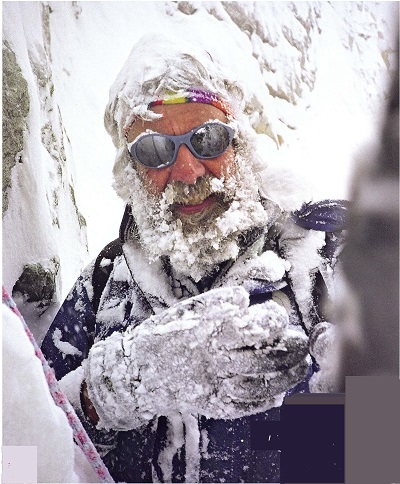
1) If there's nothing else that gets remembered, it should be this: Experts on human physiology agree that the single most important thing to remember about retention of bodily warmth is this: Keep your hands, neck (& head), and feet (toes) warm at all times. The instant you start to feel uncomfortable cold effects in those peripheral extremities, you are already losing exceptional amounts of vital bodily heat.
Thus, always wear a warm cap of some sort (wool or wool/polyester blends are best) when it's unusually cold. Also wear warm gloves on your hands, and use some sort of neck protection (a 'neck gaiter' is best), since heads, hands, feet and the neck are primary bodily surfaces where heat is radiated away from the body's core.
Putting a warm jacket on your trunk is of little use for staying warm, when those peripheral areas of your body are exposed to ambient cold.
2) Extreme Cold is your enemy, but your single worst enemy in any attempt to stay warm is WIND CHILL. Wind doesn't have to be bone-chilling to quickly exhaust you and deplete bodily reserves of core warmth. ALWAYS wear some sort of impermeable wind-resistant outer layer, whenever wind is present. BOTH cold and wind will quickly induce and enhance hypothermia (severe loss of internal bodily heat) and water exponentially increases these adverse effects, so if you get wet, quickly dry off and preferably put on dry, wind-proof clothes!
I apologise if all the foregoing seems overly simplistic and obvious, but you'd be amazed at how many people do not know these basic things! Those who do not, often end up as a dramatic 'lost hikers rescued' story on the local daily 5 O'clock local news! So, PLEASE, stay off the breaking news, eh? Local news is already boring and dummed-down enough as it is...we don't need more 'local hero hikers' crap-news.
---------------------------------------------------
RESOURCES:
The Filson Company (specific to their Filson Cruiser Jacket)
The Territory Ahead (specific to their wool or wool-blend ‘Shackets’)
VARUSTELEKA Company (Specific to their Wool Field Shirt)