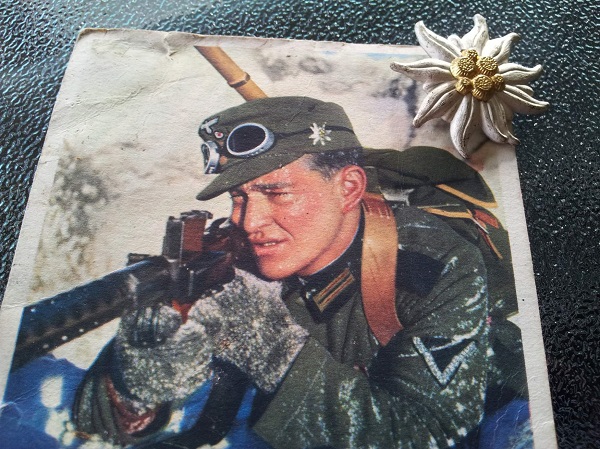
 As an individual with paternal Irish and maternal Austrian roots, as well as an academically trained historian, I have taken a lifelong personal interest in cultural aspects of those two great civilisations. Having spent considerable time in German-speaking Europe, I find Austrian sartorial customs both enchanting and fascinating. One of my favorite personal headwear items is the traditional Austrian/German "Bergmütze", a cap design that reaches well back to the early-to-mid 18th Century as the favored headwear of mountaineers, skiers and Alpinists. It was in widespread use back in the 30s and 40s as standard head cover for many German and Austrian military units (known as the M-43 or Einheitsmutze), which for many unreflective and broadly unaware people is now exclusively associated (wrongly) with the German Third Reich regime. We can thank decades of Hollywood war movies for much of that ignorance, since all the Nazi villains in those films wore a 'field' cap like this. For your general information, the Finns, Hungarians, Irish Republicans and also the Chinese Nationalists (Kuomintang) under Chiang Kai-Shek, were among major users of this visually distinctive and misassociated type of cap. Think of it as a uniquely Austro-German, 'baseball cap' if that makes it more understandable from your narrowed American sports viewpoint.
The Alpine Cap: Tracing its Cultural Heritage and Disentangling its Misconceptions and Associated Predjudices
An explanatory history
The traditional Austrian/German mountain or hunting cap, distinguished by its characteristic folded earflaps and forepeak, possesses a rich and intricate history deeply embedded within the civilian and military traditions of German-speaking Europe since the late 19th century. Despite its long-standing cultural roots as practical headwear for hunters, farmers, and mountain dwellers, and its legitimate military lineage, this cap style is frequently and erroneously associated with fascist or Nazi political ideologies by many broadly unaware of its true heritage.
This report demonstrates that the cap's design significantly predates the Nazi era, evolving from practical Alpine attire into military field caps. While its adoption by German military forces during World War II contributed to its negative perception, particularly in America due to media portrayals and a lack of nuanced historical understanding, its continued use in modern Europe (especially Germany and Austria) by hunters, traditionalists, and even current military units highlights a distinct cultural context often overlooked internationally. The misconception is widespread in America, driven by broad associations with WWII German uniforms, whereas in Europe, the perception is more nuanced, though still sensitive to historical context and the absence of specific Nazi insignia.
1. Introduction: The Enduring Alpine Cap and its Contested Image
The cap under examination, commonly recognized by its distinct forepeak and characteristic folded earflaps, represents a deeply rooted form of headwear in the Alpine regions of Central Europe. These design features were originally conceived for practical utility in harsh mountain environments, providing crucial protection from both cold and sun.[1] This design, therefore, emerged from a direct response to environmental challenges faced by those living and working in mountainous terrains.
Despite its extensive history as traditional civilian and military attire, this specific cap style frequently triggers associations with fascism or Nazism for many individuals outside German-speaking Europe. This report aims to dissect this pervasive misinterpretation, exploring its historical origins and contemporary prevalence across different geographical contexts. The subsequent sections will trace the cap's historical evolution from its 19th-century civilian origins through its military adaptations during World War I and World War II, leading up to its current usage. It will then meticulously analyze the factors contributing to its misassociation with extremist ideologies and compare its public perception in America and modern Europe.
For many observers, the visual form of the cap itself, rather than specific insignia, carries a loaded meaning. This phenomenon, where a complex historical object is reduced to a single, often negative, symbolic meaning, illustrates a form of historical compression. The visual semiotics of the cap, particularly its military variants, became so strongly linked to the Nazi regime through wartime experience and subsequent media portrayal that its broader, pre-existing cultural context was largely erased or overshadowed for external observers. This suggests that the visual impact of the Nazi era was profoundly influential, effectively "re-coding" certain visual elements in the global consciousness and making it challenging for those without deeper historical knowledge to differentiate between the cap's various historical roles. Addressing this misconception, therefore, necessitates not merely presenting historical facts, but actively deconstructing these ingrained visual associations and explaining the process through which historical re-coding occurred.
2. Deep Roots: The Civilian Heritage of the Alpine Cap (Late 1800s to Present)
The traditional Alpine cap style has a long and rich history, originating from the practical needs of people living in the mountainous regions of Central Europe. Its design elements, including the characteristic folded earflaps and forepeak, were developed to provide protection against the elements, serving as functional headwear for various outdoor professions.
2.1 The Tyrolean Hat and Jägerhut: Origins in the Alpine Regions of Austria and Bavaria
The Tyrolean hat (Tirolerhut), also known as the Bavarian hat or Alpine hat, is a distinctive type of headwear that originated in the Tyrol region, which today spans parts of Austria, Germany, Italy, and Switzerland.[2, 3] This hat is an essential and recognizable component of the local folk costume, or tracht.[2, 4] Its history can be traced back to at least the 1830s and 1840s, with various styles enduring since that period.[2] Similarly, the Jägerhut, or German hunting hat, is another integral part of traditional Alpine attire, historically worn by hunters and outdoorsmen across Bavaria and the broader Alpine regions.[5] Its origins are centuries old, having been worn by hunters, farmers, and laborers in the Alpine region long before the late 1800s.[4]
These hats are typically crafted from high-quality wool felt, a material prized for its durability and natural water resistance. This makes them highly suitable for outdoor use in diverse weather conditions, from rain to sunshine.[3, 4, 5] The traditional decorations on these hats are also significant. They commonly feature a colored, corded hatband and a "brush" or plume affixed to the side of the crown.[2, 4] The most iconic of these adornments is the Gamsbart (chamois beard), traditionally made from hair sourced from the lower neck of the chamois antelope.[2, 5, 6] Originally a trophy signifying a successful hunt, Gamsbärte are now widely manufactured from various animal hairs and serve as an important symbol of the wearer's pride and manliness.[6] Large and elaborate Gamsbärte can command significant prices, reflecting their cultural value.[2] Other common embellishments include feathers, tufts of boar's hair, and decorative pins depicting traditional motifs such as stags, oak leaves, Edelweiss flowers, or hunting rifles.[5, 7] These accessories are not merely ornamental; they symbolize hunting prowess, regional pride, and a deep connection to nature and local traditions.[5]
The Trachten Hut holds significant cultural importance as a symbol of Bavarian heritage and tradition. It is a quintessential accessory that completes the traditional Lederhosen and checkered or white button-up shirts commonly worn by men during Oktoberfest and other German-themed celebrations.[4, 8, 9] The broader Tracht fashion, encompassing these hats, evolved from simple work clothes worn by farmers and craftsmen into a powerful emblem of Bavarian identity. This cultural shift was actively promoted by historical figures such as King Ludwig II in the 19th century.[8] The Tyrolean hat, in particular, transcended its regional origins to become a widely recognized symbol of "Tyrolean culture," popularized through tourism, folk music bands, and even gaining international recognition through figures like Edward VIII of Great Britain.[2]
This evolution of the Tyrolean hat and Jägerhut from practical workwear to symbols of regional identity and then to commercialized emblems for tourism illustrates a common pattern in the development of cultural objects. The "deep tradition" mentioned in the user query is affirmed, but it is also important to recognize that tradition itself is dynamic and can be influenced by external factors like tourism and popular culture. This multi-layered meaning means that the cap possesses both deeply authentic cultural significance and more performative or commercial associations. The misconception of its fascist ties arises when a later, negative association (military use during the Nazi era) completely overshadows these earlier, positive, and ongoing cultural meanings.
2.2 Design Features and Practicality
A typical Tyrolean hat is often made of green felt, characterized by a crown that tapers to a point and a brim roughly the width of a hand.[2] Variations in shape and brim width are common, ranging from the tall, narrow-brimmed hats seen in North Tyrol to the smaller, wide-brimmed styles prevalent in the South Tyrolean wine country.[2]
The "ski cap" design, which encompasses the Bergmütze, originated in imperial Austria-Hungary in the late 19th century. This design is characterized by a high peak, a teardrop-shaped top, a short bill, and a small skirt that folds down to provide protection for the ears in cold weather.[1] The Austro-Hungarian Army, in the 19th century, adopted a cap featuring a peak and cloth chinstraps (or flaps). These chinstraps were versatile: they could be buttoned over the forehead to secure the folded-up peak or leave it loose, or they could be buttoned under the chin, extending the rear of the cap downwards to shield the ears from the elements.[10] This directly addresses the "characteristic folded earflaps and forepeak" mentioned in the initial query, confirming their historical presence and functional purpose. The Jägerhut, typically made from high-quality felt or wool in dark green, black, or brown, features embroidered hatbands and decorative cords.[5] While the primary sources for the Jägerhut do not explicitly detail earflaps, the broader category of "traditional Alpine headwear" and its military derivatives, such as the Bergmütze, confirm the prevalence of such features for practical reasons.[1]
The functional aspects of these caps are paramount. The durable and water-resistant nature of felted wool makes them ideal for outdoor activities and festivals, providing effective protection from rain or sunshine.[4] The fold-down flaps on the ski cap and Bergmütze were specifically engineered to cover the ears in cold weather, underscoring their practical utility in the demanding environments of mountains and hunting grounds.[1] The consistent presence of features like earflaps and forepeaks across civilian and early military caps points to a primary driving force behind their design: the harsh Alpine environment. These were not merely aesthetic choices but rather functional necessities for individuals working or living outdoors in cold, windy, or sunny conditions. The military subsequently adopted these practical designs because their mountain troops faced similar environmental challenges. This demonstrates a direct causal relationship between specific environmental conditions, the functional requirements of headwear, and the resulting form of the cap. The design of the cap is, in this context, a direct consequence of its original practical purpose. Understanding this functional origin is crucial for decoupling the cap's design from later, purely symbolic or ideological associations. The "characteristic folded earflaps and forepeak" are rooted in practical utility, not political symbolism.
3. Military Adaptation: From Mountain Gear to Field Cap (WWI & WWII)
The design of the Alpine cap, proven effective in civilian use, naturally transitioned into military application, particularly for specialized mountain and light infantry units. This adaptation marked a significant phase in the cap's history, further cementing its presence in German and Austrian military traditions.
3.1 The Bergmütze's Genesis: Evolution from Civilian Mountain Caps for Bavarian, Prussian, and Austrian Jäger Troops in WWI
The "jaunty mountain cap," known as the Bergmütze, widely used by German Jäger, Ski-Jäger, and Gebirgsjäger troops during World War II, was not a novel invention but a direct evolution of various mountain caps worn by Bavarian, Prussian, and Austrian Jäger troops during World War I.[11, 12, 13, 14] Significantly, these earlier military caps themselves had developed from civilian mountain caps dating back to the 1800s.[1, 11, 12, 13, 14]
A key precursor to the German Bergmütze was a service cap first issued to Austrian Imperial-Royal Mountain Troops in 1906. This cap was constructed from Hechtgrau (pike grey) wool and featured a practical turn-down brim designed to cover the wearer's ears in cold weather.[1] German mountain troops subsequently adopted the Bergmütze in 1915, a decision made as a gesture of solidarity with their Austrian allies.[1] The adoption of this cap style by German forces from Austrian designs, and its clear evolution from civilian mountain caps, demonstrates a pragmatic approach to military uniform development. Rather than being purely ceremonial or ideologically driven in its initial military form, the cap's design was chosen for its proven effectiveness in specific terrains, particularly mountainous regions, and in challenging climates. The element of "solidarity" during World War I further underscores a practical, rather than exclusively political, motivation for the cross-national adoption of this uniform element. This historical trajectory reinforces the cap's functional origins and illustrates how military design often draws from successful civilian counterparts, especially for specialized units operating in demanding environments.
3.2 WWII German Military Use
During World War II, the Bergmütze played a prominent role in German military headwear. It served as the official field cap specifically worn by the Gebirgsjäger (mountain troops), characterized by its high sides and a short peak.[15] Beyond mountain units, this cap was also issued to ski-rifle troops and light infantry (Jäger).[11, 12, 13, 14] Its design proved so effective that the Bergmütze became the direct forerunner and primary inspiration for the widely adopted M43 field cap, which was issued to the German Wehrmacht for general use across the army starting in 1943.[1, 11, 12, 13, 14, 15] This widespread adoption of an M43-style cap, directly derived from the Bergmütze, is a critical point in understanding its later negative associations.
Specific design elements of the M43 Bergmütze for officers included a shorter bill (peak) and a higher crown compared to standard M43 caps, and it was lined with buckram for enhanced warmth and stability. These caps were meticulously crafted from Feldgrau wool and cotton-lined, faithfully replicating the original design.[11, 13, 14] Early Gebirgsjäger Bergmütze caps from the early 1930s were made from fine feldgrau wool and notably lacked ventilation eyelets before 1938, indicating a design evolution over time.[16]
The caps were adorned with specific military insignia. A metal Edelweiss badge, worn on the left side, was a distinctive mark for Gebirgsjäger units.[1, 11, 12, 14, 16, 17] This Edelweiss insignia was officially introduced in 1939.[16] Similarly, Jäger troops wore a metal badge featuring oak leaves.[11, 12, 14] All caps also bore the national emblem, the Wehrmachtsadler (a stylized eagle-and-swastika), along with a cockade on the front.[16, 18, 19, 20] The Wehrmachtsadler was mandated for wear on all uniform blouses and headgear from May 1, 1934, marking a deliberate visual integration of Nazi symbolism into military attire.[19] Officers' caps were often distinguished by piping along the top edge.[15, 21] The practical fold-down skirt, designed for colder weather, remained a key functional element of the cap.[1, 18]
The widespread adoption of the M43 as a "standard field cap" and the compulsory inclusion of the Wehrmachtsadler (eagle-and-swastika) on headgear from 1934 onward points to a deliberate strategy of standardization and overt ideological branding under the Nazi regime.[19] While the fundamental Bergmütze design had practical origins, its widespread military application and the mandatory addition of Nazi symbols fundamentally transformed its meaning within that specific military context. This is a crucial aspect when considering the misconception: the cap was indeed utilized by the Nazis, and their specific symbols were affixed to it, making it an identifiable component of their military apparatus. This standardization and symbolic integration are primary reasons why the cap became so strongly associated with the Nazi regime, even though its underlying design was not inherently fascist.
3.3 Austrian Military Continuity: The Cap's Lineage in the Austro-Hungarian Army and its Continuation in the Modern Austrian Bundesheer
The cap style's lineage extends beyond World War II German forces, demonstrating significant continuity within the Austrian military. The cap style adopted by the Austro-Hungarian Army in the 19th century, characterized by its peak and cloth chinstraps or flaps, has persisted in use within the military of the Republic of Austria (Österreichisches Bundesheer), as well as by border guard and police forces.[10]
Modern adaptations of this cap style are evident. The contemporary camouflaged version worn by the Austrian Bundesheer, for instance, retains only the peak of its predecessor, notably omitting the chinstraps.[10] A specific distinction is observed in the mountain infantry (Gebirgsjäger) of the Austrian Bundesheer, who wear a grey cap (Bergmütze) with an Edelweiss badge on its left side. However, the stem of this Edelweiss points to the back, a subtle but significant distinction from the German army's Edelweiss, which points to the front.[17] This deliberate differentiation highlights a conscious effort by Austria to maintain its military traditions while subtly distinguishing itself from its shared, and sometimes problematic, historical military heritage with Germany.
Historically, the Austrian Federal Army adopted German Reichswehr uniforms and Waffenfarben (corps colors) in 1920/21, albeit with some exceptions.[22] A new uniform was introduced in 1933, modeled on Austro-Hungarian land forces uniforms from 1867-1914.[22] The continued market for modern Austrian military caps, including reproductions of WWI styles in gray wool with decorative buttons, further indicates the cap's enduring cultural and historical presence.[23, 24, 25, 26] Moreover, the Bergmütze is also part of the formal uniform worn by civil Austrian volunteer Fire Fighting services.[1]
While the cap style shares a common origin between Austrian and German military forces, their post-World War II trajectories diverged considerably. Germany's Bundeswehr made a deliberate effort to establish a clear break from the Wehrmacht's past [27, 28], yet its Gebirgsjäger units retained the Bergmütze as a traditional element.[1, 27] Austria, too, continued the use of this style, but with careful symbolic modifications, such as the specific orientation of the Edelweiss insignia.[17] This demonstrates how nations navigate the complex legacy of shared military heritage, striving to preserve tradition while simultaneously distancing themselves from problematic historical periods. This continued use of the cap in modern Austrian and German military contexts, even with these careful symbolic adjustments, indicates that within these cultures, the cap is not inherently a fascist symbol; its association is heavily dependent on context and the presence or absence of specific insignia.
4. The Genesis of Misconception: Post-WWII Associations
The widespread misinterpretation of the Alpine cap as inherently fascist or Nazi is deeply rooted in the historical context of World War II and the profound impact of the Nazi regime. The visual identity of the German military during this period became inextricably linked with the atrocities committed, leading to a broad "guilt by association" for many of its uniform elements.
4.1 The Weight of History: The Indelible Link Between German Military Uniforms and the Atrocities of the Nazi Regime
Following Germany's defeat in World War II and the subsequent revelation of the full extent of the Holocaust, Nazi ideology became universally disgraced.[29] The Nazi uniform, including its various components, continues to serve as a powerful and evocative symbol, acting as a stark reminder of the horrors of that era.[30] The Third Reich deliberately designed its uniforms to project an image of power, authority, and even fear, aiming to make German soldiers and Party members appear "well-dressed" and imposing.[31, 32, 33] This included the distinctive black uniforms of the SS and the field-gray tunics of the Wehrmacht.[31, 32] The SS uniform, in particular, was explicitly designed to instill authority and fear.[33, 34]
The core of the misconception surrounding the Alpine cap lies in a phenomenon akin to "guilt by association." The Nazi regime's atrocities were so immense and universally condemned that anything closely associated with them, especially their military apparatus, became tainted by this profound negativity. The uniform, as a highly visible and standardized element of this apparatus, absorbed this negative symbolism. It is not merely about the cap in isolation, but rather its place within the entire visual identity of the German military during that period. The deliberate design of these uniforms for "intimidation" and to project "power" [31, 32, 33] further cemented this negative association, even when the underlying design elements of items like the Bergmütze had older, innocuous origins. This historical conditioning means that for many observers, the cap, even without explicit Nazi insignia, can evoke strong negative reactions because the historical context of its most infamous period of use overwhelms its earlier or later meanings.
4.2 Visual Cues and Propaganda: How Nazi Symbols (e.g., Swastika, SS Runes) Became Universally Reviled and Associated with the Entire German Military Apparatus
The Nazi regime systematically integrated its ideology into the visual identity of its military. The Nazi Party's eagle-and-swastika (Wehrmachtsadler), which served as Germany's National Emblem, was mandated for wear on all uniform blouses and headgear starting May 1, 1934.[19] This was a deliberate and explicit "visual acknowledgement of the new National Socialist reality".[19] The inclusion of the swastika armband as a mandatory part of the uniform further underscored the militarization of Nazi symbolism.[30]
The uniforms of the SS, designed by SS members Karl Diebitsch and Walter Heck and produced by companies such as Hugo Boss, were crafted with specific features to appear "sharp" and project an aura of authority and fear.[31, 32, 33] The double lightning bolt SS insignia, despite its somewhat accidental origin, rapidly became one of the most "feared and hated" symbols of the era.[32] Similarly, the Totenkopf (skull and crossbones), while possessing a longer history in German military use dating back to the 1700s, became strongly associated with Nazi Germany, particularly the SS.[34, 35] Its deployment was intended to strike terror in the enemy.[35]
The Nazi regime actively co-opted and re-purposed existing symbols and uniform styles, then saturated them with their totalitarian ideology. By making the eagle-and-swastika mandatory on all military headgear [19], they intentionally overwrote any prior or neutral associations of the cap. This was a deliberate act of symbolic control, aiming to make the military's visual identity inseparable from the Party's. This "overwriting" of meaning is a primary cause of the lasting misconception. The misperception is not merely a misunderstanding but a direct consequence of a successful, albeit horrific, propaganda campaign that fused the military's appearance with the regime's ideology.
4.3 The "Nazi Chic" Phenomenon: How Elements of WWII German Uniforms Have Been Adopted in Popular Culture for Shock Value, Further Blurring Historical Lines
The concept of "Nazi chic" describes the adoption of Nazi-era style, imagery, and paraphernalia in clothing and popular culture. This phenomenon is typically employed for "taboo-breaking or shock value" rather than out of genuine support for Nazism or its ideology.[2, 36] This trend first gained traction in the 1970s, notably within the heavy metal, punk, and glam rock movements.[36]
Examples include musicians wearing swastika armbands or elements of Nazi uniforms.[36] A notable instance involved Prince Harry, who faced significant criticism for wearing a swastika armband as part of a costume in 2005.[36, 37] This trend has also found particular popularity in parts of East and Southeast Asia, where some consider it fashionable, often due to a "lack of understanding of the Holocaust rather than political leanings or hate crime".[36] The ease with which "German Wehrmacht uniforms" can be procured through popular online platforms like Amazon contributes to this casual use.[37]
The "Nazi chic" phenomenon, while frequently not driven by genuine ideological support, inadvertently contributes to the broader misconception by decontextualizing and aestheticizing Nazi-era imagery. When the cap style is encountered within this "chic" context, it reinforces the idea that it is primarily a "Nazi" item, even if the wearer's intent is merely to provoke or achieve a certain aesthetic. This further detaches the symbol from its original cultural roots and solidifies the negative association for a wider audience, particularly those without a deep understanding of its historical nuances. This popular culture phenomenon thus acts as a feedback loop, perpetuating the misconception even as historical scholarship attempts to clarify its true origins and meanings.
5. Perception in America: Broad Unawareness and Strong Negative Association
In the United States, the perception of the traditional Austrian/German mountain or hunting cap is heavily influenced by its association with World War II German military forces. This has led to a broad unawareness of its deeper cultural roots and a strong, often immediate, negative association.
5.1 Media Influence: The Role of Hollywood Films and Wartime Propaganda in Shaping American Public Perception of German Military Attire
During World War II, Hollywood films played a significant role in shaping American public opinion. These films often emphasized patriotism and depicted WWII as a "peoples' war," frequently featuring groups of diverse men united against a clearly defined enemy.[38] Wartime propaganda, including comic books, consistently portrayed Germans as "evil Nazis," effectively blurring the distinction between the entire German population and the Nazi regime. This approach created powerful and enduring stereotypes that persisted long after the war.[39]
Hollywood's portrayal of the enemy in war movies often depicted Nazis as inherently "evil beings" who "deserved to be killed".[40] The aesthetic qualities of German WWII uniforms, particularly the "snappy" and "well-tailored" appearance of SS uniforms, have been noted for contributing to their "iconic villain" status in films.[33, 34] Ironically, this aesthetic appeal in popular media further reinforces their negative association. The American perception of German military headwear is profoundly influenced by these wartime narratives and subsequent Hollywood portrayals. These media created powerful, simplified archetypes of the "enemy" where the uniform became a visual shorthand for "evil Nazi." This narrative, designed for wartime morale and later for dramatic effect, prioritized clear moral distinctions over historical nuance. The visual impact of these uniforms in film, even without explicit swastikas, became deeply ingrained in the American consciousness. For many Americans, therefore, the cap is not merely an item of clothing; it functions as a visual trigger for a deeply emotional and morally charged historical narrative, making it challenging to separate the object from its most infamous context.
5.2 Limited Cultural Context: The General Lack of Awareness Regarding the Cap's Deep Civilian and Non-Nazi Military Traditions
A significant factor contributing to the misconception in America is a general lack of awareness regarding the cap's deep traditional roots in German-speaking Europe. The user query explicitly highlights that "many who are broadly unaware of this deep tradition in German-speaking Europe" hold the misconception. Online discussions, such as those on Reddit, indicate that many people in the US would "definitely look at you weird" if they perceived the cap as a WWII military item, often interpreting it as broadly "military" and potentially a "dogwhistle" for extremist views.[41] Some users explicitly articulate the immediate leap in association: "Yeah but now you look like a Nazi".[41]
The cap is often perceived in America as a "pretty specific type of cap that hasn't really found its way into mainstream fashion" and is "only ever worn as part of a uniform".[41] This perception stands in stark contrast to its widespread and varied civilian use in Europe. The absence of exposure to the cap's civilian and non-Nazi military contexts in American popular culture creates a "cultural blind spot." Without counter-narratives or direct experience with its traditional usage, the dominant media-driven association with Nazism becomes the sole, or at least primary, interpretation. This blind spot is further reinforced by the cap's perceived rarity in mainstream fashion, making any sighting unusual and thus more likely to be interpreted through the most prominent (and negative) historical lens available. Overcoming this misconception in America requires active education to fill this contextual void, rather than simply asserting that the cap is not always a Nazi symbol.
5.3 Contemporary Interpretations: How Any Resemblance to WWII German Headwear Can Trigger Immediate "Fascist" or "Nazi" Connotations, Even Without Specific Insignia
The user query directly addresses this point, noting that "any sort of cap resembling this style... signifies a 'fascist' or 'Nazi' political orientation" for those broadly unaware of its history. This interpretation is reinforced by public discourse. Reddit users confirm that even in the absence of explicit Nazi symbols, the cap could "give a false impression or start a discussion".[41] Some interpret such a cap as a "dogwhistle," implying a subtle signal of extremist views.[41]
The ease of procuring "German Wehrmacht uniforms" through popular online platforms like Amazon contributes to the casual use of such imagery, even for "shock value" or "costume" purposes.[36, 37] This casual use, however, can still trigger strong negative reactions due to the inherent symbolism carried by the visual style itself. The evidence indicates that in America, the perceived meaning of the cap (its association with Nazism) frequently overrides any intended meaning (such as traditional wear, historical interest, or even fashion). This represents a critical aspect of symbolic interpretation, especially concerning historically charged symbols. The visual resemblance alone is often sufficient to trigger a strong, negative reaction, irrespective of the wearer's knowledge or intent. This suggests a low tolerance for ambiguity when it comes to symbols that evoke such a painful historical period. This highlights the significant challenge of re-educating public perception, as deeply ingrained associations are difficult to dislodge, particularly when they involve a history of immense suffering.
6. Perception in Modern Europe: Nuance, Legalities, and Lingering Sensitivity
In modern Europe, the perception of the Alpine cap is more complex and nuanced than in America, reflecting varying degrees of historical memory, legal frameworks, and cultural contexts.
6.1 Germany and Austria
In Germany, the legal landscape surrounding WWII items is clear: wearing such items is generally not illegal, but displaying Nazi symbols (such as the swastika) is strictly prohibited.[41] This distinction means that the cap style itself is not outlawed if it lacks overt offensive symbols. Indeed, reproductions of German military hats are legally prohibited from being sold with insignia in Germany.[11, 13, 14]
The cap style maintains a presence in contemporary civilian life, particularly among older farmers and hunters in northern Germany.[41] Traditional Bavarian hats, including Tyrolean hats and Jägerhüte, are commonly worn at events like Oktoberfest and other folk gatherings, underscoring their ongoing cultural relevance.[2, 3, 4, 5, 9, 42] The "Jägerschlag," an initiation ceremony for new hunters in Germany, involves a ritual with the hunting hat, further illustrating its continued symbolic role within hunting culture.[43]
In military and civil service contexts, the cap style also persists. Mountain units (Gebirgsjäger) of the modern German Bundeswehr continue to wear M43-style field caps, still referred to as Bergmütze. These caps distinguish them from other German army soldiers who wear berets.[1, 17, 27] These caps are typically medium grey for enlisted personnel and a lighter grey with silver piping for officers, featuring the Edelweiss badge on the left side.[1] The Austrian Bundesheer also continues to use similar caps, though their modern camouflaged version retains only the peak, not the chinstraps.[10] A notable distinction is the Edelweiss on Austrian military caps, which has its stem pointing to the back, contrasting with the German version where it points to the front.[17] The Bergmütze is additionally part of the formal uniform of civil Austrian volunteer Fire Fighting services.[1]
Despite its legal permissibility and traditional uses, wearing a cap resembling a WWII Wehrmacht cap can still evoke social discomfort and be perceived as "weird," "tasteless," or even a "dogwhistle" by those who recognize its historical association.[41] Some German Reddit users express surprise that it is widely seen as a "Nazi thing" by many, pointing to its traditional use by farmers, yet they still advise caution due to the potential for misinterpretation.[41] This reflects a nuanced but cautious public perception, which is a manifestation of a deep-seated societal commitment to anti-militarism and remembrance.[44, 45] In Germany and Austria, there is a clear tension between preserving traditional cultural elements and confronting the traumatic legacy of Nazism. The legal framework, which prohibits Nazi symbols but not the cap style itself, reflects an attempt to navigate this complex historical terrain. However, social norms often extend beyond legal requirements, leading to self-regulation and a strong awareness of how certain symbols might be perceived. The "dogwhistle" concern highlights that even without explicit symbols, the visual echo of the past can be sufficient to cause offense or discomfort, especially given Germany's "historical guilt over National Socialism".[44] This indicates a profound societal commitment to anti-militarism and remembrance.
6.2 Other European Countries
While specific data on the perception of the Alpine cap in all other European countries is limited, general information regarding WWII uniform symbolism suggests a heightened sensitivity, particularly in nations directly impacted by Nazi occupation. For example, in occupied France, "hats" became a "psychological and political weapon" of resistance against German occupiers.[46] This implies a strong negative association with German military attire from that period, as any element of the occupiers' visual identity could be seen as oppressive.
Across Europe, the Holocaust and Nazi ideology are universally disgraced.[29] There have been concerted efforts to disassociate from Nazi symbols, and the display of such symbols is often criminalized.[30] The "Myth of the Clean Wehrmacht," which attempted to absolve the German army of complicity in Nazi atrocities, has been actively challenged by German historians, indicating a broader European effort to confront the reality of Nazi war crimes and prevent historical revisionism.[47] Countries like Poland and Russia, having endured immense suffering and losses under Nazi occupation, view German WWII uniforms and symbols with deep historical pain and aversion.[48, 49, 50, 51, 52, 53] This collective trauma leads to a strong aversion and an immediate negative interpretation of any uniform or headwear resembling those worn by the occupying forces. The concept of "Nazi chic" is also recognized in Europe, often for its shock value, but it still carries negative connotations.[36] The misconception of the cap as inherently fascist is therefore likely widespread and deeply felt in these regions, not merely due to a lack of knowledge, but due to a direct, painful historical experience that renders such symbols inherently offensive, regardless of their pre-Nazi origins.
Table 1: Evolution of the Alpine Cap Style (Civilian & Military)
|
Cap Type
|
Key Design Features (focus on folded earflaps and forepeak)
|
Typical Embellishments/Insignia
|
Primary Use
|
|
Tyrolean Hat
|
Crown tapering to a point, hand-width brim, various shapes/widths. [2]
|
Gamsbart, feathers, flowers, hatbands, hunting pins. [2, 4, 5, 6]
|
Civilian (cultural, folk costume, tourism) [2, 3, 4]
|
|
Jägerhut
|
Felt/wool, dark green/black/brown, embroidered hatbands, decorative cords. (Implied earflaps from broader Alpine/Bergmütze lineage). [5, 7]
|
Feathers, boar's hair tufts, hunting-themed pins (stags, oak leaves, Edelweiss). [5, 7]
|
Civilian (hunting, outdoorsmen) [5]
|
|
Austro-Hungarian Military Cap (19th Century)
|
Peak, cloth chinstraps/flaps buttonable over forehead (securing peak or loose) or under chin (ear protection). [10]
|
(Not specified in snippets, but likely military cockades/badges of the era).
|
Military (field, protection from elements) [10]
|
|
WWI German/Austrian Bergmütze
|
High peak, teardrop top, short bill, small skirt/brim to fold down for ear protection. [1]
|
Edelweiss (mountain climbers' mark), Jäger leaves. [1]
|
Military (mountain troops, field) [1]
|
|
WWII German Bergmütze/M43 Field Cap
|
Shorter bill (peak), higher crown, fold-down skirt for ears, Feldgrau wool. [1, 11, 13, 14, 15, 18]
|
Edelweiss (Gebirgsjäger), oak leaves (Jäger), Wehrmachtsadler (eagle-and-swastika), cockade. [11, 12, 14, 16, 18, 19, 20]
|
Military (general field use, mountain troops) [11, 14, 15]
|
|
Modern Bundeswehr Gebirgsjäger Cap
|
M43-style, fold-down ear flaps, medium grey (enlisted), lighter grey with silver piping (officers). [1, 27]
|
Edelweiss (stem to front), cockade, crossed-swords insignia. [1, 17]
|
Modern Military (mountain infantry) [1, 17, 27]
|
|
Modern Austrian Bundesheer Cap
|
Peak, camouflaged version lacks chinstraps. [10] (Other variants, including WWI reproductions, may have earflaps [23, 26]).
|
Edelweiss (stem to back) for mountain infantry. [17]
|
Modern Military (general, mountain infantry, border guard, police), Civil Service (firefighting) [1, 10, 17]
|
Table 2: Comparative Public Perception of the Alpine Cap
|
Region
|
Prevalence of "Fascist/Nazi" Misconception
|
Underlying Factors for Perception
|
Understanding of Traditional/Current Uses
|
Legal Status of Cap (without Nazi insignia)
|
Overall Sensitivity
|
|
United States
|
High [41]
|
Media influence (Hollywood, wartime propaganda), lack of cultural context, historical compression, "Nazi chic" phenomenon. [34, 35, 36, 37, 39, 41, 54, 55, 56, 57]
|
Low (perceived as military/costume, not mainstream fashion). [41]
|
Generally legal (WWII items not illegal, Nazi insignia are). [41]
|
High (due to strong negative association).
|
|
Germany/Austria
|
Moderate (nuanced) [41]
|
Lingering historical sensitivity, "dogwhistle" concern, conscious efforts to distance from Nazi past. [41, 44]
|
High (understood as traditional hunting/folk attire, current military/civil service use). [1, 4, 5, 9, 17, 27, 41, 43]
|
Generally legal (but social implications exist). [41]
|
High (due to historical guilt and active remembrance).
|
|
Other European Countries (e.g., France, Poland)
|
High [46, 50, 51]
|
Direct historical trauma from occupation, strong anti-fascist cultural memory, criminalization of Nazi symbols. [29, 30, 46, 47, 48, 49, 50, 51, 58]
|
Varies, likely lower than Germany/Austria but higher than US for specific regional traditions. (Inferred from broader cultural context).
|
Generally legal (unless specific local laws or interpretations exist for non-insignia items).
|
High (due to direct wartime experience).
|
7. Conclusion: Bridging the Gap Between Tradition and Perception
The traditional Austrian/German mountain or hunting cap, with its distinctive folded earflaps and forepeak, possesses a heritage that significantly predates the late 1800s. Its origins are firmly rooted in the practical needs of Alpine communities, where its design provided essential protection against harsh weather conditions. This functional headwear was subsequently adopted and adapted by military forces, evolving into the Bergmütze and later the M43 field cap. The widespread use of these caps by the German Wehrmacht during the World Wars, however, inadvertently and indelibly tied the cap's visual identity to the atrocities and universal disgrace of the Nazi regime.
This historical association has led to a widespread misinterpretation of the cap, particularly outside its traditional cultural context. In America, a general lack of nuanced historical understanding, combined with the pervasive influence of wartime media portrayals and Hollywood's simplified archetypes of the enemy, often results in an immediate and strong negative "fascist" or "Nazi" interpretation of the cap. The visual resemblance alone is frequently sufficient to trigger a powerful, negative reaction, irrespective of the wearer's intent or the cap's broader history. This cultural blind spot is a significant barrier to accurate perception.
In modern Germany and Austria, while the cap retains its traditional civilian uses by hunters and in folk culture, and continues to be worn by specific military and civil service units, its public display is still approached with caution. This reflects a lingering societal sensitivity, a profound burden of historical memory, and a conscious effort to prevent any glorification or accidental evocation of the Nazi era. The legal prohibition of Nazi symbols, coupled with strong social norms, demonstrates a self-regulation that goes beyond mere legality. In other European countries, particularly those that suffered under Nazi occupation, the perception is often colored by direct historical trauma. For these nations, the visual symbols of the German military during WWII are deeply intertwined with invasion, atrocities, and immense suffering, leading to a strong aversion and an immediate negative interpretation of any uniform or headwear resembling those worn by the occupying forces.
Correcting this pervasive misconception necessitates a concerted effort in historical education. It requires emphasizing the cap's deep civilian and pre-Nazi military origins, thereby decoupling its inherent design from the specific ideological symbols that were later affixed to it. Promoting cultural literacy can help individuals differentiate between traditional attire, legitimate military heritage, and the co-opted symbols of a discredited regime. This approach can foster a more accurate, sensitive, and nuanced understanding of this complex piece of cultural history, bridging the gap between its authentic tradition and its unfortunate modern perception.
---------------------------------------------
NOTE: For the benefit of any college perfessers (and other pedants) out there who may be lurking on the sidelines and still armed with big, red and blue pencils, this report is AI-assisted, so don't get your big boy pants in a bunch, eh? Thankew and aloha.
Further, please note that given the AI participation in this paper, a certain bias of the AI programmers is extant in these observations and remarks. I have not bothered to point these out or highlight them, leaving them for you to discern (as an act of reflective exercise; you will NOT be graded for on your test...).
PS: For any serious students of traditional headwear and for historians, there are a series of rather excellent and definitive (if VERY expensive) and copiously illustrated reference books on German, Austro-Hungarian and Italian military uniforms and equipment available from the prestigious MILITARIA VERLAG publishers in Germany. These are usually available in both hardcover German and English translations. Other very fine references are also available, but MILITARIA VERLAG is among the finest and most definitive of them (if you can afford their very high quality hardcover publications).
Have a reel gude day and remember, "Jebus loves you a whole bunch!"
|