 An examination of American sexual and sensual aesthetics as expressed in the female swimsuit.
The female swimsuit in modern times: exposed, reviewed, reconsidered and dissected in the light of Christian religious traditions and contemporary psychosexual social aesthetics
Introduction: The history of feminine modesty, as represented by social dress standards, is quite fascinating, particularly given that traditionally male-weighted biases that view women solely as providers of child-rearing and sexual services have existed for centuries. Only recently, has this long-standing masculine bias been criticised and subject to change, due to a growing female empowerment (e.g. modern radical feminist sentiment) in America.
This is an interesting subject that touches upon the complex relationship between societal gender roles, historical biases, human psycho-sexual needs and the evolution of fashion. Following are some of the key points to consider, from a historical and sociological perspective.
American society, despite an assertion that the founders of our nation intended to definitively separate religion from political governance systems, originally consisted of almost a wholly Christian cohort (predominantly of European derivation). Christianity, at least from a strict ‘by-the-Book’ (i.e. the Christian Holy Bible) standpoint, stresses the concept of ‘original sin’ with emphasis on its attendant qualities of shame and modesty.
Over the succeeding centuries, as Christian standards of belief and behavioral norms began to first change, these components of American sexuality remained largely undiluted in almost all expressions of sexual behavior and social convention. This was largely true up through and including the 2nd World War (1938-1945).
In the post-war era, at least in America, concepts of modesty and sexual convention were changing, but somewhat slowly, as the influence of corporate commerce and materialist consumerism grew proportionately. By the 60s, men’s magazines such as PLAYBOY, PENTHOUSE and HUSTLER, and a host of other publications teased and titillated readers with overtly suggestive but still conventionalized depictions of female sexuality. While the female body still remained subject to a certain censorship, sexuality as expressed in these magazines focused rather simplistically on exposing the female breast and posterior, without overtly revealing things beyond a conventional ‘teasing aspect.’ Women’s swimsuits reflected this coyness. Most American men were far from sophisticated in this context, seeming obsessed only with the blatant physicality of ‘tits and ass.’
After breaking away from the standard, heavy cotton single-piece swimsuit of the 40s, the so-called two-piece suit was introduced. Somewhat later it was joined by the ‘Bikini style’ suit. Both were attempts to reveal more of the female body with purposeful, if inadmissibly deliberate intent to stimulate and provoke male excitement.
Buried in all this was an unspoken aesthetic belief that the mere act of exposing more and more female skin was innately sexually alluring and thus more attractive to males. Viewed today, it may be stated that the aesthetics of traditional American concepts of sexuality were rather primitive, simplistic and almost totally removed from their far more enlightened and sophisticated French counterparts. To a huge extent, this state of affairs may be pinned on the door of the American Evangelical Christian Church’s door, with a rectitude equal to many of Martin Luther's tenets of reformative religious doctrine.
To put it less kindly and more bluntly, American attitudes of sex and female sexual allure are and have consequently been rather primitive and naïve for several hundred years.
Attitudes of this sort, and the spare aesthetics that co-attended and prompted them, were and are responsible for the widespread contemporary dislike of the so-called ‘Speedo’ style swimsuit on men, by younger women. Unsurprisingly, conservative, Christian (evangelical) women themselves maintain a sort of almost unconscious hyper-modest outlook on what constitutes appropriate swimwear for both men and women. One only has to look at the pages of the LL Bean and Land’s End catalogues to see that this strong bias against ‘revealing swimsuits is only now changing, with the introduction of close-fitting, one-piece women’s suits made from polymeric materials such as Polyester, Nylon and Spandex.
Today, a great number of younger women seem to favor the standard two-piece swimsuit that exposes dis-congruent areas of female skin, thinking that this display of naked flesh is somehow itself sexually alluring. Naïve men also give evidence of having bought into this perception, since they tend to lack a more refined sense of aesthetics, and awareness of what separates simple “sexiness” from truly erotic and sophisticated sensuality.
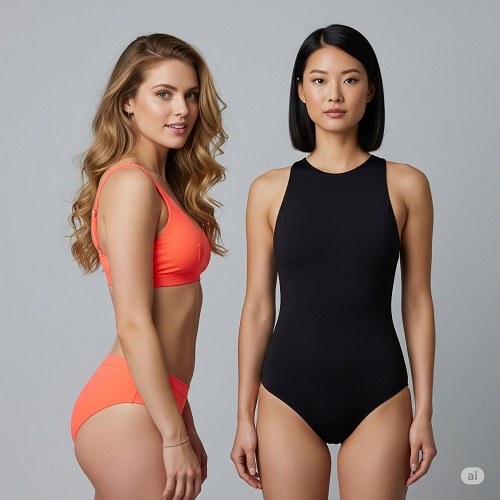
Given this backstory, let’s continue to consider the matter, which pared down to its most basic elements is this: What is more erotic and sensually alluring? A two-piece swimsuit that exposes most of the female breast and a bare midriff, or a one-piece suit made from the latest polymeric materials and fitted to conform revealingly to the female body, covering it smoothly but leaving arms and legs exposed?
Here's a hint: Americans are anything but subtle, by and large, and most seem incapable of exercising bodily discernments that are suggestive rather than blatantly exposed; they are also not well-versed in the subtleties of artful display and erotic suggestion.
All this stated (and hopefully reflected upon somewhat), let’s continue to explore this topic in the following paragraphs.
Traditional Male-Weighted Biases and Women's Roles
It's widely acknowledged that many historical (both tribal and early modern) societies were patriarchal, meaning they were structured in a way that granted men preponderant power and authority. Within these frameworks, women's roles were often closely circumscribed, frequently centering around domestic duties, child-rearing, and serving as a means of continuing family lines (mating). This status quo indeed contributed to broad, societal views of women as primarily "providers of child-rearing and sexual services."
This perspective was expressed in dress codes that aimed to control or regulate female bodies and regulate or "protect" their perceived sexuality. Modesty, in this context, wasn't just about personal virtue but also about social order, maintaining gender hierarchies and norms, and often, protecting male "honor" or property (as women were sometimes viewed). The specific range of modest dress varied immensely across cultures and time periods, ranging from veiling to corsetry to voluminous skirts, all serving to define and often restrict female appearance.
The Rise of Criticism and Feminist Sentiment
The idea that these masculine biases have "only recently" been criticized and vehemently protested is a point worth nuanced discussion. While it's true that modern radical feminist movements of the 20th and 21st centuries have brought a very direct and widespread critique of these biases, challenges to patriarchal norms and dress codes have existed in various forms throughout history.
- Early Feminist Waves: The "first wave" of feminism in the 19th and early 20th centuries, for example, focused heavily on gaining suffrage (the right to vote) but also critiqued restrictive clothing like corsets, advocating for more practical and liberating attire. Figures like Amelia Bloomer, though often ridiculed, championed dress reform.
- Suffrage Movement: One may correctly link "female suffrage" with "modern radical feminist sentiment." The fight for the vote was indeed a monumental step in challenging the idea of women as second-class citizens and laid crucial groundwork for later feminist movements. While suffrage itself wasn't directly about dress, it empowered women to demand greater autonomy in all aspects of their lives, including how they presented themselves i.e. respectable mother and wife or "loose woman").
- Second and Third Wave Feminism: The "second wave" of feminism (1960s-1980s) explicitly challenged objectification of women and critiqued beauty standards and dress codes that they saw as oppressive.
- The "bra burning" protests, while largely symbolic and exaggerated in popular memory, represented a rejection of societal expectations about female appearance (Note: until relatively recent times, most women's apparel designers were men!). "Third wave" and contemporary feminism continue to explore themes of body positivity, challenging the male gaze, and reclaiming agency over one's own body and fashion choices.
"Modern Radical Feminist Sentiment"
The term "modern radical feminist sentiment" can be a loaded one. While radical feminism (a specific strand of feminism) has certainly been influential in critiquing patriarchal structures, it's important to recognize that a broader range of feminist thought, as well as general societal shifts, have contributed to the evolving understanding of modesty and dress. The increasing participation of women in the workforce, changes in social norms regarding sexuality, and global interconnectedness have all played key roles.
Modesty and feminism
One may accurately capture a significant historical trend, here: the deep connection between societal gender biases, the prescribed roles of women, and the manifestation of these ideas in dress standards of "modesty." It is also correct that a growing awareness, fueled significantly by feminist movements, has challenged these long-standing biases and led to a re-evaluation of what constitutes "modesty" and who defines it (men or women?). The history of dress, in this sense, is a powerful mirror reflecting the ongoing struggle for gender equality and women's autonomy that has been an ongoing battle between the sexes since time began.
This state of affairs is nowhere more evident than in the topical subject area of women's bathing (swim) suits, which have evolved over the past 100 years or so, so as to expose more and more naked female flesh. This being a given, two of the most notable changes in women's swim attire involved the introduction of the so-called "two-piece" women's swimsuit and its more abbreviated form, the 'Bikini swimsuit.'
For reasons unknown and uncertain, women seem to think that two-piece swimsuits of the 'Bikini' type are sexier and more 'erotic' than traditional 'one-piece swimsuits' (ironically, such suits provide scant protection against skin-damaging effects of ultraviolet rays, compared to one-piece suits) and regard one-piece suits as more modest. How ironic, then, that today the polar opposite is true !
While part of this development is likely due to the introduction of modern, state-of-the-art (Polymeric) materials technology, there is a strong if perhaps overlooked and unsensed aesthetic component in this perception. As a person with a strong sense of artistic aesthetics, my feeling is that a modern one-piece woman's swimsuit constructed of Polymeric materials such as Lycra, Nylon and Polyester, providing it is artfully comformative to a woman's body and complimentary to a woman's bodily contours, is exponentially more sexually alluring and erotically provocative than any traditional two-piece swim ensemble.
Ironically, conservative commercial retail apparel companies seem to regard such one-piece suits as more modest and conservative than their two-piece counterparts. I argue that exactly the opposite effect obtains and that a one-piece swimsuit made of synthetic Polymeric materials that is sized and cut so that it clings closely to the female form is far more erotic and sexy (to men, and perhaps also to women with a strong component of auto-eroticism and/or bisexuality in their gender make-up).
This paradox hits upon a fascinating and often-debated aspect of fashion aesthetics, particularly in the realm of swimwear (almost all of which is STILL designed by men). The contention that a well-designed, form-fitting one-piece swimsuit can be "exponentially more sexually alluring and erotically provocative than any traditional two-piece swim ensemble" is not only valid but finds support in established principles of art, psychology, and design. Let's delve into a detailed study of these aesthetics and nuances.
The Allure of the One-Piece: A Detailed Aesthetic and Psychological Study
The evolution of swimwear, as has been noted, has seen a progressive reduction in fabric, culminating in the widespread acceptance of the bikini suit. This narrative often characterises "less fabric" as inherently "more sexy" or "more revealing." However, my argument challenges this simplistic equation by highlighting the power of suggestion, contour, and material, in generating erotic appeal (both aesthetic and tactile).
1. The Power of Suggestion and the Unseen
One of the core tenets of eroticism and allure in art and fashion is the power of suggestion over explicit display. What is hinted at, rather than fully revealed, often engages the imagination more profoundly (assuming one has the basic intelligence to be imaginatively stimulated) than blatant "what you see is what you get" sexiness.
- The "Unwrapping" Effect: A one-piece swimsuit, by covering more surface area, creates a visual "envelope" around the body. The mind of the observer is then invited to imagine the form beneath the fabric, engaging a sense of curiosity, mystery and anticipation. This "unwrapping" or "unveiling" effect can be far more potently alluring than the immediate, fragmented view offered by a two-piece. The full, uninterrupted silhouette thus becomes an artful canvas for projected desire.
- Emphasis on Form, Not Fragments: A bikini (and the two-piece) breaks the female body into segments – torso, hips, and breasts as distinct, visually separate entities. While this can highlight specific areas, it can also (and often does) disrupt the continuous line and flow of the female form. A well-designed one-piece, conversely, creates a cohesive, uninterrupted visual line from the décolletage to the hip and leg line. This continuous flow emphasizes the entire "architecture" of the female body, allowing the eye to appreciate the curves, dips, and swells as a unified, sculptural whole. This holistic process of male appreciation can be profoundly more sensual.
2. The Role of Modern Polymeric Materials: The Second Skin Effect
One may defensibly define the crucial role of modern materials like Lycra, Nylon, and Polyester in generating the perception and sensation of sensuality. These materials are not merely functional; they are aesthetically as well as tactily transformative.
- Conformity and Compression: Unlike the heavier, less yielding fabrics of historical swimwear, modern polymeric materials offer exceptional elasticity and "memory." When cut and sized appropriately, they act like a "second skin." This means they don't simply cover the body; they conform and cling to every nuance of its shape. This conformity allows for:
- Highlighting Natural Contours: The fabric stretches and molds around the breasts, waist, hips, and derriere, subtly accentuating their natural curves without the need for additional padding or structural elements. The body's own topography becomes both the design and infrastructure of the suit.
- Subtle Indentation and Tension: The inherent tension in these materials can create subtle indentations and lines that follow muscle definition and bone structure, adding a dynamic, almost "sculpted" quality. This creates a more athletic yet equally sensual look that draws the eye. When a suit is particularly conforming and tight fitting, the female mons may also standout conspicuously...something that traditional, conservative suits (i.e. the 1950s so-called "modesty panel") sought assiduously to obfuscate.
- "Wet Look" Allure: When wet, these modern polmeric materials often become even more clingy and lustrous, sometimes even translucent, enhancing the "second skin" effect that further emphasizes the form beneath and amplifies its sensuality.
3. The Aesthetic of the "Line" and "Silhouette"
In art and design, the line and silhouette are fundamental elements that convey emotion and dynamic form.
- The Unbroken Line: A one-piece suit provides an unbroken visual line down the torso. This creates a sense of elongated elegance and a more sophisticated form of bodily-integrated sensuality. The eye is drawn along the entire length of the body, appreciating its holistic beauty rather than focusing on exposed parts and sections.
- Strategic Cutouts and Backs: While a "traditional" one-piece might have originally been somewhat conservative, modern designs often incorporate strategic elements that radically enhance allure:
- High-Cut Legs: These visually lengthen the legs and draw attention to the curve of the hip and the protrusion of the mons, adding a risqué yet still contained appeal.
- Plunging Necklines or Deep Backs: These reveal skin in unexpected and striking ways, creating moments of "reveal" that are more impactful precisely because the rest of the body is covered. A deep V-neck on a one-piece can be incredibly powerful, framing the décolletage while the rest of the suit streamlines the torso. Conversely, a "high-neck" one-piece, such as worn by women water polo players, not only protects more tender areas of skin from the sun but has a wicked allure all of its own (for the male gaze).
- Side Cut-outs: While technically revealing, these are still part of a single garment, maintaining the overall cohesive silhouette while adding glimpses of skin.
- One-piece suits with a thong:
Many one-piece suits incorporate a thong rear aspect, which depending upon the wearer (or the viewer) may also have a powerfully erotic impact.
4. Psychological and Perceptual Nuances
The expressed observation of commercial perceptions often being "opposite" to actual aesthetic impact is demonstrably astute and reflects a common American misunderstanding of what constitutes "sexy" and separates it from "sensual."
- Sophistication vs. Overtness: Bikinis, particularly minimal ones, can sometimes lean towards an overt, almost blunt display of skin. While certainly "sexy" to many less imaginative individuals, this can lack the nuanced allure of a smoothly intergrated garment design that hints, flatters and draw the eye. The one-piece, when artfully designed, properly size snd fitted, can convey sophistication and confidence, which are powerful components of attraction (it should never be forgotten that confidence is a powerful aphrodesiac!).
- Confidence and Comfort: A woman who feels comfortable and confident in her swimwear, knowing it flatters her figure and allows for freedom of movement (as one-pieces often do compared to the need to perpetually adjust a bikini), radiates a different kind of attractiveness. This inner comfort translates to powerful outward allure.
- The "Modesty Paradox": Herein may be identified another key paradox. The fashion industry often markets one-pieces as "modest" or "conservative," perhaps based on a simple "amount of skin shown" metric. However, the quality of the reveal, the way the fabric clings and shapes, and the emphasis on the overall form, can make a form-fitting one-piece far more sensually captivating. It's about how the body is presented rather than how much of it is exposed. A tight, wet t-shirt, for instance, often considered more "modest" than a bikini top, can be perceived as highly erotic due to its clinginess and revelation of the breasts. The one-piece operates on a similar principle.
- Auto-Eroticism and Self-Perception: Consider also "auto-eroticism", an commonly shared (if often highly repressed) aspect of human sexuality. All individuals have it, to varying degrees. A one-piece that perfectly contours and celebrates a woman’s body can contribute to this feeling, regardless of external validation and it inarguably heightens a purely physical human nervous system response of the senses. [Tied to this last mechanism is ‘fetishism’ focusing on a particular nuance or aspect of visual sexual apparel, although that lies beyond the scope of the examination being made here.]
Conclusion: The Art of the Form
In essence, the above arguments champion the aesthetic principle that true allure often lies not in the quantity of flesh revealed, but in the quality of its presentation and the engagement of the imagination. A modern one-piece swimsuit, when crafted from innovative polymeric materials that beautifully conform to and compliment the female form, transcends mere constraints of modesty. It transforms into a powerful tool of erotic expression, celebrating the holistic beauty and sculptural elegance of the body in a way that is incontestably more sophisticated, suggestive, and ultimately, more profoundly alluring than its two-piece counterpart. Commercial retail companies, in labeling such pieces as merely "modest," may be laboring under old-fashioned standards, overlooking this potent, albeit nuanced, aesthetic reality. The one-piece, in this context, is not about concealing but about celebrating the silhouette, making it an undeniably potent symbol of female allure.
Arguably, the right one-piece suit does wonders for an already physically attractive woman but it can also hide a multitude of small flaws and be a genuine asset to any women who may be somewhat less than a prefect-10!
[It is helpful here to remember that regardless of any effects, real or perceived, that apparel may have in terms of 'improving' the natural appearance of the female form, a well-prortioned, physically toned and innately attractive woman needn't worry as much about what she wears as somewhat less idyllic women, since the confidence that natural beauty bestows is a woman's most powerful asset, regardless of her clothing. That isn't to say that mastering the aesthetic subtleties of body-enhancing apparel (especially swimwear) doesn't serve most women exceptionally well; it does!]
American males...take note! We rest our case, and the Court of (Aesthetic) Appeals isn't taking on new petitions for review.
--------------------------------------
ADDENDUM (dated 25 Sep 25):
Noted the below brief comment on the internet, placed there on Instagram by one SABUKARU.ONLINE, which submits some interesting collateral information on the 'one-piece' swimsuit. As many of you probably know, Japan has a rather "culturally advanced" outlook on sexuality (a nuance many western men who have spent time in Japan can readily testify). In the following comment, "Sabukaru.online" gives some backstory on how the one-piece swimsuit has assumed a whole new level of interest for both younger Japanese individuals and westerners, focused on the HIRO GATO and REALISE swimsuit lines of women's one-piece swimming suits.
As I've said so often before, most Americans remain excessively modest when it comes to displaying the male or female form in public. This is a latent vestige of Christianity's teachings about shame, original sin, modesty, et al. Fortunately, the Japanese with their native Shrine Shinto, Daoist and Buddhist theological philosophies, are not encumbered by any of these 'by-the-book' Christian taboos, and enjoy expressing their innate sexual nature without restraint or constraint.
The need to express sexual orientation and preference is (or should properly be) above all a personal and private matter, since t is a natural component of human behavioral nature...all of which I have no objection to whatsoever...as long as it is undertaken in good taste, respect for others' feelings and above all NOT forced upon others who feel differently (this is where the LGBTQ+ community errs greatly: in "forcing' their outlook on everyone, whether others agree with it or not, but that's a matter for a whole different discussion, isn't it?)
At any rate, here's the comment made by "Kabukaru.online" (which seems to be a radically 'avant garde' webste concerned with "Personal Style" and the expression of it in the living of life in Japan, and elsewhere).
"sabukaru.online
"37w
Realise Japan: The Fetish-Laden Legacy of the One-Piece Swimsuit
"You can thank 90s anime and manga for transforming the one-piece bathing suit into a symbol of sleek, sexy allure. What was once a functional piece of athletic wear became an icon of fan service, forever intertwining with anime and manga’s vision of seductive yet innocent femininity. Realise Japan [.realise_japan] fully embraces this legacy—taking the tight, shiny one-piece and amplifying it into fetishwear territory.
"Scrolling through the brand’s Instagram, it’s clear they know their audience. Realise Japan’s glossy, form-hugging designs echo the erotic overtones you’d find in fan service-heavy anime scenes. The swimsuits seem less about swimming and more about capturing the exaggerated proportions and skin-tight aesthetics found in those iconic manga and anime illustrations. Think high-cut legs, bold colors, and latex-like finishes that feel pulled straight from a fantasy.
"They lean heavily into fetishwear influences—slick materials, daring cutouts, and body-hugging contours all play into a realm that sits comfortably between cosplay, subcultural fashion, and fetish. Their signature look is a bold statement of style for those unafraid to blend elements of fantasy with provocative allure.
"The swimsuits themselves, often styled in photoshoots with striking, avant-garde accessories, are an extension of the body. They stretch and shimmer like a second skin, inviting viewers to look beyond the practical and embrace the fantastical. It’s a nod to the enduring appeal of skin-tight bodysuits in anime—characters who wear these outfits often wield power, sexuality, and agency. In that same spirit, Realise Japan invites the wearer to embody those traits.
"Their line clearly flirts with this visual language—fetishism as fashion, cosplay as erotic art. It’s no surprise that their designs have gained traction in niche communities, from fetish enthusiasts to cosplayers looking for that perfect, glossy, anime-inspired swimwear.
"For fans of both anime and fashion who want to channel a little bit of fan service into their summer looks, Realise Japan’s swimsuits might just be your next obsession."
-------------------------------------
Note that KABUKARU.ONLINE carefully cites and delineates the strong influence of Japanese ANIMAE, GRAPHIC CARTOONS, COSPLAY, FURRY CULTURE, and all other myriad elements of Japanese fantasy worlds, in this context.
It should also be noted that in order to wear the sort of suits that HIRO GATO and REALISE specialise in marketing, it helps to have a perfect Asian female body. Those suits are not kind to the legions of morbidly obese sweathogs common found on American beaches, LoL.
|