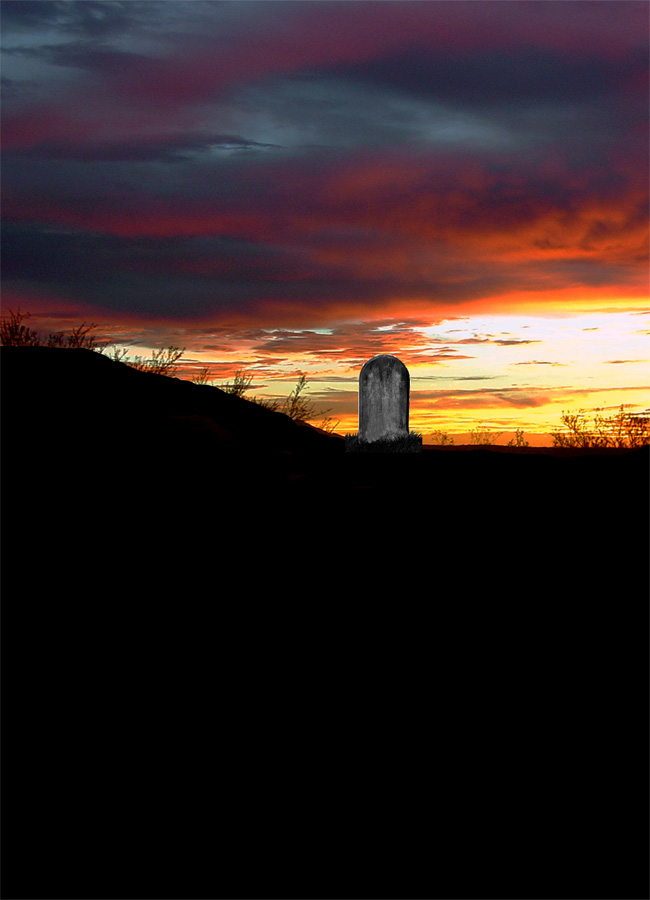
Examine the growth of cemeteries in the Old Pueblo from the 1873 addition of the Court Street Cemetery, to the 1891 deactivation of the Ft. Lowell cemetery and the continuing growth of private cemeteries in the early 20th century.
COURT STREET CEMETERY
In 1873, the commander of the U.S. Army post decided to separate his troops from the temptations of urban Tucson. Attracted by the quality and quantity of grazing land and river water, Lt. Col. Eugene Asa Carr moved his young soldiers northeast of the city of Tucson. At its peak, Ft. Lowell served as the home base for as many as 200 men stationed in Southern Arizona. At the end of May 1875, further interment in the National Cemetery was prohibited when the village of Tucson’s Committee on Cemeteries established a new Court Street Cemetery. This cemetery was bounded by Main and Stone on the west and east, and Speedway and Second Street on the north and south. When the National Cemetery shut down, recognizable graves of military personnel were moved to a graveyard in the southwest section of the Fort. Newspapers then issued calls for identification of persons in graves without documentation.
Initially the “new” cemetery equally accommodated Roman Catholics and other Christian denominations. Later, Civil War veterans and fraternal organizations such as the Tucson Volunteer Fire Department, Grand Army of the Republic, Knights of Pythias, and B’nai B’rith were given plots. In 1880, railroad tracks sliced through the graveyard and commercial buildings like that housing the Star and Citizen newspapers, which further encroached on the old burial plots. This “New” cemetery continued as the sole resting place of the dead within the city limits until 1907, when the private Holy Hope and Evergreen Cemeteries opened.
DEACTIVATION OF FT. LOWELL
Ft. Lowell was deactivated in 1891. During the following year, 80 of 91 graves were disinterred and the remains were sent to the San Francisco National Cemetery for reburial. What happened to the rest—who may have been civilian muleskinners of the Quartermaster Corps—is still unknown. In the first decade after the Army's departure, El Fuerte, a small agricultural settlement of Mexican Americans was established among the Fort’s abandoned buildings. Today a townhouse complex covers the former graveyard.
RISING REAL ESTATE VALUES
In the early 20th Century, the value of real estate in Tucson increased significantly. In July 1907, Herbert B. Tenney, J. Knox Corbett, John M. Ormsby and Frank L. Culin—all officers of the newly formed Tucson Cemetery Association—announced the purchase of 240 acres of farmland north of the city, on Oracle Road. This land would become Evergreen Cemetery, offering permanent records of each lot, with the 80 acres fronting Oracle Road boasting heretofore unheard of "perpetual care," with "a lawn maintained equal to any private lawn in the city." Just to the north was the new 120-acre Holy Hope Cemetery, owned and operated by the Tucson Roman Catholic Diocese.
THE GROWTH OF PRIVATE CEMETERIES
Despite innovations in marketing and comprehensive service, and the City Council’s prohibition of further burials in the Court Street Cemetery in 1908, there was no rush to remove bodies—or to sign up for graves in the new cemeteries. For years, local undertaker John Reilly oversaw exhumations from the old Court Street cemetery. His rule for relocation was to assume the dead to have been Roman Catholic if they appeared Spanish; if not, re-interment was in the ecumenical and multi-cultural Evergreen, which accepted the bodies of Chinese and Jewish persons, as well as the non-religious. The land of the “old” Court Street Cemetery was not deemed abandoned until March 1916, when advertised bids on 88 lots netted the government $10,000. With private cemeteries then firmly established, civic leaders could retire the flourishing township from the funereal business. With increasing wealth among the citizenry, funeral parlors rather than the front parlors of next of kin became the venue for last rites honoring Tucson’s dead.
DESECRATION OF BURIAL SITES
Unbridled civic expansion, garbage removal, and covert plundering once accounted for the majority of everyday desecration of Tucson’s burial sites. Today, road excavation, building construction, and laying utility lines routinely unearth the remains of deceased residents and passersby, especially beneath the city’s central buildings and connecting streets, old garbage dumps, gardens, and parks. Disturbing old burials is limited, and removal of bodies is generally limited to those specifically disturbed by a project. Archeologists carefully extract bones and other artifacts, and after completing their studies, coordinate with organizations like Los Descendientes del Presidio de Tucson [direct descendants of original Presidio soldiers], the Catholic Diocese of Tucson, representatives of the Tohono O’odham Nation, and other authorities to safeguard appropriate reburial of unearthed remains. Latter day discoveries during roadwork and multiple renovations and reconstruction of the Pima County Courthouse have helped to pinpoint the probable site of the old Presidio chapel and cemeteries which may help predict other potential archeological sites.
SELECTING A FINAL RESTING PLACE
Modern society carefully records matters of birth and death and many factors must be considered in selecting one’s final resting place. While Pima County’s Department of Vital Statistics says there are no laws governing or prohibiting burial of neither human nor pet on private property, key legal questions revolve around land-use zoning and property deed covenants, conditions and restrictions. Even if you do not live in a restrictive development, zoning of property for single-family homes would preclude establishing a family cemetery. Beyond this, there remains the issue of appropriate interment that will not interfere with water, gas, electric, or television cable lines. Additionally, death certificates require specification of final disposition of the deceased’s remains. Any burial on land in Arizona must be recorded on property deeds.
From small consumer advocate groups like the Tucson Memorial Society, to the nation’s larger operators of cemeteries and memorial homes, one can find assistance in circumspect funeral planning, or simply arranging to purchase a burial plot as a real estate investment. While the State of Arizona has no laws precluding the burial of human remains or cremains on private property, you will want to verify city and county rules. Depending on what you learn, you could opt for a “bio urn” which is a biodegradable urn into which both ashes and a tree or other plant can be buried on private land. Perhaps the safest and least expensive way to approach honoring deceased loved ones is by tapping into the emerging market of the virtual cemetery where you can locate a “Garden of Remembrance” to honor family, friends, and pets.
|







I find it quite amusing that citizens and cemeteries, just like in Phoenix would want to attempt to maintain "lawns," when the environment would suggest a simple desert scape to be much more practical and economic.
The Tucson community owes a lot to your research and reporting on the history of these cemeteries, private and public.
Ron