Among the biggest surprises to come my way in 2019 was an invitation to give a talk and sign copies of Dreams of the Immortal City Savannah at the Flannery O'Connor Childhood Home in Savannah, Georgia. Health issues prevented me from accepting the initial invitation but I am now slated to give a presentation in May 2020. The plan is to also have available for signing a forthcoming book in which I recount adventures and misadventures involving three iconic writers: O'Connor, James Alan McPherson, and John Berendt.
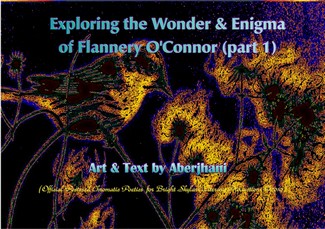
Any literary biographer will tell you writing a book of meaningful depth on an influential author requires a ton of research involving what other writers have already said about the subject. The following are reflections on another scribe's brilliantly-informed perspective, first published by AXS Entertainment as: "Events, Books, Highlight Flannery O’Connor’s Legacy."
Regarding an Exceptional Child
One of the words most frequently used to describe Flannery O’Connor is “paradoxical.” Exactly why that word is such an appropriate one is demonstrated with informed passion and masterful skill in Brad Gooch’s finely layered biography: Flannery, A Life of Flannery O’Connor.
The fact that the mystery of O’Connor’s life and work continues to draw increasing attention in the twenty-first century is amazing when considering how steeped it is in the language of her times—the very racially-charged South of the mid-1900s–– and when noting her early death from lupus at the age of thirty-nine.
Gooch begins his story by revisiting a moment which would remain a reference point of both humor and symbolism throughout O’Connor’s remarkable life. He takes us to the author’s childhood home in Savannah, just off Lafayette Square, where in 1930 she was visited by a news cameraman “to record her buff Cochin bantam, the chicken she reputedly taught to walk backward.” While a chicken may have been the first bird to enhance her public profile, in her personal essay about the incident, The King of the Birds, O’Connor noted “My quest, whatever it was actually for, ended with peacocks.”
Her childhood penchant for reversing the accepted order of things might be read as nothing more than weird if attributed to another five-year-old. Because it is O’Connor, it may instead be viewed as one early hint of a creative sensibility which in time would create and coax characters into acting out challenging dilemmas of the human condition as she observed it. Biographer Gooch’s narrative is particularly astute when it comes to his evocation of how that sensibility recognized its own value and instinctively preserved itself within “a regulated and meticulously organized world within a world.”
Her tactics included the creation of poems, cartoons, and booklets in which she presented portraits of Edward O’Connor, her adored businessman father, and the resilient Regina Cline O’Connor, her mother. They also included somewhat restrained rebellions against the authority of the nuns, at St. Vincent’s Grammar School for Girls, whose job it was to help shape her character into one reflecting modern Catholic grace and values.
Loss and Suffering
Like nearly all Americans who grew up during the 1930s, Flannery O’Connor’s childhood was marked by the economic ravages of the Great Depression. Her father lost first his real estate business, then a succession of jobs until he was forced to accept a position in Atlanta in 1938 and moved his family to Milledgeville, where in time his daughter would become one of its most famous citizens. Even more notable than the family’s financial up and downs was Edward O’Connor’s death from lupus at the age of forty-five in 1941. His daughter was then fifteen.
Each turn of fate in Flannery O’Connor’s life as recounted by Gooch seems to have reinforced her personality with powerful measures of theological insight, focused creativity, and humor. A couple of years following her father’s death, she noted: “A sense of the dramatic, of the tragic, of the infinite, has descended upon us, filling us with grief, but even above grief, wonder.” Most people stop at the “grief” part and allow themselves to simply wallow in it until ready to move on. The mystery of the “wonder” continuously pushed O’Connor forward.
At the age of twenty-five, in December 1950, she was told she was suffering from a severe case of rheumatoid arthritis, but two years later learned her true condition had been hidden from her. Sally Fitzgerald, one of her closest friends, told her she was suffering from the same disease which had killed her father. By the time she learned her actual condition, she had already distinguished herself as an aspiring writer at the famous Iowa Writers’ Workshop and as one from whom great things were expected at the renowned Yaddo Artists’ Colony. Her status as a professional author rested mostly on a number of short stories published in prestigious literary journals and on her now classic 1952 novel, Wise Blood, published just a month before learning about her medical fate.
Such “devastating knowledge” might have reduced another sensitive soul to a simmering puddle of depression from which they might never have recovered. As Gooch points out:
“She did not know whether she would be allotted the same three years of borrowed time as her father, following his diagnosis, or if indeed ‘the Scientist’ possessed a miracle cure. She had her doubts.”
She also had her faith and intellectual passion, both of which helped her to confront the enemy known as lupus. (Gooch’s report on how doctors treated individuals with the disease in the 1950s is particularly interesting in light of the Food and Drug Administration’s 2011 approval of a drug called Benlysta as a treatment option; the authorization marked the first time in fifty-four years a new drug received such an endorsement.)
To check out part 2 of this review essay or jump ahead to the final part 3 please clicking the following page links:
The N-Word Factor: Exploring the Wonder and Enigma of Flannery O'Connor Part 2
Exploring the Wonder and Enigma of Flanner O’Connor Part 3
by Aberjhani

















I enjoy reading your writing
Never stop writing !
m