A recent article on the poetry of Marc Thomas, the author of Talking to the Machines and Oher Poems, made me think about why, and how much, I have always enjoyed celebrating National Poetry Month. As with Thomas’s work, which I first became aware of during a Local Author Day event in Savannah, Georgia (USA), it has largely been about the discovery of what different poets bring to their individual applications of literary craftsmanship.
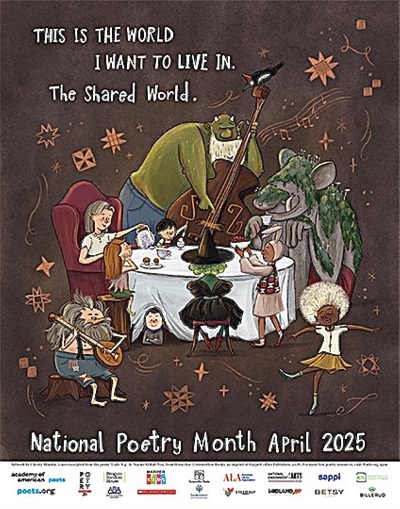
A lot of people cheered and applauded when the news broke in 1996 that the Academy of American Poets was launching observations of the inaugural National Poetry Month (NPM) annual celebrations. The Academy encouraged individual writers and organizations everywhere to participate in ways that suited them best. Creatives in my hometown responded to the call by putting on events where many would expect to find them: like libraries, schools, bookstores, and coffee shops. Others hosted happenings at unexpected locations: like nightclubs, churches, bars, parks, and river-front walkways.
As one of the organizers of such events, I was happy to help make spoken-word presentations by both local and national talents, as well as literary panel discussions, accessible to members of diverse communities. In addition, my position as an editor for the Savannah Literary Journal allowed me to publish works by such future city and state poet laureates as: Darryl Lorenzo Wellington of Sante Fe, New Mexico; and, Anis Mojgani in Oregon. Possibly more thrilling than anything else was occasionally witnessing an audience member “catch fire” for the first time and begin composing their own lines at one event, then reciting them at the next.
An Alignment of Voices
It is well known that poetry, as many understand it today, had its beginnings long before written expressions of it. Common belief proposes it developed during prehistoric times as an extension of, or variation on, storytelling. My own theory is that poetry initially evolved out of instinctive spontaneous prayers uttered as appeals to nature or to unknown, but suspected, higher powers. Viewed through such an intuitive transcendent lens, it was amazing to observe how different neophytes, centuries later, made their personal connections to this ancient practice.
There came, year after year, scholars who adapted their long-restrained literary passions to such academic formulations as sonnets, odes, and villanelles (a favorite among friends at the Poetry Society of Georgia) with respectful nods to Japanese haiku (with which I’ve experimented for a series of angel poems published in The River of Winged Dreams). Numerous cultural heritage enthusiasts aligned their voices with the French surrealists, Spanish ballads or romancero, traditional African praise poems, or the jazz- and blues-influenced writings published during the Harlem Renaissance and Black Arts Movement.
Particularly notable was the fact that members of an entire generation––during those late 1990s days as annual observations NPM expanded––took their poetic cues from slamfests, spoken word open mics, and the fluidity of Hip-Hop lyrics often composed in a heated flow of spontaneity. For a lot of such poets, that meant generally foregoing textbooks and, instead, memorizing recordings and recitals. At the time, I was a bookseller, and was as amazed as I was amused when dictionaries of rhymes began to outsell sonnets by Shakespeare or collected poems by Maya Angelou.
The AD Community Experience
Just as I took immense pleasure in participating in different forms of NPM during its earliest days, I experience a similar kind of joy upon joining the AuthorsDen community years later (just after completing Encyclopedia of the Harlem Renaissance with Sandra L. West in 2003). The AD members with whom I connected were so faithful to their relationships with poetry and so generous when it came to mutual supportiveness they often inspired both the poet and the essayist in me to write about them. These are a few examples:
• VISIONS OF THE POETS, Part 1: Andre Emmanuel Bendavi ben-YEHU
• Visions of the Poets, Part 2: The Hanging Man Dreams
• Visions of the Poets, 3-A: Journey Through Universes Beyond the Visible
My background as a journalist and encyclopedist made writing the above somewhat automatic, but I became speechless when various members presented their assessments of my work in poetry or essays by them.
Coming Full Circle
All of this brings me back, full circle if you will, to Marc Thomas’s Talking to the Machines and what the first section of the book says about humanity’s current uneasy relationship with generative artificial intelligence. The satisfaction which some take in being able to prompt generative AI to construct lines of text which mimic human composition is easily understood. Like current rapid-fire AI developments in general, it is innovative, exciting (even mesmerizing), and provides a kind of service useful for supporting different endeavors. Despite its documented threat to the relevance of human-generated works. That such poems impressively duplicate academic formulations well enough cannot be denied because, ironically enough, the formulaic nature of some poetry makes doing so, arguably, easy for digital programs.
The experience, nevertheless, of prompting software to produce a composition is very different from the experience of deeply contemplating a love affair, wrestling with the world’s injustices, appreciating the wonders of nature, or intentionally confronting painful truths, and transcribing those meditations into written or spoken verse. The soulful depths of the stories behind how certain poems emerge out of lived realities is a part of that mysterious essence which has defied scientific explanations for centuries and continues, even now, to confirm what it means to be an authentically creative artist.
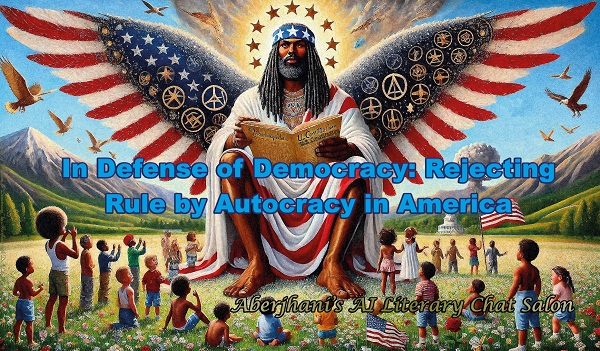
None of this is meant to take anything away from AI’s ability to enhance productivity in a variety of professional situations—or for that matter to improve the quality of human life overall. In my own flesh-blood-and-spirit-generated human life, AI (along with human coaches) has helped me create objective literary criticisms, which I have edited for accuracy and clarity, to post in my AI Literary Chat Salon. I have also used it as a tool in the production, or editing, of some original concept art creations. And yes, the increased efficiency is appreciated.
What it cannot do for me is replace the psychic and spiritual infrastructures that give meaning to words like community, personal growth, and intimacy. What none of us should prompt AI to do, I would propose, is delete the connections and practices that go beyond providing meanings to endowing what we call existence itself with soul-infused value, and enriching it with an innate kind of poetry worth celebrating in small or big ways every day of the year. That includes this one.
Aberjhani
National Poetry Month 2025




But unlike you I was never educated in poetry. Never even took a course. And I never followed poetry circles like you have. I've set myself on producing a poem a week that I post on my website and on AD. And that is it.
I didn't know that there was a poetry month, but thank you for letting me know. But there are so many national months and days, these days that it's really hard to keep up with all of them. But people like to celebrate more than I do, so I will let them celebrate and I will just continue to write poetry and try to find good poetry to read or good lyrics in songs like almost every one of Bob Dylan's back in the day.
Ron
As Aberjhani notes, I have many reservations about the cultural, political and personal impacts of Artificial Intelligences, whether they be automated language generators, high powered data analysis tools, or computerized decision support systems.
There are many discussions going on about the use of AI in assisting, imitating, plagiarizing or potentially even polluting authorship. I think Aberjhani's AI Chat Salon is an admirable experiment in developing new practices and establishing boundaries. He openly uses AI to help develop his essays, but also takes full custodianship and responsibility of the texts produced.
As yet, I have not published any of the texts that have come out of my explorations of Large Language Models, but I am considering it. If I do, I shall be open and clear about the history of prompts and iterations it took to produce the result.
AI can probably be a great boon to the production of a great deal of repetitive technical writing. I have been burdened in jobs earlier in my life with the recurring tailoring of established language to adapt to specific cases, and much of that should be greatly automated.
However, I still find AIs lacking not only in common sense and good error and fact checking, but in consciousness, taste, creativity, and the ability to deal flexibly with all the ambiguities, passions, pains and anomalies of the embodied life. It is useful as an aid to analysis, but I continue to distrust its outputs as legitimate art.