Porsche and the Geometric Imperative: A Critical Analysis of Porsche’s Mid-Engine versus Rear-Engine Architecture
Abstract
The history of Porsche automotive design is characterized by a unique dichotomy: the commercial devotion to the rear-engine layout (the 911) and the engineering pursuit of the mid-engine layout (the 550, 914, Boxster/Cayman). While the rear-engine configuration established the brand's identity, this paper argues that it represents a compromised architecture sustained by engineering brilliance and cost concerns, rather than fundamental physics. In contrast, the mid-engine platform, though often relegated to "entry-level" status (in the 914) or limited-run racers, ironically represents the optimal solution for high-performance driving dynamics. By analyzing polar moment of inertia, suspension kinematics, and the economics of manufacturing, this paper demonstrates the objective superiority of the mid-engine design in achieving the sports car ideal: agility, balance, and driver engagement.
I. Historical Divergence: The "Number 1" versus The Production Reality
The genesis of the Porsche sports car reveals the company's true engineering intent. The 1948 prototype, the 356/1, was a mid-engine roadster. Ferry Porsche and engineer Karl Rabe understood that placing the powertrain forward of the rear axle was essential for maximized neutral handling.
However, the shift to the rear-engine layout for the subsequent 356/2 (and later the Gmund and Stuttgart production models) was a concession to manufacturing logistics (and cost factors), not performance. To utilize Volkswagen components effectively and create space for "occasional" rear seats—a key selling point for a daily-drivable sports car back in the day—the engine had to be pushed behind the axle.
The Consequence: This decision locked the company’s flagship product into a physics battle that would last seventy years. It created a lineage of cars that required constant mechanical compensation (longer wheelbases, weighted bumpers, wider rear tires) to counteract their inherent imbalance. The mid-engine lineage, maintained quietly through the 550 Spyder and 718 RSK race cars, remained the "pure" strain of Porsche DNA, uncorrupted by the need for rear seats.
II. The Physics of Rotation: Moment of Inertia and Yaw Response
The primary argument for the mid-engine layout lies in Newton’s laws of motion, specifically regarding polar moment of inertia.
The Rear-Engine Pendulum:
In a rear-engine 911, the engine mass is cantilevered outside the wheelbase. This creates a high polar moment of inertia. The vehicle resists initial rotation (understeer) due to the lack of weight over the front wheels. However, once the rear mass begins to rotate laterally (yaw), it gains significant momentum. If the driver disrupts the chassis balance mid-corner—specifically by lifting off the throttle—the rear weight shifts forward, traction is lost at the rear, and the heavy tail swings violently outward. This is the "pendulum effect."
The Mid-Engine Pivot:
In the 914 and its successors, the major mass components (engine, transmission, driver, fuel) are clustered within the wheelbase. This results in a low polar moment of inertia. The vehicle functions less like a pendulum and more like a spinning top. It requires less steering angle to initiate a turn and, crucially, less energy to stop rotation.
- The Dynamic Advantage: A mid-engine car can change direction rapidly (transient response) without the chassis becoming unsettled. It allows the driver to modulate the car’s attitude with the throttle rather than fighting to keep the rear end in check.
III. Suspension Architecture: The 914’s Structural Advantage
The superiority of the mid-engine layout was highlighted during the 1970s through the suspension comparison between the 911 and the 914.
The 911’s Compromise (Semi-Trailing Arms):
The early 911 utilized a semi-trailing arm rear suspension with transverse torsion bars. While compact, this geometry possessed a flaw: "lift-off oversteer" (AKA: “Trailing-throttle Oversteer”) was exacerbated by toe-out changes during suspension unloading. When the rear of a 911 lifted (during braking or throttle lift), the rear wheels would toe out, actively steering the rear of the car into a spin. This required the 911 to be driven with a specific, counter-intuitive technique (slow in, fast out). Given the demanding learning curve of mastering the 911’s inertial challenges, this effect could be mastered and even optimized by exceptionally adept drivers but it could also be fatal in the hands of a novice or casual 911 driver.
The 914’s Solution (Coil Springs and Trailing Arms):
The 914 broke with tradition by utilizing a dedicated trailing arm rear suspension with coil springs.
- Coil Springs: Unlike torsion bars, coil springs allowed for progressive rates and easier tuning of the ride frequency.
- Geometry: The trailing arm design on the 914 provided consistent camber and toe characteristics throughout the suspension travel.
- Result: Because the mid-engine placement naturally provided stable static weight distribution (approx. 46/54), the suspension did not need to be excessively stiff to control weight transfer. The 914 could run a compliant suspension that absorbed mid-corner bumps without upsetting the chassis—a feat the tail-heavy 911 struggled to match without sophisticated damping.
IV. The "Affordable" Engineering Challenge
A common misconception is that mid-engine cars are exotic solely due to performance. In reality, they are exotic because they are difficult to engineer affordably.
The Platform Constraint:
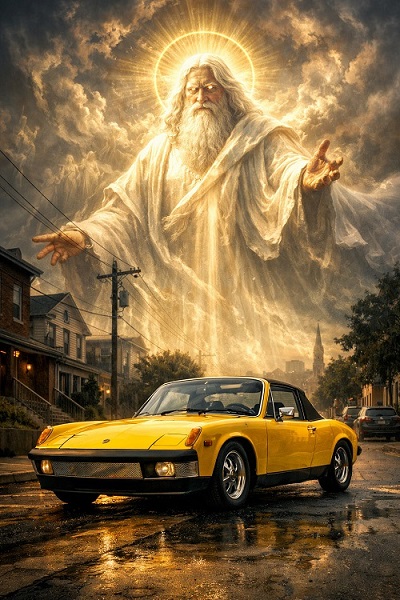
Designing a mid-engine car requires a bespoke chassis. Unlike a front-engine or rear-engine layout, which can often share floorpans with sedans or economy cars, a mid-engine layout disrupts the passenger cell. The 914 was a technological marvel because it managed to create a rigid safety cell (Targa top) and a mid-engine layout at a price point attainable to the middle class. Not unironically, this ‘affordable’ aspect helped denigrate the car as being somehow Lèse-majesté to the Porsche 914’s status, to some extent.
NVH (Noise, Vibration, Harshness):
Placing the engine inches from the driver’s vertebrae creates immense engineering challenges regarding heat management and noise isolation. The 914 solved this with a vertical firewall and engine access plate, but this also compromised ease of serviceability to some extent. The complexity of routing shift linkages around the engine to the transmission (which sits behind the engine in a mid-engine Porsche) historically resulted in vague shifting compared to the direct linkage of a 911. This is the only mechanical metric where the rear-engine 911 layout holds a simplicity advantage.
V. The Triumph of Balance Over Brute Force
The ultimate measure of a sports car is not its peak acceleration, but its usable performance.
The Horsepower Fallacy:
The automotive industry (particularly in America) has historically often used horsepower to mask chassis deficiencies. A rear-engine car requires massive rear tires and substantial power to compensate for the fact that it cannot carry as much speed through the entry and mid-point of a corner. It relies on "point-and-shoot" tactics: brake hard in a straight line, turn, and use the rear-engine weight to provide traction for hard acceleration.
The Momentum Philosophy:
The mid-engine design prioritizes momentum conservation. A 100-horsepower Porsche 914 or an early Boxster can often achieve faster lap times on technical circuits than higher-powered heavyweights because they do not scrub off speed to survive the corner.
- Technological Validation: This philosophy is validated by modern tire technology. As tires have become grippier, the "traction advantage" of the rear-engine 911 (weight over the drive wheels) has become less critical, while the "handling advantage" of the mid-engine car has become more pronounced.
The Inescapable Truth
The most damning evidence against the rear-engine layout comes from Porsche itself. When the company developed the Carrera GT and the 918 Spyder—cars designed to showcase the absolute zenith of Porsche engineering without budget constraints—they utilized mid-engine architectures. Furthermore, the modern 911 RSR Le Mans race car, despite bearing the 911 name and silhouette, moved its engine forward of the rear axle, effectively becoming a mid-engine car to remain competitive against Ferrari and Ford.
This serves as the final admission: The rear-engine layout is a romantic tradition, a triumph of brand identity, and a mechanical challenge to be conquered. The mid-engine layout, exemplified by the 914 and its lineage, is the scientific truth—a design where the machine works in harmony with the laws of physics rather than in defiance of them.
Conclusion
It is worth noting that regardless of the hard, cold, analytical evidence presented herein on the merits of one approach (mid-engine) in comparison to another (rear-engine), over the past 7+ decades there has developed another, strictly emotional aspect to the matter being examined here and that is the highly personal and individualized aesthetic preferences of the Porsche enthusiast with an air-cooled car.
It is therefore entirely reasonable that emotions will and shall continue to run high among the two groups of Porsche enthusiasts: those with mid-engine models and those with ‘classic’ rear-engine types (i.e. the ubiquitous 911 and its modern relatives). In such an emotionally related circumstance, the introduction of no amount of science and technology will significantly alter the outlook of one or the other camps. Human beings are, after all, notoriously prone to substituting and prioritizing emotional feelings for rational, analytical logic in almost any controversy imaginable. It is this nuance of human nature that makes us “Human”, after all.
An individual who has owned multiples of air-cooled, rear-engined 911 models over the years would be innately loathe to switch sides in a debate such as this, just as would be someone who had always favored and remained true to the classic 550, the 914-6, or the Boxster/Cayman Porsche models. We can see this very active and often animated colloquy being debated almost everywhere one looks in Porsche circles, these days, and there is no possible definitive resolution of the subject therefore possible.
Today, already we can see another such ongoing colloquy developing in the pits and on the paddocks over the ‘purity’ and righteousness of the traditional air-cooled Porsches versus the most recent water-cooled models, and that isn’t even taking into consideration whatever contentious debates shall develop and evolve regarding introduction of EV Porsches!
1950s era socio-political cartoonist and raconteur/critic Walt Kelly was precisely right on target with his Pogo Possum character, who (had Pogo owned a Porsche), might have observed that “In all matters and human affairs...we have met the enemy and he is in all of us.”





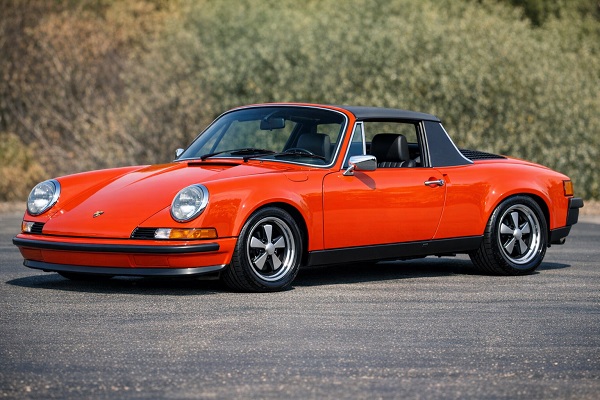













When I arrived from around the world to the Philadelphia airport and 8 inches of new snow, I was grateful that Roger's 912 had a backseat where his daughter sat sideways to accompany us back to the house.
I was about to say that NASCAR cars seem very capable on road races to handle the curves, until I read about the horsepower fallacy. On distance races like the 24 hour at Lemans, the need for gasoline stops alone makes the horsepower fallacy unworkable.
Ron