The Gold & Azure Frontier: A Brief History of California’s Youth Surf Subculture (1955–1970)
Preface
Back in the 60s, a large part of my high-school life centered around surfing, despite the fact that at the time I was what we call an ‘Inland Surfer.’ That is, the town my school was located in was about 80 or so miles from the nearest ocean. Regardless of my land-locked status, I had all the accoutrements that were de rigueur for a teenager who fancied himself an authentic surfer. This included Madras shirts, blue Keds boat-shoes, a couple of Pendleton wool shirts, even a Madras belt and faded jeans. Cut-offs were as close to having real ‘surfing baggies’ as most of us came but since I was on the school’s swim-team, I just made-do with our black school swim team suit most of the time.
During the summers, I was a lifeguard for the town’s municipal swimming pool, having gained my Advanced Red Cross Lifesaving ratings and also a WSI (Water Safety Instructor) credential, and usually worked for a month each summer as a Scout Camp Lifeguard, teaching small craft (canoeing, day-sailing and rowing, as well as giving swimming lessons). The off-shoot of all the aquatic activity was that I had a nice tan, the required long blonde hair and even gnarly knees (from surfing). In short, I was about as authentic a surfer as any ‘inlander’ could be, shy of actually living on the Pacific coast. Like iconic Hawai’ian waterwoman, Rell Sunn, and equally iconic champion swimmer & surfer, Duke Kahamamoku, I always felt truly at home in the water (but never, ever was I one-thousandth the surfer Rell or Duke were!).
My mint-green 1940 Chevrolet Master Deluxe Coupe (which I bought for only $25) guaranteed a certain cachet among my peers, although I had enough SciFi nerd in my matrix that I never quite clicked with the popular ‘in-clique.’ On weekends, I and a couple of good buddies would toss our surfboards (mine was a used ‘pop-out’, mass-produced Duke Kahanamoku signature longboard that I picked up for $15 somewhere) on the Chev and head for the coast. Well-used and covered with dings, my board nevertheless resisted getting water-logged and sinking...something I was eternally grateful to the Duke for! Off we’d go to spend the weekend at Central Coast communities like Avila Beach, Pismo, Morro Bay and Cayucos (about 10 miles north of Morro Bay).
Weekends would fly by, of course, and then it was back to our sun-baked, humdrum agricultural community of the San Joaquin Valley, nicely tanned and at least looking the part of the Jack Nitzsche's moody and evocative ‘lonely surfer’ (see list of songs at the end of this).
Looking back now, those were magical times and the romantic fantasy that fueled the surfer youth culture fixation we all lived and breathed is today the stuff of post-war legend written about in books that one rarely even reads about. I have no doubt that many old longboard surfboards are still occupying space in the rafters of garages or in the basement room at some midwest home.
All my life I have had a special love of the vast oceanic parts of our planet, a fondness that, along with an equal regard for the high mountain ranges, still remains as a vital element of my life that continues to inspire me and make my life on this beautiful planet of ours meaningful.
The following informal history is an attempt to share some of what made those times so singular and unique to me with others among us who never have never had the chance to balance on a surfboard or wipe-out disastrously on a wave beyond their abilities.
I make no pretenses here about my surfing abilities, however. I was never more than a mediocre wave-slider at best, finding surf over 6-8 feet a bit above my self-imposed abilities' limit. Fortunately, most of California’s Central Coast waves in summer average about that or slightly below, most of the time!
Regardless, I looked the part, truly relished the salty sting of fresh Pacific Ocean air and, having been born in a coastal fog bank (in San Francsco), I regarded the vast Pacific Ocean as I do Haumea, the traditional Hawai'ian spiritual mother of us all!
---
The post-World War II era in California was characterized by a unique convergence of economic prosperity, technological advancement, and a burgeoning youth demographic that found itself with unprecedented leisure time. Within this crucible, the surfing subculture evolved from a niche pastime into a global phenomenon. Far more than a mere sport, surfing during the 1950s and 1960s represented a radical departure from the rigid social structures of the preceding generation. It was an aesthetic and philosophical movement centered on the Pacific coastline, eventually exported to the American interior through the medium of a highly specialized musical genre. This transformation, catalyzed by pioneers such as Dale Velzy and articulated through the reverb-drenched guitars of Southern California, created a cultural archetype that defined American youthhood until it was eventually subsumed by the British Invasion.
The Genesis of California’s Shoreline Subculture
The origins of California’s surf culture in the early 1950s were rooted in a rugged individualism that bordered on the ascetic. Before the commercial explosion of the 1960s, surfing was the province of a small group of watermen who viewed the ocean as a spiritual and physical proving ground. The development of this subculture was inextricably linked to the evolution of the surfboard itself. As detailed in the biographical history of Dale Velzy, known colloquially as Hawk, the transition from the heavy, cumbersome solid Redwood planks of the early century to lighter, more maneuverable designs was the primary catalyst for the sport’s growth.
Velzy was a central figure in this evolution, not only as a master shaper but as a cultural architect. In the late 1940s and early 1950s, he operated out of Manhattan Beach, creating boards that were increasingly accessible to the average teenager. His innovations in balsa wood and, eventually, the integration of fiberglass and polyurethane foam, allowed for a style of surfing that was more dynamic and expressive. Velzy’s shop became the first true surf shop, serving as a communal hub where the language, fashion, and social mores of the subculture were codified. This was the era of the surf bum—a term that, at the time, carried a sense of romantic rebellion rather than sloth. These youths rejected the grey flannel suit trajectory of the 1950s, choosing instead a life dictated by the rhythm of the tides and the arrival of swells.
By the mid-1950s, the subculture had developed its own distinct patois and dress code. The uniform typically consisted of Pendletons (wool shirts made famous by the Pendeleton Wool Company in Oregon), canvas sneakers, and bleached hair—a set of physical markers signifying hours spent under the Pacific sun. This period was characterized by a localism that was intensely territorial yet deeply communal. However, the isolation of the California surfer was short-lived. The publication of the novel Gidget in 1957 and its subsequent film adaptation in 1959 served as the first major breach in the subculture’s self-preferred wall, inviting the gremlins and kooks (uninitiated outsiders) to the beaches of Malibu and beyond.
The Sonic Landscape: The Birth of Surf Music
As the 1960s dawned, the surfing subculture required a soundtrack that could translate the physical sensation of riding a wave into an auditory experience. This gave rise to surf music, a genre that John Blair meticulously documents in his historical surveys of Southern California’s musical output. The music was initially instrumental, a choice that reflected the wordless, visceral nature of the sport. It was defined by the heavy use of wet spring reverb, rapid-fire double-picking, and the driving, adrenergic stomp of the drum kit.
The pioneer of this sound was undoubtedly Dick Dale, whose 1961 hit Let’s Go Trippin’ is widely considered the first surf rock instrumental. Dale, a surfer himself, sought to replicate the roar and power of the ocean through his Fender Stratocaster. His collaboration with Leo Fender led to the development of lightweight and portable high-powered amplifiers and outboard reverb units that could withstand the volume required to fill the massive ballrooms and piers of the California coast. This power surf sound was intrinsically linked to the geography of the South Bay and Orange County, with venues like the Rendezvous Ballroom in Newport Beach serving as the epicenter of the movement.
While Dick Dale provided the adrenaline, other groups like The Bel-Airs and The Chantays expanded the genre’s reach. The Chantays’ wildly popular Pipeline, released in 1963, utilized a haunting, minor-key melody and driving rhythm that captured the danger and majesty of the Oahu North Shore’s most famous break. These instrumentals were ‘gear-driven’ music; that is, the equipment was as much a part of the art as the performer. The sound was characterized by a clean, sharp attack that contrasted sharply with the smooth, vocal-heavy pop of the late 1950s. It was a technical and aggressive style that immediately resonated with and captured the rebellious energy of California’s youth.
The Vocal Shift and the Mythologizing of the Coast
The transition from purely instrumental surf music to the vocal harmonies popularized by The Beach Boys marked the point where the subculture became a national commodity. Brian Wilson, the creative genius behind The Beach Boys, took the rhythmic foundations laid by Dick Dale and layered them with sophisticated, Four Freshmen-style vocal arrangements. Songs like Surfin’, Surfin’ U.S.A., and Surfer Girl stripped away the grit of the local beach scene and replaced it with a sun-drenched, romantic and idealized version of the fabled California dream.
Crucially, as John Blair notes in his book about Southern California surf culture (Images of America Series, SOUTHERN CALIFORNIA SURF MUSIC 1960-1966, published in 2015) this vocal surf music shifted the focus from the act of surfing to the lifestyle of the surfer. It introduced a lexicon of woodies, baggies, hodads and gremmies (beginners, today known as ‘grommets’) to a national audience. This was the nascent threshold of ‘surf-pop’, where the subculture quickly distilled into a marketable image of eternal summer (think Robert August's classic film, 'The Endless Summer'). While the hardcore surfers of the Velzy era often looked down upon this sort of commercialization, it was this very accessibility that allowed the culture to transcend its geographical boundaries.
The Interior Conquest: Surfing the Plains
Perhaps the most remarkable aspect of the 1960s surf craze was its profound influence on youths in the American Midwest and other landlocked regions. Through the medium of transistor radios and touring surf bands, the aesthetics of Southern California were exported to areas thousands of miles from the nearest coastline. This phenomenon represented a form of vicariously participatory subculture. A teenager in Kansas or Nebraska could adopt the jargon, wear the clothing, and listen to the music, and emulate surfing 'slanguage', effectively participating in a sense of coastal identity without ever seeing or touching the Pacific Ocean.
This spread was exponentially facilitated by the universality of the music's themes. Surf music, particularly in its vocal form, emphasized freedom, mobility (through the intertwined hot rod culture), and a rejection of traditional authority. The surf sound soon became a shorthand for youth autonomy. Local bands in the Midwest began to form, mimicking the reverb-heavy instrumentals of the West Coast. These groups, often referred to as frat rock or garage surf, kept the California dream alive in the American interior. The surfboard became a decorative icon in bedrooms across the country, a totem of a new world that promised more excitement than the agricultural or industrial landscapes of the heartland (although most ended up as decorative 'wallhangers' in places like Iowa and Nebraska).
The influence of surf culture even permeated the fashion industry on a national scale. The California look of tanned skin, casual attire, and a relaxed, emotionally aloof demeanor—became the standard of post-Beatnik coolness for an entire generation. This was a significant shift in American sociology; for the first time, a regional youth subculture was dictating the national trend, rather than the urban centers of New York or Chicago.
The Structural Evolution of the Subculture
During the mid-1960s, the subculture underwent a significant maturation. The influence of early SoCal pioneer surfer Dale Velzy had given way to larger manufacturers like Hobie Alter and Bing Copeland, who utilized mass-production techniques and state-of-the-art materials to meet the global demand for surfboards. The longboard era, characterized by smooth, graceful nose-riding, reached its zenith. However, the seeds of change were already being sown. As the decade progressed, the music and the sport began to diverge.
While the clean-cut image of the Beach Boys (only one of them actually surfed, surprisingly) continued to dominate the charts, the actual surf scene was becoming increasingly experimental. The introduction of the shortboard in the late 1960s—influenced by Australian designs—radically revolutionized the way waves were ridden, moving away from the nose-walking aesthetic of the 1950s toward more aggressive, vertical wave maneuvering on larger waves. This shift in the sport mirrored a shift in the music, as the surf instrumentals began to incorporate elements of psychedelia and distortion, reflecting the broader social upheavals of the Vietnam War and civil rights protest era.
The Sunset of the Surf Era: The British Invasion
The dominance of the California surf subculture as the primary driver of American youth identity finally began to wane in 1964. The catalyst for this decline was an external force that arrived with unprecedented velocity in the form of The Beatles. When the Fab Four appeared on The Ed Sullivan Show in February 1964, the American musical and cultural landscape shifted almost overnight, in a polar moment.
The new Merseybeat sound, characterized by its infectious melodies, clever lyrics, and a different kind of vocal harmony, offered a fresh alternative to the now-familiar surf tropes. The Beatles, and the subsequent British Invasion groups like The Rolling Stones, The Kinks, and The Animals, brought a continental European sophistication and a gritty, blues-influenced synergy that made the fun in the sun ethos of surf music seem suddenly provincial and even a bit naive.
As the British sound took hold, the surf bands of Southern California found themselves in a difficult position. Many tried to adapt by incorporating more complex lyrics or moving away from the ‘wet’ guitar sound, but the momentum had shifted. The Beach Boys, under the genius of lyracist Brian Wilson, survived by evolving into a sophisticated avant-garde pop act with Pet Sounds (I personally never liked that particular song), but the genre of surf music as a distinct, chart-topping entity largely began to evaporate.
By the late 1960s, the surf subculture had retreated from the national spotlight, returning to its roots as a more localized, albeit much larger and more spread-out, community. The mop-top hairstyles of Liverpool replaced the bleached-blonde look of Malibu. The focus of youth rebellion moved from the beach to the campus and the concert hall, fueled by the British blues-rock genre that spoke to a more cynical and politically aware generation.
The period from 1950 to 1970 today is rightfully regarded as a golden age of post-war California youth culture, a time when the convergence of technological innovation in surfboard design—championed by figures like Dale Velzy—and the sonic experimentation with surf music, created a unique American mythos, that like its predecessor (50s Rock'N Roll), hugely impacted America's youth.
This subculture did more than just provide a lifestyle for coastal teens; it offered a vision of a liberated, aestheticized life that resonated across the entire North American continent. Though the surf craze eventually yielded to the transformative power of The Beatles and the British Invasion, its legacy remains embedded in the DNA of modern American youth culture. The echoes of Dick Dale’s reverb and the image of a Velzy ‘Hawk’ longboard against a Pacific sunset continue to persist as iconic symbols of a pivotal moment when the US West Coast became the center of the youthful cultural universe.
Epilogue: A seismic transition from longboard to shortboard (1966)
The transition from the mid-1960s into the early 1970s marked a profound existential crisis for the California surf subculture. As the sun-drenched, harmony-laden pop of the early decade faded under the burdensome weight of the Vietnam War and the sonic complexity of the British Invasion, surfing itself underwent a radical transformation. This era saw the 'Shortboard Revolution' not only redefine the physical act of riding waves but also serve as the gateway for corporate interests to commodify what had previously been more of a soul-driven pursuit. This was soon to be recognised as both a blessing and a curse.
The Shortboard Revolution and the Psychedelic Shift
The Longboard Era, which peaked around 1965, was defined by "trimming"—a graceful, linear style of surfing that prioritized stability and nose-riding style. However, by 1967, a radical design shift began to emanate from Australia and Hawaii. Surfboards, which had formerly averaged 9 to 12 feet in length, were suddenly shorn down to 7 or 8 feet, and eventually even shorter. This allowed for a more aggressive, vertical, and total involvement style of surfing bigger and more challenging wave sets. [The very same seachange moment also contemporaneously occurred in the sport of snow-skiing, as the old, long Slalom-style, straight-tracking skis gave way to new and much more maneuverable 'short skis.']
This technical shift mirrored the musical evolution of the time. Just as surfers were seeking deeper engagement with the pocket of the wave, musicians were seeking deeper, more distorted sonic landscapes. The clean, staccato reverb of the early 60s surf instrumentals felt increasingly inadequate for a generation experimenting with counter-cultural ideals and psychedelic substances. Bands like The Misunderstood or the later, more experimental tracks by The Beach Boys (specifically recorded during the SMiLE sessions) began to incorporate fuzz-tone, feedback, and non-linear song structures. The surf sound synergistically evolved into acid rock, mirroring the surfers’ move away from the polite, contest-oriented surfing of the early 60s toward a more rexploitative, almost hallucinogenic engagement with the ocean.
The Commercial Exploitation of the "New" Surf
While the shortboard was born from a desire for greater maneuverability, it was quickly identified by commercial interests as a powerful marketing tool, potentially yielding vast new profits. The industry realized that the longboard market had become saturated; everyone who wanted a board already had one (or several). The shortboard revolution therefore provided a perfect 'planned obsolescence' window of opportunity to generate revenue. Suddenly, the millions of longboards produced by giants like Hobie and Bing were dinosaurs; shortboards were the new ideal. Shortboards with multiple, removeable skegs (fins) became the new standard surfing norm.
Commercial marketing efforts in the late 1960s thus began to exploit the flippant, rebel imagery of the shortboarder. Advertisements moved away from the family fun imagery of the early 60s and toward a grittier, more individualistic aesthetic. This was the birth of the money-driven industry as we know it today. Manufacturers utilized the radical new maneuvers to sell not just boards, but a specific brand of cool that was increasingly tied to high-performance equipment by mere association. The focus shifted from the purer waterman philosophy of Dale Velzy to a consumerist model where one's status was determined by the modernity of their ‘stick’ and the expense of the boards in one's 'quiver.'
From "Soul Surfing" to "Follow the Money"
Before the late 1960s, the prevailing philosophy among the elite was Soul Surfing. This was an approach that viewed surfing as a spiritual communion with nature, a non-competitive and deeply personal experience. No one exemplified this attitude better than the Hawaiian waterwoman Rell Sunn (Rell Kapoliokaehukai Sunn). Operating from her home in Makaha (on Oahu's North Shore), Sunn represented the aloha spirit in its purest form. To Sunn and the soul surfers, the ocean was a sanctuary and the reward was the ride itself, not a trophy or an endorsement deal.
However, the 1970s brought the arrival of big money, corporate sponsors and the formalization of professional surfing as big-money sport (like basketball, soccer, football and/or tennis). Corporate sponsors, recognizing the global appeal of the surf lifestyle, began to pour capital into organized circuits, winner's purses went sky-high. This Pro Sports model necessitated a departure from the soul-surfing ethos. Waves were no longer just gifts from the ocean; they were scoring opportunities.
This hard-driving, corporate-driven dynamic by the mainstream fundamentally changed the subculture's hierarchy forever. Success was no longer measured by one's local reputation at a secret surfing spot, but by one's rank in a highly publicised, internationally sanctioned heat. The arrival of big money meant that the rugged 'local' individualism of the 1950s was soon replaced by the sponsored pro-athlete image. The surfing image was consequently sanitized and repackaged for a global audience, stripping away much of the localized character that had defined the archetypal Manhattan Beach or Malibu scenes of the Velzy era.
The Institutionalization (or was it 'prostitution?') of the Dream
By 1970, the transition was complete. Surfing had moved from the fringes of SoCal society to a multi-million-dollar global industry. The music had transitioned from the thunderous stomp of the Rendezvous Ballroom to the stadium rock of the 70s, and the boards themselves had evolved from heavy balsa planks to high-performance, foam-cored, fiberglassed precision tools.
While the ‘Soul Surfing’ philosophy of figures like Rell Sunn remained as a quiet, vital undercurrent, the public face of surfing was now one of professionalization and corporate branding. The youth subculture of the 1950s had grown up, and in doing so, it had been exploited, integrated and wholly absorbed into the very capitalist structures it once sought to escape. The era of the surf bum was forever gone, replaced by the era of the surf professional, marking the final chapter in the development of California’s most iconic, post-war cultural export.
APPENDIX:
A selection follows of 60s surfing music, including Jack Nitzsche’s emblematic and evocative The Lonely Surfer, Pipeline, Wipeout, Miserlou, Surf City, Ride the Wild Surf, The Stomp, Honolulu Lulu, Penetration, the most popular Beach Boy hits and a few others judged to be among the most well-known and most danced-to 60s, top surf hits. [Click on the below for YOUTUBE renderings.]
Wipe Out - The Surfaris
Surf City- Jan & Dean
Ride the Wild Surf - Jan & Dean
The Stomp - The Nocturnes
Honolulu Lulu - Jan & Dean
Penetration- The Pyramids
Surfin' U.S.A. - The Beach Boys
Surfer Girl - The Beach Boys
I Get Around - The Beach Boys
California Girls - The Beach Boys
Good Vibrations - The Beach Boys
Little Surfer Girl – The Beach Boys
In my Room – The Beach Boys
----
Note #1: For the benefit of all the stuffy, pompous and condescending PhDs (Piled Higher & Deeper) that may be lurking in the reader audience (who can't seem to ever forsake their grad-student proctoring habits), this article was prepared as a collaborative project using a LLM system.
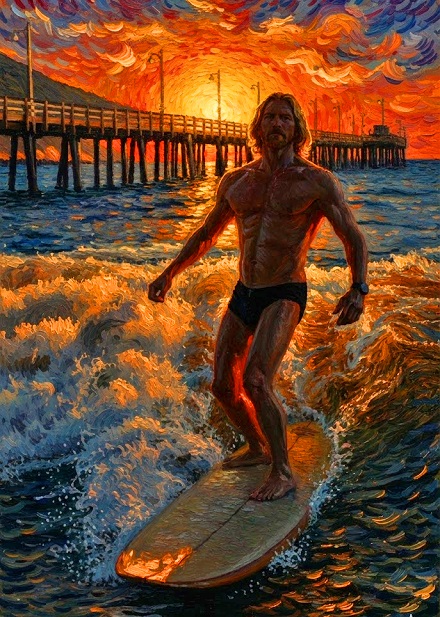
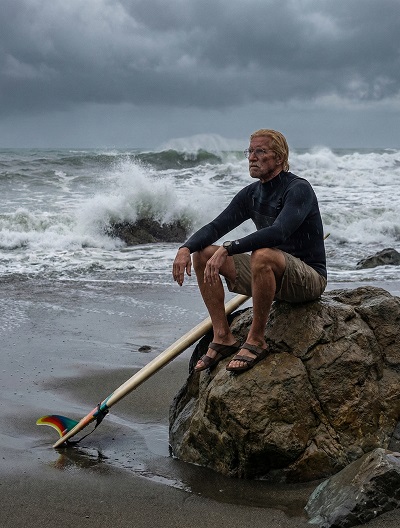
Note #2: The image used with this article is also a LLM rendering (albeit of an actual vintage photograph, taken next to the Avila Beach, California, Pier, back in the late-60s). It is done in the Van Gough post-impressionist style, partly to conceal the identity of the poor, uncoordinated schmuck on the board.
Note #3: No PhDs were hurt or otherwise abused in the preparation of this article (other than possibly some damage to certain supercilious egos...post publication).
Note # 4: For an interesting short but brief biography of champion Hawai'ian woman surfer and free-diver, Rell Sunn (who along with Duke Kahanamoku) is considered the 'soul of Hawai'ian Aloha spirit, you may find it here . Rell, tragically, was informed that she had Stage 4D breast cancer at the height of her surfing career; after valiently resisting it for almost a full decade, Rell passed away prematurely at the age of 48 in 1998. During that period prior to her demise, she became the foremost advocate of women's cancer awareness in the Hawai'ian Islands and is well-remembered today as the beautiful, talented and inspiring 'Soul of Aloha.' [Rell had, incidentally, a much-loved old Volkswagen Bug that was 'usually' operable and helped surfers recognise the perfect nature of the Bug and the Kombi VWs for use as low-cost surfer vehicles. I often wounder whatever happened to it! What stories it would be able to tell if it could speak...