Getting ‘ahead’: Motorcycle protective helmets
This is a subject quite near to my heart, both as a long-time proponent of two-wheeled vehicles and as a professional medical person: The importance of adequately protecting the human head in circumstances and situations that pose extreme potential for severe head trauma.
My concerns are based upon years of work in military and aerospace areas involving aircrew protection, survival & safety in atmospheric and space flight. Although now retired, my half-century exposure (both professional and recreational) to the consequences of high-risk human activities (such as motorcycling, which I am still passionate about, and flying) has very adequately alerted me to the inherent liabilities involved when the human cranium is suddenly exposed to abrupt, high-G impacts.
The human brain is certainly an amazing organ, but then, so too is the entire human body. Studies in medical physiology have clearly shown that while the human organism is capable of sustaining amazing punishment, in the final accounting we are all too fragile beyond a certain range of kinetic forces.
While each of us has two arms and two legs, two kidneys and a rather impressive number of physiological ‘back-up’ systems, and while we can certainly get along (albeit with less ease) bereft of a single hand, arm, foot or leg, there’s no denying that each of us has only one brain. And given the critical importance of our brain as the neurological control center of the entire body, once one’s brain is compromised, the whole game is indeed lost!
To gauge the truth of this sober fact, all one needs to do is visit a long-term post-trauma care facility, or perhaps the healthcare facility that takes care of those with serious neurological disorders such as Alzheimers, advanced senilia and/or dementia. Despite my many years of work in emergency and trauma care (in both civilian and military applications), it wasn’t until I lost a very close personal friend to head trauma involving severe temporal lobe injuries that the full force of this realization dawned upon my then more youthful awareness.
My friend owned a new Honda CB-750 (this was in 1969) and was somewhat of a risk-taker by nature having been brought up in a small Mexican coastal fishing village known as a haven for retired American expatriates. The new Honda was a remarkable bike at that time and its power and potential, attended by typical Japanese technical engineering innovations, reliability and ease of maintenance, set an entirely new standard for motorcycles. ‘Trav’ found it perfectly suited to his personality and was given to piloting it around the Berkeley/Oakland locale (San Francisco East Bay Area) like a circus daredevil. This despite the fact that he worked during the day as a Hemodialysis technologist at a major Oakland hospital.
On the particular day of his fatal crash, he had been riding around without a helmet (as was his custom) and came off the Highway 580 Freeway in Oakland, catching a green light at the end of the off ramp. Given the traffic signal in his favor, he continued through that intersection at reasonable speed to make a turn onto an adjacent avenue.
At that exact moment (it was 9PM in the evening, after dark), a car full of Black dudes hopped up on drugs ran the red light and pulled directly in front of my friend ‘Trav’, as he was sweeping through the intersection. As might be imagine, it was a classic motorcycle ‘T-bone’ impact into the side of the vehicle and stats have shown that more fatalities occur in T-bone impacts than just about any other. Without a helmet, ‘Trav’ didn’t stand a chance.
Despite a speedy response by the ambulance and immediate transport to the nearby major trauma center/ER at Highland General Hospital, it quickly became apparent that my friend had sustained major injuries to his right temporal lobe, as well as the fractures and soft-tissue injuries that one might expect from this sort of crash.
In spite of the excellent level of post-trauma care he received, ‘Trav’ expired several days later, which was probably the best thing for him, since his neurological injuries would have left him in a severely disabled state, with poor chances for any significant recovery.
That incident remains fresh in my awareness and although I have always been an extraordinarily careful driver (especially on my motorcycles), who was never without a helmet & suitable protective clothing, the lesson here is that no matter how well prepared or protected you may think you are, disaster is always lurking just around the next corner.
Obviously when one is young, this possibility lies so far off in the hazy distance that it might as well be completely nonexistent, since when one is young life seems as if it will go on forever. ‘Kids’ (anyone who is adolescent, immediately post-adolescent, or suffering from arrested adolescence…and the streets are full of ‘em) simply cannot conceive of death as an irrevocable ‘end point’ to life, hence they do things that astound and sometimes terrify us old geezer-types who have somehow managed to survive into old age. Generally speaking, ‘recklessness’ and extreme risk-taking correlate with maturity (or the lack of it, for what after all is ‘maturity’ but ‘advanced age?’), although interestingly enough several recent studies have suggested that extreme risk-taking may actually have a genetic component. [Note: One study of a well-known ‘extreme’ rock climber determined that he lacks certain basic key biochemical genetic components that normally stimulate fear (and/or consequent ‘fight or flight’ response), in his personal genome.]
But I cite this incident as a good example of what brought the importance of wearing an appropriate helmet home to me personally. My work in the US Air Force involved personal aircrew protection, referred to as ‘aircrew life support’ now, but in the immediate post-war (WW2) era as ‘personal equipment’, so I was early-on keyed to the interrelatedness of protective safety equipment to high-risk activities; in the military, this often translated into ‘head protection’ against cockpit buffeting, since despite the term ‘crash helmet’, once G-forces are of a sufficiently high enough level, no helmet on earth will guarantee survival. When I left the service and entered the civilian sector of health care, my work in the hospital saw me interacting with the ER quite often, so head-trauma cases were a daily given there, as well.
All of this served to enforce my own acquired tendencies towards promoting & encouraging safety in vehicles, so when I rode my bicycle or my motorcycle, my first and foremost thought was always directed towards appropriate headgear.
With respect to motorcycles, and due to the extremely high performance levels modern motorcycles offer, wearing of some sort of well-designed and engineered helmet is mandatory if one wishes to beat the odds and survive into old age.
All too often we see motorcycle riders wearing only a barely legal (and most often not) hard-shell ‘beanie’ and then only to comply with the legal minimum requirement stipulated in the respective state. They do not, under any circumstances, provide the sort of head protection required in about 80% of most motorcycle crash impacts and are good for scarcely more than minimal protection against scratches and abrasions.
The wise motorcyclist therefore wears a modern, fully approved (by the several helmet certification bodies, such as DOT, the Snell Memorial Foundation and various other recognised agencies) and full-coverage helmet constructed of modern polymeric materials specifically formulated to absorb, distribute and hopefully disperse head impact forces from all angles.
Assuming that one understands the importance of purchasing a safety certified protective helmet (and assuming that it is constructed of the proper materials), the key to safe use is a good fit. All too often now, as in the past, civilian vehicular helmets are made for so-called ‘round heads’. Up until the past several years, it was rare to run across a manufacturer who provided helmets for a range of head shapes.
Fortunately, most manufacturers now understand that there’s far more to a good fit (with resulting higher safety levels) than merely getting a helmet in ‘small, medium, large and/or extra-large’ sizes. In fact, there are generally two different basic ‘head shapes’ common to any population of individuals. These are what are referred to as the ‘round’ head and the ‘oval’ head. Beyond that basic distinction, the oval head shape is further subdivided into ‘round oval’, ‘medium oval’ and ‘long oval’ categories. ‘Long oval’ head shapes generally have somewhat narrow cross-sections, whereas ‘medium ovals’ feature slightly less than narrow sections.
Individuals with ‘long oval’ head shapes have the most difficulty finding a suitable helmet, due to the fact that far more people have rounded head shapes than medium or long ovals.
In order for a helmet to adequately absorb and distribute crash forces efficiently, the interior of the helmet’s liner should fit very closely, conforming to the curvature of the wearer’s skull. Gaps between the skull and the helmet liner can and do cause what we call adverse ‘initial onset G-force’ that, depending upon the severity of the impact, can result in devastating head injury…internal soft organ tissue injury (as in trauma related subdural hematoma formation) as well as skeletal fracturing.
The importance of this seemingly simple fact was commonly seen, back in the 60s, 70s and 80s, in aircraft emergency egress situations, wherein a pilot was forced to use his ejection seat to escape a crippled aircraft. Ejection seats of the first and second generation featured seat-survival kits made of either soft or hard (fiberglass) materials, on the top surface of which was a relatively soft and comfortably yielding cushion. While providing a certain level of comfort for the pilot who was forced to sit for considerable periods in the ejection seat (a nice feature on long missions of several hours or more), they could result in severe spinal injuries in the event of an ejection.
The reason for that had a lot to do with the rather simple nature of the early ejection catapults (ballistic ‘guns’ that fired a basic 30 mm pyrotechnic shell and later rocket catapults, known as ‘ROCAT’ devices). Those early catapults did not feature so-called ‘staged force’ systems, in that when the seat catapult fired, it did so with an initial G-force of about 16 G’s…all at once. The initial onset of these forces (i.e. applied instantaneous force to the pilot’s spine, going from 0 G’s to a linear full 16 G’s [Note: a ‘G’ is the normal force of gravity, or about 14.7 pounds per square inch of pressure at rest]) occurred in a mere fraction of a second (a factor known as ‘initial G-onset’). Unfortunately, the human body is ill-equipped to handle such intense load factors on critical part of the human spinal column, and, assuming all other ejection forces to be equal, the injuries to the spine could be devastating.
Among the steps taken to alleviate and ameliorate these adverse G-forces were the development of so-called graduated catapult charges that acted to distribute the G-forces in a more tolerable curvilinear manner, as well as the engineering of seat pads that did not instantly compress under sudden high-G forces.
The McDonnell-Douglas F-4 Phantom II featured English ejection seats made by the Martin-baker Company, pioneers in aircraft egress systems, and the Mk.7 (or H7AF) series seats were fitted with these progressively staged rocket catapults. They were also configured with advanced polymeric seat cushions that (like modern NASA ‘memory foam’ first used in spacecraft acceleration couches, but later adopted for bed mattresses) had a very slow rate of compression intended to help absorb ‘G-onset’ and reduce spinal column loading forces.
American pilots flying F-4s in Vietnam, however, often had to spend long hours in their planes and sitting on hard seat survival kits (made somewhat more tolerable by their carefully engineered seat cushions) still caused enough discomfort to provoke some pilots into using an additional cushion of regular ‘sponge rubber’ on top of the stock seat pad. This made things far more comfortable for aircrews until an emergency required ejection, at which time the soft sponge completely defeated the ‘slow yielding’ stock seat cushion, allowing initial onset of G to instantly load the spine with harmful force that more often than not resulted in severe lumbar spinal injury (commonly consisting of injury to the vertebral nucleus pulposis, but also occasionally resulting in spinal vertebral fractures).
It was a major effort to convince aircrews that adding a ‘soft sponge rubber’ pad to their standard ejection seats was not only ill-advised, but positively dangerous.
In much the same manner, modern crash protective helmets help absorb, dissipate and distribute harmful G-forces so as to lessen the likelihood of major head trauma and therefore wear of a poorly fitted helmet can be a serious mistake indeed. Although a properly fitted helmet (i.e. one that truly fits the head as per the above remarks) helps tremendously to protect against head injuries in a crash, even the best helmet can only go so far in its protective capabilities. Once a certain level of abrupt G-force has been sustained, no helmet in the world will assure survival in a truly severe and focused impact.
In addition to consideration of basic head shapes, when selecting a suitable helmet for vehicular use (any vehicle, actually, but particularly those for bicycle, motorcycle, rock-climbing and skiing applications) one also needs to select a helmet with lateral and somewhat softer cushioning in the area of forehead and cheeks.
As the old and prestigious English head protection firm ‘Davida’ know, human faces also come in differing configurations. The Davida Company has identified these as follows: 1) narrow forehead cross-section with fuller cheeks and narrower jaw (the so-called ‘triangle shape’); 2) broader forehead cross-section with slightly narrower cheeks and jaw (‘V shape’); and 3) uniformly broad forehead, cheek and jaw cross-section. They design and fabricated their protective helmets so as to fully conform to the individual’s facial construction and when one orders a Davida helmet, these dimensions are carefully considered and fabricated into an appropriate fit. A correctly sized and fitted helmet’s liner and lateral padding should, as a result, conform to the shape of the wearer’s head in all aspects and yet not exert pressure-spots on his skull in any place.
‘Why is this so important?’ one may well ask. Simply because of the potential for allowing adverse ‘O-G onset’ in the event of a sudden impact, in exactly the same way O-G can injure the human spinal column in an aircraft ejection.
While it is often observed that the major brands of protective motorcycle helmets (such as Arai, Bell, Shoei, et al) offer products that are extremely expensive, they also take great pains (assuming the helmet is properly fitted to the individual) to make sure they incorporate all the latest technological and biomedical advances to help promote wearer safety. A great many helmets are today manufactured in Asia, excluding Japan (read: China most notably), that while appearing quite attractive, stylish and/or appealing, are actually made from questionably safe materials. Most of these ‘cheap’ Chinese helmets do not offer a selection of head-shapes, producing their helmets in a standard ‘round head’ shape. While they may fit many Europeans (who have, interestingly enough, predominantly round head shapes), they do not suit English wearers or those from the United States (among others). A few helmet companies (Arai, notably) are known for favoring elongated oval shapes in their products, while others do not. Again, one needs to take pains (exert due diligence) to make sure that the helmet they buy fits their particular head-shape as closely as possible. The best way to determine this is to actually try on a helmet before buying it. That usually translates to visiting a motorcycle accessories dealer and actually putting the helmet on one’s head, something that cannot be done when buying via the internet.
Although helmet manufacturers are gradually getting more savvy about the importance of head shape in helmet fit, far too many still take little effort in meeting individual head-shape requirements and as always (to paraphrase a familiar admonishment), ‘buyer be wary’.
In recent years a number of studies in advanced head-impact protection technology have yielded insights about head protection that were lacking altogether as recently as 20 years ago. One of these, conducted in Belgium (in research funded by the LASAR Helmet Company) determined that additional protection could be manufactured into the exterior surface of a helmet, functioning in a similar manner to that of the human scalp. In impacts that are not directly perpendicular (notably as encountered in less forceful, lateral force impacts, such as are encountered in sliding or glancing blow impacts), an artificially viscous outer layer coating the hard external shell of the helmet can not only help alleviate impact forces, but help prevent so-called ’snagging’ circumstances…something that can happen when a helmet is forcefully caught on or dragged across an irregular surface (such as a rough asphalt roadway). Just as the human scalp may absorb some impact by yielding within a certain range of motion, so too can such a lateral semi-viscous layer on a hard helmet react to reduce injury.
Another technique reflects understandings of how the Dura-matter (consisting of the Periosteal and Meningeal layers) lining that lies between the brain and the skull’s interior surface helps distribute sudden impact forces (again within a certain range of effect). Incorporating a thin viscous layer on the helmet’s inner Styrofoam absorption layer may also be additionally of benefit, therefore.
All of these determinations involve newly emerging technologies that are quite costly to research and study, let alone incorporate into commercially produced protective helmets, and can undoubtedly benefit a user but the cost of such innovations definitely will be passed along to the consumer in the form of added expense. Compare the modest cost of basic transportation offered by the original Ford Model-T to that required to purchase a state-of-the-art Tesla Hybrid automobile and one has the entire concept in a nutshell. Advanced technology is, if anything, definitely not cheap! The question we all therefore have to ask ourselves in determining the intrinsic value of a truly advanced head protective modern helmet, is “How valuable is your head?” Cheap head, cheap helmet. Valuable head, expensive helmet.
Much verbiage is slung around these days about how long a helmet is ‘good for’, in regard to its extended ability to function as intended. Experts will frequently reiterate that no matter how good the materials are in any particular helmet, they ALL will degrade to a certain extent over time…but particularly consequent to rough use, exposure to UV light (sun) and contamination by aromatic hydrocarbons (petroleum products such as gas, oil, etc.). As a result, several recommendations are generally made by the experts: 1) if a helmet absorbs an impact of any substance (no matter how seemingly slight), it should be discarded and replaced; 2) if a helmet is more than a certain age (generally about 10 years old or more), it should be replaced.
Just how religiously one follows these dictums is entirely left up to the consumer, although those safety suggestions arise more from commercial fear of product liability on the part of the manufacturer than actual human injury that might otherwise obtain, since as noted before, no helmet, no matter how advanced or new, will guarantee 100% survivability if the forces involved exceed a certain threshhold. Something to think about, certainly.
This brings us down to the basics of selecting a suitably effective protective helmet for an activity as potentially hazardous as riding motorcycles.
First, a full coverage helmet is the best, given a choice between so-called ‘open-face’, modular or 3/4th coverage helmets. Old fashioned types like the classic ‘café racer’ puddin’ basin shells look nifty on a suitably older classic bike, but they offer scant protection in a spill. Next, a suitable helmet needs to be constructed of top quality materials (even if it means spending more money). This usually translates to 1) fiberglass, 2) Polymeric plastic compounds, or 3) carbon composite construction. When selecting a full-coverage helmet, field of vision is another extremely important consideration, since some full-coverage helmets offer slightly more restricted vertical or horizontal fields of view than others. This can be of significant importance if one is riding a modern sportsbike, with its inherently tucked ‘race-crouch’ riding position, which tends to reduce helmet upper horizontal planes of view.
Visors on full-coverage helmets should be multi-positional and not ‘all open or all closed’ in nature. Modular helmets, while usually quite comfortable and versatile, should have carefully engineered ‘fool-proof’ chin-section securing latches (resistant to crash forces).
Any helmet, regardless of type, should have an excellent Styrofoam liner, lined with a very thin inner cushioning layer (this thinness helps minimize possible ‘G-onset’ forces, described earlier). Lateral cushioning and cheek pads should fit closely to the face all round, but not be too uncomfortably restricting. The very best helmets available today feature fully removable and replaceable liners & cheek cushioning pads. Also of some importance is good ventilation, consisting of a system that should allow for flow-through circulation, but that is capable of being shut off (as in cold weather).
A note of caution should be injected here. Crash impact studies have indicated that the BEST (read: safest) helmet designs feature a smoothly rounded exterior shell that can’t (or won’t) snag on uneven sections of pavement in a sliding crash. While many helmets today feature aesthetically attractive contoured exterior shells, supposedly to enhance aerodynamics, any ‘ridge’ or ‘spoiler’ design may serve to catch the pavement in a spill, possibly resulting in traumatising cervical spine injuries should the head hyper-extend the neck with any force. Smoothly rounded exterior shells may be ‘boring’, but statistically they are safer in any fall other than a sharply focused perpendicular impact.
As far as using bicycle type helmets on a motorcycle, an application not intended by the manufacturer, it’s a very bad idea indeed. Ditto for use of ANY helmet not specifically engineered & marketed for motorcycle crash protection (such as a ski-helmet, sky-diving helmet, etc.).
Head securement components (read: chin straps) should be substantially configured and functional, while not being so poorly placed on your particular head that they serve to choke you uncomfortably, and while there are some interesting strap closure designs in use, nothing really beats the old fashioned, fail-safe simplicity of the double-D ring buckle that’s been around for decades.
Again, head-shape is a critical, key concern when buying any protective helmet. Even if your head circumference suggests a particular ‘standard’ size (i.e. small, medium, or large, etc.) may be suitable for you, you should still select a helmet that suits your head and face-shape (as discussed earlier). To not do so is to invite unnecessary and perhaps even severe complications, should you be involved in a crash.
Further, while military helmets (such as the older USAF HGU-22/P or more recent HGU-55/P types, used by aircrew in F-15/16 aircraft) look waaaay cool on a bike, they are designed, engineered and manufactured for a completely different set of G-force dynamics. Stay as far away from using them on a bike as you possibly can. Tom Cruise might get away with wearing one on his Top Gun Kawa Ninja, but in reality that’s a load of the worst sort of unrealistic Hollywood fantasy imaginable.
Weight may be another criteria to consider, since the more cervical spine loading you have, the more G-forces will have an effect (kinetics: mass & acceleration), although this is probably not a great concern, since most modern helmets strive for enhanced protection at a lower overall weight.
A good full-coverage helmet with have an equally sturdy visor made (preferably) of transparent Lexan, which is a trade-marked polycarbonate material with high impact resistance. This is more important than many realise, since your eyes are another critical system you can’t easily do without and some of the bugs one encounters on roadways can do some serious damage when you take one full in the face.
Naturally, all of the foregoing considerations count for absolutely nothing to someone who is perfectly willing (they think) to put ‘rush’ and the raw thrill of speed at the top of their life-list. Regrettably, far too many of the younger riders among us fall in that category, but it helps to remember what General Chuck Yeager said, when asked what made him such a ‘Sierra Hotel’ (military slang for ‘s**t-hot’) pilot: “Experience. I simply have had a lot more experience flying than most other pilots.”
And the only way to gather ‘enough’ experience to stretch the odds in your favor is to stay alive long enough to collect it. Helmets help tremendously to achieve that goal, although it is also helpful to realise that given the reckless disregard that passes for ‘motorist driving skills’ on today’s roads & streets these days, you can only hedge your bets so far. The only foolproof way to stay completely safe is to stay entirely off two-wheeled vehicles…but on the other hand, a life without some (calculated) risk & a few moderated thrills is hardly a life worth living, isn't it?
Taking your helmet seriously is an excellent starting point.
--------------------------------------------------------------------------
[NOTE: following are several motorcycle helmet retail businesses that take a serious stance on emphasising motorcycle helmet sizing & fit, making reference to such nuances as 'head shape'. They are listed in order of preference, with regard to these 'head-shape' considerations.
1) Chaparral Motorsports
2) RevZilla
3) Jafrum
A 4th source, although it specialises almost exclusively in selling three-quarter coverage helmets for the 'long-oval' head shape, is the Davida Company, a highly regarded English firm that initially gained fame back in the 'cafe-racer' era of England's 1950s. Their helmets are all hand-made, created with lavish attention to detail, and although a bit expensive (about US$ 450 or so) cradle the long-oval head like a glove. They're also perfect for today's 'cafe-racer' resurgence, if that's your focus.






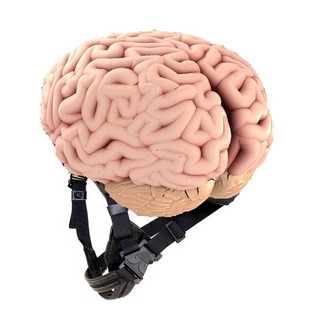













enjoyed the read and the graphic
you provide excellent motivation for wearing helmet
Never stop writing!!
m
I have two cousins who are struggling their entire lives with brain damage. The first, when she rolled in a ditch and dislodged her brain in her skull after being hit by a car crossing the street from her school bus at 11 years old. The second, riding her bike at 14, was hit in the rear by a car and thrown headfirst into a telephone pole.
I grew up riding bicycles. We never thought of a helmet in those days. My cousin had a 1964 Triumph Bonneville for two years. I don't think he ever wore a helmet. Avoiding a T-bone accident, he put the bike down and flew over the hood of a car and rolled, unhurt. Six months later, he left a curve, hit a telephone pole and woke up later with a broken collarbone. A year later, with his roommate riding behind, ran into the side of the car, smashing his right hand and leg. He quit motorcycling but not taking risks, including flying in bad weather. He died at 57 crushed between his Expedition and the bank of a gravel road. Apparently not wearing a seatbelt to keep him inside.
I have led an active life. I prided myself with never blacking out or going unconscious in spite of numerous head trauma from childhood incidents onward to where I was told by a physician to, "get in a wheelchair," because I was tripping and falling so much, sometimes headlong into my own house walls. I never wore a helmet except in high school football. I regret not wearing ear protection and wrestling in high school and college. A few times while belted in my electric wheelchair these past 25 years, I came close to a tipping over to the point where I would land on my head with a 300 pound wheelchair providing added weight. I've had two accidents with my high-tech vehicles. In both cases, I had no trauma to my body or brain at all.
I have only one correction. As far as I know, Tesla does not make any hybrid vehicles. Tesla vehicles are all electric. And I have one question: do you think that the F-35 is safe for pilots to fly?
Ron