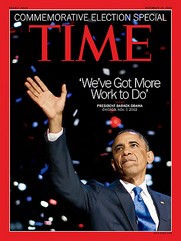
(U.S. President Barack Obama on cover of TIME Magazine)
“Beneath the armor of skin/and/bone/and/mind
most of our colors are amazingly the same.”
--from ELEMENTAL, The Power of Illuminated Love (Aberjhani)
Despite the Associated Press’s recent gloomy poll on racial attitudes in the United States, most Americans would probably agree that race should not have played as powerful a role as it did in the 2012 presidential election campaign resulting in the ultimate re-election of Barack Obama. But there are at least two good reasons that it did.
First, consider the approximately one million African-American men and women currently either imprisoned, on parole, or rushing blindly down a path likely to lead to prison. Too many of them grew up, during any given decade of the last half century, believing they were either destined to go to prison as some form of rites of passage, or they should expect to die ––as Trayvon Martin and my brother Robert Lee did––young. What were the predominant images that led them to define themselves as they did?
As powerful as the legacies of individuals such as Martin Luther King Jr., Muhammad Ali, the Rev. Jesse L. Jackson, Oprah Winfrey and others are, for many people they comprise little more than fairy-tale-like legends with minimal bearing on their individual existences. Despite the greatness of such cultural icons, much of their lives seemed but a different version of American slaves’ battle for freedom a century and a half ago.
For four years, the image of Barack Obama presence in America’s White House has embedded itself in the minds of many young black males––just as that of Michele Obama has done the same in regard to many young black women–– as a living symbol emblematic of very different possibilities for their lives. It would not have been difficult for historians who may have been so inclined––with the assistance perhaps of certain eager Republicans––to guerrilla decontextualize a single Obama term to such a degree that his phenomenal accomplishments could all but disappear from the history books.
In fact, even eight years could be erased from certain pages if empowered individuals set their minds and resources toward that end. But what cannot, and will not be erased, is the impact of his very visible presence on an entire generation entering the world at this moment, growing into adolescence at this moment, or reaching young adulthood––at this moment. Like the little boy, in the now famous video, who asked if he could touch the president’s hair to confirm that it was like his own, and to make sure he could get his cut like the president’s, there are now millions for whom the idea of a black American head of state is not a Hollywood fantasy but an historical political reality.
By contrast, consider those who grew up during the 1960s or 1970s when specific laws and/or social convention still defined them as second-class citizens. Think of the lives lost––to either death or perpetual incarceration––following the massive infusion of lethal drugs into black communities during the 1980s. Or reflect upon those who later still danced to hip hop prophecies proclaiming they were born to live mangled oppressed lives and to die early. Far too many have seen those prophecies come true in the live and deaths of such mourned talents as Biggie Smalls and the highly gifted Tupac Shakur, who once wrote this:
“I expect retaliation in a hurry/ I see death around the corner, anyday/ trying to keep it together/ no one lives forever anyway/ Strugglin and strivin, my destiny’s to die…” (from Shakur’s Death Around the Corner).
Contrary to popular urban myth, not all rappers and hip hop stars who met with an early death were slain. Some ––like “Ol’ Dirty Bastard” (Russell Tyrone Jones of the Wu Tang Clan) and Big Pun–– basically worked themselves to death. They died of heart attacks or other “natural” life-ending causes in pursuit of their versions of the American dream. Possibly some of those who died early would still be alive to share more positive insights with the world if, instead of dancing to their tragedy-haunted lyrics, communities had listened and responded with even a fraction of the kind of compassion so often displayed following visitations from monster storms like Hurricane Sandy.
NEXT: Why Race Mattered in Barack Obama’s Re-election Part 2: There Upon a Bough of Hope and Audacity Revisited
by Aberjhani
co-author of Encyclopedia of the Harlem Renaissance
and ELEMENTAL The Power of Illuminated Love
2012 Notebook on Paradigm Dancing and Guerrilla Decontextualization