UNSUNG HEROES OF BEETLEDOM: Bela Barenyi, the Hungarian ‘Godfather’ of the VW Beetle
First, a bit of backstory
In my typically American, two-car garage and occupying prime space on the right side in there, sits a bright orange beetle-shaped automobile, known to all and sundry as the ubiquitous Volkswagen Bug. Technically designated the Volkswagen Typ 1 (and to its German intimates known simply as ‘Die Käfer’), the much-loved VW beetle or bug is the world’s most produced automobile at 20 millions+ sold, a number far in excess of even the ubiquitous Ford.
This particular bug of mine is a 1973 standard VW beetle sedan, the general profile for which has remained completely recognizable ever since it was first conceived in the early 1900s. If you were to compare the very first ‘production’ bug of 1938 (the KdF) with my ’73 model, it would look instantly familiar, yet 35 years separate the two iterations and they appear brothers at a glance. The very last (first generation) VW bug was turned out in 2003, roughly synonymous with the introduction of a new 2nd generation VW beetle that tried to capitalize on the original’s worldwide popularity, yet in my opinion failed rather dismally.
That’s 70+ years during which the original bug, with only modest and not always apparent and/or visible safety/driving improvements, remained very much the same basic design it had always been since its official birth, back in 1938. Quite a remarkable story, don’t you think?
Over the course of those years, the beetle developed a cult following like no other automobile ever built and although used bugs were rather commonly available for a few hundred to a few thousand dollars just a few years ago, today the remaining survivors have been ‘discovered’ by car collectors and the same spectulatory circumstances that have dried-up the early 50s Porsche pool have impacted the humble bug (the Porsche’s humble forebear), whose price has risen exponentially.
I acquired my current 73 beetle just this year after having not had one for a few years (my last one was a beautifully maintained, pale-blue 1974 ‘Super Beetle’ that I let a smooth-talking Canadian talk me out of for a pittance, about 5 years back). I learned much about old-fashioned Canadian parsimony in that ‘cultural exchange’, I can assure you! I still regret letting that one go so cheaply but very recently I finally decided that I had reached the point where continuing to ride high-performance Japanese sportsbikes was in effect gambling with my health and well-being, and sold the last of them. Thus, having no further ‘fun machines’ on which to lavish my time, attention & money, when a bright orange beetle on Craigslist by pure chance caught my eye, I reacted quickly and purchased it for a reasonably low price. It marked the continuation of a life-long, off-and-on love-affair I have had with these Volkswagens ‘people’s cars’ since the mid-60s.
It might amuse you to know, by the way, that on one of the side-windows of my orange bug (whose name is ‘Brumel’, by the way…more about that later in this narrative)* are two pressure-sensitive decals. One states ‘Certified Emotional Support Vehicle’ and the other proclaims ‘Genuine VW Money Hole’ (since restoring a bug…any bug these days…is becoming a more and more costly undertaking with each passing year). Below the license plate is another small legend that reads: “Slow is all I know!”
The latter should ideally serve as a subtle but friendly warning to the lead-footed Hotrod Harrys that course the highways today in their over-powered Detroit muscle cars, that it’s prudent to not tailgate and just pass, since most VWs protest loudly if they are pushed beyond the 65-70 mph range. Unless you drive a specially hopped-up VW street-rod, you quickly learn to keep the RPMs below 4500 and the top speed no higher than 70 (and then only in short spurts if you want your 50-60 HP engine to last for a reasonably long time).
Unfortunately, California VW gear-heads often become obsessed with seeing exactly how far they can push normal bugs’ operating limits to the max and install heavily modified VW engines in the 100, 200 or more hp vicinity, along with suitably improved handling components. As such they often viewed as fair game to the juvenile ‘boy-racers’ for whom all unconventional vehicles are streetable racecars. While this may make a VW go MUCH faster, it also tends to melt most air-cooled engines into so many slag-heaps eventually, so VW ‘purists’ like me avoid all the high-performance urges and prefer to putt along the same way the Germans did back in 1939/40…moderately and practically!
The style referred to above is so popular with younger VW owners these days that it has gained an identifying sobriquet of its own, the ‘Cal Look’. These often grossly overwrought and highly modified bugs frequently have dropped front spindles and are impractically lowered to ‘look cool’; they may have oversized tyres, candy-colored paint jobs (yuk!) and garish interiors. It’s enough to make an old VW purist (or at least anmayone over the age of 50) want to not even be seen on the same road with them, frankly.
Aside from the unappealing aesthetics involved in the Cal Look, these cars are often personalized with the usual ‘bad taste’ custom options and this, in my opinion, simply makes them lose any former appeal they might have had for older, more mature individuals who value the original design and engineering expertise they were produced with.
The first lesson that any educated, cultured person should learn is that true design genius usually finds favor with the original specs, styling and parameters of a particular design. Professional design engineers (at least in Germany) generally have advanced degrees in both design and mechanical engineering and absolutely know what they’re doing. The average US high-school graduate (or drop-out), by contrast, generally has as little aesthetic sense as the designer of a gun with a barrel that points towards the shooter! (We actually need more of the latter items, these days, judging from all the reports of gun violence we see in the news media each day). At any rate and by my reckoning, any bug that has ‘the Cal Look’ should be given a wide berth by a prospective buyer; the only reasonable bug to consider for a restorative effort is one that is a ‘stock’ survivor…one that may be somewhat fashionably deshabille, but that is largely untouched by some puerile person’s concept of what looks (in local parlance) ‘rilly kool!’
The Volkswagen Beetle’s origins
There is a persistent story, in circulation for a long time, that the immortal VW Beetle resulted from Dr. (diplom Ing.) Ferdinand Porsche’s collaboration with Germany’s Adolf Hitler, way back in 1938. The story has it that out of the blue, Porsche approached Der Fuhrer one day with his idea for a reliable, inexpensive and mass-producible ‘people’s car’ that would further Hitler’s aspirations to develop extensive motorways in the German homeland (the so-called ‘Autobahnen’ system). Hitler’s purpose behind the autobahns was primarily to produce a reliable system of automobile roads throughout the Reich that would enable the rapid transport of military materiel even to places where the extensive German rail network would itself not permit. It was only a secondary motivation of his top to enable the ordinary German citizenry to obtain reasonably inexpensive four-wheeled auto transportation with which to travel for both business and pleasure (holidays).
Given that in the late 30s, most German automobiles were highly refined and excessively costly (thus unaffordable by consumers who were still recovering from the Great Depression’s effects), Porsche’s ostensible bright idea of proposing a very basic, ‘cheap’ and yet mechanically reliable consumer vehicle greatly appealed to Der Fuhrer, who was quite an automotoive enthusiast himnself.
Given Dr. Porsche’s universally acknowledged engineering brilliance in producing sports and racing car designs of the 30s, it was a natural bonding moment between the two and the result was eventually the 1938 VW Beetle.
That’s the simple eversion of the story, at least, and it has been making the rounds seemingly forever.
The actual truth is a whole lot more complicated than that and that Porsche, like so many other automotive pioneers in the early 1900s, had been keenly interested in development of a reasonably priced private automobile for several decades. Porsche had several designs of his own, one of which very closely resembled the eventual VW Beetle, but the actual truth (Warning! leftist liberal progressives who reject fact, logic and reproducible scientific validation may skip this part of the narrative, since it may offend some of the ‘la-la-la I-can’t-hear-you’ ilk) is most likely that the TRUE (read: factually verified) originator of the VW Beetle’s famous design was not even German but an ethnic Hungarian! His name was Béla Barényi and he first conceived of a low-cost, streamlined, rear-engined, four-seat motor vehicle way back in 1904, at the tender age of only 18 years! Porsche and Hitler actually ‘borrowed’ merely Barenyi’s concept and developed it further (but not much differently than Barenyi himself had).
Of importance to note here, a great many automobile designers of the late 20s and 30s had been designing and building small, streamlined and functional small cars for a long time before the Porsche/Hiler connection was made. In Paul Niedermeyer's utterly fascinating (and lengthy at 120 pages!) paper on this subject, it has been hotly contested for decades as to which of at least 6 to 8 individuals/firms should get principal credit for what eneded up as the VW 'bug'. Streamlining was, after all, 'the' development that had many mechanical engineers and designers captivated in the 1930s and as Niedermeyer explains it, the VW bug likely had a great many forefathers (most of which never saw actual production beyond the production of some prototypes).
As for Barenyi, after completing mechanical and electrical engineering studies at the Vienna technical College in 1926, he became an innovative, imaginative and highly prescient engineer who sought employment with various Austrian automobile companies (Austro-Daimler, Steyr and Adler) before joining Daimler-Benz in 1939. Amazingly, He remained with Daimler Benz until 1972, by then having become their Head of Pre-Production Engineering, and was better known to the automotivge engineering circles as a very prolific inventor and vehicular safety expert.
Barenyi’s immense number of patents and engineering contributions were focused principally on automotive safety (he invented the first collapsible steering wheel that helped prevent driver impalement in collisions, passive safety systems and the all-important automotive crash-protective 'body crumple zones' that today are a stanadard feature of all cars). Unfortunately for him, most of his patents reverted to Daimler-Benz, since the contractual agreements he had signed so stated in their detailed particulars and therefore his name came to be rather submerged in the Daimler-Benz marque.
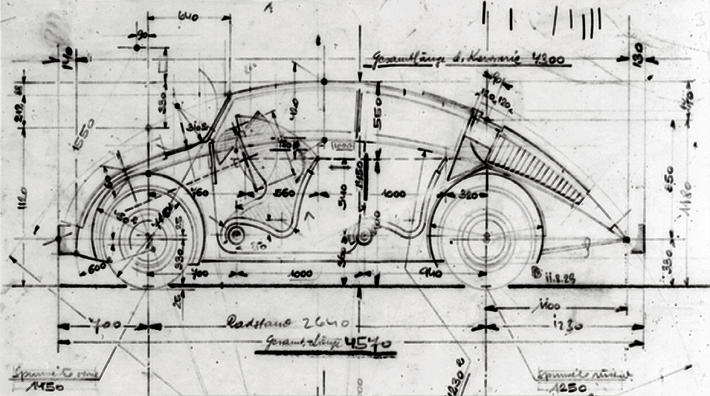
Although Barenyi’s earliest sketch of a remarkably similar VW-like chassis is dated 1918, by 1925 he had refined that concept even further. It should be mentioned, however, the in the period from 1900 to 1930 a large number of other automotive engineer-designers held similar ideas about automotive design. Many of them either designed or actually produced prototypes of a 4-wheeled, 4-passenger private transportation vehicles that had air-cooled engines at the rear. Of them, Barenyi’s design was one of the few that endeavored to place the fuel-tank at the rear of the vehicle, given his acute awareness of the potential dire consequences of a frontal collision. When Porsche approached Hitler, however, his own design placed the fuel tank in very front of the car (behind the spare tire unmder the bonnet, where it remained in every single Beetle from 1938 through 2003!
A careful and exacting survey of all existing designs for compact, ‘affordable’, consumer automobiles seating 4 passengers (including the driver) show that by the time Porsche and Hitler collaborated on what became the VW Beetle (Type 12 “Auto für Jedermann”, or ‘car for everybody’), there were a significant number of other prior machines already fielded in the very late 20s and early 30s that to varying degrees featured the basic design parameters that the Beetle was to include in its own design (it should be mentioned here that the world’s very first motor car, a Karl Benz 3-wheeled design, in 1886 had a rear-engine; in 1926, Benz & Cie. merged with Daimler Motoren Gesellschaft, a company that had been using Karl's engines in their cars since the beginning of the 20th century.) These included a Tatra, a DKW, the Ganz Standard Superior, two other Ganz designs, a Leddwinka, a Tjaarda, a Rumpler and at least 10 others. Almost all featured similar attributes like a rear positioned, air-cooled engine, transverse suspension springing and aerodynamic curves similar to those of the Beetle. Some, when compared in photographs, are remarkably 'beetle-like'.
A sketch of Baryenyi’s 1925 chassis design is particular noteworthy in that when placed together with a similar sketch of the Porsche/Hitler ‘KdF Wagen’ chassis design of 1938, they are startlingly similar. In fact, the original FdF prototype had a rear cowling vent configuration that could have been taken directly from Baryeni's 1925 body sketch! The inference would have to be that Porsche was quite familiar with Barenyi’s work by this time (as well as that of ALL of his competitors), finding that it agreed considerably with the concepts he presented to Hitler. Hitler contributed little to the process other than to approve of the idea and arrange to provide technical development wherewithal and support that enabled Porsche to proceed with the car.
Hitler, for his part in the design work, perhaps achieved somewhat greater-than-deserved recognition for his participation in the collaboration since he was a very keen motorist himself, and sketched his concept of the envisioned car for Porsche in several drawings that survoive today; it generally mirrored the body of Porsche’s concept, but due to the fact that those sketches appear quite frequently whenever the origins of the Bug are discussed, they have assumed far greater importance than they probably actually warranted. Hitler was, after all, an enthusiastic ‘dabbler’ and tyro automobile fancier who did have artistic talent and was known for taking a personal intertest in all of his ‘pet projects’ (such as the people’s car idea).
The Porsche/Hitler KdF Car
The official name selected for the new vehicle was the ‘KdF Wagen’, named after the Third Reich’s ‘Strength Through Joy’ program (or ‘Kraft durch Freude’, in German, which is KdF in its shortest form).
Permit me to here quote from Wikipedia on the KdF to help explain it: "NC Gemeinschaft Kraft durch Freude (KdF; German for 'Strength Through Joy') was a German state-operated leisure organization in Nazi Germany. It was part of the German Labour Front (German: Deutsche Arbeitsfront), the national labour organization at that time. Set up in 1933 as a tool to promote the advantages of Nazism to the German people and internationally, while also being utilized to ease the process of the rearmament of Germany. It was also intended to compensate for the poor increases in wages and for the loss of trade union rights. Through its structure of organized events and promotion of propaganda, it was also intended to prevent dissident and anti-state behavior. By 1939, it had become the world's largest tourism operator.
"KdF was composed of several departments that had its own specific goals, with each department organizing different leisure activities. It organized activities such as sporting events on factory floors, art exhibitions, discounted concerts and, most famously and popularly, subsidized holidays and cruise trips. One of its largest departments, although sometimes considered a separate organization altogether, was Beauty of Labour, which concerned itself with physical and sanitary improvements of the workplace. KdF was responsible for the improvement of several factories and sports facilities throughout its operations in the 1930s.
"KdF was supposed to bridge the class divide by making middle-class leisure activities available to the masses. It also sought to bolster the German tourist industry, something it did successfully up until the outbreak of World War II. Official statistics showed that in 1934, 2.3 million people took KdF holidays. By 1938, this figure rose to 10.3 million. With the outbreak of war in 1939, most of the organization's programs were suspended and several projects, such as the Prora holiday resort, were never completed".
The KdF Wagen was therefore envisioned as a way of providing the German people with cheap personal transportation, enabling use of various KdF leisure opportunities within Germany and Austria, and a plan was developed by Robert Ley’s administrators, after the original idea was proposed by Dr. Porsche, to allow KdF members to ‘subscribe’ towards the purchase of a KdF car through a program of regular savings.
Again, to quote Wikipedia: "KdF's most ambitious programme for German workers was to set up production of an affordable car, the KdF-Wagen, which later became the Volkswagen Beetle (Volkswagen being German for 'People's Car'). This was originally a project undertaken at Hitler's request by the engineer Ferdinand Porsche. When the German car industry was unable to meet Hitler's demand that the Volkswagen be sold at 1,000 Reichsmarks or less, the project was taken over by the German Labour Front (Deutsche Arbeitsfront; DAF). Now working for the DAF, Porsche built a new Volkswagen factory in Fallersleben at a huge cost, partly met by raiding the DAF's accumulated assets and misappropriating the dues paid by DAF members.
"The Volkswagen was sold to German workers on an installment plan, where buyers of the car made payments and posted stamps in a stamp-savings book, which, when full, would be redeemed for the car. Due to the shift of wartime production, no private citizen ever received a KdF-Wagen, although after the war, Volkswagen did give some customers a 200 DM discount for their stamp-books. The Beetle factory was then primarily converted to produce the Kübelwagen, the German equivalent of the Jeep. The few Beetles that were produced went to the diplomatic corps and military officials".
Only 289 KdF cars were actually produced in Germany before the entire production output of the Volkswagen industrial works was devoted entirely to war production, unfortunately, and at war’s end what remained of the VW Werks might have either been lost forever and at the very least shut down for good, had it not been for the coincidence that their main manufactory center facilities were located in the British Zone of Occupied Germany. There they caught the imagination of a British Major who found himself charged with managing occupational affairs in that sector. The story of his direct efforts to salvage the VW Company is extensive and certainly has been well-researched and written exhaustively about by others. It therefore need not be covered here but suffice it to say that the entire story of how this amazing little vehicle rose, phoenix-like, from the ashes of the utter post-war devastation that was Germany in 1945, is one of the most engrossing and interesting vignettes of the post-WW2 era. If you are not well-versed on the history of the humble Volkswagen Beetle, I therefore strongly suggest you read up on this subject (there are a number of excellent books available on it).
Many say today that the VW Company almost single-handedly brought about Germany’s incredible recovery at war’s end and that would not be far from the truth. But whatever the actual dynamic process of the post-war ‘German Economic Miracle’ of the 50s was, there’s no disputing that the humble VW ‘bug’ soon came to become an icon of the automotive enthusiast world and to this day remains a greatly loved and cherished object by thousands.
Bela Barenyi has the last laugh!
As has already been noted, such was Barenyi’s imaginative prescience that in his engineering sketch dated 1925, the lateral profile of his idealized car design bears a remarkable similarity to that which 13 years later took shape in the KdF prototype! Barenyi even envisioned using an opposed 4-cylinder engine, exactly like what became the standard VW powerplant for almost 71 years! But again, due to the stipulations of his contract with Daimler-Benz, Barenyi’s innovative and potentially lucrative ideas ‘belonged’ to the company. Sadly, over the years that ensued, Barenyi’s major role in all this therefore dropped below most people’s radar screens in terms of receiving proper credit for his anticipation of the famous ‘German People’s Car’, and today he is little remembered for that seminal association with one of the world’s greatest automotive developments.
It is somewhat satisfying, therefore, that in German court proceedings of 1955 Brought about by Baryeni), Barenyi was legally acknowledged by the Volkswagen Company as the ‘intellectual father’ of the VW Beetle. I would modify that appellation to ‘Godfather’ but either way, Barenyi’s involvement in the development of the Beetle should never be lost to our awarenesses. Nor should his own singular brilliance and innumerable contributions to automotive safety in general as one of history’s chief proponents of what are today called ‘passive auto safety systems’ (requiring only nominal interaction by automobile users, such as ‘strapping on’ an automatic inertial seat-restraint and crash-resistant body design). He was decades ahead of his time, of course, and it is fair to note also that a great many of his incredible insights and innovations came to him when he was still a relative ‘youth’. Barenyi thus deserves FAR more credit than he ever received publically.
Bela Barenyi lived to the ripe old age of 90 years and passed away in Germany in May of 1997. His is a story that deserves to be long remembered, as an important part of VW history all VW enthusiasts should be aware of.
------------------------
* The German name ‘Brumel’ loosely translated means “Cranky, grouchy but still sweet.” I’m sure we all know someone like that! In my case, my 73 Beetle has that sort of very German rural personality. It seems constantly determined to give me knocks on my head (hood and engine lid), legs (bumpers) and bumps (door sills) but in all likelihood, part of the fault lies with me, trying to gracefully maneuver all 6 feet of myself gracefully around in and near a very tightly constricted bug’s confines! But ‘Brumel’ it is and thus it remains (since the car essentially 'named itself')!
--------------------------
Today's Gratuitous Tangent:
As most of you may know, VW Beetles have figured in starring roles in a good many movies, perhaps the most familiar being the 1963 Walt Disney film ‘Herbie.’ What most do not know is that there have also been a few other amazing films starring VW Beetles that remain largely unknown. Perhaps the most bizarre such movie is an Australian horror/comedy film (another wonderfully whacko Ozzie flick, of which there seem to be many), shot in a fictional Australian town named ‘Paris’ and directed by Oz Peter Weir. The film’s title is ‘The Cars That Ate Paris’. (Yes!)
It is perhaps again useful to let the venerable Wikipedia describe the plot, here:
"The film begins with an urban couple driving through the countryside in what looks like a cinema advertisement. The scene comes to a halt with a fatal accident. The rural Australian town of Paris arranges fatal accidents to visitors driving through. Townspeople collect items from the luggage of the deceased passengers whilst survivors are taken to the local hospital where they are given lobotomies with power tools and kept as "veggies" for medical experiments by the earnest town surgeon. The young men of the town salvage and modify the wrecked vehicles into a variety of strange-looking cars designed for destruction. [Herein lies the film title’s connection, since many of the cars sport quills and sharp spines, rather looking like 4-wheeled porcupines. A VW Beetle is one of the stars of this mechanical menagerie!]
"Arthur Waldo (Terry Camilleri) and his older brother, George Waldo (Rick Scully), drive through Paris with their caravan where they meet with an accident that kills George. Arthur is spared and looked after by the Mayor of Paris, Len Kelly (John Meillon), who invites Arthur to stay in his home as one of his family; his two young daughters have been "adopted" after being orphaned in motor accidents in the town.
"Arthur unsuccessfully attempts to leave Paris but due to a previous incident where he was exonerated of manslaughter for running over an elderly pedestrian, he has lost his confidence in driving and there does not seem to be any public transport. Mayor Len gives Arthur a job at the local hospital as a medical orderly. Beneath the idyllic rural paradise of Paris is a festering feud between the young men of the town who live for their modified vehicles that they terrorise the town with and the older generation. When one of the hoons damages the Mayor's property and breaks a statue of an Aboriginal Australian the older men of the town burn the guilty driver's car as he is held down.
"The Mayor appoints Arthur the town parking inspector complete with brassard and Army bush jacket that further irritates the young men. The situation reaches its boiling point the night of the town's annual Pioneers Ball which is a fancy dress and costume party. What was planned to be a "car gymkhana" by the young men turns into an assault on the town where both sides attack each other killing several of the residents. Arthur regains his driving confidence when he repeatedly drives the Mayor's car into his former hospital orderly supervisor who is one of the hoons. The film closes with Arthur, and the town's other residents leaving Paris in the night."
The film’s whackiness vaguely mirrors that of another equally bizarre 1997 Australian movie titled ‘Welcome to Woop-Woop!’ but it also suggests indirectly the later Mel Gibson classic, ‘Mad Max’, with that film's weaponised cars. Director Peter Weir reportedly hatched the idea for ‘The Cars That Ate Paris’ while driving through the French countryside and finding himself directed by signs to a number of strange little rural villages.
[But I digress. This is a whole different subject, best covered in a later article. In the meantime, keep on Vee Dubbing!]
--------------------------
Sources:
1) Jason Torchinski, ‘The Intellectual Father of the VW Beetle’, The Autopian, 7 July 2022 (https://www.theautopian.com/the-intellectual-father-of-the-volkswagen-beetle-was-an-18-year-old-student-2/)
2) San Diego ‘House of Hungary’, Foregoers: Bela Barenyi. https://sdmagyar.org/foregoers/bela-barenyi/
3) Mercedes-Benz Media Group: Bela Barenyi. https://group-media.mercedes-benz.com/marsMediaSite/en/instance/ko/Bla-Barnyi-1907---1997.xhtml?oid=9904952
4) Volkswagen Anbtiegesellschaft, ‘From the Automotive Dream, to the Volkswagen Idea‘. https://www.volkswagenag.com/en/group/history/chronicle/1904-1933.html
5) Automotive Mystery & History: Who's the Real Father of the Volkswagen? Hunting for its DNA Back to 1903, Article by Paul Niedermeyer, 25 Oct 2020. https://www.curbsideclassic.com/automotive-histories/automotive-history-whos-the-real-father-of-the-volkswagen/


















Also, was it really necessary to include “ leftist liberal progressives who reject fact, logic and reproducible scientific validation may skip this part of the narrative, since it may offend some of the ‘la-la-la I-can’t-hear-you’ ilk” ? Not sure what the point of that was.
BTW, during the war VWs were hard-pressed for petro-based fuel, as you know, and there actually was a wood-burning VW produced design called the 'Holzbrenner'. Both KdF and Kubelwagen types were among the many cars thus converted. Here's a useful (brief) link that relates to it: http://strangevehicles.greyfalcon.us/HOLZBRENNER%20VOLKSWAGENS.htm . Apparently the Holzbrenners were quite an acceptable one-off and would operate problem-free, according to reports.
Really, Ron! You've got to stop 'grading' these things like that. Alas, I know old professorial habits die hard, but...LoL. Hope your T-Day turkey tests negative for Avian Influenza! ;P
However, a few visuals, placed between the paragraphs, like Barenyi’s sketch of 1918 would be something to enhance the descriptions that you are providing. Unfortunately, as I found out with my last memoir, you either have to have permission or have created the image your self for any published article that is copyrighted. That may include posting on AD. However, in the academic world with proper notation, giving credit to the source, is usually enough to use information and visuals. Anything over 49 years is out of copyright anyway.
I found the first Herbie movie delightful, but the sequel, like so many, just was a rip off of the original's fame. Car lovers probably find a talking car really interesting. I believe our cars are already talking to us in simple phrases that don't make any sense and sound very robotic.
I believe you did digress from the main Beetle theme by giving your review of The Cars That Ate Paris. But I enjoyed the Mad Max series of films. Particularly the first that turned a straight and narrow policeman into a wild eyed maniac seeking revenge. Of that series, the single passenger air boat helicopter was the most intriguing vehicle of all. Probably the forerunner of modern drones.
Your whole article was politically correct, with an overdose of Nazi history. Enjoyed very much.
Ron
PS. My former boss for three years working for GTE LenKurt from 1967-69 in California, Wilhelm Heminghaus, was in the German Navy and an officer/communicator at 21 in a ship in the Mediterranean when it was blown up and he was in the water being strafed by Allied planes.
He was very fond of telling me how they modified German cars to burn grass and sticks along the highways and run on the methane produced in the smoke. Recounted that he and his father were on a road one day and they were also strafed again by Allied planes. On a trip back to Germany in 1968 to visit his brothers, he offered to pick up a German car for me. I didn't have the money, so he brought back a Rabbit, I believe, for his daughter.