HOW DITCHING NORMS GUARANTEES FAILURE, NOT FREEDOM...
[by Paul Maglione]
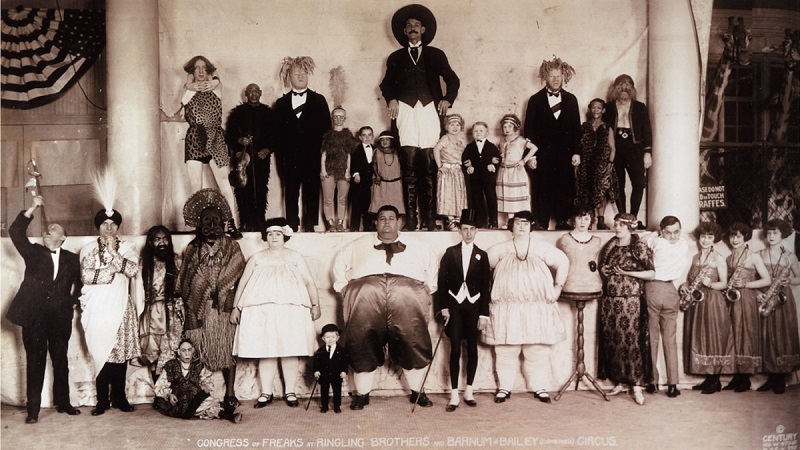
"For Baby Boomers, this famous quote, attributed to Joan Collins, humorously captures a change many of them have observed in American society during their lifetimes: “Grandmother used to take my mother to the circus to see the fat lady and the tattooed man — now they’re everywhere.”
"The reality behind the quote is that over the past few decades, American society has largely abandoned standard norms — of appearance, language, and behavior — in favor of a far more à la carte, each-to-their-own choice of how individuals should or can present and conduct themselves in society.
"Fashions, standards, and mores evolve in all societies. What differs about the sea-change in this area since the late 1960s, however, is that rather than having one set of conventions gradually replace another, there has been a progressive withdrawal from the very idea of externally perceivable norms as the unwritten framework for what mainstream society considers acceptable and unacceptable.
"The new “normal” is a near-absence of norms.
"To hark back for a second to the Joan Collins quote, the example of the general spread of obesity and tattoos — once so marginal as to be limited to unfortunate occurrences of glandular dysfunction in the former case, and sailors and convicts in the latter case — is emblematic of not only those things now accepted or even celebrated, but of their co-existence with every other possible manner in which people today choose to present themselves in society, from Goth fashion, to sportswear as everyday attire, to the fetishization of bulbous buttocks, to social media selfies photoshopped to the outer extremes of the possibilities of the human physique.
"And we have witnessed, in the past few years, the deconstruction of perhaps the oldest societal norm of all — the distinction between the two biological sexes — into the current very loud controversy over gender fluidity and pronouns.
“What’s the harm in that?” many will ask. And indeed, at the surface and individual level, this kaleidoscope of tastes, fashions, and projected identities can be seen as the simple continuation of the trend toward individualism that started as far back as the late Middle Ages.
"But, at the collective level, real dangers come when a society moves from a framework of standards to a culture with virtually no common standards at all.
"Shaped gradually over centuries by collective and implicit agreement on what was seen as desirable or healthy for both the individual and for society, norms have traditionally expressed a society’s values. For the most part, they were not enforced by the law, but rather by the sense of shame that society’s disapproval would trigger in those who transgressed such norms.
"The softer side of these once-ubiquitous societal norms was called “etiquette,” or, more generally, basic good manners. Their traditional function was to ensure a certain decorum and civility among people. One intent was to shield those perceived at the time as more vulnerable or delicate from unpleasantness and vulgarity, as seen in the lost norm that men should avoid foul language in front of women and children.
"Proper etiquette also served to prevent distasteful and annoying behavior in social interactions (not chewing with an open mouth, not speaking with a mouth full of food, moderating volume of speech) as well as to demonstrate respect or appreciation for others or for places of hospitality (not wearing hats indoors, bringing a small gift when invited to dinner). These types of observances were seen as the tangible outcome of a “good upbringing,” thus constituting positive societal reinforcement for the parents of the well-mannered individual.
"The infringement of a norm implies a judgment is being passed. And in today’s culture, being accused of being “judgmental” is akin to being labeled intolerant, hateful, bigoted, or worse. Passing judgment is the antithesis of what seems to be the only universal virtue left in modern society: being non-judgmental, or, to put it simply, being “nice.”
"Disapproval of pretty much anything has been replaced by the need to be seen as positive, caring, understanding, tolerant, empathetic, open-minded, solicitous, and generally kind-hearted. Hence the virtue-signaling flooding social media and the decline of fire-and-brimstone religion, which has been increasingly replaced by the “positivity” of its modern-day substitutes such as meditation, yoga, and “holistic wellness.”
"Culturally, being “nice” equates with the judgment-free acceptance of all forms of fashion, art, music, personal identity, and language, no matter how aesthetically unappealing, cacophonic, vulgar, or simply preposterous. Politically, the mantra of niceness has given rise to forms of moral relativism in public policy that have resulted, for example, in cash-free bail, the decriminalization of certain forms of theft and other crimes, the widespread legalization of marijuana, cities flouting federal immigration law, and the focus on historical revisionism.
"But what has replaced the self-conscious self-regulation once underpinned by societal norms?
"The prevalence today of morbid obesity, the universal spread of profanity, the wearing of unflattering or inappropriate clothes, the popularity of extensive tattoos and piercings, the rise of widespread drug abuse, the brawling in theme parks and aboard commercial aircrafts, and the problem of increasing criminal violence all point to a culture off track. Our culture has abandoned the standards that existed two or three generations ago — in terms of what they considered healthy, positive, and generally appealing for both individuals and for society as a whole.
"Those with a “progressive” bent will decry this line of reasoning, arguing that aesthetics is by its very nature subjective, that “fat shaming” is a reprehensible form of social cruelty, that formerly illegal drugs have merely taken their place alongside tobacco and alcohol, and that crime and violence are merely symptoms of an unjust society. No amount of evidence or logic will sway such views.
"But the abandonment of standards brings a far more damaging societal consequence, and it is hiding in plain sight: the creation of a highly visible and most often irreversible distinction between elite society and, for want of a better term, “the masses.”
"This phenomenon can be witnessed most easily in those places where the affluent and the privileged, as well as the moderately successful — let’s call them “the 10 percent” — live in close proximity to the remaining 90 percent, and particularly to those fellow citizens considered “the underclass.”
"In these tony neighborhoods — from New York’s Upper East Side to Los Angeles’ Beverly Hills, from Washington, D.C.’s Georgetown to Chicago’s Gold Coast — the obese, the heavily tattooed, the eyebrow-studded, the inarticulate, and the badly dressed are found rarely and readily identified as “not belonging” by these neighborhoods’ slim, elegant, and urbane local residents, as well as by the doormen, security staff, and shop assistants they employ.
"The resulting subtle apartheid demonstrates the law of unintended consequences: the loosening of societal standards, thought to increase freedom of lifestyle choices and self-expression, has also resulted in the creation of a quasi-caste system in which the plus-sized, the inked, the unintelligible, and the shabby or sloppy are — de facto if not de jure — denied the ability to compete for jobs, for mates, and generally for opportunity in the residential enclaves and in the professional sectors of the rich, svelte, chic, and highly educated.
"This is the real tragedy of a pendulum that has swung too far from conformity to “anything goes.” For these readily identifiable non-elites, social and professional upward mobility is today blocked by the very jettisoning of standards that was advertised as the path to a more modern, tolerant, free, and fluid society.
"Instead, we have a culture that is undoubtedly coarser, more unattractive, and more confrontational than it was in the recent past and, most importantly, one in which a large social class of “plebeians,” constituting an absolute majority of the population, is now limited in its aspirations — not just by education, generational wealth, and family connections — but now by language, behavior, and physical appearance as well.
"The result feels like a cruel trick played by the elites on their less fortunate fellow citizens, preventing anyone from below from joining their ranks. Yet the abandonment of normative societal standards has not been imposed from above. It is instead a cultural spin-off of the wider anti-establishmentarianism of the late 1960s.
"It “felt right” at the time to throw off the shackles of convention across a broad range of former norms in a range of cultural domains. But the trendsetters of the time did not anticipate what happens in a cultural vacuum.
"Societal standards — whether in dress, language, body shape, or behavior — have existed since the beginning of civilization for a reason. We abandoned them, for the first time in human history, against logic and at great cost. And those who can least afford it pay the highest price."
-----------------------------------------------
NOTE: This article, dated 20 Mar 23, is reprinted from THE FEDERALIST.
-----------------------------------------------------------------------------
(My) COMMENTS ON THE ABOVE:
I seldom reprint material by others here, but I feel the information it conveys is so very important that it deserves a wider audience.
Writer Paul Maglione has articulated in the above essay what far too many fail to address in a civilised, moderate and restrained manner.
What he does not explore are the motivating rationales (if one can deign to dignify them as such), and underlying social causations that arise when young, idealistic, or simply misguided idealists promote socially radical, harmful agendas that stem from their own half-complete concepts of the human life experience.
Today we in America suffer from a perversely distorted and grotesquely misshappen definition of 'diversity' (often frequently referenced as part of the DIE ideology, 'Diversity' Inclusion and Equity', which along with CRT, or Critical Race Theory and the gross delusions of what is called 'wokeism'), is presently being forced down everyone’s collective throat.
Ironically, this radical definition of 'diversity' is a major destructive factor behind our present American social chaos and disintegration.
Ironically, ‘Freedom' in America has always embraced social diversity, indeed protection of 'diversity' is what American 'freedom' is all about at a bedrock level...not, as the radical, progressive left would have you believe, protection of what they disparage as 'White privilege'.
In their narrow-minded (near-religious) zeal, these progressives (Marcusian/Marxist-inspired neo-socialists) have taken this archetypal, bedrock American concept of social diversity and fed it a diet of insular neo-socialist steroids (figuratively speaking) to the extent that it is literally forced upon all and sundry, and monstrously transformed into an ideology that brooks absolutely no compromise or dissent, whatsoever.
One of the most dangerous aspects of this process is that it incites, antagonises and irrationally stirs up the more extreme passions of those who are right of center into a posture of radical resistance and reactionism. It is this exponentially amplified, polar process that is today responsible for the 'no common ground' political stance that both the left and the right have adopted...a posture that leaves little if any room for participation in a common colloquy.
People that would otherwise not get upset or even bother to speak out against something like this are, consequently, literally gathering up the pikes and heading to the barricades, filled with fighting spirit and even more hazardous sentiments, provoked by progressive rhetorical liberal villainy.
The thesis of Mr. Mangione's essay is that abandonment of heretofore 'social norms' has exacerbated not just already severe social disharmonies but promotes a uniformly 'cheapening', commonising state of affairs in which the least beneficial, sleezier and most distasteful aspects of what he describes as the 'underclasses' are now being touted and championed as the optimal social ideal.
What most unthinking, unreflective individuals do not realise is that one of the major prime-movers behind this new ideological type of social commonality is a core aspect of modern American capitalism itself (i.e. the entertainment and mass media corporations).
They profit, after all, from their ability to 'con' simple people into buying-into their psychologically sophisticated prompts (read: through commercial advertising) to spend discretionary income on artificially created (or augmented) fantasies and ephemeral whimsies, the returns from which amount to billions upon billions of dollars of pure profit each year.
Not that long ago, before the rise of that curse of modern life known as 'social media' and its internet enabler, co-dependent, so-called 'pop-culture' was a small, isolated and limited dynamic of society. Trends, fads and what-have-you arose in strictly limited, purely regional forms, remaining unexploited, unamplified and unorchestrated, in general.
When mass society expanded to embrace the new 'electronic media' breakthroughs of the 70s/80s, exemplified by the worldwide web and the instant peer-association linkages that constitute 'social media', commercial corporations and mass media saw a priceless opportunity to brutally exploit what had formerly been merely small, localised fascinations on an exponential scale. Entertainment business followed suit, closely linked to and funded by powerful corporations, and before long even the tiniest tawdry excesses of the 'underclass' were paraded before society at large, via light-speed communications media.
These lower-class fads, fantasies and schlocky affectations quickly merged with the inherently rebellious nature of Americans and were then carefully cultivated by corporate entities (again, commercial businesses and entertainment media), so that they could be used to exploit the passionate (and highly emotional) superficialities of the masses.
Hollywood and corporate businesses, for example, spend hundreds of millions (if not billions) of dollars every year to suck the money out of gullible people's pockets, via carefully orchestrated and psychologically proven coercive techniques, honed and fine-tuned through decades of effective mass media advertising.
In Communist and socialist countries this is known by the less than benign term 'brainwashing'; in America, students of society call it 'socialisation' (a far more innocuous and less alarming term).
Thus, under the influences Americans are today subject to, thanks to the commercial exploitation and popularising of often trashy, disgusting, lower-class behavior and attitudinal disaffections, something as inherently harmful as 'radical (socialist) progressivism' may and can come about very quickly. QED. A peerage of fools remains simply an aggregate mass of fools, after all.
Mangione explains that 'etiquette' (observation of manners and social norms), serves a very important purpose in society. It helps assure that the tendency many otherwise might have, to give ready vent to their more dangerously radical (read: violent) tendencies don't reach a boil. Further, 'etiquette' under traditional American concepts of freedom, helps to promote diversity rather than hinder it.
Of course, one reason why these truths do not achieve wider recognition is that the vast bulk of 'mass culture' individuals either do not reflect on life intelligently or lack the intellectual means (and/or motivation) to do so adequately. That seems bound to never change, sadly!
The downside of this is that that 80% of the three-brain-cell, mouth-breathing morons out there shall forever doom us to a perpetual state of social angst and radically polar disharmony in 'modern' America, as long as there are far brighter individuals without adequate conscience to exploit them.
As Shakespeare so adroitly put it: "First, kill all the lawyers..." Others have modestly pointed out that that's merely a 'starting point'.... [Shakespeare could get away with that...we can't, unfortunately!]