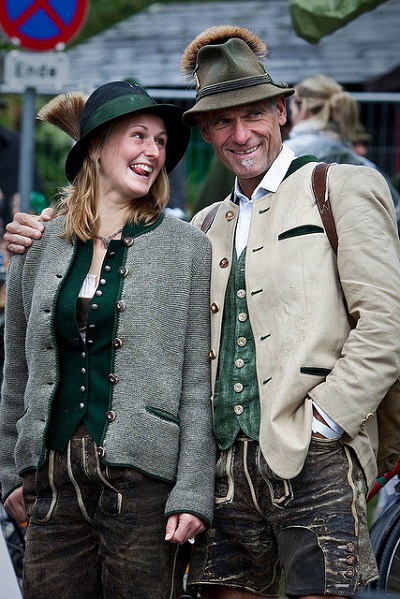
 Trachten is the German word for 'traditional regional costume.' All over Europe, each local national group has its own special 'ethnic costume.' One of the best known and instantly recognised groups of ethnic costume are those of Germany, Austria and the Germanic populations that are found scattered all across the European continent. Famed automotive designer Dr. Professor Ferdinand Porsche, who gave the world the Volkswagen 'bug' and the many Porsche sports and autoracing cars, although born in the former Austro-Hungarian region of Bohemia (now part of the Czech Republic), resumed his auto design work in the small community of Zell am See in the beautiful Salzburg region immediately after the end of World War Two. This article deals with the Trachten, or traditional regional costume, of that part of Salzburgerland in which Porsche began his new auto design empire. It is not concerned with ancient Trachten styles, but that which have evolved generally from them today.
The enduring charm of trachten: A look at Austrian Salzburgerland traditional attire
Foreword: The innate genius of Dr. Professor Ferdinand Porsche, although Porsche was Czech-Bohemian by birth, blossomed and flourished in the beautiful Zell am See part of Austria’s Salzburgerland. Porsche's association with Zell am See Austria's Salzburg dates back to 1941, when he bought the Schüttgut estate there as a retreat for his family and to maintain a connection with the Austria he grew to love.
At war's end, in the early post-war period, the Porsche family estate in Zell am See was occupied by the American military command, but the family was permitted to remain on the property. Ferdinand Porsche was initially held under house arrest in Gmünd, then taken to an internment camp in Schloss Kransberg by the French, being released on August 5, 1947. His son, Ferry Porsche, was released from custody on November 1, 1945, and returned to Zell am See.
While the exact duration of Ferdinand Porsche's continuous residence in Zell am See in the immediate post-war decade is not explicitly stated as a single unbroken period due to his imprisonment, the family maintained their home there.
Zell am See was and is still much loved by Porsche and his family and it was there that he brought to life many of his early post-war visions of modern sports car type automobiles that are today famous the world over. Although Porsche later relocated his firm to the Stuttgart area in Germany, Zell am See remains very much a beloved part of the Porsche family’s ancestral roots and they maintain a home there today, emulating the community’s traditional ‘Trachten’ on special occasions and during festivals. Given Zell am See’s importance to Porsche GmbH, following is a brief overview of the Trachten peculiar to men in Zell am See and in Salzburg, Austria.
---------------------
Nestled amidst the breathtaking peaks of the Austrian Alps, Zell am See is a picturesque town renowned not only for its stunning natural beauty but also for its deep-rooted cultural heritage. A vibrant testament to this heritage is Trachten, the traditional attire of the Alpine regions, which continues to hold a significant place in the hearts of locals and captivate the imagination of visitors. While Trachten encompasses a wide array of regional variations for both men and women, this article will delve into the distinctive features of men's apparel associated with the Zell am See (Salzburgerland) area, exploring its key components, historical context, and its remarkable resurgence in modern popularity.
A Legacy Woven in Fabric: The History of Trachten
The origins of Trachten date back centuries, emerging as practical workwear for farmers, hunters, and shepherds in the rugged Alpine environment between the 16th and 18th centuries. Over time, these functional garments evolved to reflect not only regional identity but also social status, occupation, and even personal circumstances like mourning or celebration. Each valley, village, and even local organization developed its unique "Tracht uniform," characterized by specific cuts, colors, fabrics, and embellishments.
Given its proximity to Bavaria, Salzburger Tracht shares many superficial similarities with that worn in other Austrian regions, but especially that of South German ‘Oberland.’ Today, other than during traditional Tracht festivals, the casual, generalised style affected by most men consists of the Janker, vest and Lederhose (or its alternative, the longer Bundhose), but long wool pants (as with a suit) is often the choice of professionals in Salburgerland.
While it's challenging to pinpoint a singular "Zell am See Tracht" that is definitively distinct from other Salzburg region variations, the broader characteristics of Salzburger Trachten apply. These garments were crafted from durable, natural materials readily available in the mountainous terrain, such as wool, linen, and leather. The harsh climate necessitated warmth and resilience, leading to the development of fabrics like Loden (a thick, felted wool) and boiled wool ("Walk"), known for their exceptional insulating and water-resistant properties.
The 19th century saw a romanticized revival of traditional dress across German-speaking regions, fueled by nationalism and a yearning for an idealized rural lifestyle. Trachten, once primarily utilitarian, became a powerful symbol of identity and a connection to cultural roots. This movement solidified the enduring image of the Dirndl for women and Lederhosen for men as quintessential Austrian and Bavarian attire.
Decoding Men's Trachten: Jackets, Hosen, and Hats
Men's Trachten from the Zell am See area, like much of Austrian Alpine attire, is characterized by its blend of robustness, elegance, and intricate detailing.
The Trachten Jacket (Janker)
The Janker, or traditional Trachten jacket, is a cornerstone of men's attire. These jackets are typically made from high-quality wool felt (Loden or Walk) or linen for lighter, summer styles. The color palette often mirrors the natural Alpine landscape, featuring shades of olive, forest green, moss, charcoal grey, deep navy, chocolate brown, and natural beige tones.
Key features of the Janker include:
- Mandarin-style collar (Stehkragan): A distinctive stand-up collar that adds a touch of formality and classic appeal.
- Antler, bone, or horn buttons (Geweihknöpfe): These natural buttons are a hallmark of authentic Trachten, adding a rustic and traditional touch.
- Trim (Borte): Often in contrasting colors, piping along edges provides a visually appealing outline to the jacket.
- Back pleat (Quetschfalte) and back vents (Rückenschlitz): These elements ensure freedom of movement while maintaining a tailored and formal appearance.
- Embroidery (Stickerei): Intricate embroidery, often featuring Alpine motifs such as edelweiss, oak leaves, or deer, can be found on pockets, collars, or lapels, signifying regional pride and craftsmanship.
While traditional Jankers lean towards classic designs, modern interpretations may incorporate subtle stylistic updates while retaining the core elements of the traditional garment.
The Iconic Hosen: Lederhosen and Bundhosen
No discussion of men's Trachten is complete without acknowledging the Lederhosen (leather trousers) and their longer counterpart, Bundhosen. These are perhaps the most globally recognized elements of Alpine traditional dress.
- Lederhosen: Traditionally crafted from deerskin, goatskin, or cowhide, Lederhosen are renowned for their durability and comfort. The leather undergoes a special tanning process that makes it soft yet incredibly resilient. They come in various lengths, with short Lederhosen being popular for outdoor activities and festivals, while knee-length Bundhosen offer more coverage and are often preferred for cooler weather or more formal occasions.
- Embroidery: Authentic Lederhosen are often adorned with elaborate hand-embroidered details, typically in contrasting thread colors. These intricate patterns frequently depict local flora and fauna, hunting scenes, or geometric motifs, each holding regional significance.
- Suspenders (Hosenträger): Often detachable, suspenders are a common accompaniment to Lederhosen, providing both practical support and an additional canvas for decorative embroidery.
- Fit: Traditionally, Lederhosen are designed for a snug fit that conforms to the body over time, becoming more comfortable with wear.
- Bundhosen: These are essentially knee-length versions of Lederhosen, offering a more formal alternative. They are made from similar leather types and feature the same exquisite embroidery and craftsmanship.
The Distinctive Hats
A man's Trachten ensemble is often completed with a traditional hat, typically made of wool felt. While variations exist, the most recognizable style is the Tyrolean hat, often grey or green, with a distinctive tapered crown and a brim that is often turned up at the back. Each local region in the various Austrian ‘Lander’ has a traditional hat style that is quite distinctive, however these days many younger men do not wear a hat in casual settings.
Key characteristics of Trachten hats include:
- Gamsbart: Perhaps the most striking embellishment on a traditional Trachten hat is the "Gamsbart." This distinctive brush-like ornament is made from the hair of a chamois (Gams), a mountain goat-antelope native to the Alps. Traditionally, the Gamsbart signified a successful hunt, a symbol of the wearer's prowess. While genuine Gamsbarts are now rare due to hunting restrictions, synthetic or other animal hair alternatives are used. The size and quality of the Gamsbart can indicate status. Even synthetic Gamsbart are often quite expensive.
- Hatband: A braided cord or ribbon often encircles the crown, providing a decorative touch.
- Feathers: Smaller feathers, often from local game birds, may also adorn the hat, adding to its authentic Alpine charm. Other favorite ornaments includes Alpine flowers and sprigs of greenery
The Current Popularity of Trachten in Zell am See and Beyond
Far from being relegated to historical reenactments or dusty museum displays, Trachten, including men's apparel, is experiencing a remarkable resurgence in popularity throughout Austria, and Zell am See is no exception. This revival can be attributed to several factors:
- Cultural Pride and Identity: In an increasingly globalized world, many Austrians embrace Trachten as a tangible connection to their heritage and a celebration of their unique Alpine identity. Wearing Trachten, particularly on festive occasions, is a powerful expression of regional pride.
- Festivals and Celebrations: Traditional festivals, such as the numerous "Volksfeste" (folk festivals), wine festivals, and local celebrations that punctuate the Austrian calendar from spring to autumn, are prime opportunities to don Trachten. While Oktoberfest in Munich is the most famous, similar events across Austria, including those in the Zell am See-Kaprun region, see widespread participation in traditional dress. Weddings and other significant family events also often feature Trachten.
- Tourism: The allure of authentic Austrian culture is a major draw for tourists, and Trachten plays a significant role in this. Visitors to Zell am See are often keen to experience and even purchase traditional attire, contributing to its commercial viability and visibility. Many tourist-oriented businesses, including hotels, restaurants, and shops, have staff who regularly wear Trachten as part of their uniform, further normalizing its presence.
- Fashion and Modern Adaptations: Designers have successfully integrated elements of Trachten into contemporary fashion, creating a "country house" (Landhausmode) style that blends traditional aesthetics with modern comfort and silhouettes. This has made Trachten more accessible and appealing to a younger generation, allowing for everyday integration as well as formal wear. Men's Trachten jackets, for example, are now often worn with jeans or other casual trousers, demonstrating their versatility beyond strictly traditional ensembles.
- Sustainability and Craftsmanship: There's a growing appreciation for the high-quality, natural materials and meticulous craftsmanship involved in producing authentic Trachten. This aligns with broader trends towards sustainable and ethically produced fashion.
In Zell am See, you'll find specialized Trachten shops, like "Tracht & Country by Trendmaker" or "Leder Ritsch" in nearby Kaprun, catering to both locals and tourists seeking authentic or contemporary Trachten pieces. These establishments offer a wide range of jackets, Lederhosen, shirts, and accessories, ensuring that the tradition continues to thrive.
In conclusion, the traditional Austrian Trachten associated with the Zell am See area for men, characterized by its robust Janker jackets, iconic Lederhosen, and distinctive hats adorned with Gamsbarts, is far more than just historical costume. It is a living, breathing testament to a rich Austro-German cultural heritage, imbued with regional pride and an enduring sense of identity. Its current popularity reflects a harmonious blend of tradition, cultural celebration, and a growing appreciation for quality craftsmanship and timeless style, ensuring that the characteristic regional dress of Zell am See will continue to be cherished for generations to come.
----------------------------------
[NOTE: Sources available on request] The image shown with this article is contemporary and shows a typical Salzburg couple's Tracht ensemble, though not specifically that of Zell am See.
|