DOGS IN SPACE: The early Soviet animal space flight program
Abstract: A brief historical overlook of the early post-war Soviet animal spaceflight research program that prepared the way for the first successful launch of a human being into Earth orbit (Soviet Cosmonaut Yuri Gagarin, 1961). Kalikiano Kalei, July 2018
---------------------------------------------
Dogs have frequently been referred to as ‘man’s best friend’, a status (at least as far as the United States of America is concerned) that is almost indisputably true and hugely deserved. Not just in the USA, but in the rest of the world as well and for several thousands of years, the ordinary domestic dog (Canis familiaris) has closely shared the story of humanity’s advancement from its primeval origins to the modern day. In primitive societies dogs have traditionally provided a range of assets (and sometimes still do), that range from serving as transportation enablers (i.e. sled dogs), through hunting companions and even in some cases portable sources of food.
Although in America dogs have been bred predominantly as human companions (pets), many in other parts of the world are still bred for specific working purposes (hunting, rescue, security), and given their keen senses of hearing and smell there are new uses being found for dogs every day. As pets they provide unswerving loyalty and valued companionship in a world that is increasingly less certain, socially hostile and more chaotic each passing decade. Thus, the ‘ordinary’ dog has a special, almost profoundly unique relationship with his human masters and it is particularly fitting that dogs largely enabled human space flight in the decade and a half that immediately followed the end of the Second World War. This is their story.
The immediate post war period
In 1946, at war’s end it quickly became crystal clear that the former ‘allies’ of Communist Russia and the United States, each having develped into two of the most powerful nations on the planet, albeit with radically polarized political economies, would enter into a monumental power struggle for global primacy. Not without a substantial amount of irony, the technological science establishments of both nations shared a commonality in that the spoils of their common foe’s (Nazi Germany) advanced aeronautical and weapons researches would be divided between the two contenders almost equally.
Perhaps the most significant of these researches concerned themselves with the weapons development involving reaction-engine propelled rocket vehicles, most notably that of the German A-4/V2 missile which came into use as a strategic combat weapon system somewhat later in the war. Entering operations too late to alter the war’s outcome, this radical new weapon would soon revolutionise modern warfare and set the stage for man’s advances into the upper atmosphere and from there into true space.
Standing over 46 feet tall and weighing about 13.75 tons (27,600 pounds), the V-2 rocket was the desperate culmination of World War Two German rocket research designs and used a liquid fueled (ethanol alcohol/water and liquid oxygen) reaction engine to loft a 1-ton high explosive warhead between 150 and 200 miles to its target. Rising to a height of between 55 and 128 miles (depending upon trajectory) and reaching speeds of approximately 3,500 mph with its 60,000-pound thrust propulsion unit, this amazing weapon was the apex of German rocket research studies that had begun almost a decade and a half earlier.
The subject of the German rocket researches headed by Dornberger and von Braun that led to the V-2 weapon has been extensively covered over past decades and as such much of it lies without the scope of this paper but suffice it to say that the earliest space exploration efforts of both nations (the USA and the USSR) began with the German V-2 as a common forebear. More precisely, this took shape due to a large body of information and documentation recovered by both sides that was substantially augmented by a limited number of operational V-2 rocket vehicles (and component assembles) captured by the invading Allied forces) as the Reich crumbled.
Due to quick and efficient tactical operations carried out by the US at war’s end, as both nations raced to capture key German personnel and advanced weapons systems, the United States ended up with the lion’s share of both documentation and the actual missiles themselves. While von Braun’s and Dornberger’s team (comprising the crème de la crème of the German rocket program researchers) fell into US hands, the Soviet forces did manage to capture a number of somewhat less key ‘players’ in the German rocket research program and also secured a certain number of the V-2 missile components themselves at abandoned test & production sites. From these confused and at times chaotic efforts, the consequent development of space research programs both in the Soviet Union and the United States had their common beginnings.
It is interesting to note that both sides had had their own prescient and forward-thinking rocket scientists long before the Second World War began (specifically Dr. Robert Goddard in the USA, Konstantine Tsiolkovsky in Russia and of course Hermann Oberth in Germany), but almost all of these forward thinking and imaginative men ran afoul of vague political and scientific censure in their advocacy of rocket research. It was only during the war, when Germany’s fortunes appeared to ultimately depend heavily upon rapidly developing radical new weapons systems, that German rocket research boosted this precocious new science of ‘rocketry’ into figurative orbit.
The early-to-mid 1950s American researches
In addition to capturing the von Braun/Dornberger team (and vast amounts of documents), the United States also recovered about 100 of the actual V-2 rockets, all of which were immediately brought to the United States and secured at a desert flight test facility located at Alamagordo, NM (later to become known as White Sands Proving Ground). Thus, began the process of seeking to understand the basic research theory and structural engineering that went into the V-2 German missile.
A series of test firings were carried out, the first taking place in 1946 and continuing until about 64 of the recovered rockets had been expended by 1949. Results of these American tests were at first mixed, with an almost equal number of successes and failures, but inevitably the concept of sending biological specimens up on these flights took hold as the newly emerging discipline of space bio-physiology grew.
Interestingly, while Wernher von Braun is today regarded as the ‘father’ of US orbital rocket research and space exploration, another German scientist named Hubertus Strughold (one of the key aeromedical and aviation physiology researchers in the deposed Reich) quickly took on the task of shaping up the medical and biophysical aspects of the emerging American interest in developing a space program. Today, Strughold would be regarded with the same esteem von Braun is were it not for unproven and insinuatively false claims that he was involved in medical research studies on German concentration camp inmates. Nevertheless, Strughold is still regarded (quite rightly) by many as the true ‘father of American aerospace medicine.’
As the test firings continued, it quickly became a key concern that the now vacant warhead section of the V-2 missile be fitted with instrumentation so as to allow measurement of the physical parameters of each flight. It just as quickly became apparent that some sort of functional recovery system would need to be fitted as well, so that any instrumentation package onboard could be successfully recovered for laboratory analysis.
Before long, the idea was proposed that actual biological specimens be sent up along with the instruments so that the effects of rocket flight and high altitude (among them expose to radiation, weightlessness and cosmic rays to name just several) could be measured and quantified.
Given the relatively small space available for all these added components at the top of the V-2 vehicle, it was difficult to configure a truly reliable parachute recovery system that would bear the full weight of the ejectable cargo and safely return the payload back to earth. In 1947 the first American rocket flight with transmission telemetry took place and a special program to configure a parachute recovery system for the test V-2 vehicles was also initiated under the code name ‘Project Blossom’.
Soon a determination was made that the next step forward would logically involve the use of animal test subjects. This consisted initially of a small, rather modest payload of plant seeds and fruit flies. Mice were considered the next likely test subjects, the assumption being that larger animals would logically follow.
Early attempts to send up mice were only partial successes, due to the fact that while the animals apparently survived the stresses of flight and altitude, quite frequently the parachute recovery system would fail to deploy adequately, resulting in them being killed when the instrumentation payload crashed back to earth. Given the severe constraints of the small V-2 payload section, it was imperative that an absolutely reliable and workable parachute recovery system first be perfected before any efforts could be made to boost a larger animal (such as mice, or a monkey) into the higher altitude regions.
At this time, a noteworthy medical researcher joined the combined research effort whose name was Dr. James Henry. A brilliant individual, Dr. Henry had been Assistant Professor of Aviation Medicine at USC. He soon joined forces with Dr. Heinz Haber and Dr. Otto Gauer, both former aeromedical researchers for the Third Reich (and colleagues of Dr. Hubertus Strughold) who had been brought to the United States to work for the US Government. Together with Strughold and the USAAF’s principal aeromedical researcher Dr. Harry Armstrong, they soon formed the important nucleus of what would eventually take form as the US Air Force’s School of Aerospace Medicine.
Dr. Henry, it should be noted, in addition to his work on altitude physiology associated with the US V-2 research tests, also pioneered the first successful military high-altitude partial pressure suit. This protective garment used mechanical capstan devices to physically restrict the body of its wearer in lowered pressure environments, thus enabling the wearer to survive in the event of an explosive cabin depressurisation at altitude.
Due to the fact that up to this time research results were routinely shared with the world-wide scientific community, both Dr. Henry’s suit researches and aspects of the US V-2 high altitude rocket flight program became known to many other scientists involved in similar programs, not least being the those in Soviet Union. The USSR not only quickly devised a high altitude partial pressure suit based on the Henry design for its own aircrews but also even adopted the basic principles and fundamentals to design a partial pressure suit for its canine sub-orbital test subjects! A comparison of these early-to-mid-1950s canine partial pressure suits with man-rated high altitude Russian partial pressure suits readily affirms the fact that they derived almost directly from Dr. Henry’s original design.
After the American biomedical rocket researchers’ initial work with mice had begun, it was decided that the logical follow-on biomedical specimens would be primates, specifically rhesus and chimpanzee monkeys, since it was felt that they most suitably approximated the physiological functions of an actual human test subject; further, their reflexes and learning abilities were also ideal. Key figures associated with developing the American space monkey research would be Dr. James Henry and Dr. David Simmons (who gained renown for his high-altitude balloon flights) and initial work began to develop a life support capsule and recovery chute that would fit into the marginal confines of the V-2 rocket’s nose. It is worth mentioning here that although it was felt that rhesus monkeys were suitable test subjects, Major Simmons maintained a mild antipathy towards them, feeling that the monkeys that had been selected were somewhat difficult to work with and a bit irascible.
Nevertheless, in 1948 the first V-2 flights with a rhesus monkey on board began at the Holloman proving ground (White Sands). Thus, began a series of flights using rhesus monkeys (all named ‘Albert I, II, III and IV’, etc.) which met with varying success. By the end of 1949, several of the V-2s carrying the animals had been lost due to various system failures. It was obvious to most on the team that the V-2 rocket had reached the limits of its usefulness as a carrier for primate specimens, although some V-2s were still used in non-biological flights. One subsequent design incorporated use of an unguided upper stage sounding rocket affixed to the top of a V-2, known as the ‘WAC-Corporal’ (WAC for ‘without any control’).
Fortunately, by that time enough had been learned from the V-2 researches to allow the first uniquely American high-altitude research rocket to be developed. This was the Aerojet General ‘Aerobee’ rocket, a slim vehicle some 19-feet long and a foot-and-a-half in diameter that incorporated substantial improvements over the V-2 into a purpose-made high-altitude rocket vehicle. It was on this new rocket that the first successful rhesus flights would be made, given the relatively small size of the monkey and the rocket’s ability to carry a suitable payload (about 150 pounds) to altitudes of more than 70 miles. [The Aerospace Museum of California, located in Sacramento (CA)…the home of Aerojet General…is fortunate to have an excellent specimen of the Aerobee rocket, thanks to that company’s generous donation.]
Although the first Aerobee monkey flight ended in disaster owing to failure of the parachute recovery system, the second such flight did in fact succeed. This success was somewhat marred by the later loss of the monkey test-subject due to heat-exhaustion in the desert, while awaiting retrieval from the capsule.
The third Aerobee flight, conducted in 1952, carried two macaque monkeys and a pair of mice to an altitude of about 36 miles, traveling at over 2000 mph. To everyone’s gratification, this time the parachute recovery system worked flawlessly and the bio-specimens aboard were recovered in good condition. This success marked a notable step forward for early American animal space flight researches and would pave the way for the next series of flights culminating in employment of chimpanzees as test subjects. That next stage of would await the development of more capable rocket vehicles and it was not until 1957 that animal rocket research flights (of any type) would resume in America.
By the end of the Aerobee program, over 1070 launches had been made of this very early US adaptation of the V-2 missile.
Partly due to lack of a rocket with a suitably capacious payload capability, this 5-year hiatus was also affected to some extent by a substantial wave of protest from animal rights groups both in the US and abroad who felt that use of live animals in space researches was unjustifiably inhumane.
Thus, it would be in 1958 that the first in a new series of animal space flights would begin in the US, thanks to development of the new Douglas Thor liquid-fueled intermediate range guided missile with a much greater payload capability and a two-stage version of that vehicle named the Thor-Able. Another new and more capable IRBM rocket developed by von Braun’s US Army team (named the Jupiter) would also soon figure prominently in renewed US animal space researches of the late 1950s.
The Soviet Union’s early animal space flight program
When the war with Germany ended in 1945, a certain amount of rocket research documentation, various German V-2 missile spare component assemblies and a small group of 2nd and 3rd tier German rocket scientists were assembled by the Soviets and removed to the Soviet Union. The personnel in reference were at first promised that they could remain in occupied Germany to continue their work for the Soviets, but very soon the directive changed and the personnel (along with all the rocket materiel) were routed back to Russia.
Once in the Soviet Union, this small group of former rocket program scientists were put to work on the problems of developing rocket vehicles suitable for flight test sub-atmospheric research. The team was initially coordinated by the Moscow Institute of Aviation Medicine (IAM), a facility established initially in 1935 that had been inactivated during the recent war but reactivated in 1947 to study human factors related to future space flight.
In 1949 Dr. Vladimir Yazdovskiy of the IAM received a telephone call from an individual who identified himself as Sergei Korolev, a recent returnee from the Gulags, where he had been remanded as a political prisoner during the war. Korelov had been charged by the Supreme Soviet with development of what he described as ‘special equipment’, since extreme secrecy prohibited mentioning the specific nature of his work at that time.
Preliminary experiments had by that time already taken place in the USSR using a modified German V-2 rocket in an effort to further develop a series of long-range rockets that could be used as continent-spanning strategic missiles. That original modified German V-2 was designated the Soviet SA-11 (R-1) rocket. The plan was to also develop rocket vehicles at the same time that could be used for scientific research purposes and the R-1 rocket, although essentially a direct copy of the German V-2, had been made using Russian-manufactured parts and technology.
As these experiments continued, a series of modified R-1 rockets were developed and given names such as the R-1A, R-1B, etc, but they all followed the same more-or-less design of the original V-2 derived R-1 vehicle. As the flight researches and as the team under Yazdovskiy gained experience, it quickly became apparent that quite soon living specimens of animal life would need to be sent up into the atmosphere and this led to concerns over which kinds of animals might be suitable for these sub-orbital, high-altitude flights.
Since much of the American studies involving post-war high-altitude rocket researches (including biospecimen experimentation) had been published in the world’s scientific community, Yazdovskiy’s team spent many hours reviewing, reading and absorbing the US high-altitude research findings.
Although this Russian review of US published papers revealed that the usual number of preliminary failures had been sustained, the ultimate conclusion emerged that monkeys were at least capable of surviving such flights and that they could be successfully recovered, provided the requisite life support and recovery systems could be made reliable. The Americans had at that point selected primates for several reasons, one of them being that monkeys were the closest animal life form to humans.
However, the question of which animal to choose for early high-altitude space research flights remained a hotly debated subject among Yazdovskiy’s team.
Smaller animals (mice, rats, etc.) presented special problems in that they were more difficult to fit with the relatively primitive early biotelemetry systems extant in the early 50s and the Russian view was although physiologically reasonably well-suited to serve as a stand-in for later human subjects, they were hard to deal with, train and work with.
Thus, after much debate, a decision was arrived at to use canines as high-altitude test subjects. This decision was not inconsequentially influenced by the fact that a substantial number of experimental researches had already taken place in the USSR on dog subjects. Chief among these were the famous experimental studies by the highly respected physiologist Ivan Pavlov, whose work with dogs in the late 1800s and early 1900s set a benchmark for all subsequent investigations into both dog and human behavior. Of importance was the fact that dogs were very close to human beings in terms of their emotional and physical behavior. They were furthermore a familiar part of human society about which much was already known. Finally, it was felt that they would be suitable for the sort of intensive training that would be required to adapt them to rocket flights into the upper atmosphere.
Although more suitable on the above considerations, it was felt that dogs, like human beings, are individuals in temperament and personality, no two dogs being alike just as with human beings. Technically a disadvantage, it was felt that this could be adequately compensated for by using pairs of dogs on such flights so that they could be behaviorally compared to each other. Meanwhile, progress was being made by the Soviet rocket vehicle development program under Korelov towards producing ever larger rockets with much greater payload capabilities that the early R-1 series (part of the need for larger boosters was that the Russians had not successfully been able to miniaturise their instrumentation; this would later turn into a distinct advantage for the Russian space program). The combined weight of two canine specimens, along with the needed life support systems and recovery apparatus therefore did not seem as formidable a challenge as it had to American researchers who still lacked adequate atmospheric rocket heavy-lifting vehicles.
Very soon after this decision had been made, the Moscow IAM initiated an animal study kennel so as to select and prepare suitable canine test subjects for rocket flights. Soon, it had an extensive section set up with personnel carefully selected to work with dogs in space research experimentation, training and flight preparation.
The dogs used were ordinary street dogs (we would call them ‘mutts’ or ‘mixes’), of which there were a great many living uncertain and at time quite difficult lives on the cold streets of Moscow. The dogs would have to be fairly small (generally weighing no more than about 14-15 pounds) in order to fit into the 9.8 ft3 payload space on the R-1 rocket, female and young as well. As for the female preference, it was felt that female dogs would be much easier to fit with sanitary garments intended to contain bodily waste products. Their coat colors were also considered on some importance due to the need to photograph them in flight in their life support containers (light colors would be easier to record than darker ones in the dim confines of a capsule).
Interestingly, mongrels or ‘street dogs’ were considered to be fitter and more resourceful than purer breeds, due to the fact that the experience they had gained through trying to survive on the streets would have made them hardier and more physically adaptable to extreme conditions.
After ‘collection’ and inclusion in the canine pool of candidates, each dog was carefully studied for personality traits and graded into even temperament, ‘excitable temperament’ and ‘unreactive temperament’ personality categories. Much more careful study of the dogs in each group would follow, and those deemed suitable for rocket flights would be very extensively and thoroughly trained so as to inure them to the sights, sounds and extreme stresses such flights would impose upon them.
As an extensive training program got underway, just as with human subjects, certain specimens would ‘wash out’ or be considered as unsuitable for use in the program. Those that would make the cut would ideally be of moderate temper, not easily excited and generally calm under stressful conditions. Dogs that made the primary selection tier were considered suitable for longer (perhaps orbital) flights, while those in the second selection tier might be better suited to sub-orbital, high-altitude flights of relative short duration (a few hours at most). The initial group of canines selected for continued training and preparation numbered several dozen, out of which about 10 would make the very first R-1 vehicle flights into the atmosphere and several others that would be used in a second series of flights. Some dogs that were deemed unsuited to either short high-altitude or longer orbital flights might still be kept around the kennel for non-flight study purposes.
Chief among the training & preparation procedures that the principal candidate dogs would undergo were centrifuge ‘flights’ (high G, up to 3 to 5 times normal gravity), exposures to severe vibration and extreme shaking, and confinement to a small, enclosed space for extended, gradually lengthening amounts of time. The test subjects were carefully studied throughout these procedures and their personalities and behavioral responses appropriately recorded.
In 1951, word was received that the first flights using dogs as test subjects would take place that summer. Both the R-1B and R-1V rockets (modified R-1/V-2 vehicles) would be used for the initial series of flights. Meanwhile work continued on various means of devising a life support system to protect the dogs during these flights. Initially, experiments were conducted using mechanical (capstan) partial pressure suits that fitted a dog’s body almost exactly as would Dr. James Henry’s American aircrew partial pressure suits. Using a blend of drab cotton & nylon material, fitted with lacing and capstan pressure tubing along the body & limbs, these dog pressure suits were attached to purpose-molded transparent Perspex helmets that enclosed the dog’s head & muzzle. The paws were left uncovered. A number of designs were produced before the concept became somewhat modified to provide a small, fully pressurised body-enclosure bag with extensions for the dog’s forepaws to which was mated a round globular transparent helmet. This is the form that was used later for a second series of mid-1950s flights carrying a pair of dogs that were restrained side-by-side in a non-pressurised ejectable sled [An example of this rare mid-50s spacesuit/ejection sled is on display at the Aerospace Museum of California; it is one of only a few such specimens on display anywhere in the world.)
The very first flight with dogs in an R-1B rocket took place in July of 1951 at Kapustin Yar, a remote and inhospitable testing site in the Astrakhan desert area near Volgorad and just east of the Ukrainian border. The dogs (Tsygan and Dezik) were contained in a small, hermetically sealed (thus no pressure suits were needed) life support compartment fitted to the uppermost section of the R-1 vehicle’s nose. The two dogs had demonstrated strong qualities of calmness and hardiness in prior testing, theoretically making them suitable for the all-important first flight.
After a successful early morning lift-off, witnessed by a select group of individuals who were key to the Russian dog space-flight training program, the rocket reached an apex of about 62 miles before returning to earth under a parachute that performed flawlessly, allowing their safe recovery before a very gratified group of viewers. Examination of the dogs revealed that they had come though the flight in exceptional condition, with only a very few scrapes & bruises. This was a historic moment not just for the Soviets, but for the rest of the world (although only Russia was aware of the accomplishment) since it marked the successful beginning of Soviet space flight carrying living beings into the atmosphere. Speeds reached during this initial test approached 2500 mph, with a maximum G-loading of 5 Gs, and about 3 minutes of weightlessness.
That same summer six further flights would occur at Kapustin Yar, carrying nine dogs into the sub-orbital upper reaches of the atmosphere in a similar manner as the first flight. Unfortunately, several (four) of these dogs died when the usual problems occurred with recovery systems (parachutes failed, life support functions faltered, but it was nevertheless an amazing initial step towards later success placing a human into earth orbit. Despite the sad loss of the four dogs, the derived documentation, recorded information, data and experience gained from these flights were all immeasurably valuable.
In 1954 a second series of nine dog high altitude rocket flights were undertaken. This time the newer and slightly more capable R-1D (and later the R-1Ye) rocket would be used. Intensive study of data derived from the earlier series of flights prompted several critical changes in the design of the life support and recovery systems utilized in these flights as greater understanding of the problems faced emerged.
First, the earlier hermetically sealed capsule concept would be discarded in favor of an ejectable recovery sled device to which the two dogs would be secured, side by side, in full pressure type suits.
These suits, consisting of a rubberized bag covering the dog’s body with forepaw extensions and a globular transparent helmet, would protect the dogs throughout the flight portion of the launch. However instead of riding the vehicle down to the ground under a recovery parachute, the two ejectable ‘sleds’ containing the dogs would be ejected from the payload section at different altitudes, the first at a height of about 50 miles and the second at a height of approximately 28 miles. In each case, the ejected dog would be subjected to about 3 seconds of wild, uncontrolled freefall before the recovery parachute was deployed. Even for a well-trained dog, this must have been a very upsetting experience.
Each dog’s individual ejection sled carried breathable oxygen (about 2 liters) and provided pressurization for about two hours. They further permitted the recording of important physiological parameters that could be transmitted back to the ground via radio-telemetry signals. As might be expected, the matter of removing expired C02 gas during respiration was handled by use of a common laboratory grade C02 ‘scrubber’ (such as ‘Baralyme’ or Soda Lime).
Dual ports in the globe-like transparent helmets worn by these dogs served two functions. A lower one permitted feeding and/or access to the dog before flight, whereas the upper one was fitted with a barometrically triggered device that would open the port at a preselected altitude (about 10,000 feet), enabling the dog to breathe respirable atmospheric air once it had fallen to a low enough altitude to permit this.
The dogs were secured to their respective sleds in their pressure suits by straps secured to the frame of the sled, which also contained the life support system, recovery parachute assembly and accessory electronic instrumentation for each dog.
This system of recovery would provide the initial testing of a concept that would go on to be successfully used in later dog flights, but most importantly, it was an early ‘proof of concept’ trial run for the same type of system that would be latter used to place Russia’s first cosmonaut (Yuri Gagarin) into earth orbit and safely recover him, in 1961. One is therefore tempted to say that this was ‘A small step for a dog, a big step for later manned space flight!’
In 1956, encouraged by the overall successes of the early dog high-altitude atmospheric flights, a new impetus had emerged within the Russian space program to place human beings aboard rocket vehicles. Internationally, it was becoming clear that the East (Russia) and the West (the USA), already caught up in a ‘Cold War’, were becoming engaged in a competition to see which nation would be the first to place a human test subject into an earth orbit.
In the USSR, under the supervision of one Nikolay Belov, efforts were already underway to devise newer and safer recovery and life support systems, all intended to eventually provide the means to launch into and recover a human test subject from orbit. As with similar contemporaneous efforts in the USA, these ideas included using vehicular aerodynamic braking devices to enhance parachute recovery systems, the use of a bladed recovery descent device (somewhat like an autogyro) and possibly the use of a delta-shaped, inflatable vehicle that would permit a safe glided descent (not unlike the USA’s ‘Rogallo wing’ concept). Furthermore, substantial progress had been made in the Soviet rocket vehicle program to produce much larger rockets, capable of putting enormous (by comparison to those in the US) payloads into the upper atmosphere. These developments culminated in the mid-50s in the introduction of the R-7 rocket, a vehicle whose design had been spurred on by the Soviet desire to produce an intercontinental strategic missile.
Meanwhile, in 1955 American President Dwight D. Eisenhower had announced that the US Government would attempt to launch an earth satellite for the International Geophysical Year (1957-58). This announcement served to greatly spur on similar Soviet efforts.
In 1955, not to be upstaged by the USA, the head of a select Soviet scientific team soon announced at the Copenhagen International Astronautical Federation Symposium that Russia was capable of also launching an earth orbit satellite ‘within 2 years’. The race to be first had radically accelerated almost overnight, so it seemed, but because so much of Russia’s altitude researches had been carried out in total secrecy, this was to some extent disregarded as just so much braggadocio in many Western quarters.
A year later in 1956, the first reports of Soviet dog space flight research reached the west in the form of a paper delivered to the First International Congress on Rockets and Guided Missiles by Major General Aleksei Pokrovskii, who was at that time the Director General of the Soviet Institute of Aviation Medicine. In his presentation, he covered the major findings, procedural details and data derived from the first and second series of the Soviet dog high altitude rocket flights. His four major findings (that spacesuits were an adequate means of protecting test subjects in high-altitude environments, that ejection techniques for test subject recovery had been proven satisfactory, that parachute recovery was found to be quite adequate, and that brief excursions into very high altitudes did not cause any substantial changes in the test subjects or cause any noteworthy harm, either physical or psychological) were of substantial interest to those attending the conference.
Were Western observers paying closer attention, this could have been seen as a direct implication of Soviet intentions to place a man in orbit without much delay. But again, America chose to write much of this off as mere Soviet bluster. Meanwhile, Russia had developed a space-capable, heavy-lifter rocket vehicle (designated the R-1 series) that could serve both as an intercontinental guided missile and a space vehicle payload launcher.
The former implication was apparently clear enough, as this prompted the famous initial American paranoia over a ‘missile gap’, which spurred American rocket research programs to kick into higher gear but despite this, the West seemingly failed to realise that if the Soviets could launch an intercontinental missile at the USA, it could by the same token also launch a large research payload into earth orbit. A vision of certain Western pants being caught down comes to mind here.
For his part, upon receiving this news, Eisenhower was nonplussed and insisted publicly that the US’s intentions were strictly and purely scientific and that the USA was not much interested in a ‘race’ with the Soviets to get into space soonest...or to match the Soviet ICBM capability. Behind the scenes, however, alarm bells were already sounding and red lights were flashing all over the Pentagon. The race to be first on the moon that followed had begun in earnest.
The Soviet space effort redoubled
In 1956 a new feeling of urgency had taken hold of the space research elements of the Moscow Institute of Aviation Medicine and in August of that year a medical doctor named Oleg Gazenko joined the staff with a substantial past involvement with aviation medicine (both during the war and afterwards). Gazenko had accumulated considerable experience with areas of aircrew life support and survival technology and was well acquainted with efforts to develop effective ejection seat systems for aircrew. He was therefore quite well prepared to take on the responsibilities of the Soviet space dog research program.
Almost concurrently, the availability of a new and significantly improved version of the R-1 rocket, designated the R-2, permitted expansion of the program’s high-altitude rocket flight ambitions. The new R-2 doubled the range and capabilities of the earlier R-1 V-2 clone. Interestingly, the substitution of methyl alcohol for the R-1’s ethyl alcohol fuel coincidentally addressed another not totally unforeseen post-war difficulty unique to the Soviets…the tendency of rocket ground handling crews to consume the ethyl alcohol (ETOH)! [This problem had also impacted both Luftwaffe and Russian aircrews operating in severe arctic climates during the recently ended war, since ETOH had also been used as an aircraft windscreen deicer on both sides. Consumption of the ETOH deicer had often kept combat planes grounded, when their frozen canopies could not be cleared of ice in the harsh Russian winter campaign locales!]
The R-2 had been designed as a military weapon capable missile. Slightly taller than the R-1 (about 10 feet longer), somewhat lighter and with a larger payload compartment, the new R-2 in its R-2A form also benefitted from a newer modification of the R-1 engine, all the improvements permitting the lifting of greater payloads to almost twice the altitude reached by the R-1 precursors (slightly more than 125 miles at its apex).
[Note: Versions of the R-2A were later considered by Korelov in the 1956-58 period that would carry a human occupant into sub-orbital space, but that plan was decided against when the first Vostok vehicles and R-7 rocket were developed.]
Gazenko presciently anticipated the requirements for more ambitious dog flights into the atmosphere, based upon his considerable familiarity with aviation human factors research. Since the first and second series of dog atmospheric flights had proven that the basic concepts of rocket bio flights were valid, it became apparent that more work remained to be done in the area of dog pre and post flight behavior investigations. Accordingly, Gazenko sought help from the various Moscow circuses that included among their acts, trained dogs and monkeys. Foremost among these was the Durov Family, established as an animal performing troupe back in 1911. Gaining fame as remarkable ‘communicators’ with animals (especially with dogs), the IAM brought in the Durovs’ expertise to help train and prepare the IAM’s dogs for extended high-altitude flights. One of Dr. Gazenko’s dog researchers was in fact an animal psychologist that had been an adherent to and protégé of the Durov techniques.
[It is interesting here to take note of a rather remarkable and absolutely delightful 2010 Russian animated movie titled ‘Space Dogs’, that ostensibly tells the story of Belka and Strelka, the two famed high-altitude ‘Cosmocanines’ who in 1960 were launched into earth orbit and subsequently recovered alive and healthy. The film, which provides subtitles in several languages, takes certain minor liberties with their origins, involving a circus that they had been associated with, but overall the film is a tour de force animation adventure suitable for all ages and a testament to modern Russian animation graphics technology and is highly recommended, since it underscores a certain importance of circus animal training with the Russian canine spaceflight researches.]
With the possibility now obvious that soon orbital flights would be attainable, behavioral aspects of dog training and personality gained ascendance over mere biological experimentation. The dogs at the IAM were therefore even more closely evaluated for characteristics such as temperament, stability, emotion, stress handling and excitability. They were accordingly separated on the basis of these characteristics into two categories: those that were considered candidates for shorter sub-orbital flights and those that would be more suited to longer, earth-orbiting flights (of as many as several days duration).
Since the R-2A rocket had a significantly larger payload section (measuring about 17.5 ft3), the decision was made to devise a pressure-cabin for the dogs, rather than use the previous concept of individual pressure suits in an unpressurised capsule. Due to the need to seal a large access hatch, the hermetic pressure seal was not fully proofed against leakage, complicating the concept. However, with 3 cylinders of compressed 02/air to provide breathable atmosphere and exhausting the exhaled gases outside the compartment (into the external atmosphere), sufficient life support capability for about 6 hours duration was permitted.
Further improvements had been devised in the rocket’s payload recovery system. Instead of individually ejectable ‘sledges’, the entire payload section (comprising the nose of the rocket) would be ejected from the main body of the rocket at apex of its trajectory and descend initially using a system of air-brake flaps set around the base of the payload section, devised to help slow the capsule’s free-fall until a sequenced parachute recovery could be initiated at about 3 miles altitude (15,800 feet). These ‘air-brakes’ would also serve to optimize the reentry attitude of the capsule so as to enhance survivability from thermal effects. Initial onset of G was about 8 gravities, but when the main chute deployed at about one mile (5280 feet), the G-force lessened to about 4 Gs. The capsule then descended at a uniform rate until it reached the ground, traveling at about 25 feet per second, certainly a survivable impact for a living animal.
Various biophysiological parameters of the two dog passengers were recorded continuously throughout the flight and radio-telemetered back to ground control.
The first two dogs selected for this third series of dog flights were Rhyzhaya and Damka, two particular promising candidates based upon their training records, and in May of 1957 this very first R-2A flight thundered into sub-space, reaching 130 miles of altitude and subjecting the passengers to about 6 minutes of semi-reduced weightlessness.
This first flight was therefore an unqualified success as a proof-of-concept for the new techniques adopted for survivability and payload recovery. Regrettably, the second flight (also in May) was marred when the new recovery system did not perform as specified. This, however, was the only failure of the new R-2A dog flight series, with three subsequent flights succeeding. Although a few slight signs of difficulty involving the dogs had been noted (notably a few small drops of blood on the payload section’s interior, and on a few of the dogs’ nose and rectal areas), it was felt that these were not sufficient indicators to conclude anything other than the fact that the dynamics involved in these flights were functionally successful. The last launch in the R-2A series flights occurred in August of 1957, carrying Belka and Damka. Belka was, at this time, already racking up an impressive record of successes as an experienced ‘space dog’.
Shortly before the August flight of Belka and Damka, an entirely new and far more capable ‘heavy lifter’ rocket design made its initial flight from the new Baikonur space launch facility in Khazahstan. After an initial 5 failures, the new R-7 ‘Semyorka’ rocket, which had been designed as a weapons-carrying vehicle capable of carrying a 6,600-pound warhead, successfully delivered a dummy warhead 3,700 miles to its target. Suddenly, many aspirations that had previously been mere hopeful concepts became concrete possibilities with this radical leap forward in atmospheric heavy-lifting capability. In their need to develop more powerful rocket boosters, the Soviets had managed to turn a potential disadvantage (failure to miniaturise) into an asset (larger payload capability). This would have a telling effect on the so-called ‘space-race’.
The new R-7 (8K71) rocket was 34 m (112 ft) long, 3.02 m (9.9 ft) in diameter and weighed 280 metric tons (280 long tons; 310 short tons); it had two stages, powered by rocket engines using liquid oxygen (LOX) and kerosene and was capable of delivering its payload up to 8,800 km (5,500 mi), with an accuracy (CEP) of around 5 km (3.1 mi). A single thermonuclear warhead was carried on the R-7 with a calculated yield of 3 megatons of explosive force. The initial launch was boosted by four strap-on liquid RD-107 rocket boosters making up the first stage, with a central liquid RD-108 'sustainer' motor powering through both the first and the second stage. Each strap-on booster included two vernier (guidance) thrusters with the core stage including four such vernier engines. The R-7 guidance system was inertial with radio control of the vernier thrusters. With its greatly increased lifting capacity, it would prove the key to successful Soviet atmospheric space flights for a substantial number of years.
The variant of the basic R-7 missile intended for use as a scientific research vehicle was designated the R-7A (8K71PS) vehicle and it was this variant that was adopted for the first and historic orbital satellite flight in October of 1957 (Sputnik-1), as well as the follow-on flight (Sputnik-2) that carried a living earth creature into orbit for the first time in November of 1957 (the dog Laika).
The Soviets achieve worldwide acclaim with the launch of Sputnik-1
By 1957, a section of Gazenko’s IAM research team in Moscow was already concentrating on developing an earth-orbiting, biological specimen (a dog) carrying payload. The development of the new R-7 rocket lifter was a fortuous coincidence that perfectly suited this plan.
Then, in mid-1957, the new and highly secret Soviet Baikonur launch facility was discovered during a covert US overflight of the USSR by a U-2 photo-reconnaissance aircraft. Theretofore, while the Kapustin Yar site had been known to the West (i.e. the USA), the new Baikonur launch site was completely unknown until this inadvertent discovery revealed it in the Kazakhstan desert.
The CIA soon alerted the American President that given this evidence of activity observed around the site, the Soviet Union would almost certainly have the ability to launch earth satellites into earth-orbit.
On the Russian side of the ‘Iron Curtain’, faced with the imminent prospect of having a heavy-lift rocket vehicle (the new R-7A) available for its researches into achieving orbital trajectory with an artificial satellite, Chief Designer Korolev had initially planned to launch a massive artificial satellite that was referred to as ‘Object D’ (reportedly what later turned into ‘Sputnik-3’) into earth orbit shortly before the start of the International Geophysical Year (1957), but difficulties with the new R-1A vehicle’s thrust and Object D’s development was also taking longer than anticipated.
The first R-7A rockets arrived at Baikonur in the spring of 1957 and a number of key Soviet personnel had arrived, anticipating the success of this rocket vehicle that had been under development since 1953. However, one after another, test flights of the new R-7A derivative failed in the course of the summer of 1957 and this proved a source of great concern to all gathered to witness the R-7’s highly anticipated and expected success.
Accordingly, Korolev was faced with the need to put aside plans for his complex ‘Object D’ satellite and instead opt for a much smaller and far simpler design he subsequently designated PS-1 (‘Simple satellite 1’) that could be produced and made ready far faster, and launched more readily than the larger, more complexly instrumented Object D.
Contrasted to the initial R-7 program’s continuing failures, the earlier, smaller and proven R-2A vehicle continued to achieve successes as a standard atmospheric payload carrier. Owing to international developments in the political arena, it now became imperative that the Soviets achieve ascendency as the first to place a man-made object in orbit. What was unseen by the Korolev team was that fact that characteristic internal Soviet politics would also play a substantial role in what came next.
Uncharacteristically, the Soviets suddenly broke cover and began to hold news conferences and release press statements indicating that the USSR planned to launch a satellite into orbit (Sputnik-1) as its part in the IGY.
In June of 1957, several of the Soviet high-altitude flight program dogs (Linda, Malyshka and Kozyavka) were introduced to the media at a news conference held by the Soviet State Committee for Cultural Relations with Foreign Countries. Great emphasis was placed upon the fact that despite their rigorous flight experiences, these dogs were in exceptional health and behaviorally normal. The unspoken inference was that very soon one of them would be sent into orbit and brought back safely, a message that was seized upon and carried forward in a number of articles on space research that appeared in the Western press. Much of this publicity was intended to assure outspoken international dog lovers that the Soviets’ dog charges were being properly and humanely cared for while contributing integrally to the effort of eventually placing a human being into orbit.
By August 1957, the third series of dog high-altitude flights had concluded successfully and that same month the first R-7A flight also successfully launched. It finally appeared that everything was on schedule for a historic first earth orbit satellite flight. Except for the upcoming and somewhat not fully anticipated Sputnik-2 flight (with Laika aboard), no further dog high-altitude research flights were planned until a year later (August 1958, well after Sputnik-2).
Fortunately, by this time the continuing R-7A rocket tests had finally succeeded and so Korolev’s PS-1 ‘small, simple satellite’ plan was able to go forward. Consisting of an uncomplicated, highly polished metal sphere (made from aluminum, magnesium and titanium alloy) measuring about 23 inches in diameter and weighing about 184 pounds, the spherical craft had four external antennae ‘whiskers’ that gave it quite a distinctive appearance. Inside the two joined metal hemispheres were two radio transmitters, their power supply components and associated radio-telemetry electronics. Functionally, all that the satellite could do was transmit a basic signal on several wavelengths that consisted aurally of a steady ‘beeping’ sound, since it was a very unpretentious device whose principal purpose was solely to inform the world that ‘I’m up here, circling the earth’. Called ‘Sputnik’ (Russian for fellow traveler), this name would soon be on everyone lips, once its presence had been announced to the world below.
Of course, October (in the Eastern Julian calendar) had a special significance to the Soviet Union, since it was on 24-25 October that the Bolshevik Revolution had taken place. Thus, there was a strong secondary Russian political ambition concurrently driving the already strong urge to beat the West into earth orbit.
Accordingly, on 4 October 1957, a Soviet R-2A rocket vehicle carried the simple, ‘bare-bones’ satellite into a low earth orbit successfully, an event that had an enormous impact on the entire world and one that garnered a totally unprecedented and almost unimaginable windfall of favorable publicity for the Soviet Union. The resulting world-wide acclaim had the effect of setting off a figurative forest fire within the Soviet Union’s scientific establishment, such was the propaganda value it yielded.
The sad story of the most famous dog in history
There are a number of versions of the poignant story about how Laika, a small mongrel dog rescued from the streets of Moscow achieved everlasting fame as the very first earth creature to go into earth orbit on 3 November 1957, but the basics boil down to this.
Soviet Premier Nikita Krushhev was so impressed by all the worldwide praise his nation had achieved through its history-making artificial satellite launch that he approached his Chief Designer Korolev and asked him if it would be possible to put another, similar satellite into orbit to coincide with the November 7th anniversary of the Russian Revolution (Western Gregorian calendar). Doubtless under unimaginable pressure to deliver results, Korolev assented to this request, adding that it would not only achieve earth orbit, but that it would carry a live passenger…a dog.
All of this had to be accomplished almost unimaginably quickly, within a month, since there had been no existing plan already in place to do such a thing so rapidly after the very first orbital artificial object had been launched. It is hard to imagine all the stress, pressure and anxiety that must have attended this promise, but Korolev quickly summoned his primary bio-team from a vacation they had been granted (as a reward for their Sputnik-1 successes) and set them to work on what must have seemed almost an impossible task. When they were finally gathered together, it was already the 10th or so of October and ‘Sputnik-2’ did not yet exist, not even as a concept.
The resulting development took place in a hasty, almost uncontrolled manner, with planning, development and engineering phases all occurring almost simultaneously. Engineering plans were handed over to materiels fabricators in their workshops nearly concurrently and many simplifications were carried out to permit such a hasty process to proceed; there was no time to initiate quality control or even to test concepts to be incorporated in the craft’s life support system. Furthermore, also to simplify things, there was no intent to retrieve the canine passenger safely once it was in orbit; it was, in essence, a death sentence for the poor dog chosen...a one-way trip into history, as it were. At the same time an R-7A launch vehicle also had to be modified to permit it to carry the resulting dog capsule into orbit. Expediencies included omitting the stage separator (to save weight) assembly between the payload capsule and the 2nd stage booster rocket (a concept that would allow the passenger carrying capsule to remain attached to the R-7A Semyorka’s upper stage when it went into orbit).
Prior efforts to develop a life support capsule for the new R-5A/B rockets had resulted in a pressurized cabin that could be used if it featured an automatic feeding system, but due to the short period of time the dog was expected to live (7 days was the anticipated survival time) it was decided to eliminate the automatic feeding concept and simply make food available to the dog passenger at the onset of the flight, since studies had shown that a dog could survive without food for up to 8 days. Thus, a small, half-gallon container held all of the dog’s gelatinised food and access to it was permitted electronically by a simple lid that was opened just before the flight.
Similarly, plans for the capsule’s cooling system were very basic, consisting only of a fan that recirculated air and some basic heat insulation shielding around the capsule that anticipated severe temperature changes from extreme cold to extreme heat, relative to the presence or absence of the sun’s direct rays. This would shortly prove to be tragically inadequate, once the vehicle had achieved orbit as events proved.
The original capsule, as it had been theorised in January of the same year, would have weighed only 220 pounds. However, the final Sputnik-2 satellite ended up weighing 1,120 pounds and stood 13 feet high, with a base of 7 feet width.
The satellite itself consisted of three functional levels. Stacked inside the compartment contained behind two nosecone halves were the dog compartment (at the bottom), constructed of aluminum and measuring 25 inches by 31.5 inches, a spherical clone of the Sputnik-1 satellite set above that (about 22 inches in diameter), and on top of the prior two assemblies sat a container with two spectro-photometers to record cosmic rays and solar radiation. Accessory equipment included a closed-circuit oxygen breathing system that included 02 regeneration and CO2 absorption, a fan ventilation system with a thermostat and simple cut-off device, and a heating element also controlled by a simple thermostat that tripped ‘off’ when the capsule’s internal temp exceeded 59 degrees F.
Much later, analysis of the flight by Russian scientists suggested that leaving the satellite attached to the spent booster’s upper stage in orbit would have unanticipated consequences in that rather than helping dissipate the dog capsule’s internal heat, it would rather serve as a large heat sink, amplifying the heat of solar radiation above tolerable levels which would be transmitted to the dog’s life support capsule. This fatal flaw in the hasty construction of Sputnik-2’s life support details would quickly result in extreme heat stress, killing the unfortunate dog passenger even sooner than the 7-day life support limitations had anticipated. But of course, nothing mattered much except getting the poor dog into space so that the Soviet Union could claim the historic feat of being first to put a living creature into earthly orbit.
Gazenko and his group at the IAM had been working with the group of dogs best determined to be suitable candidates for an orbital mission for over a year. In their continuing work, it was recognised that, as with their American colleagues working for NACA/NASA, they were pioneering a largely unknown field: the ability of living beings to thrive in the ultimate hostile environment to oxygen breathing earth beings. There were no preexisting rules, guidelines and/or procedures to follow; everything was being made up as things moved along. In the USA, Strughold, Stapp, Simmons, the Habers, and Armstrong were equally handicapped by lack of preexisting data. Just as the American team continued to learn from their experiments with primates, so too did the Russian team gather a tremendous amount of valuable physiological data from the dogs that would be translated into human equivalencies for space flight.
The actual training planned for ‘satellite’ dogs was in itself both elaborate and time consuming, since new requirements and restrictions imposed by the orbital mission required even further elaborate studies and data reductions. One of the initial procedures involved getting the elite group of satellite capable dogs used to the very small confines of cramped spaces and for significantly longer periods of time. Training involved securing these dogs inside restricted spaces for periods of time that gradually lengthened, until some were able to tolerate nearly 20 days in such confinement. They needed to also get used to being in dim or poorly illuminated spaces and movements restricted to only a very narrow range of mobility. Throughout that year of work and after innumerable tests, studies and trials with the most capable dogs, a small number of dogs were finally selected as likely candidates for an orbital flight.
These dogs were trained to wear a harness that secured itself around the fore-quarters and the hind-quarters. Part of the reason for this was that this harness helped to secure the sanitation garment that handled bodily wastes, but a secondary purpose was to help secure the dog to a pressurized capsule’s interior spaces and limit motion. This is the type of harness most pictures of ‘Laika’, the Sputnik-2 dog, is most frequently seen wearing.
From the final group of 6 candidate dogs selected for a potential first flight into orbit, three made the final cut. The primary candidate was a 2-year-old, 13 pound, short-haired female of white and brown coloration named ‘Kudryavka’ (‘Little curly’). The second and third dogs selected were ‘Albina’ (‘Whitie’) and ‘Muhka’ (‘Little Fly’); of these, Albina would serve as Kudryavka’s backup and Muhka would serve as a technical flight test dog (that would not fly).
Kudryavka, it has been noted, was not the absolutely perfect choice, according to scientific data & reports related to the program. She was, however, noted for her excellent calmness and docility under stressful conditions; she had also gained high scores for her ability to handle stress and harsh conditions during the lengthy training the dogs underwent. According to the leading member of the team, the best suited dog was actually Albina, an all-white dog of approximately the same size and weight as Kudryavka. Albina had flown a number of times on sub-orbital R-2A flights and was considerably experienced, as a result; she also had an excellent temperament and would likely have been selected instead of Kudryavka, were it not for the fact that she had recently had a litter of pups and had also reaasonably ‘fulfilled’ her term of service to the USSR in flying missions. She was also the IAM team’s favorite and no one had the heart, so we are told, to condemn her to what was essentially a certain death in orbit. Thus Kudryavka, also known as ‘Zuchka’ (‘Little bug’) and also perhaps as ‘Limonchik’ (‘Little lemon’), was selected as the primary candidate for the tragic but historic flight.
Interestingly, the name that Kudryavka will forever be remembered as (‘Laika’) likely came about after the 3 November flight, when the whirlwind of notoriety that followed Russia’s success in placing a dog into orbit swept the world. ‘Laika’ is in fact the Russian word for ‘Barker’, but it is also the name of several distinctive Asian husky breeds known as the West Siberian Laika and the East Siberian Laika…both are closely related to the Siberian Husky dog in temperament and looks. It was rumored that Kudryavka, as a mixed street breed, had some Samoyed blood in her, and the Samoyed dog is a member of the distinctive Spitz working dog group that includes huskies.
Nevertheless, and despite the various names Kudryavka bore at different times, she will forever be known to history simply as ‘Laika’.
Given the extremely tight time table imposed upon flight preparations necessary to launch the dog-carrying Sputnik-2, the level of activity at Baikonur must have been frazzling, to say the least, with all teams working on the pending launch putting in 16-hour days at the very least.
Part of the preparation required surgical exposure of the dogs’ carotid artery, sutured carefully under a flap of skin so that blood pressure measuring equipment could be attached. This alone required a 10-day healing period. By accounts, and since all bio-physiological information taken from the dog passenger would not be recovered, it had to be transmitted by radio-telemetry. These adjustments also required training and acclimitisation periods during training. A simple, non-invasive potentiometric device recorded movement of the dog inside the capsule and a strain-gauge fastened around her waist was used to record respiratory rate. All of this was done at the Moscow IAM and only in the last few days before the flight was the dog flown out to the Baikonur launch site for insertion into the rocket’s payload (the life support capsule). Uncharacteristically, a final radio broadcast from the IAM introduced Laika to the Russian listening audience, stating that she would shortly go into space. To everyone’s gratification, Laika ‘spoke’ to the audience, by barking into the microphone. It was a light-hearted prelude to a very sad flight.
Shortly, Gazenko and two others from IAM boarded a flight out to Baikonur with Laika and the two other dogs, Albina and Muhka. After landing everyone was immediately caught up in the final frantic preparations for the flight. There were less than 5 days left before liftoff, all being done to mark the anniversary of the Russian Revolution.
On the very last day of October, 1957, Laika underwent her on-site flight preparations, after completing her daily 10 AM walk. This began with a sponge bath and careful grooming. Shortly, the sanitation vest and harness were placed upon her, various sensors attached after prepping, and the life support system freshly charged with chemicals and oxygen. Finally, her food container was filled with a specially prepared gelatinous foodstuff that contained both food and water content. Finally, Laika was inserted into her capsule, the sensors and bio-transmitters attached and the harness secured within the padded confines of the vessel’s interior. According to the surviving records, Laika had just enough room to sit, move slightly from side-to-side and backwards, lie down and stand.
An arched insulation shield was eased into place over the lower, padded section of the capsule’s interior, after which the assembly was placed into the pressure container and the front area sealed with a dome-shaped access hatch. On the top of this hatch was located a small round viewing port, situated at about eye level, through which Laika could look out (and the technicians could monitor her). At that point, all was ready and the dog-containing life support system was driven out to the launch pad and installed in the uppermost part of the R-7A rocket’s payload section.
Of note is the fact that from that point on, Laika had a three-day pre-launch wait inside her capsule on top of the rocket. It is a testament both to her intensive training and to the level of trust she must have had in her handlers that such a wait was tolerable or even possible.
Throughout this three-day period, testing and monitoring was constant and at night, when the Kazakhstan desert’s temp dropped to very low levels, a portable conditioning unit hooked up to the payload bay kept her tolerably comfortable. In addition, several attendants also maintained a constant, 24-hour watch on her through this period.
At the last minute and shortly before the launch, water was inserted through sealed holes in the capsule so as to allow her food to be rehydrated, since she had only eaten her gelatinous food and not had any water since the capsule had been sealed, but as soon as that had been done the capsule was resealed and the pre-countdown begun. The final step was to lower the twin halves of the protective nose-cone shield in place over the satellite and await liftoff.
The first earth creature to be put into orbit around the earth
Just before dawn (5:30 AM), with the entire Baikonur contingent eagerly witnessing the event, the R-7A rocket carrying Laika was launched. Reaching a 140 x 1040-mile elliptical orbit in a mere matter of minutes, the satellite bearing vehicle carried its upper stage booster into orbit with it (according to plan), where the protective, bifurcated nose cone shroud was successfully ejected. Although Laika’s vital signs spiked exponentially during the lift-off phase, prompted as they were by over 5 Gs of gravity, extreme noise and vibrations as the rocket thundered into the skies, prior research experiments had shown that this was consistent with laboratory simulations and no cause for worry. Quite soon regular radio-telemetry signals beamed from orbit confirmed that the capsule was now successfully inserted into orbit and, moreover, that its passenger, a two-year old female dog was alive and well (at least for the moment).
This news broke upon an unsuspecting world with all the fanfare of a cataclysmic earthquake and the world’s media seized upon the reports not unlike a tiger pounces upon a prey.
Meanwhile, telemetry indicated that Laika’s vital signs were recovering in the immediacy of the orbital insertion, although at a somewhat less rapid rate. The implications were enormous and indicated that other, larger physical biological specimens (human beings) would very likely be able to achieve a similar stasis. All other measured parameters registered normal and the flight progressed through the very first orbits as expected.
However, very soon, as the Sputnik-2 capsule continued to circle, there were indications from the on-board sensors that heat was building within the dog-carrying capsule. These were accompanied by indications that Laika had become very agitated, trying to move about, and that she was barking. After about 5 to 7 hours of flight, sensors and bio-telemetry detected no further signs of life aboard the satellite. With the capsular heat sensor indicating a capsule temperature of over 104 degrees F., it was obvious that the ventilating and cooling system’s caabilities had been exceeded, with fatal results for poor little Laika. Laika appeared to have succumbed to a combination of stress and excessive heat.
This information was, of course, not related to the world eagerly following the progress of Sputnik-2, but internal speculation at the IAM suggested that they had seriously miscalculated in allowing the capsule to remain attached to the R-7A’s upper stage booster. The mass of the booster’s metal carcass appeared to have served as a huge heat-sink, thereby transmitting unexpected heating (from solar effects, for the most part, but perhaps also some from upper atmospheric frictional build-up at orbital periapsis, or perigee) effects to the life support capsule bearing Laika.
Instead of divulging these critical distinctions to the world press, an immediate propaganda cover-up began to assuage any doubters as to the safety of the satellite’s passenger. Statements released by the official Soviet news agency assured the world that the Laika was doing well and the flight was proceeding as expected. In fact, the poor dog had succumbed rather early on and the craft now carried her still remains on its silent path around the earth.
At the same time, in the West, intelligence analysts detected conspicuous changes in the radio-telemetry signals which might have indicated, it was suspected, that the dog was no longer alive. These speculations were soon picked up by the press and that in turn prompted a substantial outcry by animal lovers and animal rights activists that Soviet Russia had committed a grievous breech of humane behavior. Further speculation began that the dog would not be recovered, since no mention had been made to any sort of planned recovery of the capsule from orbit. A theory soon gained prominence among dog lovers that Laika, the dog carried into orbit on Sputnik-2, had been sent on what amounted to a coldly deliberate one-way flight to certain death.
Given that prior to that time the Soviets had taken great pains to assure the world that its sub-orbital rocket flight dog subjects had been successfully recovered and a concerted effort had been made to mention recovery efforts and systems designed for that purpose. In the absence, this time, of such information, the suspicion of Laika’s being sacrificed for mere political (propaganda) purposes became a very significant possibility.
By 7 November Laika had actually been dead for four days, although automatic radio-telemetry signals would continue to be transmitted until the craft’s batteries ran down. By then, waves of protest by English and American dog lovers, as well as animal rights groups began to put pressure on the Soviets to ‘come clean’ in its informational interactions with the world about Laika’s fate. In concurrence with this, Americans became fascinated with Sputnik-2 and rare is the person who was alive at that time who does not recall seeing the passage of Laika’s capsule passing overhead at night. Given the large, reflective bulk of the attached booster, Sputnik-2 gave off the visual appearance to the naked eye of being a quite visible star in the night sky.
By 8 November it was noticed that the Soviets had mysteriously stopped referring to the satellite’s passenger at all, merely referring to the satellite itself. On 11 November reports came from Russia that the biotelemetry signals had ‘ceased to function’ and on the 12th a statement admitted for the first time that brave little Laika had expired.
A PRAVDA article dated the 14th of November contained a considerably detailed account of the satellite and of all the training and preparations that had gone into making the flight a possibility, thus confirming how far the Russians had advanced over similar efforts in the West, thus ringing a whole new set of alarm bells in the US defense establishment.
The now inert Sputnik-2, bearing the body of the world’s most famous dog, continued to circle the planet for a total of 162 days (2570 orbits) before atmospheric orbital decay effects caused it to reenter and burn up on 14 April 1958.
There was nevertheless much residual speculation extant about the actual means and manner of Laika’s death. Claims that she had been deliberately euthanized with poisoned food were popular, as were claims that her life support system had run out of breathable atmosphere. The truth…that she had succumbed to extreme heat and stress…was not officially and definitively confirmed until many years later, by Dr. Oleg Gazenko in 1993 and later still by Dr. Dimitri Malashenkov in a paper delivered in 2002, both of whom had figured centrally in the Sputnik-2 flight. Both admitted, in so many terms, that Laika’s sacrifice had been needless (politicly motivated) and that they regretted her unnecessary loss.
Although in the public’s mind, the death of Laika aboard Sputnik-2 merely confirmed the popular sentiment that the Soviets were uncaring and inhumane people, there was no arguing that Sputnik-2 was an astonishing and brilliant achievement on a purely scientific level, for although the satellite’s passenger had been sacrificed for national prestige and political aims, it demonstrated without a doubt that human beings could and soon would be successfully launched on similar space exploration missions.
Fittingly, some 61 years after her sacrifice, Laika has become something of an icon for a great many people in the world, both dog lovers as well as average individuals. In Moscow several monuments now exist that bear witness to her role in pioneering space exploration and it is quite touching to note that flowers regularly appear on them today as a token of love, affection and respect for all that she did for humanity. Although Laika was merely one of a number of Soviet space research subjects that gave their canine lives for science, she above all others has come to represent the incredibly importance of ‘man’s best friend’ to the human race.
It is therefore gratifying that a number of books have also appeared in recent decades about her famous flight into history. Some of these are listed in the article’s index. There have also been craters on both the moon and on Mars that have been named in her honor.
And although the next major step forward would involve orbiting a human being, dog space flight researches would continue for several more years, although a hiatus of about three years, beginning immediately after Laika’s famous flight, would ensue before the final series began (in 1960).
Dog space flights test the manned Russian orbital concept
The final series of dog space flights would occur over a period extending from 1960 to early 1961. By this time sufficient confidence had been gained with life support systems capable of sustaining life (canine) on rocket flights of short-to-moderate duration to allow projection into a man-rated vehicle. A group of ‘space dogs’ that had been designated as being orbitally capable was available. These included seven prospects for the first test flight of a new man-rated space vehicle named the Vostok. This series of flights would be known in the USSR as ‘Sputnik-Korable 1-5’ (meaning ‘spaceship satellite’) vehicles; their Western (NATO) designations were ‘Sputnik 4, 5, -6,9 and 10.
The Vostok spacecraft was designed to carry a single human occupant into earth orbit and return him safely. It had been constructed in such a manner that after achieving orbit the Cosmonaut on board would be ejected after reentry and descend through the lower atmosphere under a conventional parachute recovery system. In this, it followed the preexisting, operationally demonstrated and proven dog-ejection concept for recovery used in the Russian ‘series 2’ dog sub-orbital flights.
Shaped like a ball, rather than as a bell-shaped vehicle like the planned American Mercury spacecraft, the Vostok vehicle would be flown through its entire mission automatically, from the ground. Initially no functional pilot guidance controls were installed nor were any anticipated or felt necessary. This hewed rather more closely to the ‘Spam-in-a-can’ configuration writer Tom Wolfe had later popularized in his well-known book ‘The Right Stuff’ than the American Mercury capsule it originally referred to.
This time, the canine test occupants would actually be flight testing this recovery system that was intended for human subjects. Their life support system had become relatively ‘known and proven’ hardware and a capsule constructed to house and sustain two bogs would be attached to the Vostok’s ejection seat sledge. It would be a return to the previously used type of dog life support capsule that was hermetically sealed (not requiring spacesuits), although considerably improved from the Sputnik-2’s rather hastily contrived capsule.
The very first Vostok flight on 15 May 1960 (a prototype) carried an anthropomorphic human dummy and was never intended to be recovered. Three days later the first Sputnik-Korable satellite (KS-1) was launched on its R-7A booster and would have been successful had not the vehicle suffered an unfavorable orientation during reentry, which instead of bringing it in, boosted it into a higher orbit.
When the first two Sputnik-Korable dogs were selected, it fell to a pair of dogs named Chaika and Lisichka to make the first bio-specimen carrying test flight (Sputnik-Korable 1) on 28 July 1960. Equipped with all the necessary life support required to sustain them in orbit for 24 hours, their R-7A booster lifted off normally, at first. Sadly, one of the 4 strap-on booster rockets of the R-7A vehicle separated prematurely during the launch and the rocket had to be destroyed, instantly killing the canine passengers.
A second set of dogs was them selected for Sputnik-Korable 2. These were an experienced sub-orbital dog named ‘Belka’ and a companion without any previous flight experience named ‘Strelka’. Both dogs were of about the same weight and size (12 pounds) and had demonstrated excellent personalities for a demanding flight such as this was to be.
Included in the life support capsule containing the two dogs were cameras, mirrors and lighting so as to permit actual real-time observation of the capsules occupants via radio-telemetry by the team back on earth (this was a first). As expected, vital signs for Belka & Strelka both increased exponentially during both the liftoff and the initial orbital insertion, although they slowly returned to normal ranges. Visual images of the capsule interior, however, revealed that the dogs were essentially motionless. Only continued receipt of vital signs suggested that they were alive and it was after a few orbits of the earth that they began to move normally again. This was, perhaps a response to the novelty of zero-gravity and it took a while for it to dispel. According to the recorded data, Belka later became quite agitated and regurgitated before settling down somewhat. For this reason, it was recommended that subsequent earth orbital missions of a human Cosmonaut should be initially limited to only a single transit of the earth.
As with the previous dog orbital flight, after 25 hours (18 orbits) the craft began to reenter the atmosphere with a slight attitudinal orientation glitch. This time, the erroneous orientation difficulties were successfully overcome and the Vostok vehicle descended to a specified altitude where, according to plan, the ejection sled the dog capsule was attached to ejected successfully, allowing them to descend safely to earth, where they were recovered near the city of Orsk.
Visibly glad to be back on solid ground from their historic adventure, the two dogs returned to the IAM in Moscow where they subsequently were celebrated as ‘Soviet Heroes’. Once again, the world-wide propaganda rewards for the Soviet Union were monumental.
After their flight both dogs were retired from space research as an amazed world regarded them as celebrated pioneers on par with poor Laika, who had not been as fortunate as they. Of interest is that later that same year, Strelka birthed a litter of puppies, one of which (named ‘Pushinska’, or ‘Fluffy’) was presented (no doubt as a propaganda gesture) to Jacqueline Kennedy in the White House. Pushinka’s descendants continue to thrive in the United States to this day.
The accomplishments of the dogs Belka and Strelka are noteworthy in that they not only proved that living earth organisims could survive prolonged exposure in space, but that the new man-rated Vostok spacecraft was a verified and proven design that could now be safely configured to carry a man into earth orbit for long flights. And this was in fact done shortly thereafter (in 1961) when the world’s first ‘man in space’, Cosmonaut Yuri Gagarin, was sent into orbit around the earth and recovered safely.
The final Russian dog flights
Despite the success of Sputnik-Korable 2 with Belka and Strelka aboard, a further such dog flight had been deemed necessary for definitive corroboration of the safety of the new Vostok man-rated space vehicle.
Concurrently, a new R-16 (nee Soviet 8K64) military strategic missile (ICBM) was being tested at the secret Baikonur launch site. This new missile, a true 2nd-generation intercontinental missile with extended range and enhanced payload capabilities, used a new fuel consisting of unsymmetrical dimethylhydrazine as a bipropellant in combination with red fuming nitric acid. Highly corrosive and volatile, the missile required that its fuel be unloaded for safety’s sake in the event of any problems that developed during a launch.
This was the case when on 24 October 1960 a test firing of the new military R-16 prototype experienced a countdown hold, attributable to an apparent electrical malfunction. Due to his impatience with any delays, the commander in charge of the launch (Marshall Mitrofan Nedelin) circumvented mandatory safety procedures and ordered that the problem be fixed while the immense rocket remained fully fueled, on the pad. Tragically, during the maintenance the rocket’s main fuel supply ignited, touching off a massive explosion that not only destroyed the rocket totally, but severely damaged the launch pad and also killed several hundred key Russian rocket team personnel. It was an immense and disheartening setback which also set back any plans to launch a man-bearing Vostok into orbit any time soon (since a plan had been already devised to stage that first mission in December of 1960).
However, despite the severe setback, it was decided in November to proceed with a further R-7A dog orbital flight (Sputnik-Korable 3). Thus, two new dogs were selected; they were named Pchelka and Mushka and would be part of a biological set of test specimens on the flight that included guinea pigs, rats, fruit flies and mice.
This time a telemetry link was included that would permit real-time television images of the passengers to be viewed in flight. [Of peripheral interest is that US intelligence analysts were able to decipher the signals from this mission and view the images themselves in real time.]
The KS-3 launch proceeded smoothly and unproblematically throughout its liftoff orbital phases, but when it began reentry a retrorocket booster failed, causing the vehicle to make an additional one and a half orbit circuit before entering the atmosphere. Due to anxieties over having the craft accidentally fall into foreign hands, the order was given for on-board pyrotechnics to ignite, thereby destroying the craft and its passengers.
Several weeks later, a further Sputnik-Korable (KS-4) orbital mission was launched (22 December) with two other dogs aboard. The launch vehicle was a modified R-7A, equipped with a higher rated third stage booster. Documentation of this flight, in so far as the actual dogs involved, is unclear and some uncertainty remains as to which dogs actually flew on KS-4. It would appear that, despite this confusion, the dogs Zhulka and Shutka were quite likely the KS-4 passengers aboard.
Unfortunately, the new third stage booster failed prematurely, cutting off thrust at a critical moment, resulting in the KS-4 craft failing to achieve orbit. Instead, the KS-4’s emergency escape system separated the vehicle from its booster and it described a non-orbital trajectory that arced across the USSR at an altitude of about 137 miles. At first it was assumed that the vehicle’s self-destruct mechanism had destroyed the craft, but this proved not to be the case, with the Vostok vehicle coming down safely in Siberia. On board, a 60-hour contingency timer associated (as a backup) with the self-destruct pyrotechnics was set to destroy the vehicle and the dogs aboard if it were not reached quickly and the time deactivated.
The race to find the downed vehicle and recover the dogs aboard before the deadline had been reached was in the event harrowing. Despite -45 degree (F) temperatures and sub-arctic Siberian winter weather, the team successfully managed to locate and disarm the system. However, night was falling and the actual dog extraction had to wait until morning. By the time the capsule was opened the next morning, the dogs had been in the Vostock capsule for 3 days, yet they were removed safely, appearing to be in good health. Little was said to the press about the flight, other than that it ‘had been successful.’
With the partly successful KS-4 vehicle back on the ground, despite the unanticipated booster problem, the pace increased as the USSR made ready to launch a man-rated Vostok capsule into earth orbit. Two remaining dog-carrying orbital flights would be carried out before a man was entrusted to the Vostok vehicle.
These (KS-4 and KS-5) missions, each flying a single orbital profile, were carried out with a single dog occupant, accompanied by several smaller biological specimens and an anthropological human manikin (known as ‘Ivan Ivanovich’), dressed in an SK-1 spacesuit (the very first space-rated orbital Russian pressure-suit, such as was worn by Cosmonaut Yuri Gagarin and several succeeding Cosmonauts…the female variant was designated the SK-2).
The KS-4 flight passenger was the dog Chernushka, whilst the second flight (KS-4) would carry the dog Zvezdochka. This time (9 March 1961), the KS-5 flight went off entirely without any problems and landed safely, the manikin being ejected from the Vostok capsule and descending by parachute, with the dog passenger riding the capsule down to its own recovery on the ground.
The next and final dog flight, KS-5, on 25 March 1961, also flew flawlessly with all aspects of the flight being completed satisfactorily. Again, the manikin was ejected in a final test of the cosmonaut’s egress system with the dog passenger, little Zvezdochka, being retrieved from the safely recovered Vostok vehicle in Siberia.
After this rather fast-paced course of preparation for an actual manned orbital mission and following over 10 years of dog research flights, the Soviet Dog program came to an end…except for one final flight conducted many years later (this was in February of 1966, when two dogs, Veterok and Ugolyok were sent into orbit as a final test of the new Voskhod two-man orbital vehicle).
More than 48 dogs had flown 36 missions into the upper atmosphere and orbital space, preparing the way for human beings to follow them safely into space. To say their contributions were both crucial and of tremendous importance to the advancement of space sciences would be considerably understating things, but even beyond that, their amazing service to their human masters set a benchmark that would be admired and respected for all time, both in the annals of human/canine interactions and associations and in the recorded history of humanity’s eternal quest for the stars.
----------
It is said that Soviet Cosmonaut Yuri Gagarin, whose 1961 flight into earth orbit and aerospace history had literally been enabled by Laika and by all the other Soviet space flight research dogs, never lost sight of his immense debt of gratitude for the sacrifices of those very special canine friends.
----------
[As a side note, and perhaps in fair deference to cat-people everywhere, it should be mentioned that the French briefly conducted spaceflight research with rats and cats in the 1960s, those with two cats as passengers taking place in October of 1963. The first such feline rocket flight, with a cat named Felicette aboard, was moderately successful; reaching an altitude of about 97 miles and sustaining about 9.7 Gs during the flight, Felicette was recovered successfully. A second feline passenger whose name has never been revealed, flew aboard a similar French Veronique rocket several days after Felicette, but exploded after reaching an altitude of only 55 miles. The bio-capsule containing it was recovered 2 days later with the body of its passenger aboard. It has been thus noted that, to the best information available, ‘Felicette’ is the world’s only cat ever to fly in space.]
----------
List of books, publications and information sources
1) Animals in Space: From Research Rockets to the Space Shuttle, by Colin Burgess and Chris Dubbs, ISBN 978-0387-36053-9, 2007, Praxis Publishing (Springer, Berlin). The most authoritatively researched and comprehensively written book on animal space flight research to date.
2) A Ball, a Dog and a Monkey: 1957, The Space Race Begins, by Michael D’Antonio, ISBN 978-0-7432-9431-7, 2007, Simon & Schuster, New York. A very interesting history of the American and Soviet programs to reach space first.
3) Man in Flight: Biomedical Achievements in Aerospace, ISBN 0-915268-24-8, 1979, Eloise Engle and Arnold S. Lott, Leeward Publications, Maryland. A very informative assay of progress made towards accomplishing spaceflight viewed principally from the human biophysiological aspect.
4) Space Biology: The Human factors in Space Flight, James Stephen Hanrahan and David Bushnell, Library of Congress Number 60-12021 (no ISBN), 1960, Basic Books Inc.
5) Russians in Space, Evgeny Riabchikov, Library of Congress Number 70-144291, 1971, Novoski Press Agency Publishing House / Doubleday & Company (Eng. Translation).
6) Rocket Men: The Epic Story of the First Men on the Moon, Craig Nelson, ISBN 978-0-670-02103-1, 2009, Viking / The Penguin Group.
7) Russian Spacesuits, Isaak P. Abramov and A. Ingmar Skoog, ISBN 1-85233-732-X, 2003, Springer / Praxis Publishing Ltd, UK.
8) This New Ocean: A History of Project Mercury, Lloyd S. Swenson, James M. Grimwood, Charles C. Alexander, Library of Congress Number 66-62424, 1966, NASA, US Govt. Printing Office.
9) 60 Jahre Luft- und Raumfahrtmedizin in Deutschland, Viktor Harsch (Editor), German, ISBN 978-3937394-10-7, Rethra Verlag GbR, Neubrandenburg, 2008
10) Hubertus Strughold: Life and Work in the Fields of Space Medicine, Mark Campbell & Viktor Harsch, ISBN 978-3-937394-47-3, 2013, Rethra Verlag GbR, Neubrandenburg
11) Man in Space, Heinz Haber, Library of Congress Number 53-5232, 1953, Sidgwick & Jackson Publishers, UK
12) Fifty Years of Aerospace Medicine: Its Evolution Since the Founding of the USAF School of Aerospace Medicine in January 1918, Peyton Green, ISBN 888-8-007-064-292 (Facsimilie publication), Facsimilie Publisher, India.
13) Space Medicine in Project Mercury, May Mills Link, NASA SP-4003, US Govt. Printing Office, 1965
14) Instructors’ manual for Physiological Training, Department of the US Air Force, AFM 52-13, 1953. US Govt. Printing Office.
15) 50 Years of Research on Man in Flight, US Air Force Aerospace Medical Research Laboratory, 1955, US Govt Printing Office 561-713, 1955 (reprinted 1985)
16) Soviet Space Dogs, Olesya Turkina, ISBN 978-0-956-8962-8-5, 2014, Fuel Design & Publishing, London (eng.) An invaluable record of the Soviet dog space program with equally unique illustrations and photographs rarely seen in the West.
17) From Laika with Love, Drs. Duane Graveline & Fred Kelly, ISBN 978-1-4243-3870-2, 2007, (privately published) www.spacedoc.net
18) Laika, Nick Abadzis, ISBN 978-1-59643-302-1, 2007, First Second Publishing, NYC. A richly illustrated graphic novel about the epic story of Laika, the most famous dog in history.
19) Laika: Astronaut Dog, Owen Davey, ISBN 978-0-7636-6822-8, 2013, Templar Books Publishing, USA. A simple but beautifully illustrated children’s book on Laika, the famous space dog.
20) Cosmonauts: Birth of the Space Age, Doug Millard (Editor), ISBN 978-1-85759-902-2, 2014, Scala Arts & Heritage Publishers in Association with The Science Museum (London, UK).
21) Testing the Limits: Aviation Medicine and the Origins of the Manned Space Program, Maura Phillips Mackowski, ISBN 1-58544-439-1, 2006, Texas A & M University Press.
22) Countdown: A History of Space Flight, T.A. Heppenheimer, ISBN 0-471-14439-8, 1997, John Wiley & Sons, Inc. NYC
23) Epic Rivalry: The Inside Story of the Soviet and American Space Race, Von Hardesty and Gene Eisman, ISBN 978-1-4262-0119-6, 1007, National Geographic Publishers, Washington D.C.
24) Project Mercury: NASA’s First Manned Space Program, John Catchpole, ISBN 1-85233-406-1, 2001, Springer Praxis Publishing (UK). An impressively comprehensive history of the American early spaced program although there are a few basic errors noted. Otherwise quite a stunning history.
List of films, cine and visual media
1) Space Dogs, An Adventure That’s Out of this World, 2010 Center of National Film (Russia), DVD format animated film, 88 minutes (in English). A wonderful, if somewhat ‘liberally interpreted’ story based upon the famous flight of ‘Belka’ and ‘Strelka’, the two Russian dogs that successfully flew into earth orbit and were safely recovered on 19 August 1960. Although presenting as a children’s story, the film has excellent (Russian) animation and was brilliantly produced and directed. Well worth any adult’s time to view and appreciate.
2) Space Dogs, Adventure to the Moon, 2014 Russian State Television and Broadcasting Company, DVD format animated film, 73 minutes (English). An ambitious but not as successful animated Russian children’s film that unfortunately tries to capture more of the American ‘action’ spirit in its production. Still, worth viewing and entertaining, since it deals with dogs in space.
--------
Appendix I
A chronology of Soviet dog rocket flight missions
1) 22 Jul 1951, sub-orbital. Dogs: Dezik and Tsygan. Rocket vehicle: R-1V, altitude reached 62 miles. Recovered safely.
2) 29 Jul 1951, sub-orbital. Dogs: Dezik and Lisa. Rocket vehicle: R-1B, altitude reached 62 miles. Dogs lost when parachute recovery system failed.
3) 15 Aug 1951, sub-orbital. Dogs: Chizik and Mishka. Rocket vehicle: R-1B, altitude reached 62 miles. Recovered safely.
4) 19 Aug 1951, sub-orbital. Dogs: Ryzhik & Smelaya. Rocket vehicle: R-1V, altitude reached 62 miles. Recovered safely.
5) 28 Aug 1951, sub-ortbital. Dogs: Chizik and Mishka. Rocket vehicle: R-1B, altitude reached 62 miles. Both dogs lost.
6) 03 Sep 1951, sub-orbital. Dogs: Neputevyy and ZIB. Rocket vehicle: R-1B, altitude reached 62 miles. Recovered safely.
7) 26 Jun 1954, sub-orbital. Dogs: Lisa-2 and Rhyzik-1. Rocket vehicle: R-1D, altitude reached 62 miles. Recovered safely.
8) 02 Jul 1954, sub-orbital. Dogs: Damka and Mishka-2. Rocket vehicle: R-1D, altitude reached 62 miles. Recovered safely, but Mishka-2 died.
9) 07 Jul 1954, sub-orbital. Dogs: Damka and Rhyzik-2. Rocket vehicle: R-1D, altitude reached 62 miles. Recovered safely, but Rhyzik-2 died.
10) 26 Jul 1954, sub-orbital. Dogs: Lisa-2 and Rhyzik-3. Rocket vehicle: (Probably R-1E), altitude reached probably 62 miles).
11) 25 Jan 1955, sub-orbital. Dogs: Rita and Linda. Rocket Vehicle: R-1E, altitude reached 62 miles. Recovered safely, but Rita died.
12) 5 Feb 1955, sub-orbital. Dogs: Bulba and Lisa-2. Rocket vehicle: R-1E, altitude reached 62 miles. Recovery failed with loss of both dogs.
13) 11 Apr 1955, sub-orbital. Dogs: Knopka and Malyshka. Rocket vehicle: R-1E, altitude reached 62 miles. Recovered safely (after 3 days).
14) 14 May 1956, sub-orbital. Dogs: Albina and Kozyavka. Rocket vehicle: R-1E, altitude reached 62 miles. Recovered safely.
15) 31 May 1956, sub-orbital. Dogs: Linda and Malyshka. Rocket vehicle: R-1E, altitude 62 miles. Recovered safely.
16) 7 Jun 1955, sub-orbital. Dogs: Albina and Kozyavka. Rocket: R-1E, altitude reached 62 miles. Recovered safely.
17) 14 Jun 1956, sub-orbital. Dogs: Albina and Kozyavka. Rocket: R-1E, altitude reached 62 miles. Recovered safely.
18) 16 May 1957, sub-orbital. Dogs: Damka-2 and Rhzhaya. Rocket vehicle: R-2A, altitude reached 132 miles. Recovered safely.
19) 24 May 1957, sub-orbital. Dogs: Dzhoyna and Rhyzhaya. Rocket vehicle: R-2A, altitude reached 132 miles. Cabin decompression, loss of both dogs.
20) 25 Aug 1957, sub-orbital. Dogs: Belka and Modnitsa. Rocket: R-2A, altitude reached 132 miles. Recocered safely.
21) 31 Aug 1957, sub-orbital. Dogs: Belka and Damka-2. Rocket vehicle: R-2A, altitude reached 132 miles. Recovered safely.
22) 6 Sep 1957, sub-orbital. Dogs: Belka and Modnitsa, Rocket vehicle: R-2A, altitude reached 132 miles. Recovered safely.
23) 3 Nov 1957, orbital. Dog: LAIKA. Rocket vehicle: R-7A, altitude reached earth orbit (140 by 1050 miles). No recovery system and Laika died in space after about 5-7 hours. First earth creature to reach space and orbit around the earth.
24) 21 Feb 1958, sub-orbital. Dogs: Palma and Pushok. Rocket vehicle: R-5A, altitude reached 280 miles. Cabin decompression due to explosion, loss of both dogs.
25) 2 Aug 1958, sub-orbital. Dogs: Kusachka and Palma-2. Rocket vehicle: R-2A, altitude reached132 miles. Recovered safely.
26) 13 Aug 1958, sub-orbital. Dogs: Kusachka and Palma-2. Rocket vehicle: R-2A, altitude reached 132 miles. Recovered safely.
27) 27 Aug 1958, sub-orbital. Dogs: Belyanka and Pestraya. Rocket vehicle: R-5A, altitude reached 280 miles. Recovered safely.
28) 19 Sep 1958, sub-orbital. Dogs: Damka-2 and Kozyavka. Rocket vehicle unrecorded (but probably R-5A), altitude unrecorded. Recovered safely.
29) 31 Oct 1958, sub-orbital. Dogs: Knopka and Zhulba. Rocket vehicle: R-5A, altitude reached 280 miles. Recovery system failed, loss of both dogs.
30) 2 Jul 1959, sub-orbital, Dogs: Otvazhnaya and Snezhinka. Rocket vehicle: R-2A, altitude reached 132 miles. Recovered safely.
31) 10 Jul 1959, sub-orbital. Dogs: Otvazhnaya and Zhemchuzhnaya. Rocket vehicle: R-R-2A, altitude reached 132 miles. Recovered safely.
32) 15 Jun 1960, sub-orbital. Dogs: Otvaznhaya and Malyok. Rocket vehicle: R-2A, altitude reached 132 miles. Recovered safely.
33) 14 Jun 1960, sub-orbital. Dogs: Otvaznhaya and Zemchuzhnaya. Rocket vehicle: R-2A, altitude reached 132 miles. Recovered safely.
34) 28 Jul 1960, intended orbital. Dogs: Lischka and Bars. Rocket vehicle: R-7 Vostok prototype, intended to be orbital but prematurely exploded with loss of both dogs.
35) 19 Aug 1960, orbital. Dogs: BELKA and STRELKA. Rocket vehicle: R-7A (Vostok prototype, AKA: Sputnik-Korable 5). Earth orbit attained, one orbit before a successful recovery. First earth orbit to be attained and successfully recovered.
36) 16 Sep 1960, sub-orbital. Dogs: Malyok and Palma-2. Rocket vehicle: R-2A, altitude reached 132 miles. Recovered safely.
37) 22 Sep 1960, sub-orbital. Dogs: Otvaznhaya and Neva. Rocket and altitude not recorded. Recovered safely.
38) 01 Dec 1960, orbital. Dogs: Mushka and Pchyolka. Rocket vehicle: R-7A (AKA: Sputnik-Korable 6). Earth orbit attained, but after 1 complete orbit vehicle destroyed with loss of both dogs.
39) 22 Dec 1960, orbital attempt. Dogs: Shutka and Kometa. Rocket vehicle: R-7A. Upper stage failed launch and flight aborted, but dogs recovered safely after a sub-orbital flight.
40) 9 Mar 1961, orbital. Dog: Chernushka, flown with ‘Ivan Ivanovich’ anthropomorphic human dummy. Rocket vehicle: R-7A (AKA: Vostok1). Orbit attained successfully with one complete transit of earth before successful recovery of dog and dummy.
41) 25 Mar 1961, orbital. Dog: Zvevdochka, flown with ‘Ivan Ivanovich’ anthropomorphic human dummy. Rocket vehicle: R-7A (AKA: Vostok2). Orbit attained successfully with one complete transit of earth before successful recovery of dog and dummy.
42) 22 Feb 1966 to 16 Mar 1966, orbital. Dogs: Ugolyok and Veterok. Functional orbital test of Soyuz capsule. Rocket vehicle: Cosmos 110. Earth orbit successfully attained and vehicle recovered safely (with two dogs) after a 22-day long mission. This was the very last of the many dog space flight research missions carried out by the Soviet space program.





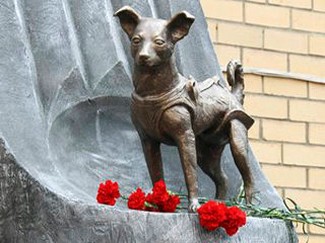















enjoyed your informative article
never stop writing
m
I recall that our Central Wisconsin Rocket Society sent up mice. I believe the acceleration from the solid fuel rocket was quite detrimental to their health. ;-) I can send you a picture of me helping to prepare a locket for launch.
Thank you so much for this very detailed and thoroughly researched discussion of use of animals in the early space programs of the United States and Russia. Much of it I had never read or heard before. I did know and remembered well that Laika was worshiped as the first cosmonaut in space by the Russians. But I didn't know that so many animals and dogs had been sent on tests by both countries during the secretive 1950s. This article shows a great deal of research and can be very helpful in maintaining history that tends to get left by the wayside of time.
I was fortunate to attend the 20-20 Conference in Huntsville in 1977, celebrating 20 years in space and looking 20 years into the future. As keynote speaker, Hugh Downs showed us his scientific side very well in his discussion of the future of space exploration. I met some of Werner von Braun's team. They lamented our not going back to the Moon in favor of the Shuttle program and unmanned missions to the planets. While there, I toured the facility at Huntsville and was able to see, I believe, Baker. Abel had died.
Spotted one little miss word…
"Herman [Germany] had Hermann Oberth in Germany…"
Ron