In the quiet corners of traditional Japanese dojos, a unique and mesmerizing spectacle unfolds. A practitioner, clad in voluminous black hakama trousers and a dark navy keikogi top, kneels on a spotless wooden floor. He draws a long, curved katana from its lacquered scabbard (saya) in one smooth, almost liquid motion. The blade describes a devastating arc through the air, flashing briefly in the dim light. Before one can fully grasp the action, the sword is cleansed with a quick, ritualistic shake and returned, unseen, to its sheath.
This is Iaido (居合道)—often simplified as "the art of the sword draw," but more accurately understood as "the way of mental presence and immediate reaction." It is a martial art defined not by combat against a visible opponent, but by an internal battle against one's own ego, fear, and lack of focus.
A Blade Born of Necessity: Applied History
Iaido’s roots lie deep within the blood-soaked soil of feudal Japan’s Sengoku Jidai, or Period of Warring States (15th–17th centuries). While Kenjutsu focused on fighting with a sword already drawn, the samurai realized that many deadly encounters began unexpectedly—on a crowded street corner, inside a narrow hallway, or while kneeling to greet a superior. In these split seconds, the speed with which one could draw and defend against a surprise attack meant the difference between life and death. Although death was an accepted possibility of the Samurai, there was no need to shorten it needlessly.
The classical form, Iaijutsu, was developed as a pragmatic system of combat scenarios (kata) to counter ambushes. Legend attributes the systemization of these techniques to Hayashizaki Jinsuke Shigenobu, a 16th-century warrior who sought a decisive edge.
With the dawn of the peaceful Edo period (1603–1868), the immediate applied necessity of Iaijutsu waned. It began to evolve from a battlefield survival skill into a philosophical path for self-refinement (Do), influenced heavily by Confucianism and Zen Buddhism.
The Ritual of the Cut: Customs and Tradition
Unlike Judo or Kendo, modern Iaido is primarily practiced solo. The "opponent" is an imagined antagonist (teki), demanding that the practitioner cultivate intense imagination and mental presence (zanshin). A typical Iaido technique is a four-stage ritual, executed with absolute composure:
- Nukitsuke: The decisive first action—a simultaneous draw and defensive cut, usually horizontal or oblique, to disable the opponent.
- Kiritsuke (or Kiriotoshi): Following the initial draw, the sword is raised above the head and brought down in a powerful, two-handed finishing strike.
- Chiburi: A symbolic cleansing of the blade, often involving a ritualized action to shake imagined blood from the steel.
- Noto: The complex and dangerous act of returning the razor-sharp sword to its sheath without looking, while maintaining focus and readiness.
According to ancient Samurai custom and Bushi tradition, the Katana was never supposed to be drawn completely from its sheath unless it had tasted blood. In the practice, or kata exercise, it is not necessary to honor that particular Bushi custom, however.
Beginners in Iaido start their journey with a bokken (wooden sword) or an iaitō—a blunt, unsharpened practice sword made of an aluminum-zinc alloy. Advanced practitioners, whose technique is deemed controlled enough, are permitted to train with a shinken—a live, sharpened steel katana. The uniform—a wide kaku-obi belt to secure the swords, the pleated hakama, and the tough keikogi—is identical to that worn for centuries, enforcing a link to the samurai legacy.
Polishing the Mirror: Modern Day Iaido
After World War II, martial arts faced bans by occupation forces, but Iaido was reinstated as a path of character building. In 1968, the All Japan Kendo Federation (ZNKR) standardized a system called Seitei Iai, or All Japan Kendo Federation Iaido. Comprised of 12 foundational kata drawn from diverse ancient schools (koryū), it provides a common ground for grading and competition.
Modern practitioners are not preparing for street duels. Their objective is self-mastery. By repeating a single movement thousands of times, they are not merely refining physical mechanics; they are "polishing the mirror" of their own spirit, attempting to achieve perfect unity of mind, body, and sword (Ki-Ken-Tai-Ichi).
Crossing Oceans: Western Participation
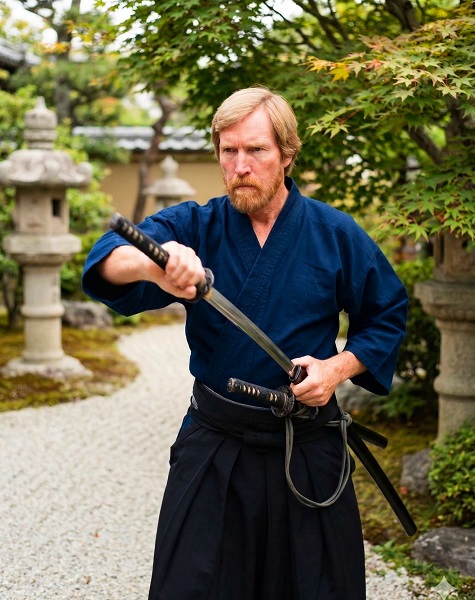
The fascination with the Japanese sword knows no borders. Since the 1970s, non-Japanese practitioners—often called "Westerners" by tradition, regardless of country of origin—have actively participated in this disciplined art. Dojos now thrive across Europe, the Americas, and Australasia, attracting dedicated students seeking discipline, focus, or a connection to a profound cultural tradition. In the image that heads this article we see a Western practitioner (myself) demonstrating this intense focus while performing a kata in a traditional garden setting.
The appeal lies in its universal application: a busy CEO may practice Iaido to develop composure under pressure, while a student might use it to cultivate concentration. Western practitioners frequently travel to Japan for intensive seminars, and many achieve prestigious dan (black belt) ranks recognized by the international federations.
Moving Zen: 'Hara' and Attitudinal Aspects
Iaido is often described as "moving Zen," and the connection is visceral. The required mental state demands absolute presence in the now (which is the essential ‘Hara’, or seat of emotions, of Zen). Any wandering thought—"Am I doing this right?" or "What's for dinner?"—breaks the kata’s unity and is visible to the trained eye of a master (Sensei).
The central, focal point of consciousness (Hara, the center of balance located just below the navel), is also called the tanden (丹田). In ancient custom and modern practice, this is the physical and spiritual epicenter of the human being. A proper Iaido technique does not generate power from the shoulders or arms; it originates from a stable, grounded center, a manifestation of willpower channeled through a balanced core.
These internal aspects are modern day echoes of Bushido, the moral code of the samurai. While the ethical component is less rigid in modern times, the core ideals—composure, integrity, and the pursuit of perfection—remain. The sword becomes a tool for internal introspection, a mirror reflecting the practitioner’s state of being and mastery of self. The legendary master swordsman Miyamoto Musashi once wrote that the true way of the warrior is the "resolution to accept death" in any moment—which translates today not to morbidity, but to an absolute acceptance of the present moment, sharp and as pointed as the blade itself.
Conclusion
Iaido remains one of the most enigmatic and visually stunning arts in the Japanese martial world. Its endurance is not due to any modern combat application, but to its profound capability to forge character. As more people worldwide are drawn to the quiet, composed practice of the "moving Zen," Iaido continues to offer a sharp edge against modern clutter—a sheathed spirit waiting to be drawn, flashing momentarily with the light of self-awareness.
It is, in its uniquely Japanese way, a very different but equally purposeful path to calm, uncluttered internal centering and in that context not appreciably much different than transcendental meditation techniques.
A Postscript: My own experience with Iaido
I first became acquainted with Iaido back in the early 1970s, a time when many Westerners were being drawn to Asian culture and customs. While an undergrad at UC Berkeley, I ‘fell into’ an Akido group on University Avenue, whereat a disciple of the Aikido art began teaching in a vacated storefront.
There were in that group a fair number of 3rd-gen Japanese-Americans students at UC who were interested not just in recapturing awareness of traditional Japanese customs and traditions but also in other Asian (non-Japanese) martial arts.
One of them was involved with Kendo practice at a local Buddhist dojo and I tagged along one evening, given my Asian studies at UC and also a widening experience in East (SF) Bay Japanese cultural activities.
The Sensei at the dojo was also a master of the Japanese sword and probably found my interest in ancient Bushido customs somewhat quaint, but welcomed me as a student of Iaido. Thus, began what I now recognise as my somewhat superficial involvement in Iaido, but it served to markedly stimulate my interest in Japanese studies at UC.
After a few years of (likely) laughable effort to emulate Japanese customs as a tyro ‘Hakujin’ deshi (student of martial arts), when I took my first Saudi medical contract in 1983, I brought along my Iaido Daisho with me and tried to dabble in both Zen sesshin and Iaido.
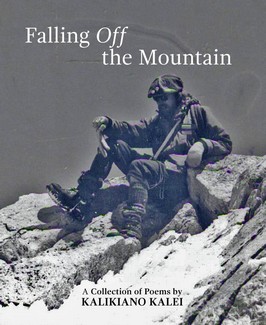
The second image accompanying this was taken by a flatmate who stumbled in on me during some Zazen kata. It’s probably difficult to picture the fact that outside the window of our flat was nothing for hundreds of kilometers except boundless Saudi high-desert, but those were, as they say, “interesting times”...particularly when the Iraqi War began in 1991.
Today, some decades later, I no longer practice Iado but I still have my Daisho, as well as a very fine and costly Katana I acquired from a master swordsmith in Japan; I also still have my kudogo, hakama and kakuobi.
My Daisho occupies a place of honor in my home, although I am ashamed to admit that I don’t dust them as often as I should (out of respect for their nature and the culture they symbolize).
A final note
Back in Berzereley, at the time, I was living in an old Spruce Street Berkeley ‘brown shingle’ on the second floor, out back. It was quite quaint in a very rustic sort of Asian sense, since it faced a lush, overgrown garden backyard. Inside, one of my windows faced the SF Bay and the spectacular view it afforded was of the Golden Gate Bridge’s narrows as it spanned the waters towards Potato Patch Shoal. Quite charming, really, and only $150/month, too!
Inside my ‘flat’, I had decorated things with a couple of antique Japanese tansu chests, a shikibuton (sleeping mat) and several antique Japanese wall scrolls. The walls were of natural Redwood and perfectly suited the rustic nature of everything.
One evening, anticipating a pending date with a particularly attractive young UC undergrad named Nancy Kawasaki, I had everything ready to prepare Macha green tea Japanese style, candles lit, and was wearing a presentably functional post-war Hanten kimono I had picked up in San Francisco’s Japan-Town. I was also well-stocked with some very expensive Japanese sake!
This was the scene that greeted poor, unsuspecting Sansei (3rd gen JA) Nancy when I met her at the door with all the quiet Bushi solemnity suited to a Gary Snyder or Alan Watts devotee, mannerisms suitably Japanese, and dressed the part, as well!
Needless to say, one look at me and the room was all thoroughly-assimilated Sansei Nancy needed to scare her off from what she likely thought was a crazed, disturbed psychotic or something! In a flash, she turned on her heel and was gone like a Tsuru (Japanese Red-Headed Crane) in flight!
True story, but I certainly learned to lean into my ‘Asian’ emulations a bit more gradually after that, in future!