Some hint of "racism" that still adheres to the poetry and the comment: English poetry traditions are still worth upholding but not at the expense of all else. The Eric Mottram I knew from an early age was not without his prejudices be they just or not...
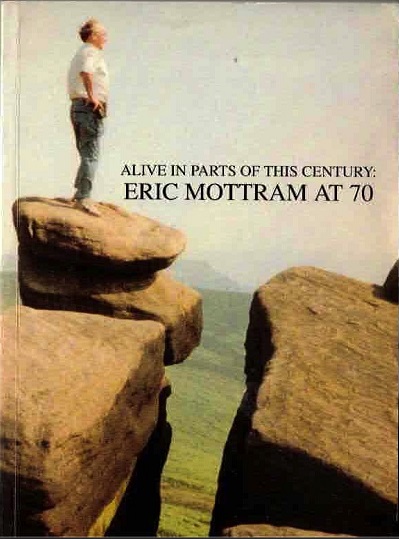
Translation of Eric Mottram's A Faithful Private - 4 with a Clive Bush Comment
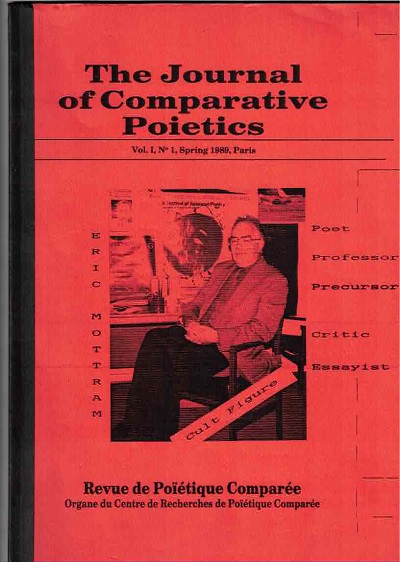
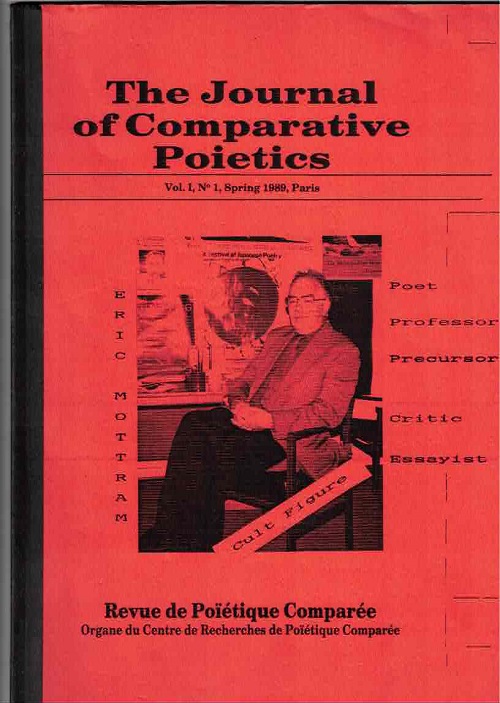
Excerpt from an article, “From space to caves in the heart recreating the collective world in Eric Mottram’s poetry” by Clive Bush, Director of American Studies, King’s College, University of London in The Journal of Comparative Poietics, Vol. I, Nos. 2 & 3 (Paris), 1990/1991, p. 49. Founder-Editor: T. Wignesan.
“The very few good English poets are buried endlessly under unbelievably overpublicized and minor poets like Larkin, Betjeman, Tom Gunn, Irish exiles, expatriates from previous colonies (and the darker the skin the better) who are endlessly flattered by the Arts Council, the British Council, and the Establishment Poetry Society and who have never understood the difference between writing “political” poetry and writing poetry politically.4* They ensure that anybody with a noisy social, sexual, racial, religious, or mental/physical problem, and almost everybody published by Faber and Faber since 1960 is instantly legitimated in a market dominated by the comforting guilts of liberals. (…) Mottram himself is absolutely unprovincial in form, content, and in the sheer range of available materials he puts together. In this sense he is closer to an English tradition which took for granted it was artistically part of Europe: a tradition which includes Chaucer, Milton, Coleridge, Shelley, Byron, and beyond Europe, an American tradition which would include Whitman, Pound, Williams, H. D., Rukeyser, Olson among many others. Jerome Rothenberg is among the exemplary poets whose sense of the world enables him to draw on traditions which range from ancient Indian and Chinese poetry to poetry of Native Americans, Eskimos, Pacific peoples: that still enormous range of different histories, often non-literate poetries, artistic practises, forms of life, and human experience which academics, aristocrats and commercial advertisers designate as “ethnic”. “
* The distinction is Kurt Well’s….(…) quoted in Eric Mottram’s Interrogation Rooms (London: Spanner, 1982), p. 10.
4. Le chanteur
l’Interstate 40 au croisement
de la State Route 27
abandonnée aux graffiti
les fumeurs et copperheads
— Visant la Gloire —
la bibliothèque d’Okemah
Oklahomah ne voulait pas
ses écritures et signes
ses cendres
au-delà des falaises d’Atlantique
la pluie tombe ne tombe pas
sur les peacans cacahuètes
sur une église
pour chaque centaine
pour le compte de la fierté civique
dans des clubs de service militaire
où un agent de service secret
témoigne sur serment quotidiennement
le chanteur en déplacement
est détenu par les Soviets
afin qu’il fasse adapter les chansons de guerre russes
en ballades américaines jouables
agent Matusow R. S. No. 115
Woody Guthrie Memorial Inc.
une corporation à but non-lucrative
pour un musée en vigueur
la date est 1972
le faux témoignage
sans vitre sans portes
la maison à l’intersection
de qui la terre
de qui
les chansons
(c) T. Wignesan - Paris, 2017
Want to review or comment on this poem?
Need a FREE Reader Membership?
Reviews of "Translation of Eric Mottram's A Faithful Private-4 by T Wignesan"
Bonjour Ron ! You're kidding yourself. You don't need to study poetry. IT is in you, though I may have my own reservations on your rather generous willingness to understand shortcomings in other poets' ramblings. In my view, literature should not be "studied", for it's one of those subjects or forms of expression that is innate. The "technical" aspects of writing can be acquired by anyone all by himself. Anyone who cannot should not write. Think of all the GREATS in the past: Did they attend "creative writing" courses made indispensable today by American universities? Thanks also for your comments on the "A Faithful Private" installments. Every good wish.
Still Living on my Feet is the follow up to Tichaona Chinyelu’s first book, In the Whirlwind, which was rooted in a sense of hard-hitting revolutionary black love. However, in this sophomore effort, Tichaona brings the revolutionary essence from deep


 Share
Share Print
Print Save
Save Follow




Ron