Showed me a grave that ripped open the earth of Iraq
And I saw, led to death
You,
Ra'is Saddam Hussein
I saw the bird of fate darken
Iraq's skies and her sun
I saw a wound in your heart
That dyed the earth in
Scarlet colours
Like a springwell of blood
To bring forth rivers of blood
Gushing out from a cleft deep
As the two rivers' depth
And when they buried you in this earth
Your body cut into her womb
A lethal scar
For a stranger's hand felled you
And thus unsettled her spirit
I saw you defy death
O Saddam
And I saw death defy you
I saw flowers on your grave
assembled yet before
It took you
I heard curses follow you
And I heard prayers unfold tenderly like
Rose petals
May God be just
May God be just
I heard your last words
Call friend and foe to unite
To protect with their lives the love
Both of them share
I heard your voice call
For all feuds to be settled
And your last prayer that was
For Iraq not to fall
Why must a man's heart be
Its own prisoner?
Why must there be things one does not see
Till the end?
Does death end time
Or turn it back?
May you forgive o Fatima
The hand that was raised against your children
O Salah-ad-Din and you
Ghows-e-Kurd
Abdul Qadir
For the sake of precious Bhaghdad
Our mother
Her deep-eyed days and pearl-like nights
For the sake of her wounds that are ours
And for the power of healing
Do not hesitate now to forgive
As I am begging Allah to enlighten
This soul
What is it
Saddam
That makes me cry over you?
And my heart said: Not you do I lament
But the light that went with you
Not Saddam speaks to it
But the earth of Iraq
I saw his grave flooded
With blood
Blood
That dyed red Iraq's earth
Scarlet red
And it tore into her soil
And ripped it
Apart with furious claws and
Asunder
Let Mahdi rise his humble voice, however foolish, however much in vain, to speak of his sorrow and his spirit's torment over the fate of a country that has once been the heart and the pulse beat of civilisation, a country of legends and ancient splendour, the country in which Sheherezade's tales were woven, the country in which Hallaj and Attar reached their zenith, the country of Harun Ar-Rashid, of Gilgamesh and the gates of Ishtar, the country of the two streams, a centre and a cross-road of the high cultures of the East and of the peoples that were their foundation.
Today these peoples find themselves captives in the labyrinth of a lethal, vicious and deeply senseless conflict that could have been avoided as we must conclude if we are ready to believe that man is given a certain radius of action.
This bloodshed has been unleashed by the invasion of an army to whom this country and its culture are unknown and inaccessible because to them it means nothing.
A withdrawal of troops at this point in time will not end it but their remaining in the country would perpetuate it.
The history of this country, of the country of Iraq, as well as the history of this conflict has reached a crucial point.
These events, whether or not one is ready to concede this, are decicively connected with the trial of the head of state and intellectual leader of Baathist Iraq, Saddam Hussein, with the verdict reached in this trial and, first and foremost, with the legitimacy of the jury that conducted it.
As each of these points are of highly controversial nature (and not unjustifiedly so) and as the verdict reached by this very jury in these very controversial circumsances is a death sentence, it is easy to understand the terrible consequences for Iraq and her peoples no less than for the region as a whole should this sentence be executed.
Whoever knows Iraqi society will be able to predict that this shall lay the foundation for a final division in the fire of feuds that shall not be settled in a hundred years; feuds that shall tear Iraq in two and into pieces creating a herd of instability that would be a lethal danger to global security. For this has long ceased to be a national or even a regional issue.
This is owed chiefly to the invasion and its nature but a mistake that has been committed (irrespective of the details and of the specific perspectives of those involved) must not be worsened by an even greater mistake.
What every conscentious person owes to the world in which we live and wish to go on living is to avert the most severe threat of all, which lies in the execution of the death sentence handed out to Saddam Hussein by a court which a majority of the Iraqi people and indeed of the international community has reservations recognising. And even if these reservations were to cease, the execution of a personage with the impact of Saddam Hussein under a government that sees itself unable to take charge of its own security, would be the utmost unwise and the most self-destructive action imaginable.
I therefore perceive it as my duty to passionately join the appeal of the international community to convert the death sentence against Saddam Hussein into a sentence of life imprisonment.
This, and only this, can help mitigate the grave conflicts that have erupted in Iraq and provide a basis for future settlement averting a national (and international) catastrophe.
It will further seem recommendable to reopen the trial at a different time, by a different court and with a different jury with the objective of reaching a final verdict and historical evaluation of Saddam Hussein's role in the political development of Iraq.
This is a task not to be taken lightly, and a lot depends on it.
There isn't much time left, and I sincerely hope that these concerns (that are shared by those who have an in-depth-knowledge of the situation) shall be given sufficient consideration before things are allowed to escalate to a point of no return.
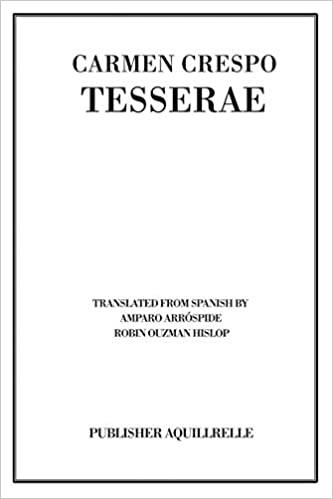
First Edition Translation of Teselas by Carmen Crespo X111 César Simón Poetry Prixe 2016 Translated from Spanish by Robin Ouzman Hislop and Amparo Arrospíde




 Share
Share Print
Print Save
Save Follow


Regis