Huang-di, the Yellow Emperor
Of great antiquity, one of the forebears
Of Chinese civilization, had no wives
And heirs while Confucius, also known
Under the agnomen of Zhong-ni,
Had his wife and son, yet did not have
A teacher to put him on Path.
Lao-zi was born in 581 BCE
To have his teacher named Shang Rong,
But, as legends say, in the age of 81
He left his high-ranking office
Of the Imperial Treasury’s Curator
And disappeared without a trace
Outside the Western Passage, also fixed
In the historical records as “Hangu Pass”
Where he left his famously known 81 verses,
In which he glorified the power of yielding.
Another sage by the name of Zhuang-zi
Was offered by King of the Chu state
The ministerial office, but retorted
By asking whether it was clever enough
To be kept and fed like a scapegoat
And then be slaughtered and offered up
On the sacrificial altar with other oblations.
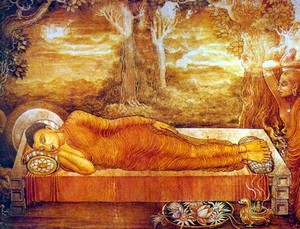
Gautama Buddha came into the world
To preach for 49 consecutive years
And found it not necessary to speak one word
To achieve the true state of nirvana.
But he got into his eternal posture one time
And only one time—when he died
At the age of 80 to be alive for ever
And ever throughout 80,000 kalpas.
(For the reader’s information, there are three kinds of kalpa: a regular, small and medium. A regular kalpa is approximately 16 million years long (16,798,000 years), and a small kalpa is 1,000 regular kalpas, or about 16 billion years. Further, a medium kalpa is roughly 320 billion years, the equivalent of 20 small kalpas.)


 Share
Share Print
Print Save
Save Follow